Sunday, August 31
Opening Hymn: When in Our Music God is Glorified (Engleberg)
Gloria: New Mass for Congregations, Andrews
Responsorial Psalm: The just will live in the presence of the Lord, Batastini
Offertory Anthem: All My Hope on God is Founded, Howells
Sanctus, Memorial Acclamation, Amen, Agnus Dei: Mass for the City, Proulx
Communion Hymn: The vineyard of the Lord is the house of Israel, Guimont
Communion Motet: The Call, Smith
Closing Hymn: I Sing the Mighty Power of God (Ellacombe)
Saturday, August 30
Opening Hymn: All Creatures of Our God and King (Laast Uns Erfreuen)
Gloria: Notre Dame Mass, Isele
Responsorial Psalm: Psalm 116, Bower
Litany of the Saints: Becker (OCP)
Offertory Anthem: I Was Glad, Parry
Sanctus, Memorial Acclamation, Amen, Agnus Dei: Mass of Creation, Haugen
Communion Hymn: Gift of Finest Wheat, Kreutz/Westendorf
Communion Anthem: Ego Sum Panis Vivus, Palestrina
Closing Hymn: Lift High the Cross (Crucifer)
On the whole, a beautiful liturgy. Some of the music could've been a little better, but watching seven men dedicate their lives to Holy Cross, the first time I had been to such a ceremony, was quite inspiring. I know several good young (and old) Holy Cross priests, and am confident that these men will continue the recent improvements to Catholic identity here at Notre Dame and elsewhere.
Today has no universal feast, but the Martyrology contains 14 entries. Among the highlights:
1. Saints Felix and Adauctus, Roman martyrs who, side by side confessing Christ in chaste faith, side by side made haste as victors to Heaven.
2. Commemoration of the sixty martyrs who, at the colony of Suffetulana in Africa, having destroyed the image of Hermes, were killed by a pagan mob.
8. Saint Margaret Ward, English martyr of Tyburn who was killed uner Elizabeth for helping Father Richard Watson to escape Bridewelll Prison.
From the desk of the Shrine’s Censor Librorum, of sorts
Recently at the Shrine questions have arisen regarding the nature and efficacy of prayer. Of particular concern was the question as to whether or not prayer has any purpose that extends beyond conditioning ourselves to accept God’s will; specifically, does prayer change the world, or just those who pray?
The position has been put forth that our intercessions before God serve simply to prepare us to accept God’s will. This was particularly captured in the opinion that St. Monica’s tears did not really effect the conversion of St. Augustine, for example. However, I would like to address this belief by raising a few points for consideration. If there are any deficiencies in this little reflection, however, I am quite sure our readers will quickly bring them to light ;).
In the 1967 Apostolic Constitution Indulgentiarum Doctrina, Paul VI clarifies that the members of Christ’s body efficaciously pray for one another. By “efficaciously,” I mean that God acts in part because of the prayer of these Christians, and would not have acted without their prayers.
“5. For after [Christians] have been received into their heavenly home and are present to the Lord (11 Cor 5:8), through Him and with Him and in Him, they do not cease to intervene with the Father for us, showing forth the merits which they have won on earth through the one Mediator between God and Man, Jesus Christ (1 Tim 2:5), by serving God in all things and filling up in their flesh those things which are lacking of the sufferings of Christ for His body which is the Church (Col 1:24). Thus by their brotherly interest, our weakness is greatly strengthened…"
"6. The Church… appl[ies] the fruits of the Lord’s redemption to the individual faithful… leading them to cooperate in the salvation of their brothers. The Apostles themselves exhorted their disciples to pray for the salvation of sinners,” clearly, from the full context of the document, with the belief that these prayers would actually call down the graces of conversion.
Thus the Council of Trent was able to declare, in its twenty-fifth session, “it is good and beneficial to invoke [the saints] and to have recourse to their prayers, assistance and suport in order to obtain favors from God through His Son…”
Drawing on Pope Paul’s words, I would propose the following model to understand the nature of intercessory prayer in the Church. In the thread to which I am responding, there was universal agreement that prayer does not change the will of God. Nonetheless, there is a grand difference between the will of God and the state of the world; God can will the world to be one way when in fact the world as it actually exists is very different. I assume that God wants the entire world to be perfected in holiness, but I can tell you that I am not. Because of our free will, God permits the world to exist in a state which He does not desire it to exist. For this reason Our Lord instructed us to pray, “Thy will be done on earth.”
Respecting the dignity of our free will, God waits to execute His will until He can do so through His servants. This is, in a sense, the incarnational nature of Catholicism -- God works through Man, through Christ and His Body the Church. Therefore, it is the work of Christ (His paschal mystery, His passion and death) which makes the will of God real on fallen earth.
For example, before Christ came no one entered heaven. After Christ came, people could enter heaven. God’s will did not change; He always desired to save Creation. But it was not until after the work of Christ that redemption could take place. Before Christ‘s work, God wanted for forgive all humankind; after Christ, God wanted to forgive all humankind. His will did not change, but the reality did. It was only with Christ’s work that God’s will was MADE REAL.
Both Paul VI and John Paul II have in recent years reiterated the classic position that the work of Christ (which is the manner in which God’s will is made real on earth) is carried on and completed by the Church, which is the Body of Christ (cf. Col 1:23-24). As part of the Body of Christ, Christians continue the redemptive work which makes God’s will real on earth. This work consists in work and prayer, so that the works and prayers we offer to God are truly efficacious in making God’s will present. Without the work of the Church (that is, without the work of Christ in His mystical Body the Church), God’s will would not be made real. (Marialis Cultus, 19: “the Virgin-Church becomes herself a mother.... For by her preaching and by baptism she brings forth to a new and immortal life children who are conceived by the power of the Holy Spirit and born of God.) Therefore, by the prayers and works of the Church, God’s will is realized, and we can truly say that our prayers effect the Kingdom of God and call down real grace and favors, rather than simply preparing us to receive these graces and favors.
In this way, for example, the tears and prayers of St. Monica did, as the Missal tells us, call down the mercy and grace of God.
God of mercy,
comfort of those in sorrow,
the tears of Saint Monica moved you
to convert her son Saint Augustine to the faith of Christ.
By their prayers, help us to turn from our sins
and to find your loving forgiveness.
St. Monica, baptized into the universal priesthood of Christ, served the mediator of Divine Will by her participation in the Body of Christ. It was immutably God’s will to save and bless Augustine, we might say, but it was the work of Christ, through the person of St. Monica (her prayer and tears), which made the will realized on earth. If Monica had not been open to serve as an instrument of Divine Will, can we really say that Augustine would ever have become a Saint? Because of her baptized participation in the redemptive work of God, saying that her tears moved God to convert Augustine is little different than saying that the Passion of Our Lord moved the Father to convert Augustine. Certainly it was always the Father’s will that Augustine be saved, but it was by the work of Christ (and the work of Christ in Monica and as applied by the Church of which Monica is part) that Augustine WAS converted.
A closing thought. At all times, but especially when speaking lofty principles such as immutability and Pauline co-redemption (Col 1:23) we must be careful not to surrender belief in a God who loves us as “abba,” as “daddy,” who really does delight in blessing his children in ways great and small, spiritual and physical. Off the top of my head I can recall two miracles mentioned by St. Therese in her “Story of a Soul.” The first was a Marian vision. The second, however, was a miracle she cherished far more: that God made snow fall on the day of her profession. And why shouldn’t it be the will of God that he loves to indulge even the smallest longings of his beloveds? To suggest otherwise may well approach Deism, which dismissed the active, material affect of God's intervention and intercession in the world as "un-rational."
“We pay God a great compliment when we ask great favors of him.”
PS - I look forward to any comments and criticisms of this post. However, due to the complex nature of the topic, all significant points made in the comment box MUST be backed up by a direct citation from Scripture, Church documents, or the Doctors of the Church. Any post which makes a significant claim without a specific citation risks deletion.
Friday, August 29
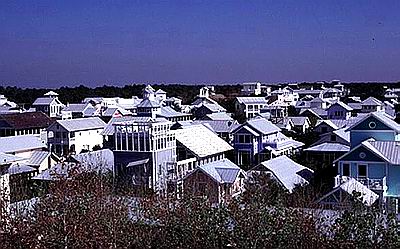
Seaside, Florida, two hours' drive from my home town and five minutes from the water
I'll be at the seashore today, enjoying one last gasp of the Florida sunshine. The town's an interesting one, Seaside, a perfect model of New Urbanist town planning and a modern interpretation of vernacular and classical traditional architecture; it's also where they filmed that wonderful movie The Truman Show.
Yes, I know, I'm going to the beach and I'm talking about houses and "The Cinema." Shame on me.
Anyway, enjoy St. Fiacre's Day in my absence! He's patron of gardening and taxi-drivers, so if you are going to take a cab to the local plant nursery, he's the one to call. He also is patron of hemorrhoids, hosiers, the piles, box-makers (huh?), tile makers and pewterers, as well as sterility, syphilis and venereal disease in general, but let's not go there, shall we? Also, for Sergei Eisenstein silent movie enthusiasts, today is the day the Russian Orthodox Church celebrates St. Alexander Nevsky's memory, but I always kinda have had a soft spot for his enemies the Teutonic Knights (hello, crusaders, big swords, chain mail, crosses...I don't see any problems here...yeah, yeah, I know, they were Germanic interlopers on the soil of Holy Mother Russia, yada yada yada...), so that's something else I'll just set aside for the time being... Incidentally, his son was St. Daniel of Moscow, which might be of interest to at least one member of this 'blog. Oh yeah, and Bl. Bronislava, a hermitess, is on today. She has a super-cool name: girls, why not consider her for your confirmation patron this year? I mean, she's holy, and Polish, and plus, her name makes her sound like she could beat the snot out of someone in a dark alley. What's not to like?
Fr. Rutler lets fly on Manichaean Vegetarians at Gerard Serafin's blog. Don't skip over the final sentence--but don't read it if you're eating blueberry yogurt because it stains when you spray it. Don Jim gives a hilarious commentary on my favorite Baroque church (likely to induce a coronary in Le Corbusier). He is right, you know: it is pretty little: which probably makes the claustrophobia even worse. Also, check out another post on Dappled Things concerning the wanderings of St. John's skull(s). Christopher may have had the face of a dog, but from the number of places that claim the Baptist's skull, well, he has had to have had at least three heads (which reminds me of a trippy-but-kinda-cool antique painting I once saw representing the Trinity). No, I don't think I'm going to take that ball and run with it.

Well, I decided that maybe a doctoral Greek seminar was not the best way to go for someone who doesn't want to be a Scripture scholar. Instead, I'm taking a philosophy seminar on the thought of Soren Kierkegaard. This nineteenth-century Danish philosopher is usually credited with having founded modern existential philosophy and ethics, or at least having developed the concepts that Aquinas laid down for this area. For those interested in John Paul II's theology of the body, Kierkegaard is key to this because existential ethics paved the way for phenomenology, the 20th century school of philosophy upon which the theology of the body is based. From my own perspective, Kierkegaard was an important influence on Hans Urs von Balthasar, one of, if not the greatest theologian of the last century, whom I hope to study in depth. In the class we'll be looking primarily at Kierkegaard's Works of Love, an important work that I read over the summer, not knowing I would take this class - it doesn't usually get regarded as Kierkegaard's most significant work, but my professor seems to think that maybe it ought to be. Whatever the case may be, this class should make an already interesting semester even more so.

Notre Dame graduate William Heyer's proposed design for a new Oratory to St. Philip Neri in Chicago
Traditional Church Architecture Alert
If you like Churches That Look Like Churches, and I do, have a browse around architect extraordinaire Professor Duncan Stroik's portfolio and weep for joy (as opposed to just plain weeping, which is an appropriate response to the work of the Rev. Father Richard "Dynamiter Dick" Vosko). Today, on St. Sabina's feast, check out his plans for Our Lady of the Most Holy Trinity, featured here before, at Thomas Aquinas College, a Spanish Baroque structure with an interior in part inspired by Santa Sabina in Rome. Professor Stroik is a long-standing fixture at Notre Dame, one of the first of the traditional architects to be invited to teach here after architectural genius Professor Thomas Gordon Smith brought about his great classical reforms in the curriculum in the early part of the last decade. Also have a look at the supercool stuff by various architects and students here, especially Michael Imber's designs for Our Lady of Corpus Christi parish in Texas and the proposed St. Philip Oratory for the Chicago Loop, seen above. Sweet! Church building and art may have gotten worse of late, but the tide, hopefully, is starting to turn.

Tomb of St. Ambrose of Milan
Great Churches of the World:
Sant' Ambrogio, Milan
Sant' Ambrogio, the oldest and most important of Milan's churches, was founded in 379 by its titular saint, Ambrose, then the formidable bishop of the city and baptizer of St. Augustine. Today he lies beneath its altar in a dim and solemn crypt. The whole church is filled with the grime and weight of history, making a visit there a contemplative and almost melancholic experience. As you approach it through the arcades of its atrim, the church's facade is low and solid with its great round Romanesque arches and mouldering brickwork, sparsely decorated save for weathered marble spoliae and a few sinister festoons of spiky ironwork. Two heavy Lombard-style square belfries flank the immense triangular gable, dating from the twelfth and eleventh centuries, but seeming even earlier, recalling some tarnished version of the glories of Ravenna. A great octagonal lantern marks the crossing, ringed with delicate arcading. Inside, you glimpse sparks of gold mosaic in the apse amid the darkness. You see the massive tenth-century pulpit that is set atop an ancient Roman sarcophagus, showing both the triumph of the Faith and the inescapability of history, and the death that makes life into history. Wonders stand in the farthest nooks and crannies, like the Sacello di San Vittore, decorated with stiff Byzantine mosaic'd saints in splendid blue and gold.
It is a trip back in time, to Old St. Peter's, to Old St. Peter's after it had stood for a thousand years at the dawn of the Renaissance, and like St. Peter's, the memory of its titular saint is omnipresent. He lies below in a new tomb, placed there after his relics were re-unearthed in the 1850s. It stands in the low-vaulted crypt, in a magnificent and strange glass ciborium framed with magnificent silver angels and arcane Greek inscriptions. Behind the glass lie the dusty, age-picked bones of Ambrose, his mitred skull giving off a strange, varnished gleam in the murky light. Faded scarlet vestments cover in baroque brocade cloth the recumbent corpse, flanked by the even more ancient outlines of St. Gervase and St. Protase, their bare brows crowned with gilded circlets, the golden martyr's palm clutched in what once was a hand. Their relics were discovered during his rule, fitting to lay beside him in death in recognition of his holiness and their bloody witness. And after you leave, there is something strange when you, filled with ecclesial quiet, meditate on his ancient heroism and holiness walking through the teeming, student-crowded Bramante cloisters of the Catholic university that stands nearby.
On this feast of Santa Sabina, why not do the Dominican thing and re-read Dan's account of his visit there as part of our Great Churches series? Of course, very soon I too will be able to give my thoughts on that very same church! I leave for Rome on the fourth of this coming month, and so expect the unexpected with my blogging accounts of my Roman adventures!
Russian nineteenth century icon of the head of St. John
Today is the feast of the beheading of St. John the Baptist. He was decapitated by order of the tetrarch Herod Antipas after being imprisoned by condemning the tetrarch's illicit marriage to the former wife of his half-brother, Philip. Herod himself seemed to take strange pleasure in hearing the Baptist's sermons, but Herodias, his wife, and her daughter Salome, were greatly perturbed by this and schemed to have him killed. The famous story of the prurient dance of the Seven Veils and Herod's rash and criminal oath to his step-daughter are already well-known. The story itself has been told and re-told and had a peculiar (and perhaps somewhat grotesque) resonance among the decadent authors of the turn of the last century, having been celebrated in Richard Strauss's Salome which perhaps over-romanticizes the tale, as well as the strange and sinister illustrations of Aubrey Beardsley for Oscar Wilde's own French-language retelling of the story (Wilde himself threatened to defect to France if his strange play was banned in England). The decapitation of the Forerunner also plays a great role in the Grail legends, and of the four Grail hallows (the chalice, the lance, the platter and the sword), one of them, the sword, is almost always said to be that which decapitated him, while in several versions the platter is said to also be that on which his head was placed after his death. He is the patron of the Knights Hospitallers, now known as the Order of Malta, whose three-story building in Rome is considered the smallest sovereign nation on earth.
Today is also the feast of St. Merry or Medericus of Autun, an eighth-century Benedictine whose reputation for holiness became so troublesome he actually ran away from the monastery to become a hermit. He later returned after his brethren discovered his hideout. He is shown in art as an abbot with prisoners and chains near him. He may also be shown experiencing a vision of God the Father or teaching monks. Today is also the feast of St. Sabina, the titular of the Dominican church of Santa Sabina in Rome, and indeed St. Dominic is said to have been greatly devoted to her. The basilica is said to have been built on the site of her house, as before her martyrdom, she was a rich Roman widow who gave over her residence to Christian worship during the persecutions. A patroness of Rome, she also watches over children who have difficulty in walking and of housewives and is invoked against hemorrhage. Today is also the feast of St. Sebbe, King of the East Saxons, the husband of St. Osyth and a hermit after resigning his crown in 694. He is said to be the founder of the first monastery at Westminster. The Catholic Forum saints' calender also lists a saint venerated today named "Hyperdulia," but that has got to be some sort of weird mistake. I mean, really.
Thursday, August 28
According to someone or something called the Truth Laid Bear (oh, now I get it), Holy Whapping is, in the Blog ecosystem, a slithering reptile. Huh. Who'd've thunk it?
Sublimity and Beauty: The Chair of Peter
Towards an Incarnational Architecture:
Part V: A Phenomenology of the Sublime and the Beautiful
Author's Note: Originally, Part V was intended to be devoted to the Trinity, human and divine relationships, and their manifestation in architecture in order to help bring the soul to the ascent through sursumactivity. However, I realize that perhaps I should touch upon this topic first before continuing. [See Parts I, II, III and IV of this series].
Over the last three centuries, a debate has raged in the realm of aesthetics concerning the nature of beauty. The Renaissance spoke of beauty as a fixed, measured, and almost sacral thing, defined by the canons and traditions of the ancients and tempered by the love of God, a thing of contemplation. With the coming of Baroque in the Church, this abstract, almost Platonic view of beauty was replaced by a desire to seek an emotional and intellectual response from the viewer in grasping the whole sum of the building, the concetto or focus of the whole structure, and thus help lead them, by this half-artificial ecstasy, further towards heaven. However, by the time of the Romantics, neither Teresian ecstasy nor quiet Augustinian contemplation was the ultimate goal of art and architecture. Instead, it was to seek out the Sublime.
Chesterton once criticized the over-used word sublime, saying that saying "It is sublime" was inferior to saying "It is beautiful." One stated, truly, that the person viewing the object felt sublime, rather than appreciating the objective nature of the object, which is beauty, not "sublimity." Herein lies the problem with the search for the sublime that obsessed poets and artists from Wordsworth to Turner and beyond to even the Impressionists: it hinges on feelings, and feelings are notoriously slippery things in a fallen world.
The sublime was a feeling of great awe, sometimes verging on fear; there was a hint always of Thanatos amid the Eros among the Romantics with their invented Gothic claustrophobias and morbid ruinous mansions, from the perversions of Beckford to the grotesqueries of Swinburne. The sublime was, at heart, beneath the sacral trappings, a form of titillation, voyeurism: people wanted to be stunned and shocked. The same emotion that caused people to tramp through the Alps leads people to defy death in the neatly hermetic capsules of thrill rides at amusement parks today.
Awe is a wonderful feeling; however, except in the presence of the Divine it never remains steady. Humanity is fickle, and novelty is the only thing that keeps it thrilled. Thus, as the decades passed, the search for the sublime became an all-consuming search for the latest fads, both decadent and wholesome. It became obsessed with the Zeitgeist, with Impressionism and Art Nouveau riding the crest of popularity until they were forgotten. While at first much beauty came of that search--no man can stand before a Monet and not feel God's hand on his shoulder--humanity became bored with beauty, and soon sought to create the ugliest things possible to further thrill themselves.
This is why the art of our epoch includes sliced cows in formaldehyde.
This is a very difficult conclusion to stomach. Should we simply throw out all the good things that have come from this modernity? Certainly the more rancid fruit of the Sublime can be thrown out without a second glance, Jackson Pollock, Gehry, and whatever performance artist du jour is soaking the NEA. But do we cast Tolouse Lautrec's posters on the bonfire of the vanities, burn Degas's sweet ballerinas at the stake, take a wrecking ball to the Horta house? Are we morally obliged to turn our back on the last two hundred years of art?
Mercifully, no. Monet and Manet still had not fully taken on the consequences of this artistic fall from grace, and the residual ghost of beauty still hung over their works. As the centuries past, Beauty's spirit withered, and thus we got things like Francis Bacon and excrement sealed in jars, and scatological Virgin Maries.
This does not mean that rush, that holy rush of excitement we get when we first glimpse the Grand Canyon or see the mountain valleys at our feet is blasphemous. In art, the sublime is, at its core, still something worthy to seek, as is the beautiful. However, one cannot exist without the other. Pope John Paul II's Christian phenomenology speaks of a subjective response to an objective truth, and both are necessary to understand that truth. The man trained in virtue, to use an Aristotelian trope, will love truth with the intensity of the romantic, and he will see true beauty with the awe of the sublime.
The underlying objective rationality of good art is ratified by our subjective and deep response within our souls. Likewise, the sublime within our souls is given resonance by our scholarly and intellectual contemplation of an object. Faith and reason, justice and peace, ecstasy and silence. The concetto of the Baroque, the iconographies of Gothic: both unite truth and beauty, and only there can we find them in their most pure and complete form. It is to these we must look in the future in our search for an Incarnational Architecture.
The sublime seemingly responds to many things: chacon son gout. Taste is fickle, yes, and it is dangerous to tie it down to the timeless canons of classicism. However, even allowing that our minds, as well as our hearts, are marred by the fallenness of the world, there is an underlying frame to all that is beautiful. The pale Nordic maiden and the Asiatic beauty ultimately have the same harmonies and resonances in their proportions. Every human body follows a divine logic in the way it is knit: they even say that, by the scale of the length of our own feet, each one of us has the ideal height of six feet. Thus, the Renaissance philosopher and architect Alberti speaks of concinnitas, "sympathy and consonance of the parts" (ix, 5), and it is this that ultimately underlies the beauty in the earliest paintings of Lascaux to the last canvas of Gaughin, and especially all that lies between. And this beauty, however flawed, ultimately is a response to our own need for the most perfect "ancient Beauty" that St. Augustine sought.
Thus, it is right and just that we be moved by many different beauties in art, as long as we seek to see the links between them. Homo sum; humani nil a me alienum puto. I am a human being: nothing human is foreign to me. Nothing human is foreign to me because God created it and redeemed it by Himself taking on humanity. Let us search for the sublime, but let us never forget to return to see the beauty that lies beneath it after the thrill has been exhausted.
A detail of Botticelli's St. Augustine
Like Mother, Like Son
Too late have I loved you, O Beauty so ancient, O Beauty so new. Too late have I loved you! You were within me but I was outside myself, and there I sought you! In my weakness I ran after the beauty of the things you have made. You were with me, and I was not with you. The things you have made kept me from you - the things which would have no being unless they existed in you! You have called, you have cried, and you have pierced my deafness. You have radiated forth, you have shined out brightly, and you have dispelled my blindness. You have sent forth your fragrance, and I have breathed it in, and I long for you. I have tasted you, and I hunger and thirst for you. You have touched me, and I ardently desire your peace.
--St. Augustine
The feast of St. Augustine of Hippo, bishop, doctor of Grace, father of the Church, is remembered today, following on the heels of his mother's memorialization yesterday. St. Augustine died this day at Hippo in the year 430 after a life full of virtue, prayer and scholarship, as well as his earlier life of debauchery, Manichaenism and a common-law marriage. Like St. Peter, he is living proof that when one is open to the grace of God, all things are possible. He is patron of brewers, sore eyes, and numerous dioceses, including St. Augustine in Florida, Kalamazoo and Superior in Wisconsin. He is the ultimate origin of the epigram, familiar in misquoted form as "When in Rome, do as the Romans do," in reference to his observance of local fasting and feasting customs as he travelled from diocese to diocese. He is also one of the saints depicted in the wall-paintings of the Basilica of the Sacred Heart at Notre Dame.His emblem is a flaming heart, recalling his words: Our hearts were made for You, O Lord, and they are restless until they rest in you.
Today is also the feast of St. Edmund Arrowsmith, one of the forty martyrs of England and Wales, executed today in 1628 by being hanged, drawn and quartered. His hand is preserved at St. Oswald's in Ashton-at-Makerfeld, England. His birth name was Brian, but he preferred his confirmation name of Edmund instead. So today, all Edmunds, Eds, Eddies and Brians out there, rejoice in the memory of their patron.
Today we also recall the Egyptian ex-robber, monk and martyr St. Moses the Black; St. Julian of Auvergne; the Elizabethan ex-Protestant cleric Bl. William Dean and a St. Vivian, who seems to be identical with St. Bibiana or Vibiana, formerly patroness of the ill-fated old Cathedral at Los Angeles and invoked to ward off hangovers, which is what ensues after having seen the new Cathedral there.
Apparently this is the most happening place on the Chicago campus.
The University of Chicago has had 473 convocations in its history (one each quarter of the academic year, plus on special occasions). Some students scanned in the texts of all the speeches given at each of these convocations, and were able to do term searches. The words "Plato" and "Aristotle," for example, came up very often, but when they typed in the word "fun"........nothing. For those familiar with Chicago's reputation, this won't come as a surprise, but I find it quite amusing, especially in the face of those who say the Notre Dame administration won't let us have any fun.
Wednesday, August 27
Finally, Gov. Jeb Bush has made an attempt to intervene in the Terry Schiavo case. Keep praying, though, as the Florida court so far doesn't seem inclined to honor his request, and still intend on setting a date for her feeding tube to be removed.
Somehow, though, it sounds to me like the beginning of a joke about a bartender. All for a good cause, of course: restoring the splendid Church of Our Saviour (S-A-V-I-O-U-R) in New York. Sounds like an evening of fun. (I wonder what the liberal equivalent would be, Janeane Garofalo and Gene Robertson eating tofu together to raise funds for the repair of the Taj Mahoney?). I guess it proves that even conversion to Catholicism can't rid an ex-Anglican of his love for martinis. I kid. I make joke. Miss Coulter, you can remove your hand from my windpipe now.
Marcel Duchamp’s Dadaist painting L.H.O.O.Q. I don’t get it, either
The Da Vinci Code Cracked, at Long Last
Carl E. Olsen at Envoy Encore, the "banana republic" of Catholic blogs (according to Mark Shea), finally does all Catholics and historians and Catholic historians a great service by refuting the Übercrap known as The Da Vinci Code. He plans to post even more on the subject soon. Keep it coming. I love a good historical conspiracy thriller as much as the next man, but both the history and the writing and the sanctimonious tone of this ponderous tome were utterly unbearable (robed albino Opus Dei assassins? Gee whiz...). I, much to my regret, wasted an evening in the airport reading it after having exhausted my portable library. You may wonder why I read it in the first place; I'm not sure myself. I was out of books, and stuck overnight at an airport with an indefinitely-delayed plane, and had finished my edifying reading during the wait. Sadly, I didn’t have my backup books, either. So I dropped by the bookstore, I see art, I see mystery, I see some hints of conspiracy and the Templars, and then I think, hey, it’s like Foucault's Pendulum. Hardly. In your dreams, Dan Brown.
Foucault was weird and paranoid but at least it didn't take itself so seriously: plus it was written by someone with an attention-span longer than a ten-year-old. It also may have been anticlerical but it pretty much smeared everyone and had a serious undercurrent of self-critical satire regarding our own age's fixation with hidden plots and secret societies, something the deadly dull Da Vinci desperately needed. Plus, heck, Umberto Eco is a real intellectual instead of a pseudo or a posseur. It got to the point I was so bored with Da Vinci I started doodling in the end-pages and writing sarcastic remarks in the margins, something I never do. Amy Welborn has already done her best to point out the book’s numerous shortcomings in her on-target review, while the boberia was so bad has even managed to get a refutation in the secular press, which comes as a great relief. Finally. Mr. Dan Brown, please, before you write another horrible novel with yourself as the thinly-disguised "hero" and go off on another tangent on the frickin' sacred feminine, please remember we Catholics invented it. Ever heard of the Virgin Mary?
St. Monica. Icon by Lu Bro.
Mothers Know Best
A blessed St. Monica's Day to all and sundry, especially Andy on his birthday and confirmation name day (well, in pectore, at least). St. Monica of Tagaste is living proof that a persistent mother is always heard, by both God and her son: her prayers and supplications after seventeen years of sadness and struggle finally led her son, St. Augustine, to become a Catholic after a long stretch as a Manichee (a long stretch in which he even fathered an illegitimate child, Adeodatus, who later was himself canonized). She also secured the conversion of her pagan husband, Patricius, who died shortly after being baptized in much happiness. St. Monica herself overcame many problems of her own, including what seems to have been a youthful addiction to alcohol, as well as the insults of her servants and finally perservered to attain the crown of heaven as the prize of all her sufferings. She is, among other things, patroness of alcoholics, victims of verbal abuse and disappointing children.
Rather interestingly, yesterday (not today as I thought) in the Carmelite calendar, was the Feast of the Transverberation of the Heart of St. Teresa of Avila. I feel bad I missed the bus. Today is also the feast of the Persian St. Anthusa, who was sewn into a sack and thrown into a well. Also today we remember St. David Lewis, a priest-martyr of the Titus Oates plot in England; as well as the Welsh hermit St. Decuman; St. Margaret the Barefoot, another patient mother and husband; St. Ebbo of Sens; Bl. Ebbo of Hamburg; Bl. Dominic of the Mother of God, a Passionist apostle to ninteenth-century England; and St. Gebhard of Konstanze, who has the singular attribute in art of a skull wearing a papal tiara. Today was also recalled in some calendars the spurious "Little Saint Hugh" of Lincoln, the less said of whose legend, probably the better. He is not to be confused of his full-size counterpart, St. Hugh of Lincoln, who was a bishop who had a pet goose who liked to eat from the sleeve of his robe.
Tuesday, August 26
Cryptology in the Sixteenth and Seventeenth Centuries
Here you can find a fascinating article on the origins of secret codes developed and used during the Renaissance. As someone who is not very good at figuring out cryptologies but finds them fascinating (I spent a good part of my afternoon experimenting with Abbot Trithemius of Spannheim's polyalphabetic tabula recta), this is a very interesting and informative article, detailing everything from substitution codes to messages hidden in musical notation, knot cyphers and even a primitive form of binary encoding! Most ingenious. Enigma has got nothing on these guys.
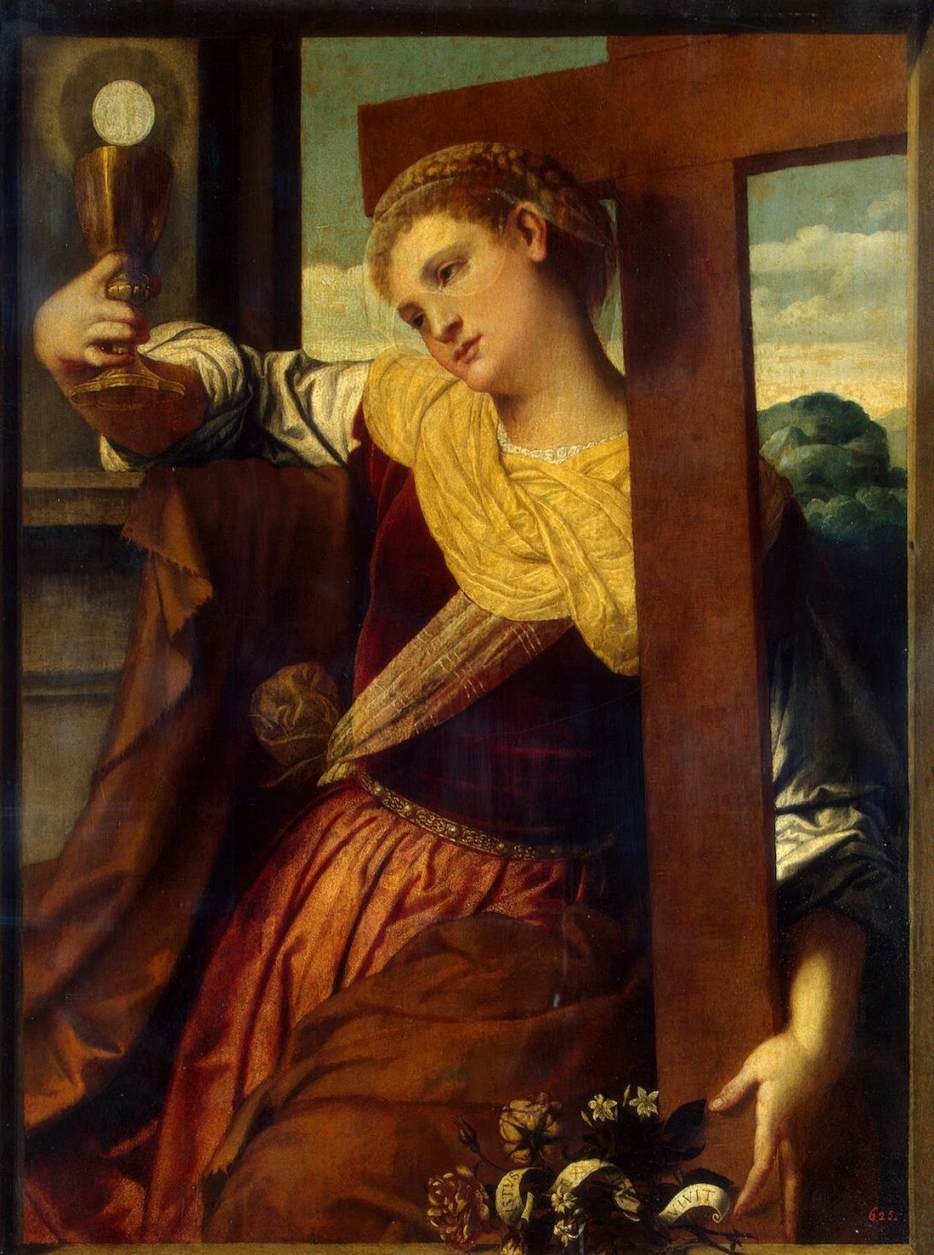
Moretto da Brescia. Allegory of Faith. c. 1530. In the Hermitage, St. Petersburg
Holy Orthodoxy
From Cardinal Ratzinger: "For the early Christians, there was no difference between what today is distinguished as orthodoxy and orthopraxis, as right doctrine and right action. Indeed, when this distinction is made, there generally is a suggestion that the word orthodoxy is to be disdained: those who hold fast to rigid doctrine are seen as people of narrow sympathy, rigid, potentially intolerant [...]. Such a [distinction] would have been incomprehensible and unacceptible for those in the ancient Church, for they rightly understood the word "orthodoxy" not to mean "right doctrine" but [...] the authentic adoration and glorification of God. They were convinced that everything depended on being in the right relationship with God, on knowing what pleases Him and what one can do to respond to Him in the right way. For this reason, Israel loved the law: from it, they knew God's will, they knew how to live justly and how to honor God in the right way: by acting in accord with His will, bringing order into the world, opening it to the transcendent." Thus Ratzinger.
Oh, from the otherwise unremarkable comic strip Kudzu today. The local Protestant preacher's amateur baseball team is facing off against some Catholic monks.
PREACHER: Those Trappists are a bunch of big show-offs!
PLAYER: They're disciplined, all right--you mean the Gregorian infield chatter!?
PREACHER: The illuminated stat sheets!
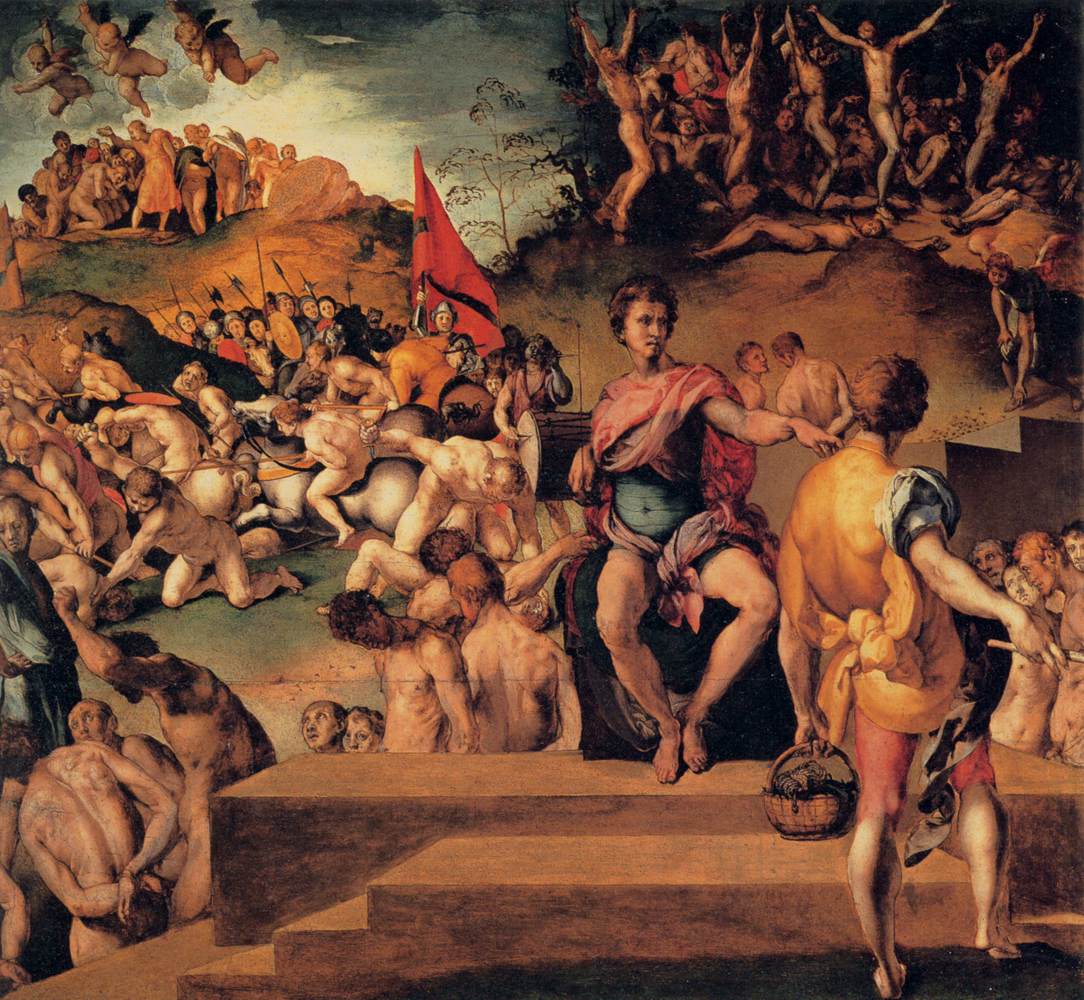
The Martyrdom of the Theban Legion. St. Alexander of Bergamo, commemorated today, was a member, though he escaped their torture only to relent and lay down his life for Christ soon afterwards. From Jacopo Pontormo's painting (1531) at the Pitti Palace, Florence.
Today is one of those days on the sanctoral cycle where there are so many possibilities, it's hard to pick a favorite. There are numerous early martyrs commemorated today. Among others, there's St. Alexander of Bergamo, who is associated with the legendary Theban legion of St. Maurice; St. Ireneus and St. Abundius of Rome, who was drowned in the Roman sewers; St. Adrian of Nicomedia, husband of St. Natalia and patron saint of arms dealers, soldiers and butchers; and the relatively late St. Victor of Cerezo, who was crucified by the Muslims in North Africa around 950. There's also St. Gelasinus of Heliopolis, a Phonecian actor stoned to death on stage (while in a bathtub, no less) in 297 (tough crowd), who sounds eerily like yesterday's comedic convert, Genesius of Rome. We also recall Bl. Thomas Percy, martyred under Elizabeth in 1572 and the bishop Bl. Vyvain of York, who died more peacefully before him in 1285. On the calendar today is also St. Teresa of Jesus Journet e Ibars, a Catalonian nun and foundress from the nineteenth century who is patroness of people rejected by religious orders, old people and pensioners. On the Russian Calendar, a post-schism monk with the unfortunate name of Adrian of Uglich is recalled today, though he also has a feast-day on something called Cheesefare Sunday. We also, more importantly, recall the martyred Pope St. Zephyrinus today, an early pastor of the universal Church who endured the ridicule of heretics, the fall of Tertullian to the Montanists, and the persecutions of the Romans. A most noble pontiff.
And here's the list of classes that will be keeping me busy:
PLS 341: Fine Arts TH 9:30=10:45
PLS 343: Mechanics/Life Sciences MWF 8:30-9:20
PLS 347: Ethics MW 11:00-12:15
PLS 381: Great Books Seminar III TH 1:05-2:45
THEO 610A: Advanced Greek MW 3:00-4:15
Directed Readings on the Enyclicals of John Paul II: TBA
Monday, August 25
Today we had combined choir rehearsal for the opening school year Mass, including practice of a version of "All Creatures of Our God and King" that replaces all instances of the phrase, "O Praise Him," with another "Alleluia." Besides simply being unnecessary and a shot at the faterhood of God, the change also causes the song to make no sense. The verses are addressed as a command to those "all creatures" to praise God; as far as I can tell, "Alleluia" is not an imperative verb, and certainly not with respect to the subject of the command. The whole affair is pretty ridiculous, especially since we do the real, non-inclusived version of this hymn at Easter each year - it seems that the whole student body (or faculty) can't deal with this. Appealing to the lowest common denominator, or most easily offended, is one of my pet peeves in youth ministry, and it does creep into the atmosphere here at times. In the first category, place our constant use of the "Mass of Creation" at schoolwide Masses, when there are plenty of other well-known or easily learnable settings out there.
Anonymous the Elder, I'm terribly sorry about the delay in my response about Theology of the Body below. Things have been a bit crazygonuts around here. I've written some more thoughts on the subject. Fellow Whapsters, please feel free to chime in at the comments box under the post entitled "They're Using Coconuts!"
El Greco, St. Louis of France with His Son Philip III; at the Louvre, Paris
Rex Christianissimus
A happy (and slightly belated) St. Louis's Day to all, especially Franciscans, Missouri residents, and French kings in our audience. St. Louis IX, son of Bl. Blanche of Castille (whose strong personality irritated him), was a noble paragon of Christian monarchy, a friend of St. Thomas Aquinas, an exemplar of chivalry in his crusading spirit, and notable for his humility. After building the gem-like court chapel of Ste. Chapelle to house the holy relics of Christ's passion he brought back from the Levant, St. Louis walked in procession in sackcloth, bearing the reliquary on his shoulder. St. Louis also once said, to an impious courtier who posed him the question of whether it would be worse to be a leper or a mortal sinner, "he is healed of leprosy in his body; but when a man who has committed a mortal sin dies he cannot know of a certainty that he has in his lifetime repented in such sort that God has forgiven him; wherefore he must stand in great fear lest that leprosy of sin last as long as God is in Paradise." Thus St. Louis. He died today in the year 1270 at Tunis on the Barbary coast, and is invoked by parishioners of the archdiocese of St. Louis, barbers, builders, button makers, construction workers, Crusaders, dying children, those in difficult marriages, distillers, embroiderers, French monarchs, grooms, haberdashers, hairdressers, hair stylists, kings, masons, needle workers, parents, parents of large families, prisoners, sculptors, sick people, soldiers, stone masons, stonecutters and tertiaries. Charpentier wrote a splendid hymn in his honor entitled Dies Tubae. St. Louis was also the patron of a shortlived Spanish mission, San Luis de Talimali, situated near my hometown of Tallahassee, which was burned to the ground in 1704 by British soldiers and their Creek allies.
Today is also the feast of St. Genesius the Comedian, the noted legendary martyr who converted to Christianity while on stage in the midst of a pagan Roman farce mocking the Church. He is patron of, among other things, comedians, torture victims, and lawyers, which perhaps suggests the Church has a bigger sense of humor than that She is usually credited with. Today is also the feast of St. Genesius of Arles, another martyr; the nun St. Hunegund; St. Joseph Calasanz, founder of the Piarists; Bl. Maria of the Translation of the Holy Sacrament, from Argentina; and lastly the Constantinopolitan nun St. Patricia, whose blood is preserved in Naples and liquefies miraculously around the time of her feast-day. Naples and environs are a site of many blood relic prodigies; the most famous is St. Januarius, whose blood liquefies several times yearly. In addition to St. Patricia's, the blood of St. Pantaleon kept at Ravello (also, unfortunately, the adopted hometown of Gore Vidal) changes from brown to red on his feast-day. I actually saw the blood with my own eyes on my travels; it is kept in a glass phial and remains liquid much of the year, a dark, murky brown, and dew often fogs the upper part of the container. It is a strange thing to see.
A Dominican, a Benedictine and a Baptist preacher are all fishing in a boat in the middle of a small lake. Around noon, the Dominican says, "I'm hungry. I think I'll go to shore and get a sandwich." So he steps out of the boat, walks across the water and goes to the shop on shore. A few minutes later he comes out with a sandwich, walks across the water, sits down in the boat and starts eating.
A while later, the Benedictine says, "I'm thirsty. I think I'll go to shore and get a coke." So he steps out of the boat, walks across the water and goes to the shop on shore. A few minutes later he comes out with a coke, walks across the water, sits down in the boat and starts drinking.
The Baptist preacher starts thinking to himself. "All denominations are equal right? If they can do it why can't I?" He says, "I need some more bait." So he steps out of the boat, and sinks like a rock.
While he's under water, the Dominican leans over to the Benedictine and says, "Do you think we should tell him about the stepping stones?"
The idea couldn't be better: "For those with serious Hobbit habits longing to venture into Middle Earth for more than a few hours, New Line plans to screen all three films back-to-back-to-back on December 16 in a daylong marathon that will carry over with The Return of the King's global release on December 17."
The timing couldn't be worse... finals week.
I must be obsessed, because I'm still trying to figure out if I could possibly swing it. Who needs to study anyway, right?
Thanks to Dom Bettinelli for the link.
On a side note, shouldn't the trailer be out by now?
Sunday, August 24
After a rather extended blogging hiatus (it's kind of tough when one's computer is packed up somewhere), I have returned to The 'Bend. Since attending the much missed 10:00 Basilica Mass (see Dan's post below), I've been shelving my beloved books, hanging up my Pope on a Slope poster (You know you're a Catholic Nerd when...), and just making the place homey in general. At any rate, my new and improved blogging (now with ND news!) should be picking up again in a day or two. Until then, happy St. Bartholomew's Day!
Basilica of the Sacred Heart, Notre Dame, Indiana (Televised on Hallmark Channel)
Opening Hymn: Joyful, Joyful We Adore You (Hymn to Joy)
Gloria: New Mass For Congregations, Andrews
Responsorial Psalm: Taste and see the goodness of the Lord (Proulx)
Alleluia: Murray, OSB
Offertory Anthem: Cantique de Jean Racine, Faure
Sanctus/Memorial Acclamation/Amen/Agnus Dei: Proulx, Mass for the City
Communion Hymn: Take and Eat, Joncas
Communion Motet: Ego Sum Panis Vivus, Palestrina
Closing Hymn: In Christ There is no East or West (McKee)
Friday, August 22
St. Rose of Lima. Bartolome Esteban Murillo, undated. Museo Lazaro Galdiano, Madrid.
And a happy St. Rose of Lima's day to St. Blog's Parish, especially to all Dominican tertiaries, to Emily on her middle-name-day and to the three generations of Rosas among my relatives. St. Rose, baptized Isabel, was given her more well-known name at Confirmation, a sacrament dispensed to her by none other than Bishop St. Turibius de Mogrovenjo, and later went on, after founding the first social work institutions in Peru and receiving invisible stigmata and a mystical marriage from Christ, to become the first canonized Saint of the Americas, proclaimed in 1671 by Pope Clement X. In addition to being patroness of Peru, Central America, the Americas, Latin America, florists, embroiderers, needleworkers, South America, and the Phillipines, she is also the patroness of those ridiculed for their piety, a protectress I'm sure my fellow Whapsters can appreciate. Check out this image of her from Notre Dame's Basilica of the Sacred Heart.
Today is also the feast of a St. Zaccheus, who may either be the Gospel figure or the martyred deacon Zaccheus whose feast day is more typically celebrated with his cousin Alphaeus on November 17. Today is also the day which recalls St. Ebbe or Aebbe the Younger, an abbess of a double monastery at Coldingham in Scotland, who with her nuns was burned to death by Viking raiders on 2 April 870 after she and her charges had mutilated themselves to escape being raped. Lastly, today is the feast of Bl. James of Mevania (or Bevagna), a Dominican friar known for his life of strict poverty and has the peculiar honor of having been beatified (or at least having his cult confirmed) by two popes on two separate occasions. Well, why not?
Karl Rahner, Hans Kung and Joseph Cardinal Ratzinger all die on the same day, and
go to meet St. Peter to know their fate.
St. Peter approaches the three of them, and tells them that he will interview each
of them to discuss their views on various issues.
He then points at Rahner and says "Karl! In my office..." After 4 hours, the door
opens, and Rahner comes stumbling out of St. Peter's office. He is highly
distraught, and is mumbling things like "That was the hardest thing I've ever done!
How could I have been so wrong! So sorry...never knew..." He stumbles off into
Heaven, a testament to the mercy of Our God.
St. Peter follows him out, and sticks his finger in Kung's direction and "Hans! You're
next..." After 8 hours, the door opens, and Kung comes out, barely able to stand.
He is near collapse with weakness and a crushed spirit. He , too, is mumbling
things like "That was the hardest thing I've ever done! How could I have been so
wrong! So sorry...never knew..." He stumbles off into Heaven, a testament to the
mercy of Our God.
Lastly, St. Peter, emerging from his office, says to Cardinal Ratzinger, "Joseph,
your turn." TWELVE HOURS LATER, St. Peter stumbles out the door, apparently
exhausted, saying "That's the hardest thing I've ever done..."
Coronation of Mary by Enguerrand Quarton (1410-1461), 1454.
Regina Coeli Laetare, Alleluja
Today we remember the Queenship of Mary, promulgated by Pope Pius XII in 1954 in his encyclical Ad Caeli Reginam: "[T]he Blessed Virgin Mary should be called Queen, not only because of her Divine Motherhood, but also because God has willed her to have an exceptional role in the work of our eternal salvation." And furthermore, he tells us, "We ask that on the feast day be renewed the consecration of the human race to the Immaculate Heart of the Blessed Virgin Mary. Upon this is founded a great hope that there may arise an era of happiness which will rejoice in the triumph of religion and Christian peace. Therefore let all approach, with greater confidence than ever before, to the throne of mercy and grace of our Queen and Mother, to beg help in difficulty, light in darkness and solace in trouble and sorrow." Thus Pius. As a member of the Knights of the Immaculata, who make the consecration to Jesus Christ through the Virgin, I can think of no more fitting devotion.
Today is also the feast of St. Gunifort of Pavia, an Englishman martyred at Pavia in unknown times and circumstances. His legends resemble that of the curious figure of St. Richard the King from Lucca, and by no means should be confused with the spurious "St." Guinefort who seems to have been a greyhound (why do I keep bringing that up? Because I am incorrigible).
Today we also recall St. John Kemble and St. John Wall, two of the Forty Martyrs of England and Wales who were executed for their alleged complicity in the trumped-up Titus Oates plot in 1678. Also on the calendar today are St. Sigfrid of Wearmouth, a Benedictine abbot who died this day in 686 and St. Arnulf of Eynesbury, a hermit who seems to have been forgotten about the turn of the last millenium and may actually be identified with St. Arnulf or Arnold of Metz, the patron saint of beer and protector of brewers.
Lastly, today is the feast day of the ninth-century churchman St. Andrew of Ireland, sometimes called Andrew of Fiesole or of Tuscany. He seems to have been an Irish travelling-companion of St. Donatus of Fiesole and later his archdeacon or the restorer of the abbey of San Martino in Mensula. In art, he is portrayed as a deacon curing a paralytic girl. Sometimes he is shown appearing to a sleeping priest; with his sister St. Brigid miraculously transported to his death-bed by angels; or with an Irish wolfhound at his feet. (What is it with dogs and saints this week, anyway?) His cultus is largely confined to the environs of Florence.
Nonetheless, our primary joy today flows from Mary: Ora pro nobis Deum. Alleluja!
Thursday, August 21
"Show Thyself as a Mother!": The Miraculous Lactation of St. Bernard, by Alonso Cano, 1650, in the Prado, Madrid
"I am come into my garden, my sister, my spouse: I have gathered my myrrh with my spice; I have eaten my honeycomb with my honey; I have drunk my wine with my milk: eat, O friends; drink, yea, drink abundantly, O beloved.
"I sleep, but my heart waketh: it is the voice of my beloved that knocketh, saying, Open to me, my sister, my love, my dove, my undefiled: for my head is filled with dew, and my locks with the drops of the night. I have put off my coat; how shall I put it on? I have washed my feet; how shall I defile them?"
--Canticle of Canticles v, 1-5
"They're Using Coconuts!"
In thiiiiiis corner, Mark "The Albino Mole Rat" Shea... In the otherrrrrr, the corpse of His Grace the late Archbishop Marcel "Not Marcel Marceau that Stupid Mime Who Was Probably a Heretic Anyway" Lefevbre... Fr. Johansen has a splendid look at the major Rad-Trad smackdown going on at Mark Shea's blog concerning Theology of the Body and Greg Popcack. I don't have the strength anymore to follow it myself as it's all too depressing, but his more humorous digest of the latest round of shouting-matches sounds about right. Suffice to say, my position is thus: Lefevbre, if you mess-a with the Theology of the Body, I break-a you face, even if you're speaking in flawless Latin and surrounded by lovely clouds of incense. However, I lack the initiative or energy to throw myself against Mark's wild detractors.
I realize that not all who attack the Theo of the Body are Lefevbrists, and not all Lefevbrists necessarily dislike the Theo of the Body...but the attacks have been coming from a RadTrad quarter...so sorry if my snap judgement is given to stereotyping. Whatever the case, Fr. Johansen manages to cheer me up. An excerpt:
"Don't you eroticize the Blessed Mother! She didn't have breasts. The Lord was nursed by a bird which gave him to drink milk from a Blessed Coconut. I read about it in the visions of Grunhilde of Thuringia. I have a deep devotion to the Holy Coconut of Nazareth."
I wonder what they'd make of the Miraculous Lactation of St. Bernard? Come on, people, we're Catholics, not a bunch of body-hating Gnostics! Haven't we handled all this already? Anyway, tough crowd. I imagine they'd probably burn us at the stake over St. Flutius.
By the way, for the record, I see nothing wrong per se with being monarchist...but, come now, crowning the Duke of Orleans King of America? That nouveau-riche upstart? You want a Hapsburg in charge. Jeez. Come on, you know, Charles the Fifth, Maria Theresa, they knew their stuff...
I mean, come now, an Orleanist? You ever heard of Louis-Philippe with that idiotic umbrella--
(Sound of duct tape being placed over Matt's mouth. Assorted mumbling).
Angels, Good, Bad and Ugly
After introducing you to St. Uriel the other day, I think it only appropriate to dispense more esoterica from my mental treasury of Angelic lore. Particularly the story of the Council of Rome that lead to Uriel's temporary excision from the calendar, as well as the more permanent removal of several other angelic figures.
While I have a great love of obscure and arcane scraps from the realm of Catholic legend, the trouble with angels is that their seizure by various occult groups has made most tradition about them difficult to sift through, as sometimes the source of many of these pious traditions is somewhat murky. Even a dictionary on the subject written by the usually-trustworthy Catholic Matthew Bunson (of Our Sunday Visitor and well-known for his eclectic encyclopedias on the Papacy, vampirism, Agatha Christie and Sherlock Holmes) too readily dips into dubious sources. For example, I discovered in his book the other day that someone had identified the angel "who encamps around those who fear [the Lord]" from Psalm xxxiv as Midael, a high-ranking officer in the heavenly army. Unfortunately the source of this was Francis Barrett's 1801 work The Magus, whose name alone sounds toxic.
Still, with a watchful eye, one can sift the folklore from the pseudo-magical nonsense. St. Uriel, having been rehabilitated from his condemnation and a constant in all lists of the seven archangels, is a good place to begin. His name means "fire of God" and some have called him both a member of the Cherubim and Seraphim, one curiosity of some of the archangels being their apparent ability to belong to several choirs of the heavenly host simultaneously. Other accounts call him the heavenly choirmaster, angel of music, and regent or prince of the sun.
St. Uriel's personality in legend and literature is one of great submission to the Divine will. He'll endure just about anything. Milton, in Paradise Lost himself praises his sharpness of mind and sight, while the apocryphal Apocalypse of Peter reports that such was his devotion to God's will that he was able to watch over Hell without flinching, thus keeping an eye on the devil's machinations. The Sibylline Oracles report that on the day of Judgment he will shatter the gates of Gehenna and call out its inhabitants to their final condemnation. He also seems to have been the cherub who guarded the gate of Eden and the angel who wrestled with Jacob.
But what about his companions? We know there are seven archangel, for sure. Beyond that point, it gets confusing. The Catholic Encyclopedia also names Sariel, Idzikiel, Hanael, Kepharel and Jeremiel or Remiel as possible candidates. At Palermo, in addition to Uriel, Michael, Gabriel and Raphael, Shealtiel, Jehudiel and Berachiel are commemorated on April 20 as yet more members of the Seven. Consulting lists compiled by St. Gregory, pseudo-Dionysius and other theologians throw in even wilder names such as Chamuel and Zadkiel and further bury us under a confusing angelic morass.
In that morass, there's a few fun tidbits. Jeremiel, for example, may act as bailiff on Judgment Day. Chamuel might have comforted Christ in the Gethsemane and wrestled with Jacob (though he will have to fight St. Uriel for that legend). Zadkiel spared Isaac on Mount Moria and seems to be in charge of the choir of Dominations.
Now what happened to the other de-comissioned extra-scriptural Angels I spoke of previously? On October 25, 745, a synod was convened at Rome by Pope St. Zachary, who feared that the devotion given to many of these angelic figures was growing wildly out of proportion, and that their role in faith had to be further defined. Given the modern-day manias concerning Angels and auras and spirits, perhaps this does not seem as paranoid as it might at first glance. The result was to re-ground the faithful and set the stage for the golden age of Angelology which would come under such commonsensical individuals as St. Thomas Aquinas. This is not to say that there weren't a few interesting legendary casualties along the way. On the whole, though, excepting St. Uriel, the most interesting thing about the rest of this de-haloed crowd are their names.
The angels, besides St. Uriel, who were removed from the calendar in 745, were Tubuas, Inias, Simiel, Raguel, Sabaoc (or Sabaoth, misspelled by me as Sadoc) and Adimus. On the whole, most of these names have little legendary associated with them.
With a few exceptions. Raguel seems to have been the angel who took Enoch to heaven. Where, a preposterous Hebrew legend relates, that patriarch was transformed into the "Lesser YHWH," the ridiculously powerful angel Metatron. Yes, I know, metaphysically impossible. I don't know, I just work here. Raguel himself, the "friend of God" has a few tales associated with him, being in charge of watching over his fellow angels' behavior like a sort of one-man Internal Affairs Department, as well as being in charge of the motion of the Earth. He also is known as Rasuil, Rufael or Akrasiel, which is doubtlessly very confusing for him. Pope St. Zachary had his suspicions and had him axed from the calendar, and he would know, wouldn't he?
Besides him, legends are pretty sparse about the outcasts. Inias (not "Sadoc" as I thought earlier) is known in popular folklore for his reaction to his demotion, not for anything he did before. He was the one whose "means of striking back is to disturb the sermons or profound speeches of churchmen by performing a loud and particularly obnoxious episode of flatulence."
So maybe we didn't lose too much but a handful of funny names and some methane. St. Uriel is respected and back on the calendar and still a big deal in parts of South America. And he's about the most interesting one in the bunch. Though maybe invoking Inias might come in handy after going to a Mexican restaurant. On the other hand, doubtless his duties have been taken over by St. Bean the Great of Mortlach.
I'm sorry I have to part after leaving that image in your head. Never mind.
A Further Apology to Chris over at Maine Catholic, Socio-Religious Gender Problems of Fifth-Century Egypt and some remarks on various St. Alans
Chris, I have to apologize for my semi-humorous treatment of your patron saint over here on his last couple of feast days! St. Christopher deserves better than to be confused with Rin Tin Tin, and there are plenty more legends associated with him than just having a dog's head. Though I still think those icons are kinda cool. Incidentally, the Vatican never culled him completely from the calendar. Unlike the hatchet-jobs done on St. Catherine and St. Barbara, he was removed to local calendars, which vary from nation to nation, diocese to diocese or province to province.
By the way, what's so bad about keeping St. Apollinaris Syncletica on the calendar? I happen to be quite fond of the old girl (presuming she existed, of course). The scary thing is I knew about her before you ever mentioned her on your blog. Funny about all those cross-dressing Egyptian hermitesses, that seems to have been a common problem back in the fifth century. Or even the eleventh, if the Cistercian martyrology is to be believed. Anyway, back to reality.
One more thing about Chris's patrons, since he mentioned he knew of no St. Alan for his middle name. There happen to be several canonized or beatified men named Alan or Alanus: I hope this cheers you up! Here they are:
St. Alanus or Almus of Melrose (d. 1270), a Cistercian abbot at Balmarino in Scotland whose feast is celebrated on June 28.
Bl. Alanus de Rupe or Alaine de la Roche (c. 1428-1475), a Dominican confessor with a popular but unconfirmed cultus and who was noted for spreading devotion to the Rosary and whose feast is given as Sept. 8.
St. Alanus of Quimper (5th cent.), a bishop whose feastday (Oct. 26) is shared with that of St. Alorus, another bishop of Quimper, and of little certain is known besides the antiquity of their liturgical cultus.
And lastly, there is St. Alanus of Gascony (7th c.), a Benedictine monk and founder of the monastery at Lavauer in France, whose feast is celebrated on Nov. 25.
"Saint Beppi," workaholic Russians and Our Lady of Knock
Today is the feast of St. Pius X, Pope, a great man whose holiness in no way should be clouded by the unfortunate schismatic associations that have clouded his name. St. Pius X is the latest pope to be canonized (1954), after his namesake St. Pius V, who had been raised to the glory of the altar in 1672 by Clement X. He was a man of humble origins (with the nickname of "Beppi"), the son of a mailman from Riese, and his humility carried over even when he had risen to the Apostolic See. His papacy was marked by a landmark devotion to the Eucharist, encouraging daily reception, as well as his well-known motu proprio on Church music, Tra le Sollecitudini. On the whole it concentrates on polyphony and Gregorian chant, two pillars of the reforms since encouraged by Vatican II, though perhaps not followed through as much as we would like. Pius X once wrote that preparation for Holy Communion was crucially important and said, even after he died to take the young communicants before his tomb, for "even there, I will bless them." He also coined the phrase "summation of all heresies" for Modernism and authorized the famous Oath against it. He died, it is claimed of grief, on August 20, 1914, fearing the destruction of the First World War.
Today is recalled also Our Lady of Knock, the famed Irish apparition well-known for having been completely mimed, or at the least, wordless. It occurred at 8 PM on this day (also a Thursday) in 1879, and was approved by the local archbishop as worthy of devotion in 1936. We also remember St. Gilbert, a French Benedictine monk of Soissons, later Abbot at Valenciennes, persecuted by a wicked count. While little is known of him, why not read something from the pen of his most famous namesake today? Today is also the feast of St. Bernard (or Giovanni) of Tolomeo, founder of the Olivetan Benedictine congregation. Today is also, in the Russian Orthodox Church, the feast of St. Abraham of Smolensk, sometimes called the "Venerable Abraham the lover of work, of the Kievan Caves." If only we could be all lovers of our work as well!
Wednesday, August 20
This is actually from Monday's Office of Readings, but it's something like 1500 years old, so what's a couple of days, really?
From Saint Gregory the Great:
"Holy men beset by tribulation must endure the assaults of those who use violence and verbal attacks. The former they resist with the shield of patience, but against the latter they launch the sharp arrows of true doctrine. In both types of fighting they win the day through the wonderful arts that virtue bestows, for with wisdom they teach the wayward while showing a courageous contempt for outward hostility; the straying sheep they set on the right path by their teaching; the attacker they suffer and overcome."
How's that for marching orders? (I always did prefer the term "Church Militant" to the rather boring "Pilgrim Church") Even amongst the warfare imagery, though, there's also a pertinant reminder to use prudence in our evengelization and to speak the truth in love, which can be all too easy to forget when Prostestants, liberals, and the culture in general start calling Mom names.
My favorite part of this passage, though, is the assurance that we will "win the day" through virtue, wisdom, and courage. Something to remember in the dark days of our culture.
The Muscular Sadness of Tomas Luis de Victoria
CD Review: Tomas Luis de Victoria. Requiem: Officium Defunctorum, 1605. Gabrieli Consort and Players. Deutsche Grammophon GmbH.
By far, the Requiem of Tomas Luis de Victoria, is the best of the Gabrieli Consort's musical offerings. Which is why, with all that marvelous intensity, it is almost unbearable to listen to. It is perfect recording of a perfect work, capturing a deep, powerful and beautiful sadness. The Requiem is a pure work of Renaissance genius embued ever-so-subtly with the first emotional stirrings of the dawn of the Baroque age. In particular, two pieces stand out, a splendid Taedet animam meam that introduces the Requiem mass proper, an extract from the Matins that would have preceded the burial of the Empress Maria of Austria, and the remarkable quadripartite Absolutio that would have been performed immediately after the liturgy to the accompanying polyphonic singing of the Libera me domine. In between are plenty of marvels as well, combining the openness of Spanish polyphony with the luxuriousness of the Italian school, as well as a majestic chanted Dies Irae.
These two motets, at beginning and end, in particular are expressed with remarkable vigor and power, a muscular, palpable sadness. Once again, the Gabrieli Consort excells at setting the scene for these pieces, providing the physical feel of the Requiem service by accompanying the singing with continuo provided by a dulzian (an archaic form of bassoon), sometimes called a bajon. This was a custom at Spanish Imperial funerals, as records of the time testify, and gives the work a degree of color and realism lacking in other more monochromatic recordings. Such attention to detail is genius, and the genius of Victoria is worthy of such care.
These realistic liturgical touches bring us back to the first time the Requiem was sung. The origins of the Requiem, published in 1605,lie in the remarkable funeral of Empress Maria of Austria, the daughter of Charles V and wife of Maximilian II. She had retired to Spain in 1581, spending the end of her days at the Convent of the Descalzas Reales, where she died in 1603. Victoria, the Empress's choirmaster at the convent, wrote the music for her obsequies. It was a splendid scene, as a manuscript preserved in the Biblioteca Nacional at Madrid tells us.
At the Vigil, according to this account, "...all the servants of Her Majesty [were] dressed in mourning capes, their heads covered with hoods... The royal chapel was hung with black velvet and damasks, as also were the pillars of the church crested with escucheons of the Imperial arms. In the centre, the sumptuous catafalque was supported on a frame 18 feet wide and 54 feet high without counting the Imperial crown at its pinnacle... [F]rom the corners of the catafalque sprung four spires with four candlesticks, each made of gratings of square wood filled with lights, being two thousand surrounding it; at the corners...stood mace-bearers with cowls, black cloaks, and maces of gilded silver..." The Vigil lasted from two to five in the afternoon, being followed the next day by three solemn Pontifical Masses, the final one being the Requiem, celebrated by the Bishop of Zaragoza, concluded by a pangyric in her honor and the incensation and absolution of her remains. "[W]ith this were concluded the royal obsequies of Her Majesty, which were the most solemn and sumptuous there have ever been in Spain." It is a testament to Victoria that you can see the Imperial obsequies in your mind's eye, for the music is truly worthy of such magnificent funereal pomp.
This recording would make a splendid addition to any CD library. Listen to it, meditate on it: this isn't just Gregorian for the bubble bath. This is a window on earthly grief transfigured by heavenly glory.
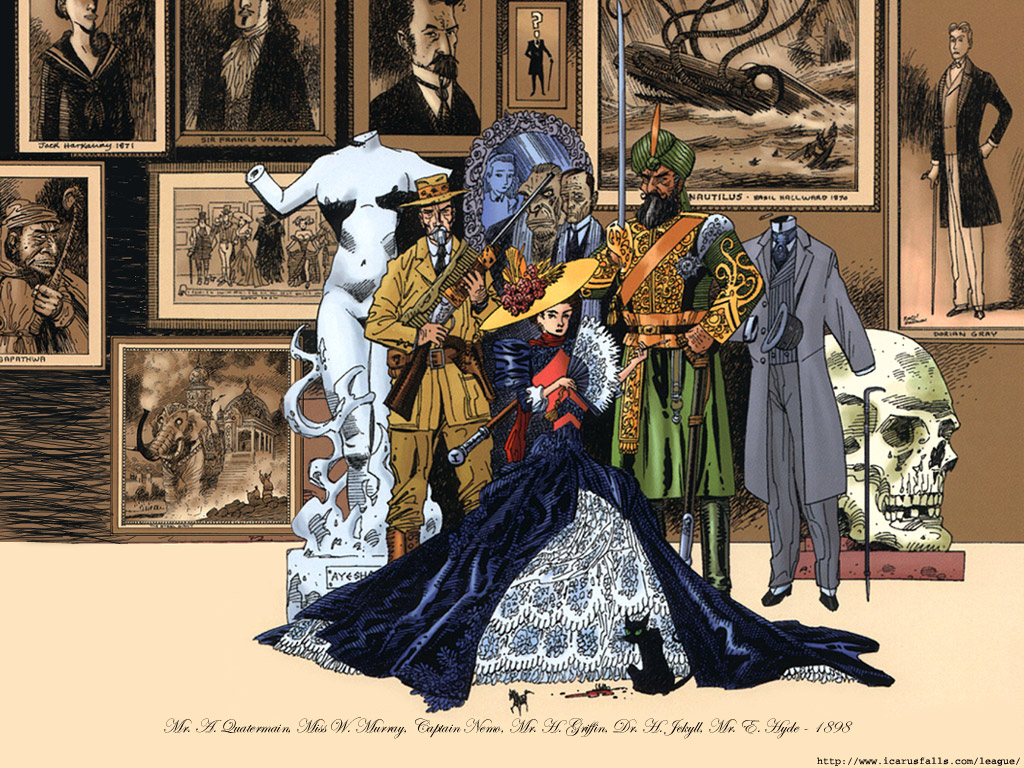
The League of Extraordinary Gentlemen, circa 1898; reprinted with the kindly permission of the Archives Department of the Annexe of the Albion Museum, London
A Caligari Cabinet of Curiosities:
A Journey into the Warped Comic-Book World of The League of Extraordinary Gentlemen
Last week, I spent a very pleasant, albeit unorthodox, evening with my father. We sat in the big dark wood-paneled living room of the white elephant we call our home, and read together the first two sections of the old League of Extraordinary Gentlemen comic book. We like to call the living room the house’s Great Hall, which makes us sound as if we conducted ourselves like Regency gentlemen (not entirely a false impression) but is nonetheless, architecturally speaking, hyperbole.
By now, you’re wondering what the heck is going on here. Why is this young nerdling reading comic books (ahem…graphic novels, whatever) instead of something more edifying? Say Summa or, at the very least, the Manuale Exorcismorum. And why me? Dan’s our X-Men fanatic around here, always mumbling about Dark Phoenixes or something. Of course, the only thing I recall about X-Men was thinking Famke Janssen almost has the same last name as a sixteenth-century Dutch semi-heretic.
You, of course, mustn’t confuse the X-Men with the sedevacantalist graphic novel SSPX-Men (involving Archbishop Lefebre and some radioactive grains of incense…I kid). Nor should you confuse it with the League, though some people are calling it a nineteenth-century incarnation of the theme.
For a brief synopsis, League, authored by Alan Moore, takes well-known characters from nineteenth-century fiction and place them together in a slightly-warped version of the turn of the last century and pits them against vintage villains as Fu Manchu and Moriarty. Mina Murray, the spunky heroine of Dracula, acts as the group’s leader. H. Rider Haggard’s adventurer Alan Quatermain played this role in the film; here the White Hunter shows up, in a flawed, age-worn and perhaps more interesting version of the movie character. I have to admit it was great fun, and almost...almost intellectually stimulating. The movie based on it was a tedious video-gamey shootout, though it had some charmingly hokey moments, lovely period sets and fun steam-powered gadgetry. However, the comic has an interesting edge to it, and it spares us from being subjected to Dorian Grey. Moore has a weird, imaginative genius, and the comic seems like a Jules Verne story illustrated by Edward Gorey to a script by Tim Burton. It may be creepy, but gosh darn, it’s certainly not tedious. Plus, I’d place Mina Murray up there with Irene Adler (i.e. The Woman to fellow Holmesians in the audience) in terms of totally sweet headstrong Victorian Women.
It’s well-drawn, clever even. You’ll find obscure references to Sherlockiana, “steampunk,” Victorian scientific romances and even real literature. It’s the only comic where you’ll find allusions to Trollope, Dracula, and James Bond on the same page. On top of that, the fake Victorian advertisements are twistedly funny, including a paint-by-numbers portrait of Dorian Grey (!!), the “Caligari Self-Assembly Cabinet” and Holmes “Play in a Day Violin Course,” which, if you’re a silent-film buff or a mystery fan are hysterically funny. Be warned, though, fellow Nerds: there’s some unfortunate prurient bits in Chapter Two (so skip over that part, please, trust me here...uck). However, besides the expected murder and mayhem there’s not much else objectionable (compared to, say, Father Ted...I'm kidding, Dan). Plus, the villain’s a Freemason: what’s not to like?
As an artist and a writer the concepts behind comic books have a certain intellectual interest. It potentially is a format that combines the strengths of filmmaking, novel-writing, and serial television in a package which seems in a sense almost like the modern equivalent of a medieval manuscript. Comics remind us Catholics the profound respect the Faith has for the communicative power of images, and their embellishment of and unity with the more “Protestant” written word in expressing the glory of God. It’s no surprise that the first “comic strips” were in illustrations for the Spanish codices containing the Cantigas de Santa Maria, songs in praise of the miracles of the Blessed Virgin. These episodic illuminations showed the healing of lepers, grateful offerings to the shrine of the Virgin, and myriad other wonders. Comics were invented by Catholics!
In the future, I’ll stick to real books, but nonetheless it was a fun divertissement. If you’re the sort of person who reads the footnotes to the Annotated Sherlock Holmes or are curious to see what Captain Nemo does on his day off, you couldn’t find a better way to spend a quiet Victorian evening than with Alan Moore and his wild imagination.
I have to dash. Our heroes are, at present, trying to stop the aerial bombardment of Limehouse by the insidious Dr. Moriarty’s Cavorite-powered superweapon, and time and the Napoleon of Crime wait for no man.
Curt Jester has an idea for getting your average Catholic in top condition: Liturgical Boot Camp.
If I may suggest an addition to Basic Training: "You call that a profound bow soldier? I can't see the back of your head! This is the Incarnation we're talking about here! Give me 100 genuflections now! I want to see that knee hit the ground!"
While I'm on the subject of great rants on the blogosphere, take a look at Victor Lams' thoughts on Marty Haugen. Since Marty is from my area, he's a bit of a local celebrity here in the Twin Cities. Thankfully, my home parish doesn't use much of The Great Liturgical Composer's pieces of work, but I can get my fill of his systematic attempt to rob the liturgy of its meaning at almost any other church in the diocese. Personally, I'd love to see this New Age-y hack's music banned from our churches. Of course, if the Mass of Creation were suddenly to be put on the index, half of our music ministries would probably be rendered unable to sing the ordinary, anything else having too much actual musical value for them to handle. Maybe we should also have a Music Ministry Boot Camp. ("You call that polyphony?")
OK, I feel better now. And now, back to your regularly scheduled blogging, already in progress.
Another Ghost of Saturday Night Live Past Returns to Haunt Us
Okay, it was loopy enough when Ahhhnuld and Arianna Huffington were in the race, but now the California recall election (alias the Battle of the Funny Accents) has been joined by none other than Fr. Guido Sarducci, the only comedian ever officially banned from St. Peter's Basilica, according to the inimitable Fr. Sibley. Fr. Sarducci did color commentary for Weekend Update during the Papal Elections of 1978 and is a noted expert in many fields, teaching numerous courses at the Five-Minute University: Religious Journalism, Principles of Existentialist Continualism, Theology and the Art of RV Maintenance, Biofeedback and How to Stop It, Basic Kitchen Taxidermy and Self-Actualization through Macrame. He also seems to wish he were a gondolier and is translating the works of Steven Foster into Italian.
Of St. Bernard in General, St. Bernards, Wolves, Domini canes and An Apology Concerning Dog-Face
Today is the feast of St. Bernard of Clairvaux. Every day this great saint would wake up and ask himself, "Why am I here" and unlike most existentialists, he always had an answer: "to lead a holy life." He revived and reformed the great order of the Cistercians, as well as helping bring about the foundation of the Knights Templar at the Council of Troyes. The Templars had nothing to do with any of that baloney in the Da Vinci Code, pace Dan Brown, though, if Umberto Eco is to be believed, nonetheless "The Templars have something to do with everything." (See this link for a source to satisfy all your Templar memorabilia needs, yeah right, like you have any...). St. Bernard composed a marvellous rhythmic prayer to the members of Christ Crucified and is patron of all professions associated with bees, especially wax-melters and candlestick-makers (probably because of his mellifluous, or honeyed, tongue). One of his emblems is a white dog, which goes along well with the wolf of St. Francis, the swan of St. Hugh and the black-and-white Dominican hound of St. Dominic. And of course, there's a whole breed of canine named after the guy. Woof!
Speaking of dogs and saints, today is also another feast of the martyr St. Christopher, who is said, according to some rather dubious legends, to have belonged to a race of men with dog's heads instead of human ones. Though perhaps this is a garbled version of another account which reduces this rather fabulous image to merely being a facial deformity (at least according to the Orthodox Ecumenical Patriarchate's website, which sports one of these odd icons). An even more clear and less weird picture of the linguistic origin of this strange story about cyncecephoroi and cannibals comes from here. Check it out. I'm afraid in the past I've given the saint a terrible time about his curious physique (sorry, Chris). Strictly speaking, the canons of iconography dictate he be depicted with a normal face, though not everyone seemed to pay attention to this.
Today is also the feast of the Martyrs of Thrace, a Persian martyr named Heliodorus and another St. Bernard, this one a Cistercian from Valdeiglesias, who is patron of the town of Candelada in Spain. Today is also the feast of St. Gobert, a Benedictine monk, a former count and crusader, who died in Brabant in the Low Countries in 1263. Today is also the feast of St. Lucius, a martyr who is not to be confused with the more famous and dubious St. Lucius of Britain (otherwise Llewrug Mar, or, the Great, grandson of St. Cyllinus), the legendary first Christian king of the island who seems to be associated with the Grail legend and was eventually been made bishop of Chur, where he was martyred about 176. But that's not our St. Lucius. The odds are he's probably just a duplicate of King Abgar the Ninth of Edessa, anyway. Drat.
Tuesday, August 19

Sorry for the lack of posts this evening, but I've had to pack the car and take care of other loose ends - I should have new material by Thursday night or Friday. Tomorrow, I'll be on the road from New York to Cleveland, catching the Indians-Twins game at Jacobs Field, a ballpark I've long wanted to visit. Thursday, I complete the journey to Notre Dame and move back into Keenan Hall. Everyone have a nice day and a half in my absence, and I can't wait to begin posting from the University so tied in with the mission of this weblog.
Continuing the "Marxist" Theme for Today
Jeff Miller over at The Curt Jester says he looks forward to our "daily church/saint whap up"! Cool! Glad someone enjoys our warped forays into hagiography! Jeff has also contributed a useful addition to the worlds of theology and humor with his A Night at the Jesus Seminar parodying the deathless Contract Scene from A Night at the Opera! So, are you following me here? "Well, stop following me, or I'll have you arrested!"
This has been sort of a busy week at work, and I've also had packing and personal engagements to take care of. Expect some new blogging this evening; tomorrow I leave for ND, but by Thursday night I'll be bringing you reports straight from stately Keenan Hall.
I enjoy the Marx Brothers' movies because they remind me other people also realize what it's like living in a small dorm room.
"I am a Marxist, of the Groucho Variety"
Movie Review: A Night at the Opera. The Marx Brothers, Kitty Carlisle, and Margaret Dumont. MGM, 1935.
Classic movies are big around the Shrine. Dan introduced us to the labyrinthine world of Hitchcock fairly early along in our friendships with him, a recommendation I am indebted to. I'm always singing the praises of Casablanca, myself, and Em enjoys To Catch a Thief. Andy, well, he's sticking to Jackie Chan for the moment (and the Hong Kong master really does have his own particular genius, I must admit) but just give us time.
Why the Marx Brothers? It's usually a thankless task to dissect humor, but it's worth considering. I love the guys, I really do, but what makes it better to watch some black-and-white actor with a bad Italian accent hit a fat policeman over the head with a frying pan than, say, any gag from Jim Carrey's oeuvre? Is it just because it's old? Some of the tricks may be the same, for people have been laughing at the same jokes since the days of Mausoleus of Halicarnassus, but there's a real comic genius at the heart of the Marx Brother's uproarious work. In A Night at the Opera, it's the wonderful combination of three of my favorite things: opera, anarchic wit, and of course, the inevitable frying pan gag.
Sure, it's just comedy, but it's well-made comedy. There's a certain pure pleasure in seeing something done well, even if it may seem a trifle plebean. Like the perfect hamburger, for example: it may not be coq au vin, but if done properly it is still heavenly. Not a moment is wasted in A Night at the Opera: everything advances both the plot and is also hysterically funny. Even something so seemingly-simple as signing a contract (with duplicate copies--you know what duplicates are, right? "Sure, they's five kids up in Canada," says Chico, obliviously) culminates in Groucho and Chico essentially ripping the thing to shreds and then Chico can't even sign the thing because he's illiterate.
Surprisingly, those obligatory moments where Chico demonstrates his piano skills and Harpo plucks his harp don't bring the show to a screeching halt; Harpo's music is heavenly, a bit of a chaser for our ears, while Chico has the funniest hands in show-business. Even so, the best demonstration of their ability to make even the most mundane moments seem comic comes in the more leisurely Animal Crackers, where Chico pounds out the song Somewhere my Love Lies Sleeping (With a Male Chorus). But A Night at the Opera is still wonderful nonetheless.
For here they manage to take pure physical humor to a whole new level, as in the famous "Overcrowded Cabin" routine, which defies description and must be seen to be believed. Slapstick is punctuated by uproarious bon-mots and verbal humor gets a spike of juice by the occasional kick in the pants. Even a sight gag gets its very own caption:
Groucho: You see that man over there eating spaghetti?
Mrs. Claypool: No...
Groucho: Well, you see the spaghetti, don't ya?
Nothing's absurdist here: that can be funny in its own way, but for two hours, it's a bit much. Instead, the real joy is seeing Groucho, Chico and Harpo in supreme control of every humorous jot or tittle, even in situations where Our Heros (disguised as ridculously bearded Russian aviators) find themselves being pursued by an angry mob down the steps of New York's City Hall.
It helps, of course, their supporting cast is almost as good as they are. Margaret Dumont is possibly the best straight-man (person?) Groucho could ever ask for, acting both as love interest and shocked foil to his insanity. Walter W. King does a good job of chewing the scenery as the evil tenor Lasspari, though he also gets a couple of good laughs out of us simply by having played the lead from I Paggliaci, which requires him to wear a ridiculous clown costume (with the sourest of looks on his face, no less). Kitty Carlisle is somewhat of a cypher, but a lovely cyper. Her role may be rather sketchy beyond here serene beauty, but at the same time, she gives her part enough spunk and class to make it interesting. Plus, as the female half of the obligatory sweet Young Lovers, she helps bring the movie to a suitably operatic and uplifting close. You can't ask for much more than that, especially after having just watched Harpo brilliantly demolish the entire backstage of the New York Opera Company.
A Christian has a union with Jesus Christ more noble, more intimate and more perfect than the members of a human body have with their head.
--St. John Eudes
Today we have a rather mixed bag when it comes to saints; none too famous, none too obscure (well, some too obscure), but all with stories to tell. Most prominent of them is the seventeenth-century St. John Eudes, founder of the Congregation of Jesus and Mary and the Sisters of Charity, and author of the devotion to the Sacred and Immaculate Hearts of Jesus and Mary. Today, around the same time St. John was propigating his message of submission to the Sacred Heart, Bl. Peter Zuñiga and the Japanese crew of the ship carrying him were beheaded at Nagasaki. Today we also remember St. Louis of Tolouse, a reluctant bishop, son of the King of Naples, who was a great-nephew of St. Louis of France and of St. Elizabeth of Hungary. He is shown in art as a Franciscan vested in an episcopal cope spattered with the fleur-de-lys emblem of his royal house of Anjou. Today as well is the feast of St. Magnus, a widower, monk and bishop who was the father of St. Agricola of Avignon. St. Magnus is patron of fish-mongers while his son is considered a protector of storks. Also on the calendar today are St. Guenninus and Bl. Guerricus, who share nothing save a similar-sounding and peculiar name.
Monday, August 18
St. Uriel, Archangel, from a Peruvian Spanish Colonial work
Angels of the Andes:
An Appreciation of the Heavenly Side of Spanish Colonial Art
I was recently in Denver, and had time to stop and view one of my favorite American museums, the Denver Art Museum. It may not be on par with the Chicago Art Institute or the Metropolitan, but nonetheless it has an excellent and rather sizable collection of lesser-know (but still high-quality art). While I tend not to stray beyond the European and Chinese galleries in museums, it also has a fascinating selection of American Indian and Western American art, including some spectacular examples of Northwest Coast Indian woodwork.
My favorite floor is the one devoted to Spain's reign in the Americas. I have a great love of Spanish colonial art and music, as anyone who's followed this 'blog knows, and Denver was the first place I was introduced to it in great detail. Rather than merely being limited to the crude (but engaging) santos carvings of New Mexico as in many other American museums, their Hispanic collection includes sophisticated and ornate works from Mexico to Peru, including numerous lace-bedecked images of the Virgin, intricate allegories and a remarkable sample of a series showing the Seven Archangels vanquishing the demons of the Seven Deadly Sins. The cultus of the Archangels was particularly strong in Spanish America, a land then still without the great panoply of local saints seen in Europe and thus in need of more universal protectors. Indeed, it's one of the few places in art you can glimpse the elusive Archangel Uriel.
Pious tradition holds that the choir of archangels has seven members; the rolls of their membership, both Catholic and heterodox, vary wildly. Since the revival of their cultus in the eighteenth century after laying dormant since the ninth, the current list seems to be the usual Michael, Gabriel and Raphael, as well as Uriel, Shealtiel, Jehudiel and Berachiel (though the Catholic Encyclopedia gives another list). These names were rediscovered when, three centuries ago, an ancient fresco containing their images and appelations was uncovered in an old church in Palermo dedicated to them. Besides that, there's a church in Germany which honors them.
However, in general, they're scarce in Europe. The unfortunate association of St. Uriel and some of those more obscure angels with the occult and the unorthodox Jewish mystical school of Kabbala tended to leave a bad taste in the mouth (as will any web search devoted to ferreting out useful information on him, as it seems to turn up a host of crackpot new-age sites with little interest in fact and less in holiness). One negative account even made Uriel, rather than being the "fire of God," the hellish "President of Tartarus." Though, in all fairness, that title might also indicate the heavenly angel who locks the Devil into Gehenna at the end of time. Whatever the case, he'd been stricken from the calendar before, in 745, when a number of other angels of apocryphal provenance were removed. Legend has it that one of them, an angel named Sadoc, was so annoyed at his demotion that he would interrupt Mass with loud flatulent noises. Another account places his excision from the calendar at the time of the Renaissance. Nonetheless, St. Uriel proved resilient and ended up getting a new feast for him and his six archangelic compatriots on April 20, celebrated to this day at Palermo.
Whatever the case, the Seven enflamed the imagination of Spanish America, particularly the lands once under the rule of the Inca, already so high in the mountains as to scrape the angelic firmament. Angels are all over the place in Peruvian art, holding up the sudarium, trampling devils, lauding the Virgin and Her Child, or even firing off matchlock muskets. Some of these angels seem so androgynous to us in their lacy skirts and curls that modern art historians have branded them "female-dressed angels," who recall the bodiless nature of the Heavenly Hosts. I'm inclined to think this supposed effeminacy has more to do with the Baroque mania for filigree than anything else. But then, there are the ones with guns, quite masculine. They verge on being sacred dandies in their fine swaggering military clothes, modelled on the uniforms of Spanish soldiers. So close is that correspondence that many of them are shown drilling with muskets in poses straight out of a seventeenth-century drill handbook. St. Uriel is typically one of them, a very suitable candidate for a marksman with his association with divine fire. It is a strange and picturesque note, reminding us of the psychological affect that European weaponry had on the Indians of our continent.
The "Angels with Guns," as they are called today, were first painted to impress the newly-conquered Incas by the power of God's bodiless agents. In time, however, the weapons became tokens of Divine protection, a bellicose comfort against demonic temptation. In many ways, it's no stranger than seeing St. Michael in medieval armor, St. Barbara in the clothes of a German princess or St. George dressed as a fashionable Renaissance gentleman. Though somehow the image of St. Michael in camoflage with an AK-47 doesn't quite strike the same quaint note.
Be that as they may, I find them quite charming, and at the same time, the recollection of Spain's military might, the sight of that belch of flame, and the memory of the smell of black powder from my father's shotgun still makes me wonder at how much more magnificent and powerful the Host of Heaven must be on parade.
Scuola San Rocco, after John Singer Sargent
Coryats Crudities and Gabrieli’s Delicacies
CD Review: Music for San Rocco, 1608. Gabrieli Consort and Players. Deutsche Grammophon GmbH, 1996.
“...to laud and prayse God and His Saints with Psalmes, Hymnes, spirituall songs and melodious musicke...”
—Coryats Crudities, London, 1611
The Gabrieli Consort’s Music for San Rocco, 1608 was the third CD I bought when I began my love-affair with early music about two years ago. It’s a splendid recording, both wonderful as an introduction to the music of Baroque Venice and as an addition to a much larger collection. It reconstructs a concert given at the Scuola San Rocco in honor of their patron saint (whose feast came only a few days ago, on 16 August) which was described with great gusto by the English traveler Thomas Coryat in his book Coryats Crudities. Indeed, this CD was recorded on-site at the Scuola itself! Talk about authentic. It doesn't get much better than this.
Many historians have traditionally interpreted this event as a Vespers service, but the Gabrieli Consort decides here instead to treat it as a “spiritual recreation,” or sacred concert, a distinctly Venetian para-liturgical practice. Recreated here, it gives us a marvelous window into the life of the Scuola. Thus we are treated to a program simply of music, rather than one of the Gabrieli Consort’s liturgical reconstructions with their chanted prayers and clacking thuribles. While I derive great pleasure from these atmospheric additions, they’re a bit perplexing to the laymen. Furthermore, it’s hard to resist the unadulterated Italian joy of just hearing one marvelous Gabrieli piece after another.
Though they won’t wear you out, I promise. The star attractions, Giovanni Gabrieli’s motets, are interspersed with instrumental toccatas and canzonas dominated that serve to cleanse the palate and soothe the ears with their gentle festivity. Gabrieli’s occasional bombast can wear thin if overdone, but the Consort does an admirable job of balancing extravagance with subtlety within the choral pieces. There are quite a few elegantly understated works here. We can hear the sonorous sound of Suscipe, clementissime Deus, where six low voices are paired with six sackbutts (a splendid but rare combination showing off the elegance of the Renaissance proto-trombone) in praise of San Rocco, as well as two subtle and sweet Bartolomeo Barbarino countertenor solos sung to the delicate pluckings of a lute.
The CD’s highlights, however, are wonderfully grandiose. There’s the Gabrieli staple In Ecclesiis, played here with an exciting raw vigor lacking in other recordings. There is also the concert’s final piece, a 33-part Magnificat. It's a wonder. It exists only in partial form in a choirbook discovered in Graz, Austria, though Paul McCreesh, the Consort’s director, has lovingly reconstructed the missing parts from a comparable and more famous 17-part Magnificat. However, that smaller version (which has been recorded by the Taverner Consort in their pleasant albeit timid Venetian Church Music compilation) pales next to this glorious hymn of the Virgin, sung to the extravagant accompaniment of a dozen sackbutts and seven chamber organs. This piece alone makes the CD worth the cost.
Every time I listen to this recording, I find a new favorite piece on it. Gabrieli’s sacred music is timeless, and never fails to uplift the soul with its joyous and infinite variety.
St. Helen, Discoverer of the True Cross, and More
Today is the feast of St. Helena, Empress, widow and discoverer of the True Cross. Relics of that holy wood can be seen at the basilica of Santa Croce in Gerusalemme in Rome, along with the crossbar of the Good Thief's own scaffold and the titulum or sign that stood over the cross of Christ. A new theory proposes that the titulum displayed there is authentic for the following reasons: the languages written on it are in a different order than in the gospels, something a forger would have never thought of, and even more interesting is that the inscriptions are actually written backwards, as it would have been done by a Hebrew working in Roman service, or intended for people for which Latin was a second (or third) language and were used to reading right-to-left.
Today we also remember St. Florus and St. Laurus, two brother-stonemasons, whose martyrdom in Illyria (with St. Proclus and St. Maximilus) seems a duplicate of that of the Four Crowned Martyrs of Rome; as well as Bl. Aimo Taparelli, O.P., noted as being one of the few Inquisitors-General of Lombardy and Liguria to live to a ripe and happy old age, unlike the more unfortunate St. Peter Martyr, another Lombard, and Aimo's own predecessor, Bl. Bartolomew Cervario. There's also the martyr St. Agapitus of Palestrina, catalogued in the Gelasian Sacramentary, and who has nothing to do with Renaissance polyphony. In Greece today, they remember the Thousand Martyrs of Armenia, two patriarchs of Constantinople, and Four Ascetics whose names are unknown to history.
Sunday, August 17
For highlighting my piece on Catholicism in America in his weekly "best of" roundup of different blog material. Welcome to the blogosphere, Earl!
"A blog? That's like that place where they found those 'blog-people,' right, Ted?"
Thanks to all our readers for their insigthful comments, for recommending us to others, and for putting up
with our personalities and at times madcap humor............
"No Dougal, those are bog people......blog people are far stranger than the simple, ancient bog people."
.......Look forward in the coming weeks to more book and music reviews, "appreciations," and other typical material, as well as some class-based material once school starts, Matt's reports from Rome, and a series about the traditions of different religious orders. Let us know if there's anything else you'd like to see us do here, and feel free to contact us personally, as some of you have, with regards to important issues like Catholic identity at Notre Dame - we're here to serve.
"Drink!"
With today's High Mass at Saint Agnes Church on 43rd Street between Lexington Ave. and Third Ave. in New York. First, a note on this church. Saint Agnes is about five years old now, the replacement for a Victorian Gothic structure that burned down in 1993. Built in a restrained baroque, the current church features one main altar effectively designed for use either ad orientem or versus populum, as well as side shrines to Our Lady of Guadalupe, the Sacred Heart, Saint Pius X, Saint Francis, Saint Therese, and others. Behind the main altar is a beautifully vivid painting of Saint Agnes, the Blessed Mother and other saints, with Saint Agnes situated in a sort of Romanesque gazebo - the painting has been criticized by some due to the fact that Saint Agnes's skirt stops above the knee - this seems to me rather ridiculous, especially since the figure in the painting is tall enough that this is not really high at all. The traditional design also includes an altar rail, used at every liturgy. The church also features a very good bookstore that, while tending to skew more traditionalist than my preferred Pauline Books and Media (I went on a shopping spree there yesterday, I shouldn't be allowed there alone.......), does feature some gems, including a selection of Tridentine missals and the beautiful Rosary I bought there a while back. That said, here are the details of today's liturgy:
Prelude: Nigra sum, sed formosa, Opus 18, No. 3 by Marcel Dupre
Introit: Dum clamarem ad Dominum, exaudivit vocem meam (Psalm 54)
Kyrie and Gloria: Mass XI, Orbis factor
Gradual: Custodi me, Domine, ut pupillam oculi (Psalm 16)
Credo:Credo III
Offertory: Ad te, Domine, levavi animam meam (Psalm 24)
Sanctus, Benedictus, Agnus Dei: Mass XI, Orbis Factor
Communion Antiphon: Acceptabis sacrificum justitiae (Psalm 50)
Antiphon of Our Lady: Salve Regina, Plainsong (note: after hearing Dominicans sing the tonus monasticus version, there's really no going back to this one)
Postlude: Magnificat du premier ton; Dialgue sur les grands jeux by Jean-Adam Guilain
Beginning next Sunday: Weekly Mass postings from the Basilica of the Sacred Heart - for those of you who get the Hallmark Channel, tune in!
Saturday, August 16
Glorification of St. Roch, after Tintoretto
A King, an Empress, and a Pilgrim
Well, anyway, while I sweep up the crumpled confetti off the floor and try to wash away the stale beer smell out of the Shrine after the wild and crazy Assumption party we had here last night (yeah right, as if), let's have a look at the saints of the day. Today's most important feast is that of King St. Stephen of Hungary, who was baptized by St. Adalbert (or Voitech) of Prague in 985. He grew, surprisingly, into a devout Christian and converted his nation, gaining the title of Apostolic Majesty from Pope Silvester II, used by his descendents and subsequent dynasties ruling Hungary well until 1918. The Holy Crown of St. Stephen, another gift of the Pope, is Hungary's most prized relic, and even today, a thousand years later, remains a sign of the Hungarian people's sovereignty and independence. Interestingly enough, it sat out much of the Cold War in a vault in Fort Knox (along with Indiana Jones's ark of the covenant, probably...I'm kidding) but now is displayed proudly in Budapest after being returned in 1978. St. Stephen was married to Bl. Gisele (the sister of St. Henry II, the Holy Roman Emperor), and their son was St. Emericus (also known as Americus, Imre or Emeric), the namesake of Amerigo Vespucci and a minor patron of the Americas.
I wore a red shirt and green socks to remember St. Stephen today. Hungarian colors, and all that. Hey, it works for me.
Today is the feast, also, of St. Uguzo of Milan, whose origins are obscure, and seems to have been an alpine shepherd killed by his employer who grew jealous of his virtues. The Roman Martyrology also tells us today of St. Serena of Rome, the sometime wife of the Emperor Diocletian, though this information derives from the spurious acta of St. Cyriacus. We can also find reference in the Martyrology to St. Roch of Montpellier (or Rock, or San Rocco in Italian) whose feast remains popular with Italians in their native land or abroad. He had a long and rather melodramatic history which revolves around his adventures as a pilgrim as well as his work as a healer during the plague. Arriving home, unrecognizably transformed by the ravages of disease, his uncle, the local governor, mistook him for a spy and had him arrested. Only after his death did a birthmark vindicate his identity. St. Roch is the patron of plague victims and cancer survivors, as well as physicians, surgeons, cattle, prisoners, Istanbul, street-pavers, old clothes dealers, cooks, and invoked against all contagious disease,. He is portrayed in art as a pilgrim with an open wound on his leg. He has a marvellous Scuola Grande named after him in Venice with some of the finest paintings of him extant as well as numerous scenes of salvation history, done by Tintoretto. The story goes that there was a contest held to have the paintings done, and each artist was given a small stretch of wall, but Tintoretto broke the rules and painted the entire space of the room. Fortunately, he won and his work was not painted over!
In San Rocco and his Scuola's honor tonight, we're eating risotto and saltimbocca (strictly speaking, Roman, not Venetian, but we do what we can), and listening to Music for San Rocco, 1608 by the inimitable Gabrieli Consort, actually recorded on site at the Scuola! I love feast days!
Friday, August 15
Bl. Isidore Bakanja, Martyr of the Scapular
Since Emily and Dan have done so admirably in digging up the saints occulted by this feast day, I feel obliged to have a bit of hagiographical fun as well, lest my fellow Whappers think I'm losing my touch! Today is also the feast day of St. Napoleon (or Neopolus) of Alexandria, an early martyr about which little is known, though his cult was heavily promoted in France during the years of his namesake's reign (surprise surprise). I've even seen some rather remarkable Bonapartist illustrations of him published after the restoration of Louis XVIII that show him with the facial features of the Corsican upstart. Rather a bit much, since Old Boney was excommunicated for his dealings with the Papal States. As a consequence, he seems to have become an unofficial patron of soldiers. Weird. Vive le vrai Roi tres chretien, à bas l'empereur!
Today, furthermore, recalls Bl. Isidore Bakanja, a Catholic African convert and devotee of the Scapular martyred by the Belgians during the darkest days of the Congo Free State. For attempting to disseminate Christianity among the African serfs (and thus awaken them to the missionaries' fight for justice and native rights), and for refusing to surrender his scapular, agents of the thuggish colonial administration had him beaten mercilessly with a spiked elephant-hide scourge and left him chained from a tree for days. A colonial inspector rescued him and took him home, and heard his tale just before two missionaries could give him the last rites on this day in 1909. Today is also the memorial of Bl. Claudio Grazotto, a Franciscan brother and well-known and talented sculptor of the first half of the twentieth century. Speaking as an artist, that's pretty darn cool.
Today also marks the feast of Saint Tarsicius of Rome, the patron of altar boys. (some of my favorite people are altar boys!) According to Damasus I, Tarsicius was martyred defending the Holy Eucharist. Tradition has it that he was carrying the Eucharist to prisoners awaiting martyrdom when he was waylaid by bystanders curious to see what he was carrying. When he refused, they beat him and tried to pry his arms away from his chest to relieve him of his precious cargo. As he prayed, his arms miraculously became stronger than iron. He was rescued by friends, but refused to open his arms until he was brought before the Pope. As he was carried into the Pope's presence, he died, his arms fell away from his chest, and the air was filled with an odor like lilies.
Saint Tarsicius, pray for us, that we may have the fortitude to defend the Blessed Sacrament against all forms of irreverence and profanation!
We present our Top Ten Criteria for Being a "Whapster":
10. Pilgrimage from South Bend, IN to Bologna.........on foot!
9. Wear the ankle chaplet given to St. Flutius in his vision of the Holy Whapping
8. Sit with us in LaFortune Student Center until it closes........then get up for 9:00 a.m. Saturday Mass!
7. Memorization test featuring saints in the Roman Canon, Litany of Dominican Saints and Blesseds, and Litany of Carmelite Saints and Blesseds
6. Humiliating initiation ritual featuring a crown of roses.
5. Take strenuous psychological test. Fail.
4. When giving advice, you always manage to cram in the phrase, "With great power comes great responsibility." Bonus points if you can also say, "My gift is my curse."
3. You consider buying an ostentatious luxury condo and naming it "Alexander VI House"
2. Your first instinct when you see a girl in a denim skirt or a guy in a polo shirt and khakis is to call the nearest vocation director.
1. When watching Mel Gibson's Passion, you plan to look very closely at the scene where Jesus walks up the stairs of Pilate's palace.
The parade of paintings continues.......
...........is On the Dormition of Mary: Early Patristic Homilies, edited by Brian E. Daley, S.J. of the Notre Dame theology dept. Featuring both accounts of the Assumption and more theological homilies, the inexpensive volume contains work by John of Thessalonica, St. Andrew of Crete, St. Germanus, St. John Damascene, and others. As I've said before, Daley is a superb teacher, a superb scholar, and a superb Jesuit, and is also very much involved in Orthodox-Catholic ecumenical relations. He is a great asset to Notre Dame, and is book a great asset to any theological library.
Can our blog use every painting of the Assumption on the Internet? Stay tuned.
Because of its rather recent dogmatic definition and its Mariological (and thus, to some "un-ecumenical") nature, the Assumption can be a stumbling block to many, such as Nicholas Kristof in today's NY Times. (Thanks to Mark Shea for the link) But I think that upon further reflection, it's easy to see how the Assumption would flow out of other doctrines about Mary; in essence, it is the natural conclusion of her entire life, and the fulfillment of two important passages from St. Paul.
In Colossians 3:3, St. Paul says that "If then you have been raised with Christ, seek the things that are above, where Christ is, seated at the right hand of God. Set your minds on things that are above, not on things that are on earth. For you have died, and your life is hid with Christ in God." Thus, the Assumption rests on the same hinge as the Immaculate Conception: in order for Mary to have "been raised with Christ," her life has to have been formed, from the very beginning by an experience of His saving grace. As Karl Rahner puts it in Theological Investigations, "Mary is she who is taken into predestining grace in Christ's becoming flesh as the victorious and definitive presence of God's mercy in the world, overcoming all sin; and therefore in her case this temporal interval has no meaning. Not because she did not require redemption, but because she is the one member of the redeemed without whom it is impossible to think of the Redemption as victorious." Von Speyr puts it a little differently, writing in Mary in the Redemption: "It cannot simply be said that the Son suffers on the Cross from the Mother. She is redeemed in a pre-light of the Cross. This demonstrates the magnanimity of the Father, a gift in advance from the Father to the Son." Thus, Mary has "been raised with Christ" with the grace of the Immaculate Conception and with her fiat at the Annunciation, that is, her acceptance of the mission that comes with that grace. Moving to the second part of the Colossians quote, regarding Mary's hiddenness, let us turn to Saint Louis de Montfort, writing in True Devotion to Mary: "Mary was singularly hidden during her life. It is on this account that the Holy Ghost and the Church call her Alma Mater - 'Mother secret and hidden.'" Mary is the exemplar of being "hid with Christ in God," appearing very little in the New Testament - St. Paul's ideal in Colossians is her reality. Thus, she is "raised with Christ" immediately, since in death (perhaps) as in life she is the model and example of the Church.
The same applies to Ephesians 1:12: "We who first hoped in Christ have been destined and appointed to live for the praise of his glory." This idea of being the "praise of glory" is the center of the mystical theology of Bl. Elizabeth of the Trinity, and this is nowhere more evident than in her Last Retreat, written just weeks before her death. "Her soul is so simple," Elizabeth says of Mary, "Its movements are so profound that they cannot be detected. She seems to reproduce on earth the life which is that of the divine Being, the simple Being. And she is so transparent, so luminous, that one would mistake her for the light, yet she is but the 'mirror' of the Sun of Justice: 'Speculum jusititiae'!" What a beautiful image to reflect upon, on this feast of the Assumption. By perfectly living this life as "praise of glory" on earth through her hiddenness and prayer, Mary, as von Speyr would say, allowed her mission to be absorbed completely in Christ, and thus became the first to share bodily in His Resureection. We are called to be, like Mary, "hid with Christ," and "the praise of his glory." The closer we exemplify this ideals, the more joy we will have in experiencing one day the life that Mary alone lives now, body and soul with Christ. I don't claim to have offered a definitive, airtight, theological proof for the dogma of the Assumption here, but I hope I've at least provided some material for reflection.
Via Fr. Sibley's rectory. Popetown, the latest BBC cartoon, is about office politics in the Vatican...and a very stupid-looking Pontiff on a pogo stick. Scary, and not in a good way. Okay, if Fr. Ted makes any guest appearances on this series I am going to be extremely cross. Sheesh, has the BBC run out of ideas?
Funny. I just took this Country Quiz, and it says I'm France. Yeah, yeah. France's taking a lotta ribbing these days, and I'm not much of a fan of the Fifth Republic, but the actual place and people, when you get down to it, are pretty nifty. Remember that the same country that produced Robespierre and Gallicanism also gave us St. Louis IX, Gothic architecture, impressionism, Jean-Baptiste Lully, Moliere and a whole lotta freakin' good cheese. And chateaubriand, a delicacy which almost rivals gaspacho, which is a remarkable admission coming from a partisan of Spain like myself. So I'm cool with this, mes amis. Though I liked that animal personality test from Fr. Jim's page that said I was a wolf (sweet!) a bit better. Still, France is good. Better than this test, which said I was the crazy henchman Renfield from Dracula, who, worst of all, wasn't even in the book! I am so not Renfield. Dr. Van Helsing, maybe (after all, he does have Papal permission to carry the Host about with him), but Renfield...criminy. "Yeeees, master..."
A Hymn to Our Lady on Her Assumption:
from the Stanbrook Abbey Hymnal:
The ark which God has sanctified,
Which he has filled with grace,
Within the temple of the Lord
Has found a resting-place.
More glorious than the seraphim,
This ark of love divine,
Corruption could not blemish her
Whom death could not confine.
God-bearing Mother, Virgin chaste,
Who shines in heaven's sight;
She wears a royal crown of stars
Who is the door of Light.
To Father, Son and Spirit blest
may we give endless praise
With Mary, who is Queen of heaven,
Through everlasting days.
(For more, see here. And thanks to Jane for bringing this marvellous image by Murillo to my attention!).
Pious Customs and Impious Oddities in celebration of the Assumption of Our Lady
In Malta, it is said a man born on this day will become a successful jockey and be well-known in racing circles. A more edifying tradition from Germany, suggests that bouquets of wildflowers and medicinal herbs should be blessed today. They decorate the home for weeks afterward to freshen the air and the soul. In Lithuania, this feast is also called the "Herbal Holy Day," "Cabbage Day," or the "Meadow Grass Festival." As in Germany, herbs were blessed, along with apples, oats, carrots and a whole panoply of newly-harvested produce. Blessed herbs were said to ward off the touch of the Devil's tail or lightning strikes. Lithuanians also have the rather interesting tradition that Our Lady distributes apples today to all those in heaven who died as infants, unless, of course, their mothers inadvertently ate an apple in the days preceding the Assumption: "Your mother ate your apple."
These vegetal images may derive from much earlier agricultural traditions. In the first millenium of Christianity, when the harvest was reaped in July, the Assumption marked the high point of the agricultural year, the end of the harvest festival that had begun at Lammastide, otherwise known as the feast of the First Fruits, usually held towards the begining of August. The custom held fast even after further developments in agriculture allowed there to be two harvests in the year. In Scotland, where the Assumption was called Marymass (or Marymas, depending on the source), the Lammas bannock (or cake, hence the famous battlefield of Bannockburn literally means "Cake Stream") were dedicated to the Virgin. Some German paintings even show Our Lady wearing robes marked with sheaves of wheat. This was most fitting: "So the glorious culmination of the Virgin's life was celebrated at the culmination of the farming year."

For such a beloved saint, "Saint Stan" rarely gets his day celebrated, because he died on the Feast of the Assumption. A Jesuit who died young, he prayed to Mary that he would be with her to celebrate with her the feast of her Assumption, and that prayer was fulfilled. He was canonized in 1605, and now has countless churches named after him; let us pray for his interecession along with Mary's on this feast of the Assumption and also his day.
In Cracow, Poland, today, is honored the memory of Saint Hyacinth, a priest from the Order of Preachers, who was designated by Saint Dominic so that he might propagate the Order in that nation. He preached the Gospel with his brethren blessed Ceslaus and Henricus Germanicus (Henry the German?) in Bohemia and Silesia. He is often known as "The Apostle to the North."
... and when it's not by John Allen, that's a fact worthy of a headline.
Read it here.
Signum magnum apparuit in coelo: mulier amicta sole, et luna sub pedibus ejus, et in capite ejus corona stellarum duodecim.
Today marks the glorious solemnity of Our Lady's bodily Assumption into heaven, long held in tradition and made infallibly part of the Deposit of Faith by the pronouncement of Pope Pius XII in 1950. In the East, this event is overshadowed by the celebration of the Virgin's Dormition, or death; theology remains silent on whether Our Lady was assumed alive into glory or chose to undergo death in order that she might be more united with Her Son. Legend tells us, according to Bl. Jacobus de Voragine, Bishop of Genoa, the chronicler of the Golden Legend that the apostles were present at Her tomb in the Vale of Jehosephat at the Assumption, and saw Her taken amid adoring hosts of angels. Naturally, St. Thomas wasn't there, having had a bad track record for this sort of thing (he was probably out buying ice cream) and when he came back, surprise surprise, he thought the apostles had been imagining things. The bishop writes: "And Saint Thomas was not there, and when he came he would not believe this. And anon the girdle with which her body was girt came to him from the air, which he received, and thereby he understood that she was assumpt into heaven."
Poor Thomas. He always gives hope to those of us, though, that, like Peter at the cock-crow, divine Grace is always ready to transform us if only we will let it.
There are numerous other pious traditions regarding the Assumption and the date of its celebration. It was said to be anywhere between three and fifteen years after the Ascension, and either in Ephesus or Jerusalem. Ephesus is, according to the Ven. Anne-Catherine Emmerich, the site of Her house, while Jerusalem has claimed the site of Her empty tomb. The feast itself, seems to have begun after the Council of Ephesus, and was celebrated in August in Palestine around 500, while in Gaul, following the Egyptian monastic usage, it was placed on January 18. Special feasts of the Assumption, instituted in the eighteenth century, were held in Italian dioceses on 20 February and 19 November, in commemoration of certain miracles. However, the Greek Emperor Maurice, according to the Liber Pontificalis, set the feast for its present date on the fifteenth . An octave was added to the feast by Pope Leo IV in 847, though it was, of course, lost amid the calendarical reforms of the 1960s. The Greek Church continues the feast from the fifteenth to the 23 or 29 August (as was customary in times past at Athos), while in the middle ages, a thirtieth day of the Assumption was celebrated on 13 September in Germany. This custom continued at Augsburg to this century. Bavaria further expands upon this custom, and celebrated a "Second Assumption" on 23 September, following the revelation of St. Elizabeth of Schönau, who wrote that the Virgin was assumed on the fortieth day after Her death.
But whatever the day it is celebrated, Our Lady's submissive love for God and Her fervent intercession remain an example and a shield to the faithful here on earth.
Assumpta est Maria in coelum: gaudet exercitus Angelorum. Alleluja.
Thursday, August 14
In two months, they're opening the rooftop passage along the wall that connects the Vatican to Castel Sant' Angelo. How awesome does that sound? Matt: You. Have. No. Excuse. Not. To. Do. This.
Saint Agnes Cathedral, Rockville Centre
My town, Rockville Centre, NY, seem to be one of few around here largely unaffected by the huge power outage, thanks to having our own power plant. Pray for everyone trying to get out of New York City and other municipalities - it's not a good situation, and a lot of terrorism fears linger in the wake of September 11.
In the words of his website, "Long live His Holiness Pope Gregory XVII!"
...........and Mark Shea's piece about schismatic bishops in gaudy clothing, I thought I'd mention my favorite antipope, Gregory XVII. Now, most antipopes are real bitter and serious in the way they conduct themselves, and have interesting stories about how they're really Pope. This guy claims that "Rome has apostatized," and has a story of Paul VI appointing him that has to be read to be believed. But what really gets me is how much this guy looks like he's enjoying the job. Having had my own stint as antipope, I suspect that God will have much mercy on this guy, since he's not exactly attracting a huge following anyway.
Today the Church of Nagasaki in Japan commemorates the martyrs Dominic Ibanez of Erquicia, a priest of the Order of Preachers, and Francis Shoyemon, a novice of the same Order of catechists, who in hatred for the name of Christian were killed under the supreme leader Tokugawa Yemitsu. What a wonderful coincidence (well, then again with God there is no such thing) that St. Maximilian's feast would fall on the same day as theirs. Truly a day to pray for the people of Japan, and Nagaski in particular.
Today the Church at Apamea in Syria honors Saint Marcellus, bishop and martyr, who, when he demolished the temple of Jove, was killed by angry pagans.
More saints over at Catholic Forum
Fr. James McCurry is an awesome guy
I'd like to give a shoutout to Fr. James McCurry, OFMConv, who gave our COM/KOI retreat last year. He helped push through St. Maximilian's cause for canonization, and is a fascinating, holy, and very funny priest. Some of his material is featured on Immaculata Mediatrix Online, a very nice site.
Mar 6:44 And they that did eat of the loaves were about five thousand men.
Entertaining the Catholic masses -- Our Lord brings the bread, we bring the circus. Here's to 5,000 visits!
The last week I was on vacation in Charleston, SC (with a day trip to Savannah). Beautiful country, elegant cities, fascinating history -- I recommend going there if you get the chance! Nonetheless, I'm naturally thrilled to return home to the sacred soil of Wisconsin and subsequent daily contact with the Shrine.
Perhaps the least-expected part of my trip to the Deep-enough South was the very strong French influence in Charleston, formerly the most significant of the English colonial ports in America. Appearently Charsleston was the refuge of French Huguenots following their expulsion from France, and the city hosts America's last remaining Huguenot congregation. I was rather surprised to discover they're still out there, somewhere; does anyone know if there are any Huguenot congregations left outside of the US?
At anyrate, their presence 200 years ago insured plenty of mousse in the local restaurants, so it's plenty justified in my book ;)
A Polish University is offering a degree in studies on Poland's favorite son, John Paul II. Professors include George Weigel, as well as personal friends of the Pope. I wonder if we can get them to start an English-language branch of the program?
The Knight of the Immaculate
It is my duty to be a saint and a great saint.
--St. Maximilian Kolbe.
Today we remember St. Maximilian Mary Kolbe, OFM Conv. (born as Raymond Kolbe), martyr of charity, apostle of Consecration, saint of Auschwitz, knight of the Immaculate. Most are familiar with the basic lineaments of his story: the death camp, the escape, the retribution by the camp commandant, his heroic replacement of another condemned man in the starvation bunker, and his holy death at the point of a needleful of carbolic acid. It was, in fact, on this very day in 1941 when that fateful injection occurred, and shortly thereafter, as he had unwittingly prophesized years earlier, he was cremated in the camp's ovens, on the vigil of the Assumption of his most beloved Immaculata. (A handful of hairs from his beard were saved shortly before his arrest, without his knowledge, and they, seemingly, are the only first-class relics that remain of this great and humble man).
But he would have been a saint even if it were not for his remarkable death of sacrificial love. Today holds great significance for me for two reasons: Maximilian is my confirmation name, and I also belong to a youth group on campus which is peripherally descended from his Militia Immaculatae, and certainly created in its spirit. St. Maximilian was greatly inspired in all his trials by the chivalric and knightly ideal (something close to my heart in today's darkness), even then still living in the imagination of the Polish nation, as most poignantly recalled by the heroic and doomed charge of the Polish lancers against the onslaught of German tanks. As a youth, he even imagined himself as a worldly general conquering the world for Our Lady with the sword, only to realize it could be accomplished only with the spiritus gladius of St. Paul. His founding of the Militia Immaculatae, his opposition to secularism which existed in his day in the form of tyrants and Freemasonry and exists today in equally potent but different guises, his legacy of consecration to the Virgin, and his innovative use of modern technology in the cause of the glory of God make him a model to all Christians today, especially those of us who enjoy blogging. Even the minutiae of his life fascinate: his monastery, Niepokalanow, was one of the largest foundations in history; his mind was ever-restless in the pursuit of knowledge, and he even conducted thought-experiments about space travel; and, when he made a long missionary trip to Japan, a premonition told him to build his "Garden of the Immaculate" at Nagasaki in a seemingly-inconvenient place. It was the only building to survive the atomic bomb a handful of years later.
St. Maximilian is patron and protector of the pro-life movement, of political prisoners, families, recovering drug addicts, and, in the words of John Paul II, "our suffering century." Let us hope that the twenty-first will emulate his holiness just as the twentieth recalled his pain.
Sancte Maximiliane, eques Immaculatae, ora pro nobis.
Keeping with Weird Al's parody of "I think we're alone now", Chinese scientists have cloned human/rabbit combos in order to harvest stem cells. I don't even want to think about what would have happened if the embryos were brought to term; it scares me. Talk about Sci-Fi brought to life.
Wednesday, August 13
Then you would have recited the best psalm response ever: Blessed be God who filled my soul with fire!
It's sort of reminiscent of Luke 12:49 "I have come to set fire to the earth, and would that it were already ablaze!" If this stuff doesn't get you pumped up to evangelize, I don't know what will.
Immaculate Conception Window, Denver Cathedral
Great Churches of the World:
The Churches of Denver
Denver may seem a counterintuitive place to look for ecclesiastical splendor, but nonetheless, the Mile-High City's sanctuaries are equally glorious evocations of God's majesty as the purple mountains that loom over its skyscrapers. I had the morning to myself when we stopped over in the capital of Colorado, and, following the advice of area resident Gregg the Obscure, I decided to seek out the Church of the Holy Ghost and the Basilica-Cathedral of the Immaculate Conception.
The Church of the Holy Ghost is a gem of art and faith. Soft morning light filled the dim interior, alighting on pale golden calligraphy and the rich dark wood of the horseshoe-shaped ciborium over the altar. Iconography is everywhere, peacocks drinking from chalices, the names of Michael, Gabriel, Raphael, and even the forgotten Uriel, the archangelic "light of God." Elaborately-carved confessionals lined the aisles. While small, the church's mixed Romanesque-Gothic interior is almost perfect in its preservation, with a sanctuary that would be the pride of any cathedral. Ornate chartreuse-green hangings and frontals graced the altar and the lofty, canopied pulpit, while overhead, the wooden ceiling soared above the elaborate arts-and-crafts style chandeliers that bathed the nave in a gentle light. When I entered, the church was almost empty, save for one woman and the Host, displayed in a monstrance beneath the ciborium. The Church is locally notable for its day-long Adoration and its Sunday Latin Masses, and I can think of no more splendid setting for either than here, in this silence.
The Cathedral is lofty and Gothic, its interior a pure white Gothic forest of colonettes and capitals, as if it were carved from solid ivory like an intricate medieval reliquary. Huge clerestory windows flood the interior with luminous grey-white light, occasional sparks of color alighting on pillars or candelabra. The old high altar stands beneath a crocketed reredos with pinnacles almost as soaring as the belltowers outside, ensconcing a veiled tabernacle beneath a windblown half-baroque Virgin enthroned in the highest niche. The cathedra is an elaborate three-part sedilia, balanced by a high ambo carved with the evangelists and St. Peter and St. Paul, grasping their keys and sword. Above stand ranks of stained-glass angels in leaf-green and purple and gold and bloody violet-scarlet.
The windows are the church's glory, one part neo-Gothic, two parts Pre-Raphaelite, with vivid, watercolor-bright quattrocento colors that look almost like melted lifesavers. Vermilions, pinks, sea-green and blue-green, worked into vast scenes of salvation history and a procession of bishops and doctors. Blasts of waved light from stormy purple clouds, spiky green palm trees with fronds like wings, celadon seraphim, framed by Gothic flourishes on the verge of retrogressing to nature, like a Corinthian capitol returning to its roots. I can still see some of them now, bishops, deacons, martyrs. St. Andrew of Crete in a leaf-green cope fringed in aquamarine, a purple-red gospel-book cradled in the crook of his arm. Or the head of St. John Chrysostom, his halo against a background of foliage almost like seaweed, or the drooping lavender-white ecclesiastical gauntlets of St. Maximus. And behind me, in the rose window above the bristling brass pipes of the organ, sat St. Cecilia, ringed by a green-winged angelic orchestra straight out of van Eyck, with fiddle, trumpet, psaltery and even the great serpentine bastard-trombone shape of a sackbutt.
On the way out, I noticed Archbishop Chaput has his name on one of the confessionals.
And it was strange to leave and enter into the noisy world of downtown Denver, where the Hard Rock Cafe has a pantheist slogan on its marquee and where the Virgin is only a place to buy records.
Becket, you're showing that thing in PUBLIC? There goes our credibility. Right, I know, we never had any, what with the blessing of ankles and the Trogdor parodies. I kid. I kid. We had a very, very, very long laugh after 10:30 mass at Zahm hall when he and Good Old Rich whipped that thing out. It's Dan, you know, though by the time the picture becomes reality, I think it may be an image of Pope Sixtus VI (come on, Dan, it'd be the perfect name for you...does this mean I still get to be Pontifical Umbrella Bearer?). Anyway, glad to finally see the Texas Ranger is on board!
Just a general update on the state of things in St. Blog's. Gratias agimus tibi to Fr. Jim at Dappled Things for the continuing fun with defrocking (thanks for taking the ball and running with it after my little display of hilarity a few weeks back) as well as these two cool little posts on Catholic folklore and science fiction. Thanks also for enjoying my Venetian civic ritual post. I hope in the near future to touch upon the ceremonial of the Holy Roman Emperor's coronation (no, not Mark Shea's) as sacerdos et rex in the near future. Once my head stops spinning: things have been hectic around here lately.
Also, have a gander in general at Fr. Sibley's site for info on Papal Elephants, Our Lady under her totally sweet title as Exterminator of Heretics, bananas foster, and a really cool looking-church in New Orleans, though I must confess it looks faintly as if it were made of legos. But not like these churches, which actually are.

Now prepare to witness the firepower of this FULLY ARMED AND OPERATIONAL weblog!!! HA HA HA!!!!
Hopefully this doesn't happen to our Becket
Holy Whapping's secret weapon, perhaps the greatest weapon of heresy destruction ever devised........faster than an inquisitorial questioning........who can quote 50 Church Fathers in a single post..................yes, our prodigal son who was lost is now found...............please welcome Becket to the blog.
As Matt mentioned earlier, today marks the feast of St. Hippolytus of Rome, the only Saint who was also an antipope! Hippolytus, who was martyred around 236, combated several Christological heresies, but became frustrated with Pope Zephyrinus, who wasn't as heavy-handed against the heretics as he would have liked. (I'm sure none of us can relate) When Zephyrinus died, Hippolytus had himself elected antipope by a small group of followers. He continued as antipope through the reigns of three legitimate popes, Callistus, Urban, and Pontius. In 236, he was banished to Sardinia. Around this time, he entered back into communion with Rome, and died on Sardinia as one of her martyrs.
While I wouldn't necessarily recommend following his example, Hippolytus certainly is one of the more interesting lives of the Saints. And maybe our favorite antipope could learn a thing or two from him.
With a sound refutation of Svend Robinson's bitter screed about the Church and the gay marriage issue in Canada. I've talked before about the neo-Donatism that says "because people in the Church (specifically priests and bishops) have sinned, the Church has no right to speak on any moral issues." Besides being a modification of an ancient heresy, this is, as Bettinelli points out, a copout. And for all that I discussed in my previous post about the Church in America, the Church in Canada is in even greater need of our prayers, so that the land of the Jesuit martyrs and my beloved Basilique may not have to face more persecutions.
Recent events, such as judicial nominations, the gay-marriage issue, and the CBS nonsense, have gotten me to thinking about the state of the Church in America, and I've drawn some conclusions:
1. Catholics in America have always had a very tenuous status with regards to government office - both in the Know-Nothing days of the past and in the present the attitude has been, "We'll tolerate you, but if your views in any way conflict with the mainstream of American culture, you sure as heck better line up on our side." (See: John F. Kennedy)
2. The Church needs to look seriously at situations in which things like tax-exempt status could be taken away because of views considered incompatible with American law - I don't see this being totally out of the question, and y recent post about Catholic education also discusses this issue. My point basically is that if the Church runs into legal or economic hot water with the government, it's necessary not to give in but to be prepared so that we can face the consequences bravely but also practically, so that we can continue to perform the necessary works of the Church with lesser financial resources and legal status.
3. The mainstream media does not understand the Church, because it sees everything she does in terms of a power struggle, usually one in which old men in the Vatican are trying to assert their power over people's lives, specificaly their sex lives. While I don't agree with those who say the media blew the priest scandals out of all proportion (if one priest does something like that, it's horrific), I do think that if the media doesn't at least try to understand what the Church is doing, the rift between Catholicism and American culture will grow even larger, and a new wave of anti-Catholicism will develop. Perhaps media outlets that propagate the view of Mel Gibson's Passion as anti-Semitic, ought to consider what they're doing when they lionize activists who protest "oppressive" teachings by desecrating the Eucharist and throwing condoms at cathedrals. Of course, this double standard is nothing new, but the consequences will become more grave if it is not righted.
4. The pressing need right now is to embrace the new evangelization and the universal call to holiness rather than Call to Action and Voice of the Faithful's universal call to power and ordination. Our culture is in bad need of evangelization, and if we stand on the sidelines and just let it decay, we do no one any favors. In our daily lives, we need to be unafraid to embrace all that comes with being a follower of Christ, and, in charity, inviting others to do the same. Glorious as martyrdom might be when necessary, woe to our generation if we do not do all that we can to prevent it.
With CBS going all medieval (to use a term I don't like) on us with warped tales of hidden protocols, excommunications, conspiracies and the Vatican Secret Archives (which has a gift-shop, incidentally, and isn't that sinister), I suddenly feel in the mood for a song. Because a Secret Archive needs Secret Agents. Maybe, say, Johnny River's Secret Agent Man, or, in this case...
Secret Archives Man
There’s a priest who keeps the records full of danger
In service to the Man born in a manger.
With every book he takes,
Another myth he breaks,
Odds are he’ll talk to Warren Carroll tomorrow.
Secret archives man, secret archives man,
Write down the call number and I’ll take down your own name.
Beware of Daniel Goldhagen, though he might seem quite kind
A stupid name can hide a screwy mind
Ah, be careful what you write,
Or he’ll scribble something trite,
Odds are it will be in The New Republic on the morrow.
(lead chamber organ solo)
Secret archives man, secret archives man,
Write down the call number and I’ll take down your own name.
Swingin’ a thurible in Lateran one day,
And then stuck in some Montana parish straight away,
Oh no, they played the wrong part of the script,
Who cares what’s from your lips:
Odds are CNN will forget it by tomorrow.
Secret archives man, secret archives man,
Write down the call number and I’ll take down your own name.
Buchenwald: Never Forget
Martyrs of Tyranny
Today is the feast of Bl. Otto Neurer, the protomartyr of the Nazi persecutions. He was an Austrian priest who found himself in the midst of a persecution as the Germans occupied his country. Thousands of his parishioners at Gotzens were detained, tortured, harassed or even murdered. He provoked the tyrant by opposing the marriage of one of his flock to a divorced man, who happened to be a friend of the Gauleiter of Tirol. He died by being hung upside-down at Buchenwald, after offering to baptize a prisoner who turned out to be a camp spy for the Germans. He died of his tortures on May 30, 1940, and relics of his ashes remain at Gotzens. Today is also the feast day of Bl. Jakob Gapp, an Austrian Marianist priest who opposed the Nazis and later went into voluntary exile in France. He later fled to Spain, but returned to France to minister to what seemed to be Jews who wished to convert. It turned out that they were actually Gestapo agents, and he was abducted from Hendaye across the border and sent to Berlin, where he was decapitated on this day in 1943.
This seems to be a big month, thematically, for the martyrs of the Second World War: we've had St. Edith last week, Bl. Karl yesterday, and these two martyrs today, nicely rounded out by the Knight of the Immaculate, St. Maximilian, tomorrow. God works through coincidences sometimes.
Today's saints also include St. Hippolytus, an early martyr inadvertently split into two saints by a clerical error, and who was dragged to death by horses. (Not having had my coffee, I neglected to mention this morning that he also was an anti-pope: check out Em's post above for more on that rather unusual story.) Today's also the feast day for St. Nerses Glaietsi, otherwise known as Chnorhali, the uncle of St. Nerses Lambronazi. He was a well-known Armenian bishop-poet of the tenth century. There's also St. Gertrude of Altenberg, another holy relative, this time the daughter of St. Elizabeth of Hungary, and St. Maximus the Confessor, a Byzantine theologian.

In honor of their new sidebar link on our blog, I've decided to offer a review or, more properly, a tribute, to one of my favorite haunts, Loome Theological Booksellers, of Stillwater, MN. If you come out to see this place, be sure to set aside several hours, even a whole day if you're as committed a bibliophile as I.
Upon entering the old Swedish church in which it is housed, one is greeted by the sweet scent of hundreds of thousands of used books, each with its own story to tell. Once the pilgrim (If you'll allow the usage) has traversed beyond this initial siren scent, 2,000 years of theological treasure awaits him. Whether one is in search of 10¢ encyclicals or $1000 all-vellum sacramentaries, Loome's will have it somewhere deep within its shoddy bookshelves (it's obvious where the money goes). Their staff will travel anywhere in North America or Europe in search of a particular volume (I want that job!) If Loome's can't find it, I would question its existence. I've heard rumors of volumes supposedly lost in the Fire of Alexandria turning up in their back room ...
Seriously, though, if you're looking for anything rare, Catholic , and out-of-print (we all know what OP stands for, after all), drop them a line. If you're ever in the area, stop by, you won't regret it. And while you're in town, let me know and I'll buy you a cup of coffee!
Tuesday, August 12
Ste-Clotilde, Paris
Jean Langlais (1907-1991), longtime organist at Ste-Clotilde, a beautiful basilica on the Left Bank of Paris, composed many works during his lifetime, but few are as spectacular as the first part of this disc. The Kyrie of the Missa Salve Regina kicks off with the first notes of the monastic tone "Salve Regina" on trumpet and organ, soon followed by men's voices singing "Kyrie Eleison" in the the notes of this beautiful chant. The tone continues and deepens in the Gloria, where treble voices are introduced to great effect, lending even greater solemnity to such an already-solemn Mass setting. Following the Gloria is an organ piece called "Rosa Mystica," taking the same essential "Salve" theme and elaborating on it a bit more than the Mass parts did. The "Sanctus" continues in the theme of the Gloria, with majestic organ and voice preparing the way for the coming of Christ onto the altar. The Benedictus provides a typical post-Consecration calm until building up the sound again for the final "hosanna in excelsis." The Agnus Dei is similar, with a quiet beginning, but ending in the sort of medieval chorus that one expects to hear in movies like Becket. The disc also contains Langlais's better known Missa Solennelle, which is, as the title suggests, a quite solemn setting, and two other organ works, "La Nativite" and the masterful "Te Deum." But, in my opinion, the true highlight of this disc is the Missa Salve Regina. Seldom will you hear music more majestic or more Catholic - listen to the clips on Amazon and you'll agree.
Starring........The Dominican (Denim Skirt!), the Franciscan (Humble!), the Carmelite (Intense!), and the Polyester One (Few vocations!)
Dominican: Hey gals, let's go look SO GOOD in our habits!
Franciscan: Word!
Carmelite: (sends a letter saying Word!)
Dominican (to polyester one): why don't you go to the mall and look at pantsuits?
Polyester One: Okay! (thinks: maybe if I dress like a man, they'll make me a priest!)
Cardinal Ratzinger: censured!
(Trying on habits)
Dominican: This cappa: so good or no good?
Franciscan: So good! (from Our Lady of Sorrows to Easter, at least) How do you like my summer habit?
(Puts on white habit, black veil)
Dominican: No good! (not for your Order, anyway)
Franciscan: How about this one
(puts on brown habit)
Dominican: So good!
Carmelite: (writes letter) does this wedding dress look good for my vestition?
Dominican and Franciscan: So good!
(leave store; Dominican and Franciscan see Polyester One)
Franciscan: she looks censured or ORTHODOX!
Polyester One: I'm becoming a Sister of Life!
Dominican and Franciscan: That blue habit looks SO GOOD!
Carmelite (writes): I feel the indwelling of Jesus in my soul.........oh, that he would take me now so that I could sit forever by His left ankle.
All Three: SO GOOD!
Look for future adventures of TEEN NUN SQUAD!
This NY Daily News Op-ed by Richard Chesnoff features the quote "I was pretty relieved when the papal order known as Vatican II proclaimed in 1965 that 'the Jews should not be presented as rejected or accursed by God.'" I would like to commend Mr. Chesnoff, but I'm going to let you guess why (only one answer is correct):
a. Scrupulous citation of sources
b. Deep understanding of how Church councils and papal authority work
c. Citing what is really the perennial teaching of the Church - albeit one that was much-misrepresented, even by those in authority
d. Understanding that a presentation of the Passion of Christ that implicates Jews along with the cowardly and guilty Pilate does not consitute a justification for violence against Jews by any honest Christian standard
Cell at Santa Sabina where Saint Dominic met with Saint Francis and Angelus the Carmelite
I thought I'd bring up something from a discussion that Andy and I had a while ago about the present state of the Church. We both agreed that with Protestantism slowly dying (see: both the Gene Robinson affair in the Anglican Church and all the evangelical converts to Catholicism) and things inside the Church gettings straightened out (see: recent episcopal appointments) that a real renaissance (not like the Renaissance, luckily, at least as far as the virtue of the Pope goes) for the Church is dawning. That said, we agreed that most major renewals of the Church in the past have led to a new religious Order (that is, not just a congregation) rising up to take the lead: for example, the Jesuits in the counter-Reformation. However, we were wondering if that would be the case this time around. Andy seemed to think so, while it's my perspective that since the current state of the Church is formed by Vatican II, what we'll experience instead is a revitalization of the existing Orders to serve the new evangelization (one that is already going on). Thus, I think the existing Orders will take the lead, and I don't yet see any new group that I think is really in a position to rise up as that possible new Order. That said, what do you think? Will there be a new Order to take the lead? If so, who will it be, what wil its charism be? Does it already exist? Feel free to comment.
Bl. Karl Leisner (1915-1945), "Dry Martyr" of Dachau
In regards to saints, today might seem a comparatively quiet day on the calendar, but there are many great lives buried amid the obscure names. There's St. Felicissima, martyred after her sight was restored by St. Gracilian, another martyr, who, like her, was executed under Diocletian. In the Greek Church, many martyrs of that period are recalled today as well, including the military official Anicetas and his nephew Photius, who were burned to death. Today, in the West, is also the feast of St. Hilaria, who was also burned around the same time, as well as the bishop, Canterbury, St. Jambert. Today is also the feast of St. James Nam, a Vietnamese priest who was beheaded in 1838, as well as two slightly better-known beati.
First, there is Pope Bl. Innocent IX, who reigned for two months in 1591, a former Patriarch of Jerusalem and Cardinal of the Church of the Quattro Coronati. He had great ideas for the papacy, but died before they could be realized. Second, and last, is Bl. Karl Leisner, a "dry martyr" of the Nazi regime. He was a seminarian and deacon who attempted to form Catholic youth groups, but received much opposition from the dictatorship running his nation, and even had to arrange "camping trips" into neighboring nations in order to discuss doctrine safely with his charges. His home was raided by the Gestapo, and he spent six months in an agricultural work-camp, where he dodged Nazi officials to secretly arrange masses for his fellow inmates. He was later imprisoned at Freiburg, Mannheim and Sachsenahusen before being transferred to the fearful Dachau camp, where he was secretly ordained a priest by a visiting French bishop. He was so sick he had to postpone his first mass for a week. He survived the war, but not for long, dying of tuberculosis on this day in 1945, three months after the liberation of Dachau.
Monday, August 11
St. Clare Receiving the Palm from the Bishop of Assisi as a Foreshadowing of
Her Entrance into the Consecrated Life, c. 1360
A Fond Fairwell to St. Clare, Foundress of the Order of Poor Ladies (and a little bit of Lawrence, too)
I have been very excited to see some of the responses of our well-educated readers on the subject of Franciscan art history. Philemon, in particular, your contribution was very much appreciated. So, before we retire, or sing our compline (Franciscan, Dominican or Carmelite), or even before we just decide to not sleep tonight (if you're one of the Acoemetae), one last post in honor of a fair flower of Catholic virginity, St. Clare. Her life was truly amazing, daughter of a beata, her mother Bl. Ortolana Fiumi, and sister of another, St. Agnes of Assisi, she strove against all odds to revive the heavenly life in the Church by a rejection of earthly life, and securing the unheard-of Privilegium Paupertatis, a liberty of constraint, a freedom through boundaries, a treasure from poverty. And anyone who has to watch over television has to have had amazing willpower.
But, before I say goodbye, a few more minor (and Minorite) links:
The Franciscans took over the custody of the Holy Land from the Knights of the Holy Sepulchre, and later the prior of the Franciscan house at Zion became the Order's Custodian for some years. The Equestrian Order of the Holy Sepuchre, which was fully revived in 1847 under the Latin Patriarch, remains close links to the Friars Minor, and is second only to the Maltese Knights in the chivalric heart of the Faith. Read about the liturgy of the Basilica of the Holy Sepulchre as it was celebrated centuries before St. Clare, as witnessed by the great pilgrim Egeria (also known as St. Silvia). You can also find information on the Franciscan custody of the Holy Land here.
Assisi was the font that brought forth these two noble saints. You can read about the flags (and flag conflicts) of the city's districts here. More importantly, you can also find some spectacular images of the local shrines: tomb of St. Clare, Santa Maria degli Angeli, Santo Stefano, and the Benedictine Church of San Pietro, which, I am told, is an excellent setting for liturgy. Santa Chiara, where the saint is buried, is presently the home of the famous crucifix of San Damiano, where St. Francis first heard the call to rebuild the Church. Farther afield, at San Francesco in Arezzo, there are some spectacular frescoes on par with the Upper Church of Assisi by Piero della Francesca.
Also, I neglected to post on the feast of St. Lawrence because his memorial had been occulted by the Sunday Proper and was travelling for much of the day. Nonetheless, it's hard to pass up the patron saint of El Escorial, a building dear to my melancholic Spanish soul. Also, the ever-informative Philemon tells me that the Perseid meteor shower is called the Tears of St. Lawrence. Of course, you all know already he is one of the patron saints of comedians because he told the executioners to turn him over because he was done on that side. As recorded by Bl. Jacobus de Voragine (who was, naturally, a Dominican, and thus never told a lie): "And after this he said with a glad cheer unto Decius, Thou cursed wretch, thou hast roasted that one side, turn that other, and eat." (cap. cxvii). If you don't believe me, see here. But back to St. Clare.
Lastly, what Franciscan holy day would be complete without some mention of the Wolf of Gubbio? I don't know why, but I've always liked that story. "Then the wolf grew old and died. And the people were sorry, because whenever it went through the town, its peaceful kindness and patience reminded them of the virtues and the holiness of St. Francis." I like to fancifully imagine that, while peaceful and no longer ferocious, the animal lost none of its elemental courage and nobility. As G.K. Chesterton once asked and answered, "The real problem is--Can the lion lie down with the lamb and still retain his royal ferocity? That is the problem the Church attempted; that is the miracle she achieved."
And there was both that royal ferocity and gentleness in the two saints of Assisi, and that indeed was a miracle to behold.
Christus vincit, Christus regnat, Christus imperat
An Appreciation of Thees and Thous, and a Few Thoughts on the Nature of Fatherhood
I remember, when I was quite young, correcting an even younger friend of mine on his way of saying the Hail Mary: “Blessed are You among women.” I’d been taught it with Thees and Thous, and I’d never really thought about it any other way; it wasn’t conservative to me; that was just the way you said it. I remember much later reading an essay by William F. Buckley describing his reaction to the bowdlerized Novus Ordo he had been subjected to for a daughter’s wedding in the late sixties, and coming across a similar problem: “It’s Thee to you, buster!”
It seems easy enough to understand. Not using Thee in regard to God and the saints seems, to those of antiquarian bent, disrespectful. The modernizers assume they’re just cleaning out another cobweb, while it looks to some as if the traditionalists are afraid we’re going to grab Our Lord around the neck and give Him a noogie.
However, you couldn’t be farther from the truth. When you examine the grammar, the error is not that we take liberties today by addressing the Deity with You, but that we’re being much too formal, in a liturgical “place” where we should not be formal. Indeed, a stiff, businesslike formality seems to pervade the entire Englishing of the Novus Ordo: sometimes, the collect can verge on sounding like a Dear Sir or Madam letter. Thee and Thou and Thine are actually the long-lost familiar form of You, something English has seemingly lost but exists in many languages, such as the Tu form in Spanish and equivalent Romance languages (remember my Te igitur post last week?) and even in German with, I believe, the du form. Dear Sir.
You don’t send your dad Dear Sir letters, do you? Or worse, To Whom It May Concern.
The difficulty here is that we don’t understand the idea of reverent familiarity. Perhaps this comes from the disappearance of monarchy as a viable political system and, in general, a devaluation of the paterfamilias as an authority figure. A king stood at the head of all his subjects, and was owed loyalty and obeisance. But, in much of the political theory of the Middle ages and Renaissance, he was also, quite literally, the father of his country, the bridegroom of the state. In Venice, this was made most real in rituals such as the Marriage of the Sea, where the Doge wedded himself to the state’s symbolic lifeblood, the Adriatic. And while a monarch was His Majesty, he was also the subject of the populace’s adulation, ideally, an approachable figure who could be loved and who would watch over his subjects with paternal kindness. Some echo of this could be seen in the American “Olive Branch” petition which begged George III, like a father, to intervene in Parliament, or in the long Russian tradition of assuming that, “If only the Tzar knew,” all would be well. We'll ignore for the moment that both ideas were utter failures. You get the point.
The same goes for fathers. We’ve heard the stories of how few fathers are portrayed as good men on television, and certainly too many dads today want to be friends first and fathers later. I'm not suggesting we go back to Ward Cleaver, but something's wrong here. We don't know how to respect people we love, how to honor them with intimacy. Respect is, on the whole, a lost virtue, and when we think of respect it is too often the dry, half-resentful, half-fearful respect we owe to the mandarins of an elected government. There is no intimacy in respect today. You’d never think of applauding a senator or a state governor as the nourishing head of a national family. I’m not sure you should, either, but intimate respect is a virtue that the family needs, both for mothers and fathers.
No monarchy was perfect, and no father is perfect, as I said above. However, human nature still needs fathers, and while true democracy is indeed rooted in natural law, we still have a monarch, Christ the King, despite all our attempts to dethrone Him. Heaven is a monarchy, and its court ceremonial is the Mass, studded with phrases and gestures that recall the age of Kings, beseeches and thees and thous, formal bows and genuflections. In attempting to modernize this, we risk turning worship from the audience of a king to a circuit court hearing. A king is king, but he is also father. The familiarity of Thee should be balanced with the distancing of a bow; instead, we call God the unfamiliar, distant “You” of a man we don’t know, and forget even to cross ourselves. The supplications recall God is far above us, but the Thees and Thous, the language you’d use to your father or mother, recall the incomparable tender compassion of His divine Fatherhood.
Let’s stop sending the Ocean of Divine Love “To Whom it May Concern” letters, shall we?
The Upper Basilica, Assisi
In the vein of Dan's post below, I thought I'd share some marvellous examples of Franciscan art. While the Friars Minor and Poor Clares are not known as much for their spectacular artistic abilities like the Dominicans with St. John of Fiesole (Fra Angelico), nonetheless they managed to snag Giotto, the first painter of the Renaissance, to do the marvelous frescoes for the Upper Basilica at Assisi. It makes perfect sense, upon reflection, that the lover of God's creation, St. Francis, should be celebrated by a painter who so lovingly recorded the details of that creation in paint and plaster. Remember from which order comes the principle of sursumactivity!
On the 'net, there's some pictures of other famous Franciscan churches in Assisi, including the Portiuncula and San Damiano. One can also find a very interesting neoclassical Franciscan church at Limerick in Ireland, as well as the Franciscan monastery at Tepeyanco de los Flores, Tlaxcala, in Mexico. Also, for a touch of my favorite style, there's the Baroque (and partially Gothic) Franciscan Church at Plzen in the Czech Republic. There is also the ex-Jesuit Franciscan mission San Xavier del Bac in Arizona, known as the "White Dove of the Desert," and the better-known "rosary" of Franciscan missions strung along the California coast, founded by Bl. Junipero Serra in the eighteenth century. There is also a lovely neo-Gothic Poor Clare convent at Woodchester in Britain. Check out the habits!
But, anyway, one can see even amid their holy poverty, the Franciscans and Poor Clares still gave the highest praise in their churches and monasteries to the glory of God.
Considering that we normally focus so much on Dominicans and Carmelites around this place, I thought that on the Feast of Saint Claire I would link to some Franciscan communities of both men and women that are worth checking out:
Men:
Franciscan Friars of the Renewal - these guys are awesome, humble and have a New York attitude - what more could you ask for?
Capuchin Franciscan Friars - Archbishop O'Malley, Archbishop Chaput, and lots of other good things going for these guys.
Conventual Franciscan Friars - they look good to me, and the inimitable Fr. James McCurry is one of them.
Women:
Sisters of Saint Francis of Perpetual Adoration: A few miles away from Notre Dame, these sisters often show up on campus for Vespers, Lucernarium, or lectures - a good bunch with a nice Perpetual Adoration chapel.
Poor Clares of Perpetual Adoration: Mother Angelica's group. 'Nuff said.
Poor Clares: The general worldwide website - they seem to be pretty on the ball in terms of who they link to.
Uh, does anyone know what happened to our comments boxes?
(insertion by Dan: Haloscan appears to be, not entirely untypically, on the fritz)
I fixed the translational error in my Te igitur post below. Thanks to Alan Phipps for the head's up!
A hearty Guten Tag to all German-speaking visitors! Last week, on August 3, we went international, and I learned how to say "Holy Whapping" in German. From Credo ut Intelligam:
Schrein der Heiligen Schläge
In der katholischen Weblog-Szene hat sich blitzschnell der Shrine of the Holy Whapping einen herausragenden Namen gemacht, den einige Studenten der Universität of Notre Dame in Notre Dame, IN, pflegen. Obskurste Dinge werden uns da präsentiert; Paradebeispiel ist ein Posting über obskurste und wohl meist ausgestorbene katholische Gemeinschaften wie die Agonizanten, die Träger des Sterns, die Brüder vom Sack, die Regularkanoniker der Priorei der Zwei Liebenden, die Bedlam-Bettler, die Ritter vom Grünen Schild und die Blinden Schwestern vom Hl. Paulus ("some of whom can see, and still exist today"). Nicht schlecht auch die Legende vom Hl. Flutius von Bologna, von dem sich der Weblog-Name herleitet. (Oder ist es umgekehrt?). Ernsthaftes gibt es auch, und nicht zu wenig. Katholische Vielfalt at its best.
Now only if I sprechened the Deutsch. Thanks, nonetheless, for the interest and for enjoying my obscure orders post!
St. Therese's Retreat Center in Columbus has to be the nicest retreat place I've ever seen. In my experience, the most one can usually hope for in a retreat place is maybe a decent chapel from the 50's or something tasteful from the past decade or so. Not in this case - this place has a Romanesque chapel built in 1930 but that feels more like something out of the 900's. It has beautiful Carmelite-themed phrases (some of them from St. Therese herself) painted on the walls, and a wonderful painting in the apse with the Blessed Mother surrounded by the Apostles. The retreat center as a whole has a monastic feel, and if it weren't for the lack of a choir in the chapel one would wonder if this was really built as a retreat center (which it was). A great place for any type of retreat, and quite appropriate for a Dominican retreat, considering the long, fruitful association between the Dominicans and the Carmelites that has influenced such greats as St. Teresa of Avila and Bl. Elizabeth of the Trinity (and Lord knows how many Dominicans through their prayers). For more on this subject, it's worth reading about Saint Teresa's vision of Saint Dominic towards the end of her Autobiography. Truly amazing reading. (Yes, I realize that so far on St. Clare's feast day I've posted about Dominicans and Carmelites - but don't worry, there'll be some Franciscan material forthcoming. On a side note, you know you're on a Dominican retreat when someone, in a conversation, compares Franciscans to Protestants owing to their many divisions.)
P.S. Thanks to Matt for posting about Saint Clare before I could even publish this, thus negating my parenthetical apology above.
Saint Francis and Saint Clare of Assisi
Today is, most importantly, one of the three feast days of St. Clare, founder of the Poor Clares or Clarisses, and patroness of Television. She is said to have loved music and well-composed sermons (amen!) and was humble, merciful, charming, optimistic, and chivalrous. She would get up late at night to tuck in her sisters who'd kicked off their covers, and chased away an invading army with the consecrated Host. You go, girl. Today also commemorates a Franciscan martyr, Bl. Agathangelus Nourry, strangled to death with his own cinctures by Abyssinians in 1638.
There's also, today, in the realm of more obscure saints, St. Philomena of Rome, a supposed virgin martyr whose cult was forbidden in 1961 because of a misidentification in relics. You can recognize her in art by her arrows, anchor and wreath of flowers (she seems to have been martyred in a very complicated way). There seems to be another saint by that name venerated in San Severino with a similar vita and a more well-established background, so I guess, no biggie. St. Philomena owes her shortlived existence to the nineteenth-century phenomena of "catacomb saints," whose relics were unearthed in Rome's cemetaries and then divided and dispersed to the Church abroad in order to share the wealth. Unfortunately, it was later discovered the marks identifying a martyr's tomb were not quite as clear-cut as the archaeologists of the day thought. Still, some seem to have been authentic as several martyrs of this type are still venerated, such as a martyred St. Christopher in Mexico and the bones of St. Severa that are displayed at Notre Dame. St. Philomena isn't heard much about these days, though she seems to be the namesake of a website featuring both beauty tips and a Nun of the Month. It looks like a cross between Teen Girl Squad and the Legion of Mary. (Arrowed!!!).
Today we also have Bl. John Becchetti, an Augustinian hermit and Italian relative of St. Thomas a Becket, as well as the "fool for Christ"St. Alexander the Charcoal-Burner. Today is also the feast of the subdeacon-martyr Tiburtius, who also worked a miracle of raising a dying man back to health after he had fallen out of a window. Today is also, in the Greek church, the feast of St. Mary the Senator, who was healed by a wonderworking icon of the Virgin sometime in the sixth century and also that of St. Feodor and St. Vasilii of the Kievan Caves, martyred by arrows (a favorite theme today) at the close of the eleventh century by a jealous drunkard king.
And so I won't be posting any details from my weekend experience. That said, notice that our sidebar link to the Dominican Province of Saint Joseph is not going anywhere. Also, in my estimation, it seems that the Province is doing the same thing for men (and appealing to a similar demographic) as a certain Tennessee-based group of Sisters, of whom you may have heard (if you read this website for long, it's sort of hard to avoid them), is doing for women. Basically, these guys are doing a really good job - worth checking out.
Sunday, August 10
Sanctuary, Cathedral of Christ the King, Atlanta (completed 1937)
Mass: Sunday, August 10, Nineteenth Sunday in Ordinary Time
Time and Location: 12:00 Noon, Cathedral of Christ the King, Atlanta, Georgia
Hymnal: Printed Handout (Worship in pews, and referred to in sheet)
Opening Hymn: Alleluia! Sing to Jesus
Gloria: Unspecified Organ Setting (Modern)
Offertory Hymn: I am the Bread of Life
Sanctus/Memorial Acclamation/Amen/Agnus Dei: Unspecified Organ Setting (Modern)
Communion Song: Eat this Bread
Closing Hymn: I Want to Walk as a Child of the Light
On the whole, a good vernacular mass in a beautiful church, with excellent organ accompaniment to the otherwise nondescript (though serviceable) Ordinary setting. My only complaint on the music selection, besides the use of the omnipresent Voice-of-God piece "I am the Bread of Life," was that the closing hymn's lyrics tended towards saccharineness, though there were a few good phrases buried beneath the sugar. Getting to sing "Alleluia! Sing to Jesus" virtually makes up for it. The hymnal included extensive settings for the Liturgy of the Hours, which was a good sign, though it did not include the actual text of the Readings, which struck me as unfortunate.
Saturday, August 9
"We'll always have Bologna..."
"Play it again, Sam." And again, and again, and again.
Yeah, yeah. Bogart didn't say it. But still, you can hear Rick say an awful lot of other things on the new Casablanca 2-DVD set issued this week. It's one of my favorite movies, if not my favorite. Certainly my favorite classic movie, and my favorite non-"artsy" movie, to use Dan-speak. It's got everything you could ever want: comedy, tragedy, intrigue, war, politics, idealism, cynicism, self-sacrificing love, and Ingrid Bergman (ooooooh, Ingrid...). Umberto Eco even says that's why it is so great: the film builds on and weaves together all the great archetypes of literature and myth and sets them in a vast symbolic dialogue, if you can forgive him for his semiotobabble in this essay. As a special-features fiend, this DVD's also got plenty to recommend it. Among other things, there are movie trailers, ten minutes of lost footage, a Bugs Bunny parody Carrotblanca (blasphemy!), two documentaries and the pilot episode of the obscure 1955 Casablanca TV series, which I found difficult to imagine (considering the movie is such a perfect, self-contained artistic unit) but sounds rather interesting nonetheless. I haven't bought it yet myself, but it looks like my number-one choice for my gift to Dad for his birthday. I'm sure he'll let me play with it a few times, too, before I leave for Rome! Anyway, grab the DVD and round up the usual suspects!
God is there in these moments of rest and can give us in a single instant exactly what we need. Then the rest of the day can take its course, under the same effort and strain, perhaps, but in peace. And when night comes, and you look back over the day and see how fragmentary everything has been, and how much you planned that has gone undone, and all the reasons you have to be embarrassed and ashamed: just take everything exactly as it is, put it in God’s hands and leave it with Him. Then you will be able to rest in Him—really rest—and start the next day as a new life.
—St. Edith Stein
In honor of today’s feast, introduced so well by Emily below, why not check out this online compilation of some of St. Edith's work, as well as writings about her? Or this article concerning her relationship with the theology of St. John of the Cross? While I have not had the blessing to read the philosophical works of St. Edith in detail, I have always been struck by her story: convert, martyr and a saint whose life unites the Old and New Covenants. At my desk at school, an icon of her watches down on my work, and I hope, inspires me to be, like her, blessed by the Cross. I’m attending a wedding today, and the bride and groom hope to name their first child together (if it's a girl) after this great saint.
Today is also the feast of another recently-beatified martyr, who I feel moved to mention: Bl. Ceferino Giménez Malla, called El Pele, the Gypsy martyr of the Spanish Civil War, who hid priests from the Communists and died rather than throw away his Rosary. He is the first Gypsy whose holiness was recognized by the Church, though the Gypsies claim as their patron a St. Sara the Egyptian of Gypsy stock who was the maid of St. Martha. Other saints of the day include Bl. Falco, a hermit whose relics are venerated at Palena, Italy; and, in the Greek Church, the Empress Irene, as well as the martyrs Julian, Marcian, John, James, Alexis, Demetrius, Photius, Peter, Leontius, Maria the Patrician, Gregory the “Sword-Captain” and many others who suffered at Constantinople in AD 730 under the Iconoclast heretics.

Today we celebrate the feast of one of the newest saints, Saint Edith Stein, (Theresa Benedicta of the Cross), proclaimed a saint on October 11, 1998. As a Philosophy major and JPII groupie, I feel we owe her a great debt, as her writings on Phenomenology were one of the main inspirations behind John Paul II's Theology of the Body. Jewish by birth, Edith converted to Catholicism after reading the autobiography of Theresa of Avila. She later became a Carmelite, but was captured by the Nazis. She died on this day in 1942 at Auchwicz.
Friday, August 8
An Appreciation of Liturgical Latin by a Non-Speaker
Thus, when in this state of Quiet, I, who understand hardly anything that I recite in Latin, particularly in the Psalter, have not only been able to understand the text as though it were in Spanish but have even found to my delight that I can penetrate the meaning of the Spanish.
--St. Teresa of Avila, Autobiography, cap. xv.
I do not, shocking as it may seem, speak Latin, and have certainly not studied it in the orderly fashion that my learned blogging compatriots Emily and Dan have. Before you move to defrock me of my Catholic Nerd credentials, hear me out. I know enough Spanish and Italian to puzzle my way through the easier bits of the Archivum Liturgicum. I could recite from memory most of the Ordinary of the mass, and know a few fragments of motets and hymns. This is to some extent the result of my fondness for the old rite though, to be more honest, it is also related to that my CD library is largely composed of thirteenth- through seventeenth-century ecclesiastical music.
Lemme put it this way, I sing medieval French Benedicamus Domino settings in the shower. Quite well, thank you so very much.
However, I can’t say I really understand what I sing, not like a scholar would. I know the translation, but the translation and the original seem to hover disparately around each other. In unfamiliar rites, I catch a word here and there, a sketch of an idea, a benedicite, a Dominus, an In principio erat Verbum. So perhaps I ought to come out and explain why it is I love this universal, if neglected tongue, the official language of the Church for all the attempts to uproot it in the last forty years. I admit that perhaps it would not be prudent today to go back to all Latin, all the time (the Second Vatican Council seems to presuppose rites in a mixture of both Latin and the vernacular, which seems wise enough), but at the same time, at least we ought to understand what this ancient tongue can mean to us today and tomorrow.
Some languages convey different species of meaning better than others. Latin is the best language to express the spiritual depth of the Mass in all its manifold nuances. English is a broad language, and at times, a shallow language. When it attempts to become profound, it becomes verbose and often florid. Latin, like the holy city of Jerusalem, is a language compact, unified, one with itself, and for all the talk of arcana and overblown ritual, the poetry of Trent (and Vatican II) is elegant in its simplicity.
Take, for example, this single phrase: Te igitur, clementissime Pater. The opening of the Roman Canon, the oldest and most poetic of the Eucharistic prayers. Translated into English, it becomes, roughly, “...to Thee, therefore, most merciful Father…” Five words, compared to four, and it also is the middle of the English version, rather than the beginning. The English version starts out "We offer to Thee," while the Latin begins with God's own Te, which is quite striking. [Thank you, Mr. Alan Phipps, for the important translational correction and the even better insight into the text]. Varying and less faithful other translations, which include the execrable "We come to You, Father," and "We offer to You, most merciful Father," continue to invert the Thee-we inversion of the Latin text and also introduce other foreign ideas. But I'm not here to talk about translations, that's a whole other Diet of Worms. But you get my point. The compactness is gone, and even more importantly, the prayer's word order which names God first is almost irreproduceable in English.
Then there's the words themselves, in sound and feel. Pater has a strong, hard, powerful sound to it, an ancestral sound more akin to the German Vater than the slippery, soft word “Father.” Clementissime is possessed with a far different, far deeper sound than that of the weaker “most merciful.” English is an additive language, enlarging the word by qualifiers, such as “most.” English is a wide language, and is marvellous when rhetorical breadth is needed. But Latin deepens and narrows the sense of the word, making Clementissime something apart from just clemente, a whole new species of mercy in its sharply-defined but sacred profundity.
The English language has given the world the greatest novels and plays, long and sprawling works like Dickens and Defoe, because novels are by nature grand canvases that create a whole new world. The Romance languages have, instead, bestowed upon humanity great poems and theologies and songs, Virgil and Aquinas and Puccini. Theology and verse must be taut, economical: all eternity compressed into a single point. And where all these types meet, there is no better place for their mother tongue, this root of music and font of philosophy. For the Mass is the one great poem, the one perfect song lifted up to God.
Well, surprise, surprise, they're at it again. On Wednseday, CBS's Vince Gonzales reported the shocking news that the abuse scandal cover-up was a conspiracy reaching into the heart of the Church, with orders coming straight from the Vatican. The faith of millions of Catholics is about to be shaken! The Church may not be able to take this blow!
Yeah, right.
Even on the surface, this is an obvious piece of yellow journalism. For starters, Gonzales uses the phrase "secret archives of the Vatican". If that isn't a dead givaway, quoting a former priest seals the deal. This is the stuff of which poorly-written, anti-Catholic conspiracy books are made.
For the real story click here.
Last but not least, Jeff Cavins might be on the CBS Evening News tonight, so watch it if you can stomach it.

"A Dominican soul is a soul of light whose rapt gaze dwells in the inaccessible splendor wherein God conceals Himself."
In honor of Saint Dominic's feast day, I'd like to feature an article on Dominican spirituality, courtesy of my favorite OPs, the Dominican Sisters of St. Cecilia (aka, the Dixie Chicks) I was blessed with the opportunity to visit their motherhouse over Spring Break. (you know you're a Catholic Nerd when ...)
Even as someone who is up on such things, I was truly amazed at the peace and joy I saw at every turn. Pray for more men and women to join the ranks of St. Dominic, as they are so much needed in the world today.
The Dominicans and the Jesuits have many things in common. The Dominicans were founded to combat the Albigensian heresy, the Jesuits fought Protestantism. They also have many differences. But what are they?
Well, you seen Albigensians walking around lately?
Anyway, happy St. Dominic's Day to all! The Domini canes, the pursuing hounds of God, to use the pun, are so cool. And be sure to check out the Top Ten Reasons Dominicans are Totally Sweet at Catholic and Enjoying it! I gotta run. I'll be home by Monday!
... for a good cause. My friend and fellow ND class of '06 member Chris Christensen asked me for a little help promoting the Association of Students at Catholic Colleges' 2003 Conference, coming up this November. The theme is The Eucharist on Campus. Fr. Mitch Pacwa, S.J. will be delivering the keynote address, and students will discuss ways to promote Eucharistic Adoration on campus. So, if there are any Catholic college students out there (and I know there are!), take a look at the site and consider heading out there to meet other Catholic students from across the country!

Today we celebrate the feast of the founder of my favorite order, Saint Dominic. His life is an example to us all, especially as we march forward with the New Evangelization and look for ways to spread the Faith. He made great strides in combating the wide-spread Albigensian heresy by his simple lifestyle and his promotion of the Rosary. Dominic was not only a fierce debater and skilled apologist, he also practiced great charity and tenderness of heart, an example which we would all do well to remember in our apologetic endeavors. His humility and the desire to continue his ministry of preaching caused him to turn down offers of three bishoprics. For obvious reasons, his example as a student stands out most in my mind. A student's primary vocation is his studies, and Dominic followed this with great seriousness. However, charity was always foremost in his mind. Once, he sold all his books (!) to feed the poor.
So, in this Year of the Rosary, Saint Dominic, ora pro nobis!
Thursday, August 7
Our Lady of the Rosary, Pompei
On retreat, specifically a vocation retreat in Columbus, Ohio for the Dominican Province of Saint Joseph, that is, the East Coast province. For those of you who may have been wondering why "great churches of the world" turned into "great Dominican churches of Italy" for a while, this is something of an explanation. That said, with Matt and Andy both out of town and me on retreat, expect some brilliant posts from Emily (but don't worry, Emily - no pressure). I'll be back to the world of blogging Monday morning, so until then pray for me as I contemplate the Luminous Mysteries (the theme of the retreat) and attempt to discern God's will for my life.
Santa Maria Sopra Minerva, Rome
This website provides virtual tours of many great churches in Rome. Enjoy!

Saint Cajetan might be well-described as someone who was involved in everything. Early in his life, while working in the court of Pope Julius II, he helped reconcile the relationship of the Republic of Venice and the Holy See. After the death of Julius in 1523, he founded a religious confraternity known as the Oratory of Divine Love. This group, which he was assisted in founding by the futurePope Paul IV, eventually became known as the Theatines. The congregation grew quickly and built the Church of Sant' Andrea della Valle in Rome. As if Cajetan had not done enough already, he then met up with Saint Jerome Emiliani and helped him found the Somaschi, which later became united with the Theatines. Late in his life, Saint Cajetan spent time in Naples preventing Lutheranism from gaining inroads there, and died in 1547 after experiencing a mystical crucifixion. Cajetan, like Sixtus II, is not a terribly well-known saint, but his body of work speaks for itself: he gave his all to the work of the Church as one of the most difficult periods in her history began. Let us honor him today for all that he gave to the Church and continues to give through his prayers.

Now, on the surface, this might seem like "Early Pope with a funny name (yawn)," especially falling in a time of the calendar filled with many more well-known saints (Ignatius, Dominic, Edith Stein, etc.) and important feasts (Transfiguration, Assumption). But Saint Sixtus, like most of the saints, has a fascinating story, which can be found at the invaluable Catholic Encyclopedia. Among other accomplishments, Saint Sixtus healed a potential schism between the African and Asiatic churches by putting forth definitions about the validity of baptism in which he said that someone baptized by a heretic is still baptized (thus why today Protestants still have Christian baptisms), yet refusing to excommunicate those who disagreed with him (seemingly a lesson that John Paul II has taken to heart). Interestingly enough, Sixtus and his companions, who were martyred in the persecutions of Valerian, are commemorated in the Martyrology two days in a row, yesterday for their suffering and today for their martyrdom. Sixtus II was truly a wonderful pope, and though he is certainly not well-known as saints go, it is fitting that we honor and remember him.
Wednesday, August 6

Lest my recent comments box exchange with Fr. Jim Tucker make me seem like too much of a Gothic partisan, I thought I'd review one of my favorite neoclassical churches. But before I begin, a short biography of Saint Sulpice, also known as "Sulpice the Pious." The patron of delayed vocations, Sulpice, born in 570 at Vatan, wanted to become a monk at age 16 but because of familial pressure remained a lay farmworker until age 40. Known during that time for his piety, he was invited in 612 by his friend Saint Outrille, the bishop of Bourges, to become Archdeacon of Bourges. Six yerars later he became a priest and served in the court of King Clotaire II as military chaplain (the first military chaplain in the history of France). Later becoming archbishop of Bourges, he was known as being very kind to the poor, pressuring civil authorities to repeal unjust taxes. He founded an Abbey in Bourges, where he retired as Archibshop was buried after his death in 647. Saint Sulpice is commemorated on January 17.
The current church of Saint-Sulpice stands on the site of a 12th century church, built by the nearby Abbey of Saint-Germain-des-Pres as a parish church, at the time outside the city of Paris. Today's edifice was begun in 1646 and more or less completed in its present from by 1789 when the revolution prevented the second tower from being completed. One of the largest churches in Paris (almost as large as Notre Dame!), Saint-Sulpice greets the visitor with its imposing columned facade and towers fronting the adjoining square. For those who have heard me talk about Notre Dame de Montreal, it is no coincidence that the facade may seem familiar - the Sulpicians designed Notre Dame de Montreal with both Notre Dame de Paris and their mother church in mind, thus resulting in an interesting juxtaposition of the neoclassical and Gothic facades.
The interior of Saint-Sulpice is lined by a new type of Corinthian column designed by architect Daniel Gittard, who also brought in the element of oval-shaped barrel-vaulting, allowing for large, mostly clear windows that allow in more light than other churches of the genre typically do. Unadorned except by statuary, the nave leads one to focus directly on the high altar, and above it the lightly-stenciled stained glass featuring the Risen Christ. Behind that high altar, the beautiful Chapel of the Blessed Virgin features a stunning white-marble representation done by Jean-Baptiste Pigalle of the Virgin and Child standing atop the orb of the earth and crushing the serpent. Other famous elements of the church include the murals of the angels by Eugene Delacroix, including an especially famous portrayal of Jacob Wrestling the Angel.
Saint-Sulpice is famous for its liturgy, and at the center of that is its famous organ by legendary French builder Aristide Cavaille-Coll. Still considered the "best-preserved" of his instruments, this is the most famous organ in Paris and is played at liturgies and weekly concerts. Its organists are almost as famous: consider that only two men, Charles-Marie Widor and Marcel Dupre, held that position between 1870 and 1971! Louis Vierne, although known mainly for his work at Notre Dame, was Widor's assistant before getting that prestigious job.
Saint-Sulpice has gained literary fame through the work of French Catholic convert author J.K. Huysmans, who in his book La Bas features a saintly man who serves as bellringer of Saint-Sulpice and who helps steer the book's protagonist away from dabbling in Satanism. Huysmans also was quite the liturgical critic, and while Saint-Sulpice was not his church of preference, he found it to be far preferable to right-bank churches, such as the Madeleine, which featured opera music at their liturgies.
The religious order that grew up around Saint-Sulpice, the Sulpicians, have long been known for running seminaries, and their most prominent seminary was that of Saint-Sulpice, located right near the church: its prominent graduates include Saint Louis de Montfort and Saint Eugene de Mazenod.
It's hard to do justice to Saint-Sulpice in this small space. It has so many things going for it, yet none of these necessarily by themselves can equal the beauty of a Saint-Chapelle or a Saint-Denis. But put together, and they make for quite a church: one whose seminary trained saints, whose priests stood heroically in the face of the French Revolution, and one that, through its music and its neighborhood, is inextricably part of Parisian culture. Walk in Saint-Sulpice and you won't lament the state of the French Church and wonder if the buildings aren't becoming tourist attractions, as I was tempted to do at Notre Dame. You'll realize that like Saint-Sulpice itself, the Church, while imperfect on an individual and at times institutional scale, has so much good in so many different areas and such a great promise from her Founder that she can rise above even the stagnation of present-day European culture.

"Anglo-Catholic"...but for how long?
I recently came across the webpage for S. Clement's Anglo-Catholic (Episcopal) Church in Philadelphia, and it got me to thinking about the impending schism in the Episcopal Church and the Anglican Communion. It's more than a little startling, really: it might be St. John Cantius for all the incense and ritual. Now, liturgy is not always a sure gage of theology (though the saying lex orandi, lex credendi comes to mind nonetheless) but the world which these images evoke seems a million miles away from the current scandal. Especially if you consider this is a parish that sings motets such as Tu es Petrus on the feast of their patronal saint, the fourth to occupy the chair of Peter. The Anglican Communion was always about having one's cake and eating it too, the via media that awkwardly brought low- and high-churchmen together (as well as liberals and conservatives in both camps) with nothing in common but an ambivalent king and a disinterested parliament, and perhaps martinis. In the past, they had the luxury of acting Catholic without the worrying theological gravity of Rome. But if you venerate a long-ago saint as Pontifex Maximus, why not go beyond and recognize a living man as his successor? It's time to stop playing and do it for real. You cannot serve two masters. Or three, or four, or five, or the hundreds of members of the Episcopal conference.
The time for a break is now. Come on, now, my friends, and swim the Tiber! The water's fine!
Chapel, Charterhouse of the Transfiguration, Vermont
The Transfiguration is a very popular name and inspiration for monasteries, and we may blog about several of them before the day is out (what better day, you know?). Of particular interest to me is the Charterhouse of the Transfiguration, located in Arlington, Vermont - not so much because I have a particular interest in joining the Carthusians, but their radical spirituality is quite attractive simply to study and think about. Founded in 1086 by St. Bruno at the monastery of Chartreux (or Chartreuse - it's where the extremely strong liqueur of the same name is produced, though currently outsourced by the Carthusians to a separate company), the Carthusian Order is most well known for its English martyrs and for being the only Order that old never to experience a major reform (This was even impressive in 1668, causing Pope Innocent XI to exclaim: "Cartusia numquam reformata, quia numquam deformata!"). Their house in the United States, founded in the 1950's, was finished in 1970 and is not the most aesthetically pleasing in the world, but somehow it fits: their life is stark and seeks not to please the senses but to throw everything into God. Rarely allowed to even talk to each other, the Carthusians live a life, to quote Colossians, "hidden with Christ in God." What an inspiration - even if most of us aren't called to that radical a life, the Carthusians may lead all religious communities in letters just thanking them for existing.
P.S. This Catholic World Report article gives a nice overview of the Carthusians.
A XV century icon of an event John Paul ll calls an "icon" in itself
In his almost twenty-five-year pontificate, Pope John Paul II has in some way addressed almost very important subject to the Christian life. Among the most important of these, and among those in greatest crisis when his pontificate began, is the consecrated life. He addressed this topic in the Post-Synodal Apostolic Exhortation Vita Consecrata, issued on March 25, 1996. Why bring this up on the Feast of the Transfiguration? Precisely because John Paul II makes the event of the Transfiguration a key to the understanding of consecrated life.
The first chapter of Vita Consecrata, entitled "Confessio Trinitatis", focuses especially on the Transfiguration. In paragraph 14, he states that,
"In the Gospel, many of Christ's words and actions shed light on the meaning of this special vocation [that is, living "in the image of Christ"]. But for an overall picture of its essential characteristics, it is singularly helpful to fix our gaze on Christ's radiant face in the mystery of the Transfiguration. A whole ancient spiritual tradition refers to this 'icon' when it links the contemplative life to the prayer of Jesus 'on the mountain.' Even the 'active' dimensions of consecrated life can in a way be included here, for the Transfiguration is not only the revelation of Christ's glory but also a preparation for Christ's cross."
John Paul II so brilliantly brings out the connection between the Transfiguration and the consecrated life that it's hard for me to even comment. Thus I continue to quote from paragraph 15:
"The event of the Transfiguration marks a decisive moment in the ministry of Jesus. It is a revelatory event which strengthens the faith in the disciples' hearts, prepares them for the tragedy of the cross and prefigures the glory of the resurrection . . . Like the three chosen disciples, the Church contemplates the transfigured face of Christ in order to be confirmed in faith and to avoid being dismayed at the disfigured face on the cross. In both cases, she is the Bride before her Spouse, sharing in his mystery and surrounded by his light . . . But those who are called to the consecrated life have a special experience of the light which shines forth from the Incarnate Word."
John Paul continues in paragraph 16 that "The [evangelical] counsles, more than a simple renunciation, are a specific acceptance of the mystery of Christ, lived within the Church." It is thus no wonder that he would have included the Transfiguration in the Mysteries of Light suggested in Rosarium Virginis Mariae. Those mysteries are very much, I think, mysteries of vocation: the Baptism in the Jordan dealing with the call to missionary work, the Wedding at Cana dealing with matrimony, the Proclamation of the Kingdom and call to conversion with the universal call of all people to holiness, the Transfiguration with consecrated life, and the institution of the Eucharist with priesthood. And while all people ought to contemplate the Transfigured Christ while discerning their vocation in life, it has a special applicability to those who feel called to the consecrated life. Their entire lives, whether active or contemplative, are a proclamation that indeed "is good for us" to be with the Lord and to live like Him. They do not, like Peter, try to bottle up the majesty of the Lord by building a booth but instead gaze upon this unapproachable life and let it shine out through them to the entire world. Deo Gratias both to John Paul II for bringing this mystery to our atention, and to all who are called by God to the consecrated life - let us pray for and encourage them in their dedication.
Tuesday, August 5
"But [Gene Robinson] also said that if the conservatives do splinter the church, they would be replaced by people who gravitate to a church that embraced gays.
'What they fail to realize ... we’re going to be having a lot of people come into our church because of that,' he said."
It seems to me that I've heard this one before ... over and over and over again. I could go on about Truth and popularity having nothing to do with one another, but I won't insult your intellegence here. Even beyond the obvious, though, this argument just doesn't hold water. There are already enough denominations that are willing to lie (knowingly or unknowingly) to their members in order to conform to the culture. If people want to find a church that approves of homosexuality, I'm sure they already have done so. Why on earth would they jump up and switch to the Episcopal Church? (of course, I'm sure such people feel alot less church loyalty than you or I, but still, it takes time and energy to switch denominations)
Another question brought up by this issue is what Episcopal conservatives will do if their church confirms Gene Robinson as Bishop. If a more conservative branch of the church breaks off, we will see one of the biggest Protestant church splits in recent memory. I'm sure we'll see Episcopalians becoming disillusioned by thier church's inability to define doctrine. Whichever way things are decided, we may see converts to the Catholic Church coming out of this, as Episcopalians realize that they are putting their faith in a church that is subject to majority rule.
Once again, blogging will probably be sparse from this particular Holy Whapping denizen over the next week: I'm heading to home base soon, but not before a stopover in Atlanta to attend the wedding of a good friend of the family (and, incidentally, my confirmation sponsor) at the Cathedral of Christ the King. Knowing that particular parish, it should be quite a beautiful liturgy. I may drop a line or two here and there, but considering I will probably not be able to swing by the CU Boulder computer lab and knowing the vagaries of blogging through a laptop hooked to a hotel telephone line, who knows? When I get back, I hope to continue my posts on architecture (God willing!), some considerations on liturgical Latin from the perspective of a non-speaker, more Lost Rites, and some other fun stuff. Of course, Dan, Andy and Emily (i migliori fabbri, to misquote T.S. Eliot) will continue to amaze you in my absence with their typically top-notch posts! Vale, for now!
Well, it's required a morning's worth of work, and for me to check this site something like 200 times, but ALL the permalinks are working. I'll be adding new categories and links later today - to all our new visitors, feel free to browse!
Piazza San Marco, from a painting by Canaletto
Lost Rites of Christendom:
Holy Week in Venice
The Church has preserved numerous ancient traditions throughout these last two millenia. However, there have been just as many pious customs and ritual practices that have fallen into obscurity or proven unable to be continued due to political, social or religious changes. I hope to recreate a tiny glimpse of some of these undeservedly-forgotten glories, such as the Sarum Use, the ceremonies of the Holy Roman Emperor's coronation or, in this instance, the colorful religio-political pageantry of the Serene Republic.
Venice had its own liturgical rite for many centuries, known as the patriarchino, though it was restricted to the church of San Marco in 1456 by papal brief. Based on the Gregorian cycle, it was known for its long and elaborate offices, and for the peculiar fact that the city's secular ruler, the Doge, could give a blessing in it, and indeed, most liturgical changes in the use came at his bequest. The Doge played a peculiar role in Venetian liturgy, which at times verged on being a figurative priest-king as the Holy Roman Emperors sometimes styled themselves. The religious processions in Venice were dominated, not by clergy, but by civil procurators and state officials, with perhaps only the Doge's chaplains and the Patriarch breaking the secular rhythm.
On Palm Sunday, the Doge would walk to San Marco in state, preceded by banners; musicians wielding silver trumpets well over eight feet in length; stewards; notaries; the six Canons of San Marco in embroidered copes; the Patriarch in his mitre; the court chaplain proper, holding the white candle commemorating the gift of a taper to Doge Sebastiano Zani by Pope Alexander III; the Grand Chancellor, and then the Doge himself, surrounded by squires carrying his attributes of state, including the golden umbrella and the folding stool of office. On either side stood the two most senior ambassadors, usually the Papal nuncio and the Imperial orator. Behind him followed conusellors, relatives, knights and senators. All carried gold-leaf palm branches and dressed in rich scarlet robes as they processed around Piazza San Marco in a re-enactment of Christ's entry into Jerusalem.
During Holy Week, the court would visit various churches around the city to venerate holy relics, light candles or receive indulgences. On Good Friday, when the Passion was read, the Doge himself would play the role of Christ. The day's procession was one of mourning. The Basilica was draped in black to match the robes of the court, while at the center of the ceremony was a coffin containing the consecrated Host, carried under a funeral baldaquin. After ceremonies in the Basilica, the Host would be removed to a ciborium and sealed with the Doge's signet ring to the mournful chanting of the choir.
Easter, however, brought back to life both Christ and Venetian festivity. The processions for that day included an elaborate journey after High Mass at San Marco to the convent of San Zaccaria. At San Marco, the rituals preceding this parade were even more opulent. The choir and Doge's throne were draped with brocade, while the golden altar-piece known as the Pala d'Oro was exposed to the populace. The Canons greeted the golden-robed Doge in his palace and bestowed upon him a Paschal candle, then accompanied him to the portals of San Marco. There a cleric knocked on the door and was greeted by the response, "Quem quaeritis in sepulcro Christicolae?" that is, "Whom do you seek in the tomb of Christ?" The priest would respond, "The crucified Jesus of Nazareth, O angel of heaven," to which the choir would sing back, "He is not here, for He has risen, just as he said. So proclaim the news again and again, for He is risen." A kiss of peace was exchanged between the Doge and the priest, and then passed down through the whole civil hierarchy to the most junior senator. Mass would then be sung, and the joy of Christ's resurrection made manifest to all.
Including the one to our origin story.............others aren't working yet, including the "Incarnational Architecture" and some of the church reviews. I'm working on it, but it gets a little hairy when dealing with the older archive material - if anybody knows how to do this, please comment with some tips.

Salus Populi Romani, ora pro nobis
As Dan has already noted, today is the day on the liturgical calendar which recalls the Dedication of St. Mary Major in Rome, sometimes also known as Our Lady of the Snows (Maria ad Nives), a title very dear to me during my long winters at Notre Dame. The legend runs that the foundations of the edifice were marked out by a miraculous snowfall during the hot summer of 352 under the reign of Pope Liberius, though it was not completed until the time of St. Sixtus III. The national shrine of Our Lady of the Snows is at Belleville, Illinois, and is administered by the Missionary Oblates of Mary Immaculate, who are currently celebrating a healing novena in honor of this ancient wonder. On August 5, white rose petals are scattered throughout St. Mary Major in commemoration of the snowfall. The basilica also houses a wonderworking image of the Virgin thought to have belonged to St. Helena, known as the Salus Populi Romani or Health of the Roman People. The chapel in which it is housed is known for a liturgical peculiarity in which the response to the Pax Domini is omitted, in commemoration of the time when, it is said, Pope St. Gregory celebrated mass there and Et cum spiritu was sung back by angels. The basilica is also where, on November 12, 1964, Paul VI proclaimed the Virgin to be the Mother of the Church.
Today is also the feast of St. Addai (or Thaddeus) and St. Mari, who are venerated as the apostles of Mesopotamia by the Catholic Chaldeans and Nestorians of Iraq, and are thought to have been contemporaries of the Apostles. Lastly, St. Afra of Augsburg, Penitent and Martyr, is remembered today. In art, she is depicted crowned and enthroned, holding a dead tree. She may also be painted suspended from a tree and scourged, bound to a tree and burned, boiled in a cauldron, or holding a fir cone. She is the patron saint of Augsburg, Germany, and invoked by penitent women.
"Is it through Moses alone that the Lord speaks?" complain Aaron and Miriam in today's reading from Numbers, and their complaint echoes today in newspapers throughout the country and the world, and in the "concerned Catholics" they interview: "Is it through the Pope alone that the Lord speaks? After all, I have my conscience. We need a revolutionary, prophetic voice to liberate us from our captivity to that old man in Rome." Consider the two situations: Moses had contracted a marriage with a Cushite woman; John Paul II has acted in a manner the media find insufficient on sexual abuse and now sees fit to speak out against gay marriage. Puzzling decisions both, and that of Moses is only really understandable in its Old Testament context. But listen to the words of the Lord when He calls Moses, Aaron, and Miriam to the meeting tent:
"Should there be a prophet among you,
in visions will I speak to him;
not so with my servant Moses!
Throughout my house he bears my trust:
face to face I speak to him;
plainly and not in riddles.
The presence of the Lord he beholds.
Whey, then did you not fear to speak against my servant Moses?"
Considering that the authority of the papacy is much higher than that of Moses, since it has been given directly by Christ as the Vicar of Christ on earth, we ought to be very careful in challenging it, and do so with full knowledge of what is actually being said (see yesterday's post vs. Mike Barnicle). Otherwise we may end up with a spiritual form of the leprosy that physically overtook Miriam: woe to us if that be the case.
"But even though I understand what he's saying, obedience is hard!" Indeed it is - and today's Gospel, interestingly enough, provides the solution. Jesus walks on water, and Peter walks out to meet him - becoming frightened, Peter begins to sink, until Christ lifts him up again out of the water. "O you of little faith, why did you doubt?" says the Lord. If we keep our eyes on Christ, as Christopher West likes to say, we can walk on water just as Peter did. Thus, by keeping our eyes on Christ through prayer, especially through the Eucharist, we can help accomplish an even greater miracle than walking on water: we can experience the joys of Heaven and lead others to do the same.
The Facade of Saint Mary Major.
Built on the Esquiline Hill in Rome by Pope Saint Sixtus III, this most intimate of the four major basilicas was constructed in celebration of the conclusion of theCouncil of Ephesus (431), which declared Mary to be the Mother of God or Theotokos. This was a much-disputed Council, of course, and the dogma would really not be fully accepted until the Christological definiton of Chalcedon in 451. That said, Saint Mary Major is the oldest church dedicated to the Virgin Mary in the West, and it is indeed a very beautiful one, the interior having been preserved from the overdone Baroque that victimized many churches in Italy. It contains under its high altar the crib in which Christ was placed after being born. Also of note in this church is the body of the great Tridentine Pope Saint Pius V, entombed in the Sistine Chapel off the right aisle. St. Pius V was a Dominican, and for all the many Dominican spirits among us, here's a list of Dominican iconography in Saint Mary Major. Like all the major basilicas, Saint Mary Major has much longer opening hours than most other churches in Rome and is very easy to visit. It is also located right near Saint John Lateran (be sure to re-enact the Holy Whapping, as I did, while you're in the area!), making it possible to hit both of these major basilicas in a very short time.
Monday, August 4
"What, being named the Brothers of Death is going to hurt our vocations initiative?":
Fun With Obscure Religious Orders
I have at hand a very interesting book entitled The Dictionary of Religious Orders by Peter Day (London: Burns and Oates, 2001) which lists a seriously hefty number of monastic orders and religious institutes, both past and present, occasionally with brief thumbnail descriptions of their habits. Most of the stranger ones are extinct, but many still exist, much to even my surprise.
Some have colorful names: the Agonizants, the Armenian Religious of Genoa, the Bearers of the Star, the Friars of the Sack, the Valliscaulian Order (otherwise known as the Brotherhood of Cabbage Valley, extinguished at the time of the French Revolution), the Canons Regular of the Priory of the Two Lovers (which remains utterly mystifying), the Theatine Hermitesses, the Crutched Friars , the Abraham-men or Bedlam Beggars (homeless monks in Tudor England, sometimes mistaken for lunatics), the Austrian Knights of the Whip and White Eagle, the Knights of the Green Shield, the Blind Sisters of St. Paul (some of whom can see, and still exist today), the shortlived Brotherhood of Death (who lasted thirteen years and struck me as rather creepy, what with the whole putting-a-skull-on-the-refectory-table thing) and the Nuns of Saint James of the Sword, who sound like I wouldn't want to meet them in a dark alley.
Then there are such curiosities of religious dress as the Sisters of Mercy of Holy Communion, an extinct Anglican order whose veils covered the whole face (and who apparently were, despite the name, dedicated to God the Father); the Canons Regular of the Valley of Josaphat, who wore dark red habits and beards; the Canonesses of the Order of St. John of Jerusalem, who had red habits and black cloaks with the Maltese cross on their shoulder; the Jacobite-Indian-Syriac Bethany Fathers, who wear yellow Indian robes and live in ashrams, and most memorably, the defunct Byzantine Acoemtae (literally, "Sleepless Ones" or "Watchers") who wore green habits with red crosses and must have used up a lot of caffeine.
I also discovered the habit of our old friends the Jesuati (otherwise known as the Gesuats, Jesuats or Jesuatesses), nuns who who wore a white tunic, a black veil and a brown scapular. The female branch of the order seem to have survived, despite their getting the boot out of Venice, until the year 1872, and were known for being particularly strict.
I think my Catholic Nerd quotient has just gone up about ten points, wouldn't you say?
3000 hits inspired a similar party at Holy Whapping.
........As members of the 3000 hit club - but while it took them 20-year careers, it took us less than three weeks! Thanks to all our readers, and also to Mark Shea for his mention and putting us on his sidebar today. Keep coming back, and feel free to comment regarding what we're doing right and what we can improve on (we're working on the archive links........)
P.S. I was actually present at Tropicana Field, one of baseball's worst stadiums, when Boggs recorded his 3000th hit - just in case you doubted my ability to pronounce on the matter.

Tyburn Hill, site of the death of many martyrs and murderers
Mad Dogs and Englishmen
In addition to St. Jean-Baptiste Vianney, as Dan noted, today is also the feast day of St. Ia (literally, "Violet") of Persia, a martyr of which little is known for certain, including whether he or she was a man or a woman (note to self: never name a child "Ia"). There's also another unknown saint of the day, Isidore of Besancon: we know he's a guy, but not much else. Today, according to the Roman martyrology, is the feast of St. Perpetua of Rome, who is traditionally said to have been the wife of St. Peter (also known as Joan, Concordia or Heleca) and thus the mother of St. Petronilla. However, in all likelyhood, she was a Roman matron who died about c. AD 80 and who was actually married to St. Nazarius. Her relics are venerated at Cremona and Milan, according to records compiled by the indispensible Benedictines of Ramsgate. Most enjoyably, today is the feast of St. Sithney or Sezni, who is the patron saint of mad dogs, having legendarily turned down the job of being protector of young women as being too challenging (Ladies, I just report the news, I don't make it up). His cultus is still alive at Guissény (formerly Ploesezny) in Brittany. This day is also the commemoration of St. Molua, abbot, known variously as Lua, Da Lua, Luanus, Lugid or Lughaidh (I gather he must have had several passports), who founded over one hundred monasteries and had a monastic rule which made the Carthusians look like Club Med. Speaking of Carthusians, some of their English Dissolution-era martyrs are commemorated today, the London laybrother Bl. William Horne and his Companions hanged at Tyburn, very unusual as the secretive Carthusians seldom publicize their holiness. Near the spot of their death is is the convent of the Tyburn Nuns, a fascinating order (for their site, click here).

University of Colorado at Boulder
A Catholic Nerd in BoBo Land,
or, Live from the People's Republic of Boulder and Strangely Enjoying It
Today, I am blogging from enemy territory, so to speak, the library computer lab of the branch University of Colorado in Boulder, known more affectionately to its inhabitants as the People's Republic. We've done our hiking up in Rocky Mountain National Park (which included me carrying two third-class relics to the end of a trail that went at least 10,000 feet above sea level) and now it's time for my father to attend his legal conference here. Boulder is a wild, weird place where the Sixties never quite died and ended up sticking around sitting on the front porch in a semi-comatose stupor. It's a town so liberal where the only way to restore ideological balance was to install the headquarters of Soldier of Fortune magazine, a place I have to admit is worth visiting just for the name.
The government of Boulder (shall I call it the People's Soviet of Workers and Yuppies?) is pretty much your typical trippy Woodstockian commune with some Paul Erlich dropped in for good measure. Though I suppose they wear ties to meetings. Some of the other communities in the area have protested "Boulder Imperialism" as City Hall (a very elegant art-deco structure, by the way) buys up forest land around their towns to prevent sprawl. The only reason that the place hasn't turned into your standard leftist urban mess (i.e., D.C. under Mayor Marion "Party Time" Barry or pre-Giuliani New York) is that the gentrified yuppies or hemp-wearing Bourgeois Bohemians (BoBos, to use the neologism) are so rich that nothing short of an order to round up all the kulaks and have them shot would screw things up. Anyway, I doubt they'd actually shoot any of them, just force them to listen to some elderly hippie chick with unshaven legs strumming on a guitar about rainbows and stars and ponies, and perhaps saving the whales. Which is arguably much worse than a firing squad.
Well, I tell a lie, there are some crumbles in the social fabric: the public restrooms on Pearl Street look like Beirut or possibly Bladerunner. Pearl Street, incidentally, is a hoot. It's the center of town, pedestrian, tree-lined and very pleasant to stroll along. It's also Fruitcake Central: the craziness around here, true to form, is wonderfully diverse. And kinda scary. There are of course, your typical Ben and Jerriatrics, but you also get representatives of the Random Street Lunatics' Union No. 4270, girl punks in combat boots and beardie-weirdie Caucasian Eco-Rastafarians waving petition clipboards at you. There are also Tibetan new-agers lost in the ozone again (like Captain Beefheart and his Lost Planet Airmen), contortionists, bongo-players, balloon-animal makers, a be-piercing'd bald man in K-Pax sunglasses wearing pyjamas that looked like something out of the Boxer Rebellion as interpreted by Jackson Pollack, gemütlich yuppie matrons in elegant pastels as well as the inevitable Peruvian musicians peddling their CDs. Or neo-hippie students taking classes like "Getting in Touch with Your Spirit-Animal." (If you're like Mark Shea, it's a naked mole rat, by the way). Last night I spotted what appeared to be a veil-wearing elderly Berber woman with a blue-tatto'd chin and an odd, unwashed gentleman wearing Indian robes covered in bells and jangling drink cans. He was pushing two hooked-together tricycles and either making peace-signs or the hand of blessing at passers-by. He had red nailpolish on, incidentally.
The Village (either the Greenwich or The Prisoner variety) has nothing on this place.
Liturgically, the trip has also been strange. Unfortunately, I don't have the luxury, like Dan, of being able to go to Tridentine Masses wherever I travel. My hometown, Tallahassee, Florida, is about three hundred miles away from the nearest indult Mass. Here, in Boulder, the closest one was in Denver and not in the evenings. Instead, I accidentally stumbled into a two-hour "teen" Mass last night, after driving twenty-five minutes to avoid having to go to another, closer parish where I was afraid there would be a similar guitar extravaganza for their 6:30 liturgy. Nobody told me it was going to follow me around. Serves me right for not going earlier in the day, I guess. I admit it's very pleasing to see young people so enthused by the Sacrament, but on the whole it was really not my cup of tea. There was a guitar group in the apse; I tried to think of it as a retrochoir like at San Giorgio in Venice or Seville Cathedral, but that didn't work. That, plus the gyrations and waving arms were extremely distracting, though I wish I had the charity to look beyond these details. I did try hard to concentrate. On the other hand, there was incense, Sanctus bells rung properly (three rings, thank you so very much), a tabernacle veil, an altar frontal (!) and plenty of candles, which left me thoroughly confused. Stuff like that juxtaposed against shouting teens and a slide projector is just very odd. Still, I did get to meet a Passionist brother in full habit named Matthew who liked Notre Dame. He said, "nice shirt," as I had an ND polo on, and I said "nice shirt" back to him, as he had the big cross-and-heart on his robe.
So, why am I in such a good mood, what am I doing here, where the closest thing to a religious articles store are the four or five Tibetan boutiques that line Pearl Street (one of which, weirldly enough, has a statue of Our Lady of Fatima trying to infiltrate the idols in the front window) and the nearest analogy to a Paulist bookstore is the occult shop underneath the Ben and Jerry's?
Well, there's my father's meeting, of course, but I like the place in spite of all its weirdness and occasional wrong-headedness. Liberals, when they're not shoveling tofu, eat very well. This is a town of bon-vivants, probably all subsisting somehow on Federal grants. There are plenty of Italian places, as well as exotica like the Indian grocery store, a Siamese take-out place, a Moroccan restaurant, Vietnamese dining and even a Tajikistani tea-room (built in Tajikistan and shipped here). Though I plan to stick to Italian for the time being. Plus, there are plenty of semi-normal used bookstores, one of which is devoted entirely to mystery novels, as well as the wonderful library for UC Boulder, a campus done in a sort of Rocky Mountain Italianate style which (almost) rivals Notre Dame in beauty. The mountains and streams under the deep blue-purple sky help, too. Stretching through the center of town is Boulder Creek. Along the creek runs a wonderful bike and pedestrian path with plenty of shade, offering the viewer glimpses of the waters below, dappled by old-gold light dancing on the glass-clear, smoothly-ripping waters swiftly sliding towards the Plains beyond the town. And the Colorado Shakespeare Festival, where I plan to go see Hamlet tomorrow if I can get tickets.
I'm not much for the Sixties, but it's good for the occasional laugh. Though when I remember it also produced Birkenstock, bellbottoms, the Symbionese Liberation Army and the non-liturgical use of incense, I'm glad I'm just a visitor here. It's good to laugh at folly, but laughter soon turns to tears.

A great resource for finding more about the Cure of Ars, the patron of pastors, is The Cure of Ars Today (also available on tape) by the inimitable Fr. George William Rutler, himself pastor of the wonderful Our Saviour's on Park Ave. in New York. One of my favorite parts of the book is Fr. Rutler's accounts of Vianney's battles with the devil, including one in which Satan told him, pointing to a picture of the Blessed Mother, "If it were not for that woman, you would be mine!"
In my own vocational research, it seems to me that the role of diocesan priesthood is one of the most difficult, demanding, and often lonely callings in the Church, though of course it also reaps bountiful rewards. Deo gratias for all the courageous men who take up this calling and live it faithfully. Let us thank and pray especially today for our own St. Blog's contingent of priests, such as Fr. Jim Tucker and Fr. Bryce Sibley - keep up the good work, Fathers.
The topic of this article provides a good segue for me to discuss one of my major qualms regarding the gay-marriage issue, and that has to do with Catholic education. If active homosexuals were to be granted marriage rights, would there be any means for a Catholic school to keep flamboyantly gay teachers out of its classrooms without facing lawsuits? This is a very important question, and one that, if answered "no" could very well lead to the dissolution of Catholic education in this country - if Catholic schools cannot control their own hiring policies, it would seem useless to keep them open when their resources could be diverted to an organized homeschooling movement in which this would not be an issue (if that is blocked, then Mr. Vere's "religious persecution" fear will have come true). Now, it's possible to say, "Well, what harm would a gay math teacher really do?" From a curricular standpoint very little, but education extends beyond that, and any committed teacher is going to somehow inculcate his values to his students. If these values are clearly inimical to those of the Church, that is a serious problem. Now, I don't buy into the modern canard that "If you preach morality, your life must be perfect." As I have said, that is Donatism. We are all sinners and thus, in a sense, hypocrites, but Catholic schools have an obligation to have faculty who are at least trying to live by the moral standards the Church sets forth.
The question I am discussing has already been raised in a recent case involving a choir director, and expect it to come up more often, even if gay marriage does not become a reality - the recent Lawrence decision may be enough to make it an issue. Anyone with a sharper legal mind than mine should correct me if I'm misreading the issues here.
........And whether or not one is actually out there, I thought I'd use the opportunity to start a series of topical open blogs in which readers can recommend books on various subjects. Let's start out with The Eucharist, being the source and summit of the Christian life and all. Beyond Eccclesia de Eucharistia, which I think we'd all agree would be a good place to start (after reading John 6, etc.), I would recommend a book by Fr. Francis Randolph called Know Him in the Breaking of the Bread: A Guide to the Mass. In this book, Fr. Randolph, an English priest, does a wonderful runthrough of the parts of the Mass, their history and current use, and how he thinks they can best be celebrated. While not a book of Eucharistic theology per se, Fr. Randolph's book is a great way to become more deeply involved in the Mass - his exposition of the Roman Canon is particularly good, and was a foundational influence on my devotion to that prayer (for those who know my passion for the Canon, I guess that's kind of scary). On a related note, has anyone read Fr. Thomas Kocik's Reform of the Reform: A Liturgical Debate? I've been thinking about reading it, since I see it at St. Agnes every week, but keep putting it off. That said, this is an open blog, so take advantage of the comments boxes to recommend any additional books about the Eucharist and the Mass.
Now I've just been reading Love and Responsibility, and I can say pretty confidently that Barnicle failed to do his research, whatever his other ideological biases. It seems clear to me that Karol Wojtyla (later John Paul II) has done more serious, mature thought about sexuality than 99% of people on this planet. Between Love and Responsibility and Theology of the Body, Pope John Paul has put together a view of Catholic sexuality that recapitulates the traditional teachings of the Church in this area by combining them with a phenomenological, personalistic view of humanity. Thus, for him, the problem with practicing homosexuality is that it fails to take into account the dignity of the body and the meaning of sexuality as both an expression of love and a sharing in God's creative love through the conception of children. That is in addition to (or rather an explanation of) the fact that it is consistently condemned in the Bible. Agree or disagree, people like Barnicle at least ought to try to understand this - and also abandon the neo-Donatism that that says that because of sex abuse, the hierarchy has no right to pronounce on these matters. Unless they actually pay attention to what the Church is saying, the secular media in the U.S. will live more and more in a fantasyland removed from any view of Catholic reality - and, more importantly, from the future life of the Church. That is sad both for the unfairly portrayed Church, and for everyone in this country who trusts what the media says, since to be distanced for the Church is to be distanced from Christ.
P.S. Barnicle is still wishing upon a star that Abp. O'Malley is going to act more like Bp. Spong (or like pre-jail characterizations of people like Paul "Street Priest" Shanley) than like JPII - all I can say is, fat chance.
Saturday, August 2

Jesus Meets His Mother, Giandomenico Tiepolo (sorry about the bluriness - this is the only image I could find of this)
Situated on the northern side of Venice's Grand Canal, the church of San Polo dates back to a ninth-century edifice of the same name. The current church is an originally Byzantine design later modified in Gothic and neo-classical before receiving a more recent restoration. The church itself is very beautiful, and features one of Tintoretto's famous paintings of the Last Supper, but its most famous features is the Oratory of the Crucifix in the former narthex, containing Giandomenico Tiepolo's renderings of the Via Crucis. The classical grandeur portrayed in the first few stations places the events in Jerusalem very much in the context of the Roman Empire, and reminds modern Christians of how through Christ the Church spiritually conquered and ultimately outlasted that human creation. The classicism of the first three stations gives way in the fourth to a very human pathos, as Jesus meets His Mother, depicted in a very brooding fashion by Tiepolo. This depiction of the Blessed Mother struck me immensely due to its uniqueness - though we do not see the exterior pain of, say, Michelangelo's Pieta, the brooding exterior portrays an inner sadness and resignation yet faith. Though Mary is portrayed less than in some other versions of the Stations, the two Stations that do portray her do so in a remarkable manner. To go back to von Speyr's conception, here we see Mary at a key moment in her mission, which, as always, is contained inwardly. We do not see Mary's face in this rendering, and that is the way she would have it - her mission is enitrely contained in that of her Son, and thus His greatest moment of self-emptying is also hers. Mary has become completely united to the sacrifice of her Son, and thus her image is no longer important - like John the Baptist, she must decrease until her entire being is absorbed in that of her Son. This does not, of course, make it impossible to portray Mary later in her life, such as at the Assumption, but I think that Tiepolo's rendering is very appropriate for the moment and a wonderful illustration of the Mariology that von Speyr would put forth in Mary in the Redemption. The Tiepolo Stations are but one (or fourteen, rather) of the many treasures of Venice, and are very much worth checking out and contemplating on any visit to that beautiful city.
.......You know things are even stranger than usual, but here's one he sent me, somewhat modified:
To the tune of "O Sacred Head Surrounded":
At Christ's Most Holy Whapping,
His ankle did He bruise,
And devil, hap'ly clapping,
Did chuckle at his ruse,
But Christ His Cross still bore when
He felt His ankle's sting,
Though humbled then before men,
He reigns now as their King.

I thought I'd give a mention to Suzhou, the city often called the "Venice of China." I've come across this beautiful Chinese city in two films this summer, first the Chinese movie Together, which I highly recommend, and the Disney Circlevision movie Reflections of China. Located near Shanghai and the Yangtse River, Suzhou consists of 60% water, its canals thus meriting the comparison to Venice. I find, at least in photography, that Suzhou is more aesthetically beautiful than Venice (though of course it lacks Venice's dozens of beautiful churches), no doubt due to its less modern and urban location. I don't tend to be the most provincial person in the world, but it would be hard for even the most die-hard urbanite to resist the tranquil beauty of Suzhou's canals. It is unfortunate that China's Communist government makes the country a rather unattractive place for Americans (especially Catholics) to visit (incidentallly, Becket, if you're reading this, did you go to Suzhou?), since it does contain quite possibly some of the most beautiful, most well-preserved landscapes in the world - again, I'm no John Muir, but I am fond of Psalm 19 ("The heavens are telling the glory of God, and the firmament shows forth the work of His hands......). Let us pray, then, that someday it might be more easily possible to visit a place containing such wonders of God's (and God through man's) creation.

Buoniauto's Triumph of the Catholic Doctrine, Santa Maria Novella, Florence
I preface this review by stating that I'm the least naturally "Thomistic" person on this blog, for several reasons. First of all, my philosophical thought tends to be much more favorable to that of Plato than to that of Aristotle, with whom (fairly or unfairly, as we shall see) St. Thomas tends to be most associated. This can be seen very clearly in my writing method, which tends to eschew things like outlines and go about itself in a more meandering fashion. (On a side note, I'd be very interested to see an English edition of St. Edith Stein's translation of Disputed Questions on Truth, in which she converted the disputations into synthetic arguments in order to get more quickly to the heart of the problems at hand). There's also the simple fact that since so many of my friends are so into Thomas, I feel like it gives me room to look more at other areas of the Tradition, including recent material such as Balthasar and von Speyr (this in no way excuses me from reading Aquinas, and as a great books major my primary area of study is equipping myself with the Western [and to an extent, Eastern] intellectual tradition - I simply don't feel as much of a need, or a desire, to focus on Aquinas. As will become clear when I post my whereabouts next weekend, the course of my life may in fact lead me to a much deeper study of Aquinas). I approached Pieper's book with this outlook, and found it to be a wonderful read.
Pieper begins his book with a realistic appraisal of the thirteenth century, dismissing idealistic notions of its being a time of peace and stability, but making it out to be (as it was) a time of political and intellectual crisis, which I personally find far more exciting - it was, as Fr. Rutler might say, a time in which saints are made, and Thomas Aquinas was, of course, quite an important one of those. The genius of Pieper's book for me also comes in its resolution of many of my personal reservations about Thomas. I quote:
"What is great in the great appears to consist precisely in those qualities which rule them out as representatives of a 'movement.' And this is also true of Thomas. His greatness, and incidentally his timeliness, consists precisely in the fact that a real 'ism' cannot properly be attached to him; that, therefore, 'Thomism' cannot really exist. Not, at any rate, if we understand the term to mean a specific doctrinal tendency conditioned by polemical theses and demaracations, a system of tenets handed down from teacher to pupil, as is the case with any 'school.'"
As someone who has often been frustrated by Thomists and the idea of "Thomism," this sentence was music to my ears. Coming from Pieper, a man often described as a "Thomist," it carries additional weight, since he was obviously wielding no ideological axe. Pieper goes on to say that "Thomas was neither Platonist nor Aristotelian; he was both," referring to Aquinas's refusal to lock himself into any intellectual system but instead to seek the truth in all (he also makes the very good point that Plato and Aristotle were very different types of thinkers, since while Aristotle can be approached as philosophy, Plato's work in many ways constitutes a theological system). The rest of the book serves as a wide-ranging study of Thomas's thought, and includes a wonderful section on the disinction between "essence" and "existence," and how Thomas was in some ways the first truly existential theologian. (For students of the Kierkegaardian existential tradition and the subsequent Schelerian/Husserlian phenomenological tradition, this is extremely important). Basically, Pieper does an incredible job of making St. Thomas present even to those, like myself, who are not naturally inclined to his way of thinking about things. He also succeeds at making him into a true "saint for our times," which, like the thirteenth century, feature intellectual and political crisis as well as a confrontation of Christianity and Western culture with other systems of religion (interestingly enough, the same one) and thought. Thus, the inspiration of Saint Thomas does not have to consist purely in his works (though this is important) but in his "theology on the knees" to use a term of Balthasar, and his ultimate realization that all of our work "is straw" in comparison with the magnitude and the mercy of God. We are not all called to be "Thomists" as such in the traditional meaning of the term, but to be like Thomas, using all the intellectual tools avaiable to us in the spirit of Faith. St. Thomas, ora pro nobis.
Friday, August 1
"It is against reason to be burdensome to others, showing no amusement and acting as a wet blanket. Those others without a sense of fun, who never say anything ridiculous, and are cantankerous with those who do, these are vicious, and called grumpy and rude."
--Summa Theologica, II-II.cxlviii.4, trans. Gilby.

Blessings of Armor and Swords, 1595, courtesy of Old Oligarch's Painted Stoa
The Old Oligarch has promulgated some spectacular engravings from a facsimile 1595 Roman Pontifical. Totally sweet. Though I swear that there is such a thing as Canonical Humiliation. All right, yeah, if you must pry, it's not called that, but that's the basic idea. See the Tertia Pars and consult the Degradatio ab Ordine Pontificali and related chapters downward to Prima Tonsura. This provides for how to degrade a wayward bishop/priest/deacon/subdeacon, etc. Of course, there's actually no part of the rite that involves Father Ted kicking Bishop Brennan...
Hello, St. Blog's! I admit I've been off the blogosphere for about two days now--I'm starting to get withdrawal symptoms--but I'm back, for at least a moment. I'd like to say that it was the result of being kidnapped by Evil St. Louis Jesuits or the Manichees, but in reality, I'm on vacation. I'm writing from the Aspen Lodge and Dude Ranch in Estes Park, Colorado. The mountains are spectacular.
My mother, grandmother and I are tagging along while my father has a legal conference in the area. We might be down in Denver in a few days, and who knows, maybe I'll get to kiss Archbishop Chaput's ring or be witness to an unsubstantiated Christopher West sighting! I'm well equipped, anyway, with my copy of Kreeft's abridged Summa and a bunch of other Nerdly books (you remember my portable library from my time at the beach, right?). Anyway, while I'm at it, Old Oligarch tells me, pursuant to my Pontificale post below, that if youall like arcane Tridentine rituals, the Libreria Editrice Vaticana publishes "beautiful facsimile editions of the Pontificale Romanum, editio princeps (1595-1596). The same series as the Missale Romanum and other books ordered by Trent. The Catholic University of America Newman Bookstore sells them, but beware, they range $60-$100 a pop. Totally worth it though."
H'mmm, I don't usually have that sort of soldi on hand, but perhaps something might able to be arranged. Especially since I will be at Libreria central in about a month when my study-abroad year in Rome starts to kick in! Maybe they'll give discounts to especially egregious Catholic Nerds.
Oh yeah, and unleash the power of the blog and check out this new site which is interested in wanting to know what ancient Catholic original sources you want scanned and posted onto the Net. Anyway, I'm going hiking tomorrow, so better get some sleep...

The Institution of the Rosary, by Giovanni Batista Tiepolo, in the Gesuati, Venice
Take a boat ride into Venice and you'll likely pass the church of Santa Maria del Rosario, also known as the "Gesuati." To the first-time visitor, such as myself, it will likely seem odd that a Jesuit church would have such a Dominican name. Upon entering the church, you will be even more surprised to see paintings of Dominican saints in a church with such a nickname. But there is more to this than meets the eye. Santa Maria del Rosario has never been associated with the Jesuits, and in fact its nickname is from far before their foundation, going back to a lay Order called the Gesuats, founded in the parish of Sant'Agnese in Zattere in 1397, also with roots in Siena. The original church, still located next door to today's structure, was their Venice convent church until their suppression by Pope Clement XI in 1668. The Dominicans bought the convent, and ultimately built a new church, completed in 1735. This church features art from Venice's best, included a Tintoretto Crucifixion, and several Dominican-themed paintings by Tiepolo. It sits right on the waterfront and is thus one of the most painted and photographed churches in Venice. Through all this, the Gesuat name has stuck to the church, a last remnant of a long-dissolved Order. For those disappointed travelers seeking the actual Jesuit church, the Gesu of Venice is located on the other side of town, towards the city's north front on the bay.
......thanks to webmaster Steve Maderak. I'd recommend you take a look, not only because yours truly is pictured on the Officers page, but also because our choir has a good sound (due to our amazing director) and provides what I find to be a wonderful ministry at the Basilica. The Recordings page offers a chance to buy our CDs and also provides a good look at our repertoire. Take a look at the schedule page for info on when to see us (though I wouldn't recommend showing up at rehearsal if you're not a member!). The Lit Choir Shadow Government, of which I am a "new school member," shows that maybe that ethanol in the air at ND is really going to everyone's head.