Thursday, March 25
The Midwest and the Middle Ages
If a man had gone across England in the Middle Ages, or even across Europe in more recent times, he would have found a culture which showed its vitality by its variety. We know the adventures of the three brothers in the old fairy tales who passed across the endless plain from city to city, and found one kingdom ruled by a wizard and another wasted by a dragon, one people living in castles of crystal and another sitting by fountains of wine. These are but legendary enlargements of the real adventures of a traveller passing from one patch of peasantry to another, and finding women wearing strange head-dresses and men singing new songs.
A traveller in America would be somewhat surprised if he found the people in the city of St. Louis all wearing crowns and crusading armour in honour of their patron saint. He might even feel some faint surprise if he found all the citizens of Philadelphia clad in a composite costume, combining that of a Quaker with that of a Red Indian, in honour of the noble treaty of William Penn. Yet these are the sort of local and traditional things that would really be found giving variety to the valleys of mediaeval Europe. I myself felt a perfectly genuine and generous exhilaration of freedom and fresh enterprise in new places like Oklahoma. But you would hardly find in Oklahoma what was found in Oberammergau. What goes to Oklahoma is not the peasant play, but the cinema. And the objection to the cinema is not so much that it goes to Oklahoma as that it does not come from Oklahoma. In other words, these people have on the economic side a much closer approach than we have to economic freedom. It is not for us, who have allowed our land to be stolen by squires and then vulgarised by sham squires, to sneer at such colonists as merely crude and prosaic. They at least have really kept something of the simplicity and, therefore, the dignity of democracy; and that democracy may yet save their country even from the calamities of wealth and science.
But, while these farmers do not need to become industrial in order to become industrious, they do tend to become industrial in so far as they become intellectual. Their culture, and to some great extent their creed, do come along the railroads from the great modern urban centres, and bring with them a blast of death and a reek of rotting things. It is that influence that alone prevents the Middle West from progressing towards the Middle Ages.
For, after all, linked up in a hundred legends of the Middle Ages, may be found a symbolic pattern of hammers and nails and saws; and there is no reason why they should not have also sanctified screw-drivers. There is no reason why the screw-driver that seemed such a trifle to the author should not have been borne in triumph down Main Street like a sword of state, in some pageant of the Guild of St. Joseph of the Carpenters or St. Dunstan of the Smiths. It was the Catholic poetry and piety that filled common life with something that is lacking in the worthy and virile democracy of the West. Nor are Americans of intelligence so ignorant of this as some may suppose. There is an admirable society called the Mediaevalists in Chicago; whose name and address will strike many as suggesting a certain struggle of the soul against the environment. With the national heartiness they blazon their note-paper with heraldry and the hues of Gothic windows; with the national high spirits they assume the fancy dress of friars; but any one who should essay to laugh at them instead of with them would find out his mistake.
Wednesday, March 24
In Honor of Tomorrow's Solemnity

The Virgin Annunciate. Antonello da Messina (Italian, ca. 1430–1479). Oil on panel; 13 5/8 x 17 3/4 in. (34.5 x 45 cm). Galleria Regionale della Sicilia, Palermo.
This Should Have Been Posted on St. Patrick's Day, But I Forgot
I seem to remember he was Romano-British by birth so I presume this means last week we ought to have been chowing down on a two-course meal of sphaghetti and steak and kidney pie, right? I have no idea where all the soda bread and corned beef is coming from... (Ducks angry shower of flying potatoes). *
A friend of mine commented recently something to the effect that she was neither Italian (St. Joseph, which came this last non-penitential Friday to a church basement near you) nor Irish (duh), and therefore was splitting the difference and going out and partying on St. Cyril of Jerusalem's day last Thursday.
Sunday, March 21
Holy Roman Macaroni
February 7 at 9:21 PM Tony Stark meets Sister Bertrille: "I AAAAAMMMM FLYIIINGGGG NUUUUNNNN!!!"
February 14 at 12:42 PM The one downside with having effectively switched over to the 1962 calendar is that I can no longer ask everyone why they're celebrating St. Cyril's day with red hearts and candy...
February 21 at 10:24 PM I was very good last night and resisted the urge to sing "God Save Emperor Franz," when that Austrian chick got the gold medal for skiing. AEIOU.
March 3 at 9:25 PM The Pope in the movie Becket sounds like he runs a pizza place in Queens. [NB: This joke blatantly stolen from Dan of the Holy Whapping.]
March 8 at 6:34 PM: Something just occurred to me. Has anyone ever seen Pius IX and William Shatner in the same place at the same time?*
*(A priest-friend of mine trained in Rome tells me he sees them at the Caffe Greco having coffee all the time. So there goes my whole idea for a blockbuster conspiracy novel. On the other hand, I'd pay good money if Shatner did an audiobook version of the Syllabus Errorum.)
March 20 at 11:01 PM "Why does everything come in Giant Size, King Size, and Holy Roman Empire size boxes? A package of macaroni as big as a Japanese car is not what I need." --P.J. O'Rourke
Further comment by yours truly: This got me thinking. Does a Holy Roman Empire-sized box mean it's one giant box filled with 300 tiny fun-sized boxes of macaroni? Or, given the religious situation in the HRE, 200 tiny boxes of macaroni and 100 tiny tins of lutefisk?
Friday, March 19
New Line Art from Matthew Alderman
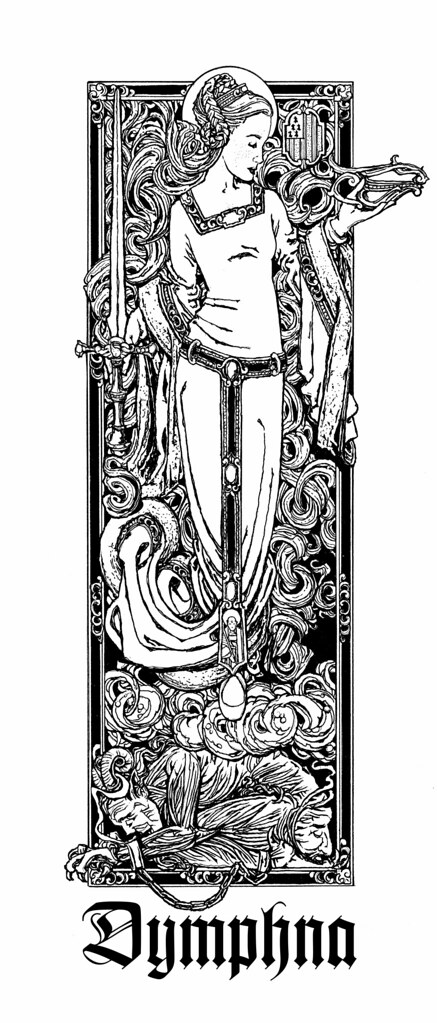
Matthew Alderman. S. Dymphna of Gheel. Private Collection, Minnesota. January 2010.
From the Catholic Encyclopedia:
There are at Gheel fragments of two simple ancient sarcophagi in which tradition says the bodies of Dymphna and [her confessor and fellow martyr] Gerebernus were found. There is also a quadrangular brick, said to have been found in one of the sarcophagi, bearing two lines of letters read as DYMPNA. The discovery of this sarcophagus with the corpse and the brick was perhaps the origin of the veneration. In Christian art St. Dymphna is depicted with a sword in her hand and a fettered devil at her feet. Her feast is celebrated 15 May, under which date she is also found in the Roman martyrology.(More).
From time immemorial, the saint was invoked as patroness against insanity. The Bollandists have published numerous accounts of miraculous cures, especially between 1604 and 1668. As a result, there has long been a colony for lunatics at Gheel; even now there are sometimes as many as fifteen hundred whose relatives invoke St. Dymphna for their cure. The insane are treated in a peculiar manner; it is only in the beginning that they are placed in an institution for observation; later they are given shelter in the homes of the inhabitants, take part in their agricultural labours, and are treated very kindly. They are watched without being conscious of it. The treatment produces good results. The old church of St. Dymphna in Gheel was destroyed by fire in 1489. The new church was consecrated in 1532 and is still standing. Every year on the feast of the saint and on the Tuesday after Pentecost numerous pilgrims visit her shrine. In Gheel there is also a fraternity under her name.
Thursday, March 18
Bishop Baraga Miracle!

Wednesday, March 17
Christmas Day Snowball Fight at Clear Creek

The Benedictines out in Oklahoma at Clear Creek are known for their austerity. However, like all good monastics, they know how and when to cut loose, as these photos posted on their website show. You can see the foundation of their future Thomas Gordon Smith-designed church in the background.


Tuesday, March 16
Also, What of Baritsu?
That being said, if anyone has photographic evidence of a churchlady tearing a phonebook in half...
Monday, March 15
Caption Contest!

The chapter of canons of the Collegiate Church of the Holy Zebra mark their titular feast-day.*
Thursday, March 11
A Lost Cardinal
On the day of the consistory the Cardinal-designate waits in his apartments, dressed in beautiful robes, usually surrounded by friends, until the papal Master of Ceremonies, formally announces the honor to which he is about to be raised and accompanies him to the Vatican. [...]The majority of the piece seems to spend way too much time censoriously agog at the cardinals' elaborate traditional wardrobe (one wonders how it might compare in comfort and extent to the Rockefellers and Vanderbilts of their day, just as pricey but far more drab), but this reminds us that men who wear red silk are quite capable of being humble.
Cardinal Barnabo, on the other hand, forgot all about the consistory, and, on being searched for, was found hearing confessions while the court awaited him at the Vatican.
Wednesday, March 10
Caption Contest!

Pope Benedict is delighted to discover he is the 1 millionth prelate to visit Gamarelli's.
(Image brazenly stolen from somewhere in the archives of The Crescat.)
Musica Sacra Florida Conference, March 19-20, 2010
The Florida Chapter of the Church Music Association of
America is pleased to announce:
The 2nd Annual Musica Sacra
Florida Gregorian Chant Conference
Sponsored by the Florida Chapter of the
Church Music Association of America in conjunction with the Department of Music, Ave Maria University, Ave Maria, Florida.
Friday & Saturday, March 19-20, 2010
This two-day workshop will present both beginning and advanced musicians with lectures, breakout sessions, and rehearsals that will enrich their knowledge of Gregorian chant and its use in the Roman Catholic liturgy.
Led by a faculty of chant specialists from around the state, attendees will learn more about the history of Gregorian chant and its role in the liturgy as well as experience the chant in the context of both the Divine Office and the Mass. Beginning chanters will be introduced to the basics of notation and rhythm according to the classic Solesmes method. Experienced chanters will learn new repertoire and advance their understanding of rhythmic and interpretive nuance. Resources and practical methods for the cultivation of Gregorian chant in the life of the parish will also be discussed. A special breakout session will be devoted to helping priests and deacons with their liturgical chants.
This workshop is ideal for choir members, parish music directors, music students, teachers, parents, seminarians, deacons, priests, and anyone who is interested in learning about the heritage of sacred music within the Roman Catholic Church.
Registration fees are $40 or $15 for students (with I.D.) and include the price of instructional materials and instruction. Overnight accommodations will be available at AMU’s Xavier Conference Center. Participants can choose among various options for room and board. For prices and options, go to http://www.musicasacra.com/florida
Pre-registration is required. Deadline: Friday, March 5th, 2010 [This deadline has been extended; last-minute registrations will be permitted. Just get moving! --MGA]
To register, visit: http://www.musicasacra.com/florida
Contact Information: Susan Treacy (239) 280-1668 or susan [dot] treacy [at] avemaria.edu
Faculty:
Keynote Speaker: Jeffrey Tucker – Managing Editor, Sacred Music
Mary Jane Ballou – Director of the Schola Cantorae, St Augustine, FL
Jennifer Donelson – Nova Southeastern University, Fort Lauderdale, FL
Timothy McDonnell - Ave Maria University, Ave Maria, FL
Michael O’Connor – Palm Beach Atlantic University, West Palm Beach, FL
Susan Treacy – Ave Maria University, Ave Maria, FL
Jamie Younkin - Florida Institute of Technology, Melbourne, FL
Registration:
Registration fees are $40 and include the price of instructional materials and instruction. Students (with I.D.) are $15. Payment is accepted online or due upon arrival at the conference. Pre-registration is required. Deadline: Friday, March 5th, 2010. [See above. This deadline has been extended; just get moving.] Registration is available at: www.musicasacra.com/florida
Room & Board Options:
Overnight accommodations will be available at AMU’s Xavier Conference Center.
Participants may choose from among the following options for room and board.
Xavier Conference Center — Single occupancy $45
Xavier Conference Center
— Double occupancy ($30 per person) $60
Saturday Breakfast $5
Saturday
Lunch $7
Location:
Ave Maria University, 5050 Ave Maria Boulevard, Ave Maria, FL 34142A campus map can be accessed at: http://www.avemaria.edu/uploads/pagesfiles/352.pdfAll events except the closing Mass are located in the Bob Thomas Student Union, labeled 05 on the campus map.
Hildreth Meiére, Hiding in Plain Sight

One of the great joys of being an enthusiast of recent art history is the rediscovery that is under way of much of the twentieth century's heritage of traditional art and architecture. There are the big, dominating figures such as Comper and Goodhue, who did not so much disappear from memory as drift to the peripheries, and there are the numerous "minor" artists, architects and craftsmen who might not have towered in their day and age, nonetheless produced handsome portfolios of work that are worth revisiting. One of these artists, a muralist and painter, is emerging back into the light in the form of the first major exhibit of her work ever. Her name is Hildreth Meiére, and she is one of those folks who seems to have had the uncanny knack of hiding in plain sight. Her existence was just pointed out to me by Stuart Chessman at the Society of St. Hugh of Cluny; he has a great post on her here. There is a vast website dedicated to her here.
When I say she has been hiding in plain sight, I mean her work is immediately recognizable, though you would have never put a name to it, or assumed it all flowed from the same genius, yet when you finally realize it, you wonder how you could have never wondered, who came up with it? New York is just about encrusted with her work--the big metal tondi on the side of Radio City Music Hall, the altarpiece in Fordham's university church, the mosaics in St. Bart's narthex and the Torah ark in the synagogue across the street from the Central Park Zoo, even the front of the altar in the Lady Chapel at St. Patrick's Cathedral where, during my Manhattan days, I frequently attended a "young adult" mass featuring, as a pleasant surprise, good hymns, Gregorian chant and polyphony. Her funeral was at St. Vincent Ferrer, a twenty-minute walk from my old apartment, and possibly the most perfect church in North America. She did the mosaics at another Goodhue favorite of mine, the Nebraska state capitol. She is even, to my astonishment, responsible for some of the doll-sized furnishings in the miniature Gothic church interior on display in the basement of the Chicago Art Institute, which I have often admired, though perhaps questioning the historicity of a full-fledged Tridentine tabernacle in a fourteenth-century English Gothic church.
The exhibit sounds quite promising. It is at the Regina A. Quick Center for the Arts at St. Bonaventure University in St. Bonaventure, New York, and is in the midst of a ten month run that began back in September.
Image sources: here, here and here. Originally posted on The New Liturgical Movement Friday March 5, 2010.
Monday, March 8
Unhappy Hipsters
"He deeply resented her insistence that their wardrobes coordinate."(More here).
"Babe, look! It says here that some people live in trailers, intentionally, without a hint of irony."
"Nutmeg sat stoically atop the cushions. Yet her internal dialogue was a cacophony of discordant thoughts, mostly centered on the absurdity of the double Nelson clocks."
"Unable to complete another painting, he surrendered to the realization that he was truly…madly…deeply in love—with plywood."
While we're on the subject, why not have a look round Bad British Architecture?
Friday, March 5
A New Low in the Field of Hokey Pop Christian Art?

So-bad-it's-hilarious Church Art from The Crescat: "When you only saw one set of footprints in the sand, that's when I let the bear eat you." (More.)
Hmm, actually that sounds kind of Donatist. Also, I'm amazed to have discovered a painting that makes Thomas Kinkaid look like Rembrandt by comparison.
Personally, there's potential: but only if Our Lord was riding on the bear and they were both in full armor. (Thus Colbert: "And, ladies and gentlemen, the number one threat to America... BEARS!"). Or maybe it should just be St. Corbinian.

Monophysite Cracker Would Make a Great Name for a Band*
By the way, why do marketing people assume that something flavored bright orange (the color, not the fruit) tastes like cheddar? As to the Christological analogy, I assume it has something to do with Artotyrite Montanism, whose reverence for cheese is only slightly surpassed by some of my fellow denizens of the Dairy State. Not that I am complaining. Now if you just got the Manichaeans in here with their melons, you could get an entire appetizer table.
*Actually, probably the cracker in question is more precisely speaking, Eutychian, though that is a subset of the Monophysite heresy. I'm thinking fig newtons are Nestorian, though, as it is a thing inside of another thing...or maybe that's more Monothelite....
Thursday, March 4
It's Ten O'Clock: Do You Know Where Your Brown-Throated Three-Fingered Sloth Is?
I mean, parents? Sure, both kids and dogs poop indiscriminately all over the place, start out on all fours, and talk like Scooby Doo for a while, but eventually kids get better, or at the very least, more interesting, and in theory can take care of you in your old age. (Let's see a miniature schnauzer do that.) On the other hand, if you dress them in funny sweaters, small children are more likely to bite back, which only serves you right for trying.
(Which reminds me: the fifth greatest thing about Wisconsin is nobody dresses their pets in allegedly amusing sweaters. Midwestern dogs are very clearly outdoor creatures.)
2. On a related note: I'm willing to tolerate that an indulgent owner might want to feed Fluffy or Mr. Pittypoo or whatever you wish to call your cat, various flavors of luxury cat-food; animals do have tastebuds and seem to be very good at enjoying themselves (I will not make the worthwhile if somewhat irrational point that there are probably North Korean children who don't eat nearly as good as many American cats, as there is probably a logical fallacy somewhere in there), but one wonders why anyone in their right mind would buy a cat food designed to look like party mix. Cats don't know what party mix is. Heck, I'm not sure the concept of party actually means anything to them: considering 99% of their life is party time by human standards, it would be difficult to conceive of anything else but parties.
Perhaps a better alternative is the tree sloth. Vaguely anthropomorphic and cute in a weird, gangly way, this somnolent, shambling animal spends most of its day asleep**, is known to native tribes of its home range by names derived from various forms of the words, "sleep," "eat," and "dirty," and will give pet parents a taste of the joys of raising teenagers.
*And one of them is named Franz-Josef, and it's hard not to like that.
**Actually, a recent study says sloths only sleep 10 hours a day in the wild. That being said, I am not coming up with a new name for the sin.
"In this bucket," said Stephen, walking into the cabin, "in this small half-bucket, now, I have the population of Dublin, London and Paris combined: these animalculae - what is the matter with the sloth?" It was curled on Jack's knee, breathing heavily: its bowl and Jack's glass stood empty on the table. Stephen picked it up, peered into its affable, bleary face, shook it, and hung it upon its rope. It seized hold with one fore and one hind foot, letting the others dangle limp, and went to sleep. Stephen looked sharply round, saw the decanter, smelt the sloth, and cried, "Jack, you have debauched my sloth."
--Patrick O'Brian, H.M.S. Surprise
***
The sloth, in Brazil, is often called bicho-preguiça, or "lazy animal." The word bicho is also Spanish as well as Portuguese, one of those oddly all-purpose bits of vocabulary one finds in other languages that, while I usually associate it (perhaps wrongly) with bugs and creepy-crawlies, is flexible to apply to animals as large as buffalo. Careful, though--I was rather surprised to discover it has a different slang meaning in Puerto Rico, which, this being a (somewhat dysfunctional) family website, I have no desire to reveal here.
Also, the correct answer to the title question is: where he always is, hanging from the slowly-rotating ceiling fan.
Wednesday, March 3
Toledo Cathedral (No, the Other One)
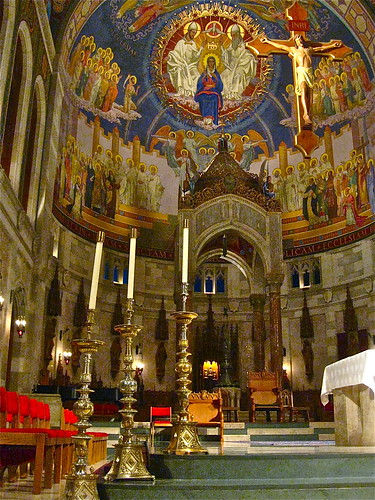
(NB: Someone seems to inexplicably placed the font where the high altar used to be, but, of course, this was not the original layout.)
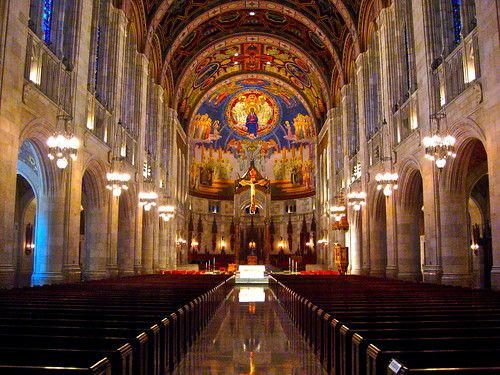
And here is an exterior, from flickr.com user erozier2:

What is particularly fascinating is the image above was created by running an ordinary photo through a computer program to reduce the distorting perspectival effects of shooting from the ground up. More on this technique can be seen here, in an item written by the photographer himself.
Monday, March 1
Epistle Organ (1736), Mexico City Cathedral










![[SMMMHDH]](http://www.mgilleland.com/music/smmmhdh.png)