Tuesday, August 31

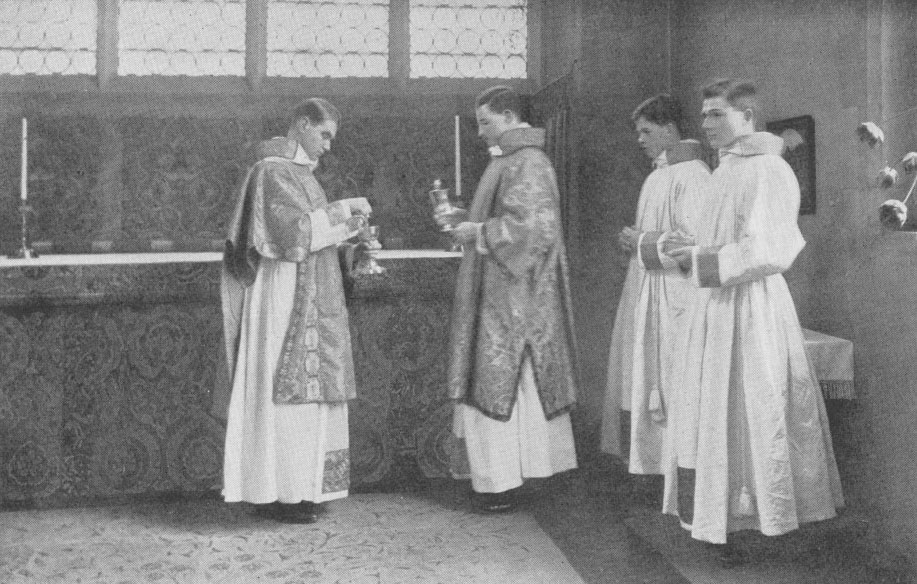
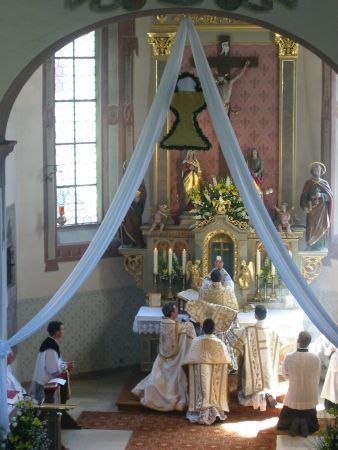
That's an image of eighth-century iconoclasts hard at work with a pot of whitewash. We'd've called them "liturgical design consultants" today. For more on the subject, see this intriguing article on everybody's favorite (?) "church renovator," good old "Dynamiter Dick" Richard Vosko, who, if you look him up in the thesarus, is the antonym of Duncan Stroik. Turns out Dick's not even a real architect!
Monday, August 30

The Ordo Karolingianus, Part III
This part takes us from the beginning of the Liturgy of the Eucharist to the singing of the Sanctus. There is probably very little here likely to cause controversy to a person familiar with the 1962 Missal. The only significant additions have been the slight re-structuring of the Offertory prayers (such as the Suscipe, Sancte Pater) to be said aloud in the manner of the present Offertory (i.e., Blessed are You, Lord, God of all Creation, which are okay, but seem a little 'constructed' in their character). My omission of the Benedictus at the very end of the post is deliberate--you'll see what I have planned for it in Part IV. My name for the Secret, the 'Prayer of Separation,' comes from the theory that the term 'Secret' is a misreading of the name of a prayer said when the offerings were separated, since the faithful often brought great messes of very unhygenic offerings in addition to the unconsecrated Species. Since the Secret seems to have been spoken aloud originally, the name seems something of a misnomer, though it has a certain poetry to it that "Prayer over the Gifts" lacks. Perhaps "The Oblation"? Someone with good taste and imagination should come up with something, or maybe it's better to stick with the old name, even if it is somewhat odd: oddness is not always a bad thing.
I imagine that most of these portions of the mass, even the Secret and the various prayers of Oblation, could be chanted: I seem to recall reading the entire rite now has notation attached to it. Perhaps the 'more moderate voice' I have suggested for the parts formerly silent could be represented modally somehow.
P. (or deacon) Awake, brethren, and look with reverence to the East, whence shall come the glory of the Lord.
P. Let us pray.
THE LITURGY OF THE EUCHARIST
Here, as is set forth according to the customaries of the local church, shall be found the Offertory procession, as appointed on feast days and solemnities. The antiphon appointed for the day or the mass might be sung here as the priest silently recites the Suscipe, Sancte Pater or, if not sung, then it should be recited aloud by the priest: an appropriate hymn or anthem may be substituted. If no hymn is sung, then the priest shall say the Offertory prayers aloud upon returning to the altar. The priest shall come to the entrance of the sanctuary and receive the oblation from the faithful there.
Then shall the priest return to the altar and say silently or aloud, but in a somewhat moderate voice, holding the paten aloft:
Suscipe, Sante Pater
P. Accept, O Holy Father, Almighty and eternal God, this spotless host, which I, Thy unworthy servant, offer to Thee, my living and true God, to atone for my numberless sins, trespasses and faults: on behalf of all here present and likewise for all faithful Christians whether living and dead, that it may profit both us and them as a means of salvation unto life everlasting.
R. Amen.
At the southern horn of the altar, he should then mingle the water and the wine in the chalice, saying silently all the while:
P. O God, + who in creating man did exalt his nature most wondrously, and still more wondrously did reestablish it anew, the mystery of the mingling of this water and wine, grant that we may come to share in His Divinity, who has humbled himself to share in our humanity.
Then, raising his voice again, shall the priest say these words and lift the chalice:
P. We offer unto Thee, O Lord, the chalice of salvation, humbly begging of Thy mercy that it may ascend before Thy divine Majesty, with a sweet fragrance, for our salvation and for that of the whole world.
R. Amen.
[Then, should it be used, incense shall be set using these silent prayers:
P. Through the intercession of blessed Michael the Archangel, standing at the right hand of the altar of incense, and of all His elect may the Lord vouchsafe to bless + this incense and to receive it in the odor of sweetness. Through Christ Our Lord. Amen.
If an acolyte should incense the people, the following prayer is omitted.
P. (incensing the cross) May this incense blessed by Thee, arise before Thee, O Lord, and may Thy mercy come down upon us. (And the altar) Let my prayer, O Lord, come like incense before Thee; the lifting up of my hands, like the evening sacrifice. (And the people, or when handing the thurible back) May the Lord enkindle in us the fire of His love and the flame of everlasting love.]
Then shall the priest wash his hands at the south horn of the altar, saying silently:
P. I wash my hands in innocence, and I go around Thy altar, O Lord, giving voice to my thanks, and recounting all Thy wondrous deeds. O Lord, I love the house in which Thou dost dwell, the tenting place of Thy glory.
Then shall he stand in the midst of the altar, facing it and praying aloud, but still moderately, with upraised hands:
Suscipe, Sancte Trinitas
P. Accept, most Holy Trinity, this offering which we are making to You in remembrance of the Passion, Resurrection, and Ascension of Jesus Christ, Our Lord; and in honor of blessed Mary ever Virgin, blessed John the Baptist, the holy apostles Peter and Paul, and of N., (that is: the name of the Saints whose relics are in the Altar, the saint of the day, or the patron of the church or diocese) and of all the Saints; that it may add to their honor and aid our salvation; and may they deign to intercede in heaven for us who honor their memory here on earth. In a spirit of humility and with a contrite heart, may we be accepted by Thee, O Lord, and may our sacrifice so be offered in Your sight this day as to please Thee, O Lord God. Come, O Sanctifier, Almighty and Eternal God, and bless + this sacrifice prepared for the glory of Thy holy Name.
Then shall he turn to face the people, and say these words:
P. Pray, brethren, that my Sacrifice and yours may be acceptable to God the Father Almighty.
R. May the Lord receive this Sacrifice at thy hands for the praise and glory of His Name: for our good, and the good of all His holy Church.
The Prayer of Separation (Secreta)
The appointed secret is here said aloud, in a normal voice, by the priest, concluding forever and ever, to which the people shall say Amen. Then shall the priest say these words to the people, turning to face them with upraised hands:
P. The Lord be with you.
S. And with Thy spirit.
P. Lift up your hearts.
S. We have lifted them up to the Lord.
P. Let us give thanks to the Lord our God.
S. It is right and just.
THE PREFACE
Here shall the priest say the appointed preface, ending …with the archangels, cherubim, and seraphs, ceaselessly singing with one voice:
THE SANCTUS
And all shall be up standing, and shall sing:
Holy, Holy, Holy,
Lord God Sabaoth:
Heaven and earth are filled with Thy glory.
Hosanna in the highest.
Processions at Mass
One of the most significant impressions my first Tridentine Low Mass had on me was the economy of ceremonial in the old rite. There was a strong and undilated dignity about the way the priest seldom strayed from the altar, moving only side-to-side with a peculiar and dignified shuffle from Epistle to Gospel corner. The tabernacle was right there in front of him, God literally in your face, and so there was little need for the repeated slouching crossings of the sanctuary or knots of Eucharistic ministers so common today. With the Mass cards, he had everything at his fingertips, and there was none of the frantic page-flipping, botched memorizations or book-juggling so common in parochial celebrations of the current Rite.
There's really no reason that the ornate simplicity of the priest's gestures and posture can't imbue celebrations of the current rite and serve, perhaps, as an inspiration for a future revision of ceremonial. It weds various ceremonial gestures quite fixedly to certain parts of the mass, giving a sense of permanence unlike today where there are, for no good reason and quite in contravention of the rubrics, ten different ways of making the long-standardized orans gesture. Indeed, the more I think about it, the more the old rite, properly done, seems to be a practical benchmark for the noble simplicity which is called for by the current documents.
The Low Mass, of course, is not the perfect, or normative, mass: that honor goes to the Solemn mass in all its forms, both pre- and post-Conciliar, and even the present rubrics (such as those given in the present Caeremoniale Episcoporum) recognize the importance of pulling out all the stops for a Solemn Pontifical Mass. While, sadly, such venerable and harmlessly beautiful customs as the bishop's private candle-bearer, the pontifical gloves, and the bishop vesting at the altar, seem to be absent, there are nonetheless glorious rubrics calling for as many as seven candle-bearers (!), the wearing of an episcopal dalmatic beneath the bishop's chausible, and as many as four deacons, two to assist the bishop and two to assist at mass. I've never seen a mass done that way, but there's nothing legal stopping it from happening in every cathedral in every diocese in the United States. This 'noble simplicity' is a world away from the fantasies of Dick Vosko and Edvard Sorvik, and seems to tremble excitedly on the verge of spilling into full-blown clerical baroque with the addition of just a few more sentences here and there.
What distinguishes the Low Mass from the current parish mass is it knows, rubrically, how much it can handle: it does what it does well. It is a model for the sort of liturgy perfect for a contemplative weekday, and its sense of gravity is perfect for Sunday as well. It is, however, without some celebratory additions, not suitable for any given Sunday: though the full-blown Solemn High of the Old Rite is also beyond the needs of many small parishes. The present rubrics allow, quite brilliantly I think, the introduction of 'high mass' customs into what might have been a silent Sunday Low Mass, such as incense, a processional, hymns and the sung ordinary of the mass.
However, few have seen the genius of this idea and instead we have, in many cases, a Sunday Mass with the same lack of liturgical splendor of a Tridentine Sunday Low Mass, but without its rubrical economy: while there was a quiet grandeur to the solitary priest with the server, it seems gone today when servers wander all over the sanctuary in elaborate and redundandly aimless loops. There's no reason this has to be, even if the current rubrics remain unchanged.
First, sanctuaries should be designed to be more compact, unless, of course, the priest is willing to use a large and spacious sanctuary to his advantage. At the Indult parish I attended in Rome, I was actually much closer to the priest and altar than I would have been in my home parish, with its versus populam altar. Compactness allows the undignified spectacle of large and aimless and unceremonialized processions to the tabernacle and the ambo. Admitted, the current rubrics require some walking, such as at the Gospel and the readings, which is a dignified aspect of the current rite, or with the collect read from the priest's sedilia, which I think probably could be restored to its former position at the old Epistle corner of the altar. However, a small church where grand ritual will be rare should attempt to minimize those long and empty distances.
That being said, a grand church by nature will have a vast sanctuary: and it should learn to use it to its advantage. Processions are certainly in keeping with the new rite, and, gilded over with the pomp of the old, they could be magnificent. At present, St. Peter's retains the custom (seen often in medieval liturgies) of stational processions around the church, prayers at side-altars, and incensations, proceeding some solemn vesperal services.
This, in microcosmic form, is a model to the medium-sized or large parish or Cathedral where solemnity should be more pronounced. The Gospel procession, which is solemnly ceremonialized with much dignity here at my home parish of Notre Dame, is an eminent example of such a practice. Lights, incense, even banners, would be fitting for such a procession: and as a procession, it really ought to go somewhere more than just the shortest distance between two points. Perhaps one could circle the altar, or run round the rim of the sanctuary. It's more a matter of aesthetics and good taste than simple rubrics.
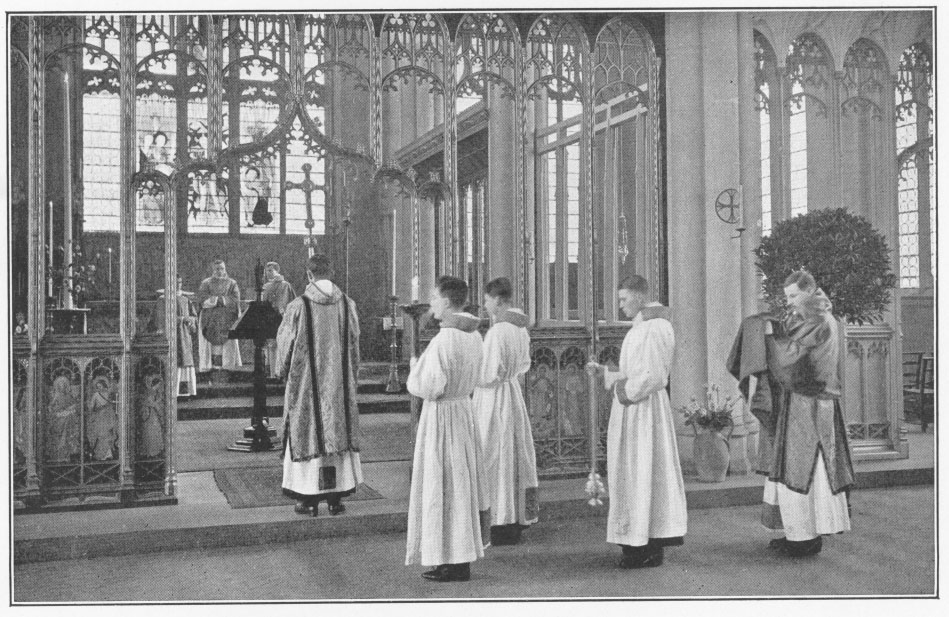
The same should go for the Offertory Procession. More often than not, this is a rather undignified knot of underdressed laymen and women who wander up the main aisle, a world away from the medieval precedent cited to revive this fitting custom. The custom of some high-church Anglicans--who often cite the procession-loving Sarum rite for the source of their revived practices--might be worth considering at this point. In some cathedral churches, several servers retire to a side-chapel and bring up the unconsecrated species in a veiled chalice accompanied by lights, a crucifer and an incense-bearer. Should laymen wish to accompany this procession, they could easily carry up the basket of alms often included in many present-day offertories. But no tank tops, shorts, or flip flops.
Should the priest be required to return to the tabernacle (say, at an altar of reservation in the apse) from the altar of sacrifice, it should be given some measure of dignity. At Notre Dame, when the unused Hosts are taken up from the Communion ministers, they are returned to the tabernacle accompanied by two taperers, a laudable custom indeed.
Another point, I think, worth mentioning, is the current state of the entrance procession. This has often necessitated the awkward placement of the sacristy either in the west end of the Church or the addition of a duplicate and wholly unnecessary vestry, often in a disused side-chapel. This is wholly uneccessary. It would be far simpler to process in from the sacristy behind the sanctuary--which is often provided with a door into a side transept for easy access--then loop around a side-aisle to the back and turn to the front.
This once again revives the ethos of the medieval procession in a simple and dignified manner, allows all those hymn verses to be sung without the priest standing around doing nothing at the sedilia, and I have seen it done to great ritual advantage both in Rome, at the church of Santa Maria Sopra Minerva, and also at my home at Notre Dame on Sundays when it is too cold to sneak outside the church and pop into the narthex. It prevents an undignified traipse to the back from an east-side sanctuary, and also frees the parish from having to add yet another room to a parish already crowded with cry-rooms, reconciliation chambers, and Eucharistic broom-cupboards.
Small churches may not be able to fully approximate this ideal. In some cases, it might seem rather contrived, as in miniscule daily-mass chapels which is why I suggest these only for high feast days in medium-sized or large churches. Certainly, at simple masses, servers should be trained to take the shortest path between two points, and effort should be undertaken to determine the best way of doing it, as well as teaching them some measure of dignified bearing. And while vast processions--or even simple ones--might be beyond the abilities of some parishes on Sundays, they should remain an ideal, and the movement of the priest and his assistants around the sanctuary should be treated as ritual rather than mere pragmatism. Noble simplicity does not mean sloppiness, and it also means, if you can't pull off something grand, try to do something small in the best way you can do it.
Serious Disputed Questions
Don't ask me how I found this, or even why I was looking for it, but it's the funniest thing I've read in a long time. If you don't recognize the reference, it's from Lewis Carroll's poem Jabberwocky.
Don't ask me how I found this, or even why I was looking for it, but it's the funniest thing I've read in a long time. If you don't recognize the reference, it's from Lewis Carroll's poem Jabberwocky.
Sunday, August 29

The Ordo Karolingianus, Part II
Here, we come to one of the more controversial parts of my revision. The Karolingian Mass, while an attempt to come up with a noble and dignified rite, is also governed by some pastoral practicalities. In order to disseminate the beauties of Trent on a wider scale, I have conformed some portions of it to the framework of the Missa Normativa (such as a spoken canon) to prevent, should such a mass be widely implemented, excessive shock to those faithful who are unfamiliar with it. This is perhaps somewhat controversial, but I see it as a tradeoff which allows the faithful to slowly grasp the verbal and ritual beauties of the older rite while keeping some of the more familiar aspects of the new.
In that spirit, I have included some fixed form of the Prayers of the Faithful, as the Council suggested, borrowing heavily on the Deprecatio of the early Gelasian Sacramentary, a litany similar to the long prayers at the beginning of the Eastern Rite, which I have also considered. The language of these Gelasian prayers is somewhat more florid and eastern, and perhaps somewhat foreign to the more terse style of the old Roman rite, but this departure from simplicity is important in order to prevent much of the monotony and lack of poetry which is evident in many home-brewed Prayers of the Faithful. It is probably best they are restricted to Sundays.
In general, though, I have avoided as much eastern borrowing as possible; while many quite lovely eastern formularies were incorporated into the Missal of Paul VI, this practice seems historically unknown in the generic Roman rite, though, in its defense, the rites of Lyons and Sarum owe much to the east. (In the unlikely event that communion is established with some of the Western-Rite Orthodox who use modernized forms of these rites, their liturgical practices might be revived, but at present, that would seem a needless archaeologism.) At the risk of seeming repetitious, however, I have retained the Eastern custom of responding Lord, have mercy to the Intercessions, remembering their original place in the Kyrie at the beginning of the mass. However, tampering with the opening Kyrie would have been utterly disastrous and unecessarily antiquarian, so their current position remains unchanged.
Given also that, should this mass be implemented on a wide scale, it would probably be impossible to get rid of the noisier aspects of the Pax without a great deal of protest from the pews. In the hopes that the more solemn elements of this Mass may eventually temper the decorum of the faithful, I have kept it, moving it, however, to before the Offertory. This is, to some degree, a historical revision, as one of the two original Pax rites was there, as it still is in the Hispano-Mozarabic rite, but also for pastoral reasons to avoid confusion and unseemly noise before the Sacrament. Parishes may omit it, or perhaps restrict it to the clergy if they wish: a revival of the still-valid Roman form of the ritual might be particularly beautiful.
Needless to say, the rubrics for this Mass presuppose the faithful observance of the present GIRM which requires both genuflecting whenever passing the tabernacle and the bowing of the head to the names of the Trinity, Jesus, Mary, the saint of the day, or the Pope. This should do much to restore the ritual flow of the prayers, breaking them up and making them seem less monologuic and monolithic.
I have elected to remain silent on the nature of the Responsory Psalm or Gradual (as well as the Aleluia or Tract), though I hope it will combine aspects of both the new and the old rites. I think also the addition of several sequences to the feasts of the year--not many, but some--would be suitable, but this is principally my fondness for prolix Medieval liturgy talking.
Part III, tomorrow, will cover the Liturgy of the Eucharist, from the Offertory to the Prayer over the Gifts or Secreta.
THE KYRIE
Standing at the middle of the altar, facing it, the priest shall say aloud, in either six-fold or nine-fold form:
P. Lord, have mercy. (or, Kyrie eleyson)
R. Lord, have mercy.
P. Lord, have mercy.
R. Christ, have mercy. (or, Christe eleyson)
P. Christ, have mercy
R. Christ, have mercy.
P. Lord, have mercy.
R. Lord, have mercy.
P. Lord, have mercy.
THE GLORIA
P. Glory to God in the highest:
R. And on earth peace to men of good will. We praise Thee, we bless Thee, we adore Thee, we glorify Thee, we give Thee thanks for Thy great glory.
O Lord God, heavenly King, God the Father almighty. O Lord Jesus Christ, the Only-begotten Son, Lord God, Lamb of God, Son of the Father. Thou Who takest away the sins of the world, have mercy on us. Thou Who takest away the sins of the world, receive our prayer. Thou Who sittest at the right hand of the Father, have mercy on us. For Thou alone art holy: Thou alone art the Lord: Thou alone art the Most High, Jesus Christ: with the Holy Spirit, in the + Glory of God the Father. Amen.
THE COLLECT
The priest, still standing before the altar, but at the southern horn, shall read the collect from the Missal, his arms raised.
P. Let us pray. (Then shall he pray the Collect.) World without end.
R. Amen.
THE LITURGY OF THE WORD
Then shall the priest, an acolyte or a lector, properly vested and appointed to the purpose, read or sing the Lesson for the day from the ambo on the north side of the sanctuary, which he shall conclude by saying The Word of the Lord to which all shall respond Thanks be to God. The priest, if he does not sing the Lesson, shall retire to the sedilia on the south side of the chancel. Then the priest, or the lector, or some other minister, decorously vested, set aside for the purpose should sing the Graduale or Responsory from the ambo, to which the people shall make the prescribed responses as given in the Proper of the Day. Then shall be read the Epistle in the same manner as the first Lesson. The Alleluia or Tract is to follow, which shall announce the Gospel procession to the ambo, which, on festal days, should be accompanied by lights, the setting of incense, and other fitting ceremonial. All shall stand. Then shall the priest shall pray silently this preparation before the Gospel:
Munda cor meum
Cleanse my heart and my lips, O Almighty God, Who did cleanse with a burning coal the lips of the Prophet Isaiah. In Thy gracious mercy vouchsafe so to purify me that I may worthily proclaim Thy holy Gospel.
If a deacon is present, he shall proclaim the Gospel, first taking care to say the silent preparation himself. Afterwards, he shall say to the priest, Grant, O Father, thy blessing, and the priest shall say unto him, + The Lord be in thy mind, and in thy heart and upon thy lips, that though may worthily proclaim His Gospel.
The Gospel
P. The Lord be with thee.
R. And with thy spirit.
P. + (on the Evangelistarium) The continuation (or beginning) of the holy Gospel according to St. N.
R. + (on forehead, lips and breast) Glory to Thee, O Lord.
Then shall the priest read the gospel, and the people respond: Praise to Thee, O Christ. Then the priest shall say silently, kissing the Gospel, Through the words of the Gospel, may our sins be blotted out.
THE HOMILY
The homily, as appointed by the Sacred Council, shall follow here on all Sundays and solemnities, and following it on those days, the Creed shall be said, all standing, the priest facing the people:
THE NICENE CREED
I believe in one God, the Father Almighty, Maker of heaven and earth, and of all things visible and invisible. And in one Lord, Jesus Christ, the Only-begotten Son of God, born of the Father before all ages: God of God, Light of Light, true God of true God. Begotten, not made, consubstantial with the Father, through Whom all things were made. Who for us men and for our salvation came down from heaven. (Here all shall kneel.) And became incarnate of the Holy Ghost from the Virgin Mary: AND WAS MADE MAN. (Here all arise.) And also was also crucified for us under Pontius Pilate, he suffered and was sepulchred: and on the third day He rose again, in accordance with the Scriptures. And ascended into heaven and sitteth at the right hand of the Father. And the same will come again in glory to judge the living and the dead: His kingdom will have no end. And in the Holy Ghost, the Lord and Giver of life, Who proceedeth from the Father and the Son: Who together with the Father and the Son is adored and glorified: Who has spoken through the prophets. And one holy, Catholic and Apostolic Church.
I confess one baptism for the remission of sins and I look for the resurrection of the dead and the life + of the world to come. Amen.
THE LITANY OF INTERCESSION
[If a deacon be present among the sacred ministers, he, rather than the priest, should sing or say the portions of the Litany that follow here from the petition O Almighty and ever-living God to We entreat, with his hands folded before his breast. This prayer may be omitted on weekdays that are not solemnities; and while these petitions shall be used, some may be omitted as is considered decorous by the local priest, ordinary or other superior.
P. (turning to the people, arms upraised) The Lord be with thee.
R. And with thy spirit.
P. Let us pray. (He returns to face the altar, arms still upraised.) O Almighty and ever-living God, hear us and have mercy upon us as we call upon Thee, the Father of the Only-Begotten, and upon the Son of God Who is the Creator from all eternity, and upon God the Holy Ghost.
R. Lord, have mercy.
P. (or deacon) We beseech Thee, O Lord and God, deign to give the holy Church of God set up throughout the whole terrestrial globe, peace, keep Her in unity, and guard Her throughout the world from all principalities and powers: and may Thou grant unto us that,leading a peaceful and quiet life, we may glorify God, the Father almighty in Heaven.
R. Lord, have mercy.
P. We entreat Thee, Christ our Lord, for the rulers of Thy Church: for our most holy Father, Pope N., for our bishop N., and for all the venerable priesthood and diaconate, and all ministers of the sacred altar, all Virgins and widows, and for all the faithful who worship before God: for this holy house of God and all who enter it with faith, reverence and the fear of the Lord.
R. Lord, have mercy.
P. We beseech the might of the Lord to strengthen all civil authorities who hold in high esteem justice and right judgment, and also upon all the armies in their service.
R. Lord, have mercy.
P. We pray to the Lord our Ruler for this city, for all cities, countries and nations and all those living therein in the faith of God.
R. Lord, have mercy.
P. We entreat the Lord and Governor of the world for the comfort of good weather and rains, for the careful tending of the winds, and for the favorable course of the seasons.
R. Lord, have mercy.
P. We beg the mercy of almighty God for our Catechumens: that our Lord and God would open the ears of their hearts, and the gate of mercy; that, having received by the font of regeneration the remission of all their sins, they also may be found in Christ Jesus our Lord.
R. Lord, have mercy.
P. We invoke the Lord, the Giver of Life, for all those who have come in unto the Christian faith and are now numbered among us: and in whose hearts hath been enkindled the burning desire for heavenly grace.
R. Lord, have mercy.
P. We entreat the Lord of mercies for the doers of good works, who, out of fraternal charity care for the needs of the sick, the homeless, and the destitute and beg for the safety also of those undertaking long journeys by sea, by land or by the air, or the captive whom wicked powers have oppressed or the hardships of hostility afflicted.
R. Lord, have mercy.
P. We implore the mercy of our Redeemer for those caught up in the weakness of human infirmity, who rejoiceth in all worldly errors.
R. Lord, have mercy.
P. We beg the most merciful Lord for the strength of our souls and bodies, and the forgiveness of all our sins.
R. Lord, have mercy.
P. We entreat the Lord of glory and the Judge of all flesh for the repose of the faithful departed, and especially for all those holy priests of God of this church.
R. Lord, have mercy.
P. We humly ask the Lord, who formed us in His own image and knowest all things, to look in on our hearts and behold the prayers we keep in silence therein.
R. Lord have mercy.
Silence may be kept. Then shall the priest say this collect:
P. Let us pray. Grant us, O Lord, the Angel of peace and the solace of the saints, that our flesh might be free of blemish and our souls living in faith: hear us, O Lord, hear us as we commend to the judgment of providence both ourselves and all that we have, which we have received from the Lord Who is their author. We ask this through our Lord Jesus Christ, Who liveth and reigneth with Thee and the Holy Spirit: one God, forever and ever.
R. Amen
P. Remembering the great Mother of God, Mary most Holy, with all the saints, let us commend ourselves and one another, and our whole life, to Christ, our God.
R. Amen.]
THE PEACE
Then the priest shall turn to the altar and say this collect:
P. Let us pray. Grant us, O Lover of humanity, whose Son Jesus Christ said to His Apostles: Peace I leave with thee, my peace I give you, in this service here, Thou would free us from every sorrow and deign to grant us Thy holy kiss, that we might live in charity and peace.
R. Amen.
[P. (or deacon, turning to the people) Brethren, greet each other with the kiss of peace and love, that thou might be fit for this holy altar: and to partake of the body and blood of our Lord Jesus Christ.]
[Then shall the ministers and the faithful give each other the peace, if this ceremony be observed according to local practice.]
The priest shall conclude thus:
P. The peace + of the Lord be with thee always.
R. And with thy spirit.
P. Let us pray.
Then shall the Liturgy of the Eucharist begin.
Saturday, August 28

The truly Sublime and the truly ridiculous in one convenient picture.

More Thoughts on that Slippery Term "Noble Simplicity"
"In celebrating the Holy Mysteries, we should fear neither an appropriate 'otherworldiness' nor the incarnational use of signs, movement, color, sound and the bodily senses...We should make noble simplicity a guiding ideal in all the ceremonies of parish or cathedral. But the words 'noble' and 'simple' are meant to be kept together so that they propose one ideal.
"That ceremonial should be 'noble' excludes both a casual and careless style and a pretentious and self-consious ritualism. Nobility speaks to us of a sense of graciousness and splendor, which may be equally evident at a solemn mass or at the simplest celebration. Nobility means offering the best for God: noble actions, gestures, and also noble altars, vessels, vestments, etc. In this nobility we recognize that God is beautiful, that He should be adored with beauty...
"A fear of nobility in worship finds no place in the rich Christian culture which is embodied in the directives of the Church... The pragmatic approach to noble simplicity in ceremonial is achieved through attention to fine detail: how one genuflects, how people move in harmony, knowing what object is required at this particular moment of worship, what to prepare in the sacristy, etc... A casual regard for detail produces liturgy that is uncertain and clumsy, hence neither noble nor simple.
"...Better 'ritual' should lead away from a verbal, or verbose, style of worship, to more prayerful and reflective celebrations. An emphasis on the 'sacred action' frees the liturgy from didacticism, from adding little homilies, explanations and directions. The celebrant who understands action, gesture and word, as an integrated whole, allows the liturgy to speak for itself. He does not regard the liturgy as primarily talking to people.
"...The lover wills the best for the beloved...one strives to give the faithful the finest forms of worship which raise them to participate with joy in the foretaste of heaven and pledge of eternal life."
--Msgr. Peter J. Elliott, Ceremonies of the Modern Roman Rite, 1994.

Noble Simplicity Reconsidered
Noble simplicity: these all-too-well-known words are often bandied about liberally by the church restorers, self-appointed liturgists and other hangers-on of the present era of the Church. They're used to justify felt banners, tree branches, and those hideously ubiquitous dead plants that show up during Lent. It's interesting, though, that their first use in ecclesial parlance is a very brief, almost passing, reference in Sacrosanctum Concilium (no. 34), which was considered fully implemented in a Congregation for Divine Worship document some years later through some almost infintesimal changes in pontifical ceremonial. That's it!
No liturgical hijinks, clown masses, sanctuaries covered in beeswax, or otherwise. There's no mention of abolishing incense or such fantastic and wonderful additions such as assisting priests in copes, subdeacons with humerals or cloth-of-gold vestments. It doesn't even really become connected with church design until a later edition of the IGRM, and Sacrosanctum Concilium, for that matter, suggests, not "noble simplicity," but "noble beauty" for church design.
The phrase is, admittedly, a problematical one by its vagueness. However, if one traces it back to its historical origins, one finds some very surprising, and perhaps wonderful things, as architect Duncan Stroik writes: "The art historian, Winckelmann used 'noble simplicity' as early as 1755 to describe the genuine work of art that combined sensual and spiritual elements as well as beauty and moral ideas into one sublime form." In Winckelmann's case, this was found in Greek sculpture, not OCP liturgical clip art gnomes.
The accent seems to be on 'noble' rather than 'simplicity,' and the coordination and combination of many themes into one great whole: much like the polyphony which Sacrosanctum Concilium urges to be preserved. Or the way an ideal mass brings forth all the senses: tasting the Host, smelling the incense, seeing the glitter and gleam of the church, hearing the glorious Gregorian chant. That is the sort of noble simplicity which has always historically characterized the Roman rite, especially in its Tridentine incarnation, and in the (very rare) proper celebration of the Missa Normativa: minute complexity coordinated and knit into one overarching and comprehensible whole. This is the noble simplicity I want.

The Ordo Karolingianus: Part I
A prelimiary draft for a reform of the reform of the Mass of the Roman Rite based on the best authorities of the pre- and post-Conciliar period and of the present day, intended in order to stimulate discussion and foster interest in a definitive form of the Mass drawing on both the new and old rites, and many venerable customs of all eras of the Church's history.
This form of the Holy Mass may be offered fully in Latin or English, or some combination thereof, provided that the admixture of languages is laudable and not capricious in nature. It is particularly laudable that the Ordinary be sung in Latin: however, given the current drought of interest in this venerable tongue, it is fitting and proper to offer much of the beauty of the ancient Mass in a suitable translation into the vernacular. Some deliberate archaicism has been attempted to express the distance which exists between the vernacular liturgical tongues the Church has used for ages, such as Church Slavonic or Greek, and the vernacular of the street, while also serving to underly many of the otherwise untranslatable expressions of courtesy, such as quaesimus, supplices, etc., as well as the familiar (and not at all formal) Tui used in the Latin to address God, closer to the Italian Tu and the obsolete Thou than the more formal You of many translations. Where You is used here, it is taken to mean a plural. The translations are largely derived from an English translation of the 1962 Missal given in Kocik's The Reform of the Reform? and an unofficial Englishing of the 1970 Missal prepared in 1992 by the St. Gregory Foundation for Latin Liturgy. Portions placed in brackets may be omitted at the discretion of the priest, but effort should be made to include them in Sunday liturgies. Today, the fore-Mass up to the kissing of the altar is displayed; tomorrow, the Kyrie, the Liturgy of the Word, and the Liturgy of Intercession--a fixed form of the General Intercessions derived from the Gelasian Sacramentary--will be presented.
THE FORE-MASS
The priest, having recited the introit upon entering the church, enters and stands at the foot of the sanctuary, facing the altar, and, with the acolyte, who shall kneel, should say or sing the preparation in a great voice, unless a hymn be sung, in which case they shall say it privately. Should a deacon or two deacons be present, they should stand on either side of the priest and take the parts of the server.
P. + I will go up unto the altar of God.
S. To God, Who giveth joy to my youth.
Psalm xlii
Judica me, Deus
P. Judge me, O God, and discern my cause from the unholy nation; deliver me from the wicked and deceitful man.
S. For Thou, O God, art my strength: why hast Thou forsaken me? And why do I go about in sadness, whilst the enemy afflicteth me?
P. Send forth Thy light and Thy truth: for they have led me and brought me unto Thy holy mount and into Thy tabernacles.
S. And I will go up unto the altar of God: to God, Who giveth joy to my youth.
P. And upon the harp I will give praise to Thee, O God my God: why art thou sad, O my soul, and why dost thou disquiet me?
S. Hope in God, for I will yet give praise to Him: the salvation of my countenance, and my God.
P. Glory be to the Father, and to the Son, and to the Holy Ghost.
S. As it was in the beginning, is now, and ever shall be, world without end. Amen.
Then shall the priest turn to face all the people and say unto them distinctly the following salutations from the Holy Scriptures, and they shall answer to it as follows:
P. + In the Name of the Father, and of the Son, and of the Holy Ghost.
R. Amen.
P. The grace of our Lord Jesus Christ, and the love of God the Father, and the communion of the Holy Ghost be with thee.
R. And with thy spirit.
P. Brethren, let us acknowledge our sins, that we might fittingly celebrate the sacred mysteries.
The General Confession
Then shall the priest return to his position as before, and bow low before the altar and say, with the rest of the people, the words of the Confiteor, taking care to say my brothers and sisters in a moderate voice as not to confuse the saying of the prayer. The server shall remain kneeling, and incline his head towards the priest at the appropriate words of the prayer. Should a deacon be given the part of the server, he shall bow profoundly rather than kneel.
I confess to Almighty God, to blessed Mary ever Virgin, to blessed Michael the Archangel, to blessed John the Baptist, to the holy Apostles Peter and Paul, to all the angels and saints, and to you, Father (or to you, my brothers and sisters), that I have sinned exceedingly in thought, word and deed: (here each shall strike his breast three times) through my fault, through my fault, through my most grievous fault, and I ask Blessed Mary ever Virgin, blessed Michael the Archangel, blessed John the Baptist, the Holy Apostles Peter and Paul, all the Angels and Saints, and to you, Father (or to you, my brothers and sisters), to pray for me to the Lord our God.
Then shall the priest turn again towards the people, and say these words:
P. May the almighty and merciful Lord have mercy on us, + grant us pardon, and, having forgiven us our sins, bring us to everlasting life.
R. Amen.
[Returning to face the altar, the priest and the server shall say:
P. You will turn us again, O God, and quicken us.
S. And Thy people will rejoice in Thee.
P. Show us, O Lord, Thy mercy.
S. And grant us Thy salvation.]
Then shall the priest raise his arms and say this collect:
P. Take away from us our iniquities, we beseech Thee, O Lord: that we might worthily enter with pure minds into the Holy of Holies. We ask this through Christ our Lord.
R. Amen.
[The priest shall ascend the altar, bless the incense, should it be used, saying May this incense be blessed by him in whose honour it is to be burned. He shall cense the altar.]
Then shall he greet it with a kiss, saying silently:
P. We beseech Thee, O Lord, by the merits of those of Thy saints whose relics are here, and of all the saints, that Thou wouldst vouchsafe to pardon me of all my sins.
Friday, August 27
Coming Attractions: The Karolingian Mass
In the next few days, I will begin posting extracts from a draft proposal for a revised form of the Mass, compiled by myself from both the 1962 and 1970 missals, with a minor interpolation based on the Gelasian Sacramentary. Authors and documents I have considered include Sacrosanctum Concilium, the pre- and post-conciliar authorities and historians of liturgy (such as the Dominican Aidan Nichols, Cardinal Ratzinger, Fr. Harrison, Jungmann and others), both traditionalist and reformist, as well as the current state of the Church and Her needs. I have elected to exclude interpolating non-Roman prayers into this draft rite as smacking too much of excessive antiquarianism, despite my great love of the elaborate ordines of Lyons and Sarum--and my private fantasy of bringing them back from the dead--preferring to cultivate more exclusively the unique heritage of Rome.
This Ordo Karolingianus, as I have called it in honor of Pope John Paul II (Karolingian souns so much cooler than Iohannopauline), remains just an idea on paper, but I hope that it might inspire discussion and commentary (though, I pray, no fist-fights or mutual exchanges of anathema maranatha) among my learned readers. Gentlemen: keep all hands, arms, wings, flippers and associated appendages inside the vehicle at all times.
There is the danger, of course, that such a third option will satisfy neither liberals nor conservatives. However, unless some compromise is reached that will make many of the beauties of the Tridentine ordo for a broader audience, I believe that many indult Tridentine communities--which I know and love and fervently wish I could belong to--risks being a footnote--a glorious and picturesque footnote, though--to Church life. Now, I rather like footnotes, but considering that meanwhile, ordinary parish liturgies have remain unchanged, I find this unfortunate, since the current Mass, while an acceptible and valid form of the Roman Rite, and capable of being served by much of the same ceremonies and music as the old mass, nonetheless lacks much of the textual poetry and ritual finesse of the old rite.
This, I hope, is the beginning of one such attempt at a compromise.
In the next few days, I will begin posting extracts from a draft proposal for a revised form of the Mass, compiled by myself from both the 1962 and 1970 missals, with a minor interpolation based on the Gelasian Sacramentary. Authors and documents I have considered include Sacrosanctum Concilium, the pre- and post-conciliar authorities and historians of liturgy (such as the Dominican Aidan Nichols, Cardinal Ratzinger, Fr. Harrison, Jungmann and others), both traditionalist and reformist, as well as the current state of the Church and Her needs. I have elected to exclude interpolating non-Roman prayers into this draft rite as smacking too much of excessive antiquarianism, despite my great love of the elaborate ordines of Lyons and Sarum--and my private fantasy of bringing them back from the dead--preferring to cultivate more exclusively the unique heritage of Rome.
This Ordo Karolingianus, as I have called it in honor of Pope John Paul II (Karolingian souns so much cooler than Iohannopauline), remains just an idea on paper, but I hope that it might inspire discussion and commentary (though, I pray, no fist-fights or mutual exchanges of anathema maranatha) among my learned readers. Gentlemen: keep all hands, arms, wings, flippers and associated appendages inside the vehicle at all times.
There is the danger, of course, that such a third option will satisfy neither liberals nor conservatives. However, unless some compromise is reached that will make many of the beauties of the Tridentine ordo for a broader audience, I believe that many indult Tridentine communities--which I know and love and fervently wish I could belong to--risks being a footnote--a glorious and picturesque footnote, though--to Church life. Now, I rather like footnotes, but considering that meanwhile, ordinary parish liturgies have remain unchanged, I find this unfortunate, since the current Mass, while an acceptible and valid form of the Roman Rite, and capable of being served by much of the same ceremonies and music as the old mass, nonetheless lacks much of the textual poetry and ritual finesse of the old rite.
This, I hope, is the beginning of one such attempt at a compromise.

The Renewal of the Sacred Liturgy in the Light of the Present Decadence of the Acolyte
In the midst of the great turmoil which afflicts the Church regarding the place and nature of the Mass, one solitary figure stands, almost completely ignored, as if in the eye of a hurricane. He is the lonely, cassocked figure of the altar boy, standing on the edge of the sanctuary, abandoned. In some parishes, many servers have little sense of the great ministry they have been called to fulfill, nor the long and honorable tradition they can trace their office back to, all the way to tbe blood of the young martyr St. Tarcisius, who died rather than give up the Host to profanation. In several parishes I know, some simply neglect to show up and serve their obliged Sunday mass, something unthinkable forty years ago. Under these circumstances, it is no wonder that, from the pews at least, it looks as if few of these poor souls are cut out for the priesthood.
This circumstance in particular (around 50% of priestly vocations come from the ranks of the altar boys) has often been cited to justify the entrance of girls and women into the ministry of server. At the moment, this change has not seemed to affect considerably the number of boys involved, though I will admit having seen parishes where whole teams of servers were girls. This is, presently, the exception rather than the rule. Until comparatively recently, I supported the entry of girls into the servership because I knew quite a few and also precisely because I didn't see many vocations among the male servers. Also, at least around ND, they're kinda cute in those albs, as long as they don't wear those ridiculous shoes.
At present, I'm ambivalent on the question, and treat it for what it is, a neutral temporary measure which, while not necessarily in keeping with the historic custom of the Church is nonetheless not a threat to it, unless improperly politicized.
I think, though, the question of male versus female servership is, however, a bit of a red herring. The present decadence of the ministry of server set in long before these recent changes. Its roots date back to a highly unexpected and unforseen consequence of the liturgical changes of the 1950s and '60s. Before the onset of the dialogue mass during the pontificate of Pius XII, in itself a healthy phenomenon, a server was an absolute prerequisite at the Mass. Even the priests of the Vatican Observatory, given to celebrating their daily Mass at very odd times, were forbidden from dispensing with a server. However, at present, with the server's part taken by the congregation, much of the mystique has been lost: instead, the role of the altar boy is less of a partner in the mystery than a peripatetic lectern or candle-bearer, rather like an assistant at a High Mass. Indeed, if one compares the general outline of an old Pontifical High Mass, with prayers said from the chair and various processions, with the present Mass, many of the rubrical changes of the post-Conciliar era seem to make more liturgical sense, but we will have to turn our attention to that at a later date.
However, the altar boy's place remains greatly simplified, perhaps too much so. There is very little special training they need now, less of a sense of an entry into a heretofore-unknown world, a magical and sacred world full of mysterious and evocative gestures and familiar recited prayers. I think that, with the ministry of server being a seed-bed for future priests, simply as a pragmatic matter, their role should be considered in detail in any future revision of the mass.
In short: give the boys something to say.
At first, this proposal may seem both in contradiction to Sacrosanctum Concilium's dictums that liturgy should be both a matter of active congregational participation and perhaps also should achieve a noble simplicity, since so many of the prayers which distinguish the present Roman rite from the 1962 missal are said silently, or at the very least, quietly, just between priest and server. Furthermore, the pessimistic pastoral impossibility of forcing the X-box generation to learn Latin looms large on the horizon.
All these objections can be easily overcome. The principal reason many of these silent and semi-silent prayers, such as the Introibo at the entrance, were removed in the missal of 1970 was their relatively late entry into the Mass. Yet, I should think that any good priest worth his (blessed) salt would be praying silently--mentally, in this case--throughout the Mass.
Yet, upon reflection, they don't seem to interfere with the Roman Rite's preeminent simplicity: and in comparison with its sister rites of Lyons, Milan and Sarum, as well as the rites of the east, from the perspective of the audible prayers such as the Gloria, the Kyrie, the Preface, and so forth, the older rite looks and sounds quite simple and dignified. Go to a well-said Low Mass and tell me otherwise.
Admitted, the regulations regarding priestly gesture are sometimes mind-numbingly complex, but if they are properly digested and enacted, they have a surprisingly simple grace to them. A few crossings--such as those post-Consecration over the Oblation, which seem inappropriate and may have evolved from some other gesture entirely--could have been cut, and some rubrics reduced to mere guidelines, but given the general lack of uniformity at present, some detailed, yet abridged version, might do wonders for the decorum of priest and server on the altar. Tell a boy to hold a candle, and he'll do it any old way, but tell him the right way to hold a candle, and you have given him a special and unique task.
Look at the way a soldier marches on parade: it's a way of imparting discipline desperately needed in the slouching culture of today. The current Instructio Generalis on the Roman Missal, and its 1970 predecessor, assumed the priest and server would know what to do, how to carry himself with dignity: after all, that's what seminaries were for. Unfortunately, this well-meaning idealism has proven misplaced in pastoral practice. Some people have natural dignity. Other people don't. Those who don't have to learn how to get it. It's a long, hard, complicated road to noble simplicity.
My inquiries into the matter, from a historical perspective, suggest that it might have been better if the silent prayers destined for reform were divided into two classes. Some could have been digested and pruned into a spoken, congregational form, such as a single Confiteor prefaced by a short greeting as we have at present, or simply said aloud, as with the Canon or the Secret, which seems to have originally been intended to be spoken anyway.
The other class would have been those silent prayers the priest--or the server--could have benefitted from and as such, remained silent, as befitting their origin as prayers of private devotion. Some, such as the prayers surrounding the priest's communion, could have been considerably simplified--such as the separate Domine, non sum dignus could have been enfolded into the response of the laity, while others, such as the Munda Cor Meum should have stayed that same, rather than unnecessarily edited. In the case of the Munda, it removed fruitful biblical imagery of the kind the Council Fathers sincerely wished to keep and further ennoble. Others, such as the Placeat Sancte Trinitas could be retained in some form as either additions to or alternate forms of the present silent prayers post-communion.
The Introibo, followed by Psalm 42, is exactly the sort of prayer which would restore some sense of confidence and significance among the servers, something the priest can't do without their help, unlike, say, holding a book. It could be recited back and forth between priest and server while the congregation was singing a hymn, like the introit was sung at high mass, or perhaps even authorized as a pre-Mass devotion in the sacristy (as it was originally) or at the west end of the Church in the manner of a station in the old medieval rite. Given that it would be silent (except at a daily mass, perhaps), it would be no great concern to the faithful, save perhaps to give them an appropriate ritual tableau to suggest that the altar be approached incrementally rather than in one straight shot. It wouldn't even have to be recited in Latin, though I think that wouldn't be beyond the abilities of a generation able to enumerate twenty or thirty different species of Pokemon.
Lastly, I would like to make a plea for the wide revival of the sacramental ministries on a more stable juridical base, principally because of the fact that, while I do not think these changes beyond the abilities of seven-year-olds, it would give greater dignity to the Mass at present to allow servers to be much older, perhaps teenagers or even grown men. The Council of Trent expected the stable conferral of the minor orders on laymen not destined for the sacristy, including the ministries of Acolyte and Subdeacon: this unfortunately never was implemented.
At present, the true, installed ministries of Lector and Acolyte are only to be found in seminaries and in one diocese, unsurprisingly that of Lincoln, Nebraska: the altar boys and readers we have are not true acolytes and lectors but "lay readers" and "servers." The conferral of these ministries (which would, I presume, permit the wearing of appropriate vesture) on adult male laymen would give both greater dignity to the Mass, a greater sense of purpose to those who love the mass yet are not interested in the priesthood, and permit the laity to involve itself in the liturgy without the unseemly clutter of street-clothed people seen in so many parishes at present.
Such a move would also form a trained class better able to dedicate themselves to the proper serving of the liturgy. Perhaps even the raising of these ministries to a clerical dignity, as they were in the past, and is the case at the present with the permanent diaconate, might also be a fitting conjunction and fulfilment of both Trent and Vatican II.
The altar boy, and his unique role, is equally part of the heritage of the Counter-Reformation and of Blessed Pope John's sadly misunderstood call for Aggiornamento. May he come to play an important part in the true implementation of the Second Vatican Council.

Prayer to One's Patron
O heavenly Patroness, Monica, in whose name I glory, pray ever to God for me: strengthen me in my faith; establish me in virtue; guard me in the conflict; that I may vanquish the foe malign and attain to glory everlasting. Amen
(from the Raccolta)
A Novena
O St Monica, troubled wife and mother, many sorrows pierced your heart during your lifetime. Yet you never despaired or lost faith. With confidence, persistence and profound faith, you prayed daily for the conversion of your beloved husband, Patricius and your beloved son, Augustine.
Grant me that same fortitude, patience and trust in the Lord. Intercede for me, dear St Monica, that God may favorably hear my plea for (mention your petition here) and grant me the grace to accept his will in all things, through Jesus Christ, our Lord, in the unity of the Holy Spirit, one God forever and ever. Amen.
(from this site)
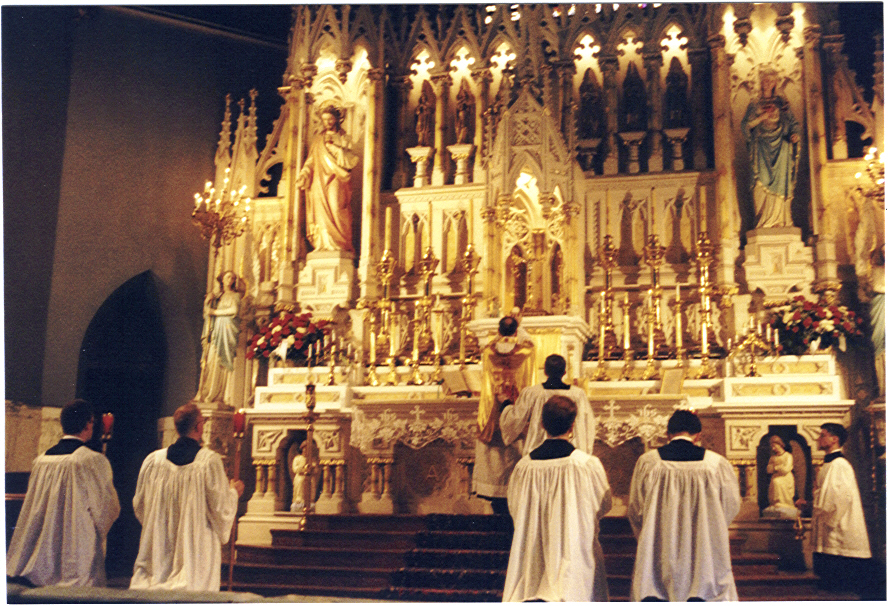
Here's a very interesting reply from the Congregation of Divine Worship on the question of the orientation of the priest at mass, dated September 25, 2000:
The Congregation for Divine Worship and the Discipline of the Sacraments has been asked whether the expression in n. 299 of the Institutio Generalis Missalis Romani constitutes a norm according to which the position of the priest versus absidem [facing the apse] is to be excluded. The Congregation for Divine Worship and the Discipline of the Sacraments, after mature reflection and in light of liturgical precedents, responds:It's that last passage (italics mine) that is really most intriguing, wouldn't you say?
Negatively, and in accordance with the following explanation.
The explanation includes different elements which must be taken into account.
It is in the first place to be borne in mind that the word expedit does not constitute an obligation, but a suggestion that refers to the construction of the altar a pariete sejunctum [detached from the wall] and to the celebration versus populum. The clause ubi possibile sit refers to different elements, as, for example, the topography of the place, the availability of space, the artistic value of the existing altar, the sensibility of the people participating in the celebrations in a particular church, etc. It reaffirms that the position towards the assembly seems more convenient inasmuch as it makes communication easier (Cf. the editorial in Notitiae 29 [1993] 245-249), without excluding, however, the other possibility.
Thursday, August 26
Blessing of Beer
P. Our help is in the name of the Lord.
All. Who made heaven and earth.
P. The Lord be with you.
All. May he also be with you.
Let us pray.
Lord, bless + this creature, beer, which by Your kindness and power has been produced from kernels of grain, and let it be a healthful drink for mankind. Grant that whoever drinks it with thanksgiving to your holy name may find it a help in body and in soul; through Christ our Lord.
All: Amen.
The beer is sprinkled with holy water.
--From the 1964 Roman Ritual, VIII:5
P. Our help is in the name of the Lord.
All. Who made heaven and earth.
P. The Lord be with you.
All. May he also be with you.
Let us pray.
Lord, bless + this creature, beer, which by Your kindness and power has been produced from kernels of grain, and let it be a healthful drink for mankind. Grant that whoever drinks it with thanksgiving to your holy name may find it a help in body and in soul; through Christ our Lord.
All: Amen.
The beer is sprinkled with holy water.
--From the 1964 Roman Ritual, VIII:5
Wednesday, August 25
The Patriarch of Lisbon's Tiara
If you go to the website of the Patriarchate of Lisbon, and I'm sure everybody has at one point or other, you will find the see's quite singular seal: a triple tiara above a crozier and a double-barred archiepiscopal cross. It's not, surprisingly enough, a gesture of ultramontane fealty, one soon realizes as the odd heraldic details start to build up: the triple crown is peculiarly attenuated, while the papacy abandoned the crozier as an insignia of office centuries ago. In fact, it is a vestige of the papal insignia supposedly granted to the newly-erected patriarchate in 1716. While the late heraldist Archbishop Bruno Bernard Heim, no great lover of the baroque, scoffed at the story and reports the then-current incumbent had not placed the tiara above his shield, Archibald King's 1957 Liturgy of the Roman Church records it as cold fact:
If you go to the website of the Patriarchate of Lisbon, and I'm sure everybody has at one point or other, you will find the see's quite singular seal: a triple tiara above a crozier and a double-barred archiepiscopal cross. It's not, surprisingly enough, a gesture of ultramontane fealty, one soon realizes as the odd heraldic details start to build up: the triple crown is peculiarly attenuated, while the papacy abandoned the crozier as an insignia of office centuries ago. In fact, it is a vestige of the papal insignia supposedly granted to the newly-erected patriarchate in 1716. While the late heraldist Archbishop Bruno Bernard Heim, no great lover of the baroque, scoffed at the story and reports the then-current incumbent had not placed the tiara above his shield, Archibald King's 1957 Liturgy of the Roman Church records it as cold fact:
Pope Clement XI (1700-21), at the request of King John V of Portugal (1706-50), accorded papal insignia to the patriarch of Lisbon. The king had earned the gratitude of the Sovereign Pontiff, not only by his victories over the Turks, but also by his lavish expenditure and costly presents. [Note: And you have a problem with this how?] The glorification of the Portuguese monarchy, and, incidentally, of the Church of Lisbon was part of the royal programme for the establishment of the pure absolutism of divine right. The Pope in the bull In supremo apostolatus solio had in 1716 created the patriarch of Lisbon, and later conceded the distinctive papal insignia for the occupant of the see on certain solemnities of the year.The Catholic Encyclopedia adds to this some equally fascinating details:
Among the privileges thus granted was the right to wear the fanon, subcinctorium, and falda. [The fanon was a peculiar striped shoulder-cape worn by the Pontiff, while the subcintorium was a maniple-like device attached to the cincture, worn by the Pope and certain Ambrosian-rite bishops, and the falda was a skirtlike vestment with an extended train.] A tiara, known as a triregunum, was conceded at the same time, which, although not identical with the papal triple crown, looked very much like it at a distance. The Pope sent the patriarch two flabella, and from that time, two only were used in Rome. The sedia gestatoria of the Lusitanian patriarch was said to have exceeded that of the Pope in magnificence. The practice of receiving Holy Communion at the throne in solemn Masses was not, however, conceded to the patriarch of Lisbon. (162)
The discovery of America added a vast territory to the Church, over which it seemed natural that a patriarch should reign. In 1520 Leo X created a "Patriarchate of the West Indies" among the Spanish clergy. In 1572 Pius V joined this rank to the office of chief chaplain of the Spanish army. But in this case, too, the dignity is purely titular. In 1644 Innocent X gave the patriarch some jurisdiction, but expressly in his quality of chaplain only. He has no income as patriarch and is often also bishop of a Spanish diocese. In 1716 Clement XI, in answer to a petition of King John, who, in return for help in fighting Turks, wanted a patriarch like the King of Spain, erected a titular Patriarchate of Lisbon at the king's chapel. The city was divided between the jurisdiction of the Archbishop of Lisbon and the new patriarch. In 1740 Benedict XIV joined the archbishopric to the patriarchate. The Patriarch of Lisbon has certain privileges of honour that make his court an imitation of that of the pope. His chapter has three orders like those of the College of Cardinals; he himself is always made a cardinal at the first consistory after his preconization and he uses a tiara (without the keys) over his arms, but he has no more than metropolitical jurisdiction over seven suffragans.I don't know how many of these fascinating (if perhaps slightly dubious) practices persist, but they seem to have at the very least been in full swing as recently as one hundred years ago. We at the Shrine are currently seeing if we can get St. Flutius's Basilica here formed into a minor patriarchate; while we're not interested in the tiara, we might like to get one of those liturgical drinking straws the Pope used to use. And the shoes. Definitely the shoes. It's all about the buskins, dude.
CSI: Mount Athos. You heard it here first.
Tuesday, August 24
Thought for the Day
Gender bias in the Old Testament?
In Gen 2:18, "The LORD God says, it is not good for the man to be alone. I will make a suitable helper for him."
(Note: the NAB leaks out here and inserts "partner for him," whereas the Nova Vulgate states, "adiuatorium.")
Many theologians attribute common areas where women are unfairly treated by men as coming, predictably, from the Fall, as one of the consequences of the Fall (see Gen 3:16). However, with the verse above, we have a problem.
If Woman was created as a "helper" for Man, and this was before the Fall, does that somehow suggest that Woman is not completely equal with the man?
I was listening to this topic on Relevant Radio the other day and had these thoughts, largely inspired by whatever program it was.
Clearly, this is not "helper" in the sense of someone to cook the food or help plow the fields, since the creation of the woman is before the Fall, so such manual labor was wholly unnecesary. Indeed, humanity's purpose was quite direct and clear, simply "to know, love, and serve God."
But how can Man learn how to love God without a more direct experience of what love is? For we have a supernatural vocation of complete self-gift of ourselves to God, complete love of God. In order to have any chance at success, Adam would need a pedagogical help from God.
Man needed the Woman to understand his own ideal relationship with God; how can a heavenly, eternal communal love be understood without the intial experience of an earthly communal love? For this, the Woman was created to be helper of the Man -- to help understand the nature of God and embrace his eternal destiny. The role which Eve played was so profound and a help so essential to salvation that, perhaps, it alone was the most significant help for sanctification until the coming of Christ Himself. But certainly, that Woman was created as "helper" of Man does not suggest a lesser dignity, but instead propells both Adam and Eve to an eternal dignity, complete communion with the Divine.
Gender bias in the Old Testament?
In Gen 2:18, "The LORD God says, it is not good for the man to be alone. I will make a suitable helper for him."
(Note: the NAB leaks out here and inserts "partner for him," whereas the Nova Vulgate states, "adiuatorium.")
Many theologians attribute common areas where women are unfairly treated by men as coming, predictably, from the Fall, as one of the consequences of the Fall (see Gen 3:16). However, with the verse above, we have a problem.
If Woman was created as a "helper" for Man, and this was before the Fall, does that somehow suggest that Woman is not completely equal with the man?
I was listening to this topic on Relevant Radio the other day and had these thoughts, largely inspired by whatever program it was.
Clearly, this is not "helper" in the sense of someone to cook the food or help plow the fields, since the creation of the woman is before the Fall, so such manual labor was wholly unnecesary. Indeed, humanity's purpose was quite direct and clear, simply "to know, love, and serve God."
But how can Man learn how to love God without a more direct experience of what love is? For we have a supernatural vocation of complete self-gift of ourselves to God, complete love of God. In order to have any chance at success, Adam would need a pedagogical help from God.
Man needed the Woman to understand his own ideal relationship with God; how can a heavenly, eternal communal love be understood without the intial experience of an earthly communal love? For this, the Woman was created to be helper of the Man -- to help understand the nature of God and embrace his eternal destiny. The role which Eve played was so profound and a help so essential to salvation that, perhaps, it alone was the most significant help for sanctification until the coming of Christ Himself. But certainly, that Woman was created as "helper" of Man does not suggest a lesser dignity, but instead propells both Adam and Eve to an eternal dignity, complete communion with the Divine.
Isn't this a sign of the Apocalypse?
mInDu' SaD ghaj ram.
neH wa' ghaj pem.
'a 'e'vaD wovqu' wovmoHwI'vam.
HeghDI' HovDaj, ngabchoH pem.
I fear for the future of civilization. Via Unskilled Labor, which I found (naturally) via Fr. Sibley, I discovered...yes...Bo Logh, a blog written entirely in what I am told on good authority is Klingon. Not being a Trekkie (I watched Babylon 5 as a child), I wouldn't know unless someone told me. And that's not the only one, too. Yikes, this is almost as bad as Leonard Nimoy singing that friggin' Frodo song. Or Leonard Nimoy singing anything, come to think of it.
mInDu' SaD ghaj ram.
neH wa' ghaj pem.
'a 'e'vaD wovqu' wovmoHwI'vam.
HeghDI' HovDaj, ngabchoH pem.
I fear for the future of civilization. Via Unskilled Labor, which I found (naturally) via Fr. Sibley, I discovered...yes...Bo Logh, a blog written entirely in what I am told on good authority is Klingon. Not being a Trekkie (I watched Babylon 5 as a child), I wouldn't know unless someone told me. And that's not the only one, too. Yikes, this is almost as bad as Leonard Nimoy singing that friggin' Frodo song. Or Leonard Nimoy singing anything, come to think of it.
Where can you see lions? Only in Kenya, it seems. Warning--this link verges on the hallucinogenic. Really.
Saturday, August 21
"Sometimes it just seems
everybody only wants to depose me."
Ok. So it's about as clean as a real rap song. And it's slightly more factual than Michael Moore. But it's still Eminem meets Saddam, and that's pretty amusing.
The Real Hussein II - powered by Kizash
everybody only wants to depose me."
Ok. So it's about as clean as a real rap song. And it's slightly more factual than Michael Moore. But it's still Eminem meets Saddam, and that's pretty amusing.
The Real Hussein II - powered by Kizash
NEWS of the WEIRD - Current News:
"Chutzpah: A Minneapolis firefighter Gerald Brown who was fired in 1995 for abuse of sick leave, but who won a contentious grievance hearing and was reinstated with 18 months' 7 back pay, was scheduled to return to work on June 2, 1997. When that day arrived, he called in sick. Star Tribune, 6-7-97."
"Chutzpah: A Minneapolis firefighter Gerald Brown who was fired in 1995 for abuse of sick leave, but who won a contentious grievance hearing and was reinstated with 18 months' 7 back pay, was scheduled to return to work on June 2, 1997. When that day arrived, he called in sick. Star Tribune, 6-7-97."
Another WHAP (TM) Against Heresy
"What did you just do? Those people walked away with their heads hanging low." - My Mom
I think I have reasonable goals in my life. To see a stigmatist. To see the Pope. To get into Notre Dame. Check, check, check. Happily today, I was able to knock off another thing from the ol' "To Do" list: Have a nice discussion with some door-to-door evangelizers.
They knocked on the door with their Watchtower booklets in hand. Ah, Jehovah's Witnesses. An apologetics softball. Sure, I'll take a magazine. Sure, sounds interesting. When was your religion founded again?
"It goes back to Abel, sir."
Uh-huh. But when was it organized?
"Umm in the 1800's. Our founder realized he was being lied to, and did some research. But the message goes back to Abel, Enoch--"
Huh. You don't say. But being Catholic, to me, it's really important to see a historical record of a religion, evidance that it's always existed the same way, at least back to Christ Himself.
"Well, look sir. There are 1,000s of religions. Thousands. But only one of these can be true; Christ only started one church, only taught one religion."
(blink) Did he really say that? SCORE.
I totally agree. And that's why it's so important to have a historical record. Certainly there are 1000's of denominations -- since the Reformation. But you're right, Christ only taught one religion -- and there's only one religion I know of which can trace its history from Christ, to 12 man, who ordained a couple hundred, who ordained a couple thousand bishops... down to this day.
"Um, ok. (the two look at each other) I guess we're a little rusty in this area, but we could check and get back to you--"
That's ok. I leave for school tomorrow. Yes, college. Pardon? I go to Notre Dame, in Indiana. Actually, I study historical theology there.
From here we discussed the nature of the writings of the Fathers of the Church (that is, its remarkable consistancy with the Catholic Church). We discussed the remarkable uniformity of the Christian Faith until the Reformation, and the chaos afterwards. We discussed the lack of any authenticated historical record for the teachings of the JW's. I did throw them a bone and said I wouldn't trust what I read about them on the Internet and get my future information on them from the horse's mouth -- "As a Catholic, I can certainly understand having your religion misrepresented. Hopefully, you'll do the same with regard to information you get about us." We complimented our mutual commitment to the culture of Life, and they went packing. Apparently, with heads hung. But hopefully it'll inspire them to look into the historical record of Christianit. Or at least, it'll inspire them avoid Catholic majors in historical theology.
"What did you just do? Those people walked away with their heads hanging low." - My Mom
I think I have reasonable goals in my life. To see a stigmatist. To see the Pope. To get into Notre Dame. Check, check, check. Happily today, I was able to knock off another thing from the ol' "To Do" list: Have a nice discussion with some door-to-door evangelizers.
They knocked on the door with their Watchtower booklets in hand. Ah, Jehovah's Witnesses. An apologetics softball. Sure, I'll take a magazine. Sure, sounds interesting. When was your religion founded again?
"It goes back to Abel, sir."
Uh-huh. But when was it organized?
"Umm in the 1800's. Our founder realized he was being lied to, and did some research. But the message goes back to Abel, Enoch--"
Huh. You don't say. But being Catholic, to me, it's really important to see a historical record of a religion, evidance that it's always existed the same way, at least back to Christ Himself.
"Well, look sir. There are 1,000s of religions. Thousands. But only one of these can be true; Christ only started one church, only taught one religion."
(blink) Did he really say that? SCORE.
I totally agree. And that's why it's so important to have a historical record. Certainly there are 1000's of denominations -- since the Reformation. But you're right, Christ only taught one religion -- and there's only one religion I know of which can trace its history from Christ, to 12 man, who ordained a couple hundred, who ordained a couple thousand bishops... down to this day.
"Um, ok. (the two look at each other) I guess we're a little rusty in this area, but we could check and get back to you--"
That's ok. I leave for school tomorrow. Yes, college. Pardon? I go to Notre Dame, in Indiana. Actually, I study historical theology there.
From here we discussed the nature of the writings of the Fathers of the Church (that is, its remarkable consistancy with the Catholic Church). We discussed the remarkable uniformity of the Christian Faith until the Reformation, and the chaos afterwards. We discussed the lack of any authenticated historical record for the teachings of the JW's. I did throw them a bone and said I wouldn't trust what I read about them on the Internet and get my future information on them from the horse's mouth -- "As a Catholic, I can certainly understand having your religion misrepresented. Hopefully, you'll do the same with regard to information you get about us." We complimented our mutual commitment to the culture of Life, and they went packing. Apparently, with heads hung. But hopefully it'll inspire them to look into the historical record of Christianit. Or at least, it'll inspire them avoid Catholic majors in historical theology.
Random Cardinalatial Facts from an Interesting Website
On the title Eminence:
On the title Eminence:
The title Eminentissimus, 'Your Eminence,' was one of the titles of the Byzantine Emperor and thence passed to the Holy Roman Emperor, from which it afterward passed to leaders in his court. Apparently at Richelieu's suggestion, Urban VIII on June 10, 1630 restricted it to cardinals, who until then were usually entitled 'most illustrious' and 'most reverend,' to the three ecclesiastical Electors of the Holy Roman Empire,42 and to the Grand Master of the Knights of Malta, who bears the title to this day, the only layman so honored.And on betting on the outcome of papal elections (G-Money, take note! Hah.):
On 21 March 1591 Gregory XIV banned all betting on papal elections, the length of the pontificate or the creation of cardinals."I read elsewhere the penalty was (or is?)excommunication. Ouch.
And He's Not Even Anglican!
Here's a pic of a very P.O.D. monsignor blessing the Boy Scouts of America Sea Scout fleet. Also here. With that sort of biretta, I'll even let the rather vivid stole slide. And friend Taylor, if you will allow me to be a Sly Ultramontane Jesuitical Chauvinist, while he looks like a spiffily-dressed denizen of S. Clement's Anglo-Catholic, Philly, let me note that is unmistakeably the Roman Book of Blessings he's got in his hands...
Here's a pic of a very P.O.D. monsignor blessing the Boy Scouts of America Sea Scout fleet. Also here. With that sort of biretta, I'll even let the rather vivid stole slide. And friend Taylor, if you will allow me to be a Sly Ultramontane Jesuitical Chauvinist, while he looks like a spiffily-dressed denizen of S. Clement's Anglo-Catholic, Philly, let me note that is unmistakeably the Roman Book of Blessings he's got in his hands...

Guardi's image of the ducal Bucentoro state barge being rowed out to the blessing of the sea at Venice.
The 1964 Rituale Romanum
Due to a peculiar and wonderful series of events, I have become the proud owner of a much-loved and much-worn edition of the American version of the mid-Vatican II Roman Ritual. Confiteor: I borrowed the book from the parish library around two or three years ago and promptly forgot about it; I only recently returned it and the parish secretary, a good and deserving lady (and a reader of this blog), did a little bit of asking around the parish office, and then told me I could keep it, considering I would probably make better use of it myself than at the Co-Cathedral, considering many of the texts and rubrics included are now sadly defunct.
It's a fascinating text because of its somewhat transitional nature and the quality of the English translations of many of the benedictions, allocutions and orations. The only fly in the ointment is the persistent and slightly irritating use of "May He also be with you" for et cum spiritu tuo. Unlike the current Book of Blessings, with its more general prayers, it contains all sorts of formulas for the blessings of unusual (sometimes slightly bizarre) events and objects, including quite a few approved, yet un-codified, in the previous decade by Pius XII.
Paging through it, one can find an English translation of the old rites for exorcisms of people and places--including some finely baroque adjurations of the ancient serpent, every spectre from hell, every unclean spirit, liberally spangled with red signs of the cross--and also processions for averting tempests and on rogation days, a deprecatory blessing against pests, benedictions of radio stations, beer, bees, the sea, a bridal chamber (Christopher West take note!), lime-kilns, marble factories, lard, lillies (for St. Anthony's day), fire, cars, wheelchairs, "a more solemn blessing of a railway and its cars," seismographs, mountain-climbing tools, dynamos, and, most strangely, mobile film units for road safety, which are introduced with this surprisingly flippant--if appropriate--note: "On August 9, 1961, Good Pope John blessed forty mobile film units designed by the Italian government to inform the people, both pedestrians and motorists, about safety rules in the streets and highways. Anyone who knows Italy will know how opportune this business was" (!).
It gets even more wonderfully obscure: blessings of the ring of St. Joseph, a blessing of the sick with the sign of St. Maurus the Abbot, a blessing of water for the sick in honor of the Virgin and St. Torellus (by a Brief dated December 16, 1628), blessings for palm leaves on the feast of St. Peter Martyr, and to crown it all magnificently in this orgy of P.O.D.-ness, the famous Oath against Modernism. What's not to love?
In the next week, I'll be posting extracts from it, including a wonderful rite for solemnizing a betrothal and maybe a bit more about those film units.
Friday, August 20
The Most Significant Election for Catholics Since JFK...
... One way or another. Either we end up with another nominal Catholic, or it increasing looks possible that we could tip the scales for Bush in the final count.
CBS News Poll: Kerry And Bush This Close, August 20: "The recent tightening of the race reflects a loss of support for Kerry among some of this election's most contested groups: Independents, veterans and Catholics."
I'd say either way, it's the most significant election for Catholics in 40 years.
... One way or another. Either we end up with another nominal Catholic, or it increasing looks possible that we could tip the scales for Bush in the final count.
CBS News Poll: Kerry And Bush This Close, August 20: "The recent tightening of the race reflects a loss of support for Kerry among some of this election's most contested groups: Independents, veterans and Catholics."
I'd say either way, it's the most significant election for Catholics in 40 years.
Hosts without wheat?
This story from New Jersey is a real life application of a hilarious/heretical conversation that Dan, Emily, Andy and I had late one night last spring (sorry Matt, the consequences of being in Rome). The basic question was, what exactly is required, in terms of ingredients, for a host to be validly consecrated? We concluded that flour and water are necessary, and that there cannot be too many additives as to change the constitution of the bread; i.e., some salt is ok, but not too much. The catch here is that wheat flour is required: no rye, barley, oat or anything else.
As for solving the Haley's problem, I think the diocese's solution of a low-wheat host or simply receiving the Blood is the best way to go about it. After all, no one has a right to receive the Eucharist under both species, even though the Hussites insisted that's the only way to go about it. The important thing to remember is that there is no difference between the Body and the Blood of Christ as He is fully present in each. It's not as if the Body is one part of Christ and the Blood another, and they both perform different functions. Rather, each one fully unites us with God. So it really shouldn't make a difference if one receives only one species. Certainly the girl might feel awkward and different since she's the only kid who can't receive both species, but that's not much to write home about.
This story from New Jersey is a real life application of a hilarious/heretical conversation that Dan, Emily, Andy and I had late one night last spring (sorry Matt, the consequences of being in Rome). The basic question was, what exactly is required, in terms of ingredients, for a host to be validly consecrated? We concluded that flour and water are necessary, and that there cannot be too many additives as to change the constitution of the bread; i.e., some salt is ok, but not too much. The catch here is that wheat flour is required: no rye, barley, oat or anything else.
As for solving the Haley's problem, I think the diocese's solution of a low-wheat host or simply receiving the Blood is the best way to go about it. After all, no one has a right to receive the Eucharist under both species, even though the Hussites insisted that's the only way to go about it. The important thing to remember is that there is no difference between the Body and the Blood of Christ as He is fully present in each. It's not as if the Body is one part of Christ and the Blood another, and they both perform different functions. Rather, each one fully unites us with God. So it really shouldn't make a difference if one receives only one species. Certainly the girl might feel awkward and different since she's the only kid who can't receive both species, but that's not much to write home about.
Thursday, August 19
An interesting new book on Notre Dame history:

Notre Dame vs. The Klan: How the Fighting Irish Defeated the Ku Klux Klan
I had never heard of this incident: apparently there was a 1924 riot in South Bend between Klansmen and the men of Notre Dame. The sample chapter was very engaging:
Bill Foohey was in his dorm room studying chemistry when the call to arms sounded again. It was a Monday night, around 9:15. After Saturday’s thrills, the young men of Notre Dame were settling back down into the weekday routine of classes and studying. Sophomore Hall had been quiet until the telephone at the end of the hallway rang, setting off a burst of activity. Doors slammed open and shut and feet pounded excitedly up and down the hall. Foohey closed his textbook, walked to the door of his room, and stuck his head into the hallway. The sounds of frenzied young men reverberated off the thin walls of the drafty building they called “the Cardboard Palace.”
“They’ve got one of the boys downtown!” shouted his friend I. I. Probst, who had apparently taken the report on the dormitory’s only phone. He seemed more ecstatic than upset. Who could they have? Foohey wondered. Most of the men who lived on campus were probably getting ready for the next day’s classes or heading to bed. Maybe it was one of the many upperclassmen who lived in town. Even though they were technically subject to the same lights-out rule as the men on campus, everyone knew they went out most nights to play pool and smoke cigarettes, which was forbidden on campus. The Ku Klux Klan might have grabbed a random Notre Dame man off the street to avenge the whipping they had taken on Saturday. Foohey could see his peers through their open dorm room doors hurriedly tying their shoes and throwing on jackets. Through the window at the end of the hallway, he could see the shadows of men from Freshman Hall running across the quad toward town. It appeared that the freshmen had a head start. The men of Sophomore Hall were getting ready in a panic, terrified that they might miss the fight.
“We’re going to have to teach them another lesson!” someone yelled as he flew down the stairs. A general cheer of support followed. Probst punched Foohey on the arm as he ran past him.
“You’re coming, aren’t you?” Probst asked.
Read the rest of the chapter here.
Notre Dame vs. The Klan: How the Fighting Irish Defeated the Ku Klux Klan
I had never heard of this incident: apparently there was a 1924 riot in South Bend between Klansmen and the men of Notre Dame. The sample chapter was very engaging:
Bill Foohey was in his dorm room studying chemistry when the call to arms sounded again. It was a Monday night, around 9:15. After Saturday’s thrills, the young men of Notre Dame were settling back down into the weekday routine of classes and studying. Sophomore Hall had been quiet until the telephone at the end of the hallway rang, setting off a burst of activity. Doors slammed open and shut and feet pounded excitedly up and down the hall. Foohey closed his textbook, walked to the door of his room, and stuck his head into the hallway. The sounds of frenzied young men reverberated off the thin walls of the drafty building they called “the Cardboard Palace.”
“They’ve got one of the boys downtown!” shouted his friend I. I. Probst, who had apparently taken the report on the dormitory’s only phone. He seemed more ecstatic than upset. Who could they have? Foohey wondered. Most of the men who lived on campus were probably getting ready for the next day’s classes or heading to bed. Maybe it was one of the many upperclassmen who lived in town. Even though they were technically subject to the same lights-out rule as the men on campus, everyone knew they went out most nights to play pool and smoke cigarettes, which was forbidden on campus. The Ku Klux Klan might have grabbed a random Notre Dame man off the street to avenge the whipping they had taken on Saturday. Foohey could see his peers through their open dorm room doors hurriedly tying their shoes and throwing on jackets. Through the window at the end of the hallway, he could see the shadows of men from Freshman Hall running across the quad toward town. It appeared that the freshmen had a head start. The men of Sophomore Hall were getting ready in a panic, terrified that they might miss the fight.
“We’re going to have to teach them another lesson!” someone yelled as he flew down the stairs. A general cheer of support followed. Probst punched Foohey on the arm as he ran past him.
“You’re coming, aren’t you?” Probst asked.
Read the rest of the chapter here.
Wednesday, August 18
As someone who is incredibly anal about grammar and punctuation, a condition that is undoubtedly a consequence of my years of Latin education, I heartily endorse the Apostrophe Protection Society. Its serving an important purpose for English speaker's, who seem to be losing sight of the apostrophes proper use's.
From a conversation this morning:
G-Money: I can see someone confessing this in Ireland, and the confessor asking what kind of odds he got. And say, letting him go with three Hail Marys if he got 6 to 1 on Arinze, but making him say a decade if he only got 3 to 1.
G-Money: I can see someone confessing this in Ireland, and the confessor asking what kind of odds he got. And say, letting him go with three Hail Marys if he got 6 to 1 on Arinze, but making him say a decade if he only got 3 to 1.
Tuesday, August 17
Techie stuff...
The good news: for whatever reason, The Shrine seems to be as yet unplagued by the Blogger Navbar.
The not-so-good: On the other hand, I can't get the quick-edit buttons to show up for anything.
Any thoughts? It's not a big deal on either count, just mystifying to someone who usually has no problem with websites. If only I could hard-code everything...
The good news: for whatever reason, The Shrine seems to be as yet unplagued by the Blogger Navbar.
The not-so-good: On the other hand, I can't get the quick-edit buttons to show up for anything.
Any thoughts? It's not a big deal on either count, just mystifying to someone who usually has no problem with websites. If only I could hard-code everything...
Monday, August 16
Congratulations to Old Oligarch and Zorak, who will be having either a Young Oligarch or a mantis nymph, or something in between, in late January! The ultrasound is here.
I hope this doesn't mean Zorak will be eating O.O. anytime soon.
I hope this doesn't mean Zorak will be eating O.O. anytime soon.
I don't know if this is accurate or just more "The Bishop said (fill in the blank)" meets the media vultures.
Either way, keep Papa in your prayers.
Either way, keep Papa in your prayers.
A friend from school asked me to pass this along:
The Association of Students at Catholic Colleges (ASCC) announces the release of a free, online publication for college students entitled Faith Essentials for the Catholic College Student.
Each monthly issue of Faith Essentials features two articles by Catholic scholars around the country, and, though aimed at the Catholic college student, this publication is also suitable for those looking to deepen their Faith and for anyone interested in Catholicism. Subscribers will receive an email announcing each new issue, the full text of which will be on ASCC’s website.
The first issue, to be released this September, includes an article by Dale Ahlquist, President of the American Chesterton Society, on G.K. Chesterton’s ideas on thought and education, and another by Rev. Brian Daley, SJ of the University of Notre Dame on Mary and the early Church. Future writers include Dr. Peter Kreeft, Bishop Robert Morlino, and Dr. Marcellino D’Ambrosio.
To subscribe, visit ASCC’s website at www.catholiccollegestudents.org
and click on “Faith Essentials.”
"Miniver loved the days of old
When swords were bright and steeds were prancing;
The vision of a warrior bold
Would set him dancing.
Miniver sighed for what was not,
And dreamed, and rested from his labors;
He dreamed of Thebes and Camelot,
And Priam's neighbors."
Yet another sign I was born in the wrong era/country:
Took my little sister to see The Princess Diaries 2 last night, and throughout the movie, I just kept thinking, "Oh, come on, are arranged marriages really that bad?" Not that I'd want one, necessarily, but I was more sympathetic to the idea than the movie.
But that's probably just me.
When swords were bright and steeds were prancing;
The vision of a warrior bold
Would set him dancing.
Miniver sighed for what was not,
And dreamed, and rested from his labors;
He dreamed of Thebes and Camelot,
And Priam's neighbors."
Yet another sign I was born in the wrong era/country:
Took my little sister to see The Princess Diaries 2 last night, and throughout the movie, I just kept thinking, "Oh, come on, are arranged marriages really that bad?" Not that I'd want one, necessarily, but I was more sympathetic to the idea than the movie.
But that's probably just me.

This was funny...
...especially because of how effectively Che has been marketed as a cultural phenomon through various global capitalistic venues, undercutting his message for the sake of enhancing the status of his person. It's Mickey-Mouse McCommunism, brought to you by your nearest dollar!
Washington Post: What Is the Vatican Saying About Women?
An interesting and refreshingly fair commentary and critique of the new Vatican document from a Notre Dame prof.
Thanks to Fr. Tucker for the link.
An interesting and refreshingly fair commentary and critique of the new Vatican document from a Notre Dame prof.
Thanks to Fr. Tucker for the link.
Sunday, August 15
A Proposition
To all the Dome-Bound this coming Sunday:
Anyone interested in stopping by a Marian shrine around Milwaukee or Chicago to start the school year off right? I'm thinking Holy Hill, Our Lady of the Angels or St. John Cantius (not explicitly Marian, but still quite Marian).
To all the Dome-Bound this coming Sunday:
Anyone interested in stopping by a Marian shrine around Milwaukee or Chicago to start the school year off right? I'm thinking Holy Hill, Our Lady of the Angels or St. John Cantius (not explicitly Marian, but still quite Marian).

The Feast of the Assumption of the Blessed Virgin Mary
This has always been my favorite Marian feast day, mostly because of the complete and utter mystery of it. It was made even better for me when Dan and I visited the House of the Virgin Mary a few years ago outside the ruins of Ephesus in Turkey. According to local tradition the Assumption is said to have happened here but there is another tradition placing the Assumption in Jerusalem where this Whapster is inclined to believe it actually happened. Either way, seeing the house where the Blessed Virgin and St. John the Apostle lived was an incredible opportunity.
While on the trip, I came across another interesting tradition thanks to our guide. According to her, there is a tradition in the East that St. John was also assumed bodily into Heaven and that it happened not six miles from this house in Ephesus. In the 1920's, a 6th century basilica built by Justinian dedicated to the Assumption of St. John was uncovered nearby. I've asked several priests and none have ever heard of this tradition. Does anyone have any information on the subject?
Saturday, August 14
Like Emily said, I don't want to brag, but...
Like all good papers here in the Bible Belt, the Dallas Morning News has a religion section every Saturday. Every once in a while I get mad at a letter to the editor in this section (can't imagine why!) and fire off a reply. Nothing's ever come of it until this week when they actually printed my letter. I was replying to a Mormon putting words in Peter Kreeft's mouth. Kreeft's article has been archived so it can't be linked, but basically he said that marriage, like all things on earth, is a reflection Heaven. I think he called it an "embryo" which will grow into something better in Heaven. As to what exactly that will be, he didn't say, but he certainly didn't say it won't exist.
Like all good papers here in the Bible Belt, the Dallas Morning News has a religion section every Saturday. Every once in a while I get mad at a letter to the editor in this section (can't imagine why!) and fire off a reply. Nothing's ever come of it until this week when they actually printed my letter. I was replying to a Mormon putting words in Peter Kreeft's mouth. Kreeft's article has been archived so it can't be linked, but basically he said that marriage, like all things on earth, is a reflection Heaven. I think he called it an "embryo" which will grow into something better in Heaven. As to what exactly that will be, he didn't say, but he certainly didn't say it won't exist.
Friday, August 13
Here's exactly why it's a bad idea to have Europe involved:
Blix Needs More Time to Monitor U.S. Elections
Scrappleface: Riding the fine line between parody and reality.
Blix Needs More Time to Monitor U.S. Elections
Scrappleface: Riding the fine line between parody and reality.
A Kernal of a Strand of a Thought
Well getting ready this morning, I was wondering why it is that Catholics have roughly equal enthusiasm for divorce as the rest of the population, when we are so blessed with a sacramental marriage and explicit knowledge thereof. Despite the divine presence in marriage, the aggregate numbers of marital failure and unhappiness are about the same as for the rest of the population.
IQB: Examples of when marriage can be annuled: (meanting, of course, that it never existed sacramentally in the first place) "Finally, a person might exclude the essential property of openness to children and say, 'Okay, I'll get married, but only on the condition that we never have kids, and if I knew we were going to have kids, then I just wouldn't get married.' Again, an essential property of marriage is excluded, and so the marriage itself is excluded."
Artificial birth control?
I don't have any more time to work this out. Thoughts? Too far? Plausible? I don't know. Please do my thinking for me today.
Well getting ready this morning, I was wondering why it is that Catholics have roughly equal enthusiasm for divorce as the rest of the population, when we are so blessed with a sacramental marriage and explicit knowledge thereof. Despite the divine presence in marriage, the aggregate numbers of marital failure and unhappiness are about the same as for the rest of the population.
IQB: Examples of when marriage can be annuled: (meanting, of course, that it never existed sacramentally in the first place) "Finally, a person might exclude the essential property of openness to children and say, 'Okay, I'll get married, but only on the condition that we never have kids, and if I knew we were going to have kids, then I just wouldn't get married.' Again, an essential property of marriage is excluded, and so the marriage itself is excluded."
Artificial birth control?
I don't have any more time to work this out. Thoughts? Too far? Plausible? I don't know. Please do my thinking for me today.
Wednesday, August 11

Peyto Lake, Alberta
I'll be hiking in the beautiful Canadian Rockies over the next week. Blogging will be minimal to none until I return at long last to Catholic Nerd Central at my beloved University of Notre Dame ten days from now. In the mean time, as Andrew Cusack would say:
1. Find out more about the Principality of Schwarzburg-Rudolstadt.
2. Be on the watch for bizarre blog phenomena, like Greek Orthodox cars.
3. Listen to Historic Mexican Organ Music that everybody likes to play on their Historic Mexican Organs.
God bless and meanwhile, don't do anything I wouldn't do...on second thought, forget I said that, considering I'm the sort of person who keeps photocopies of eighth-century monastic curses in my study closet.

As it was St. Lawrence's day yesterday, I feel obliged to follow Don Jim's lead and post a link about the Escorial, the massive palace-monastery-university dedicated to St. Lawrence and built in the shape of the gridiron which roasted him to death. I've seen the original gridiron, which preserved in the church of San Lorenzo in Lucina in Rome. I have a great fascination with its namesake edifice: in fact, my tiny dorm room at Notre Dame I've nicknamed the Escorial as well.
It (the monastery, not my dorm room) was built by Philip II of Spain, a fascinatingly morbid individual who might have been a Goth in another epoch (the pretentiously creepy subculture, not the pillaging tribe) but instead channeled his gloom into a more fruitful Catholic outlet, commissioning some rather striking black-and-silver skull-emblazoned vestments for his own Requiem mass.
San Lorenzo del Escorial is a mammoth building, replete with Solomonic imagery--indeed, aging idol Tyrone Power died there while filming the biblical epic Solomon and Sheba on location back in the black-and-white era. The place's stark, stripped aesthetic is in marked constrast with the Baroque I love, but yet its severe geometries nonetheless have an overpowering bare splendor to them. Indeed, the cube repeated in the Temple's geometry appears in the frescoed vaults as a symbol of Divine perfection rather than the more conventional Pythagorean sphere. Even weirder is that in the palace's relics collection is a bizarre yard-long feather thought to have been shed by the Archangel Gabriel.
Hey, I suppose it's possible. If it's not true, it's still worth keeping, if only to irritate agnostics.
"My name is Hans and I can't stop thinking about Lutherans. These guys are cool; and by cool, I mean totally sweet."
Guys, we may have won the P.O.D.-out contest last month, but I think one of our pals in the C. of E. has just tied Fr. Bryce for the week's weirdness quotient. Anglican Taylor Marshall has discovered the secret spiritual life of the Ninja, as well as the ultimate source of their Real Ultimate Power. Also, Lutherans are mammals and their purpose in life is to flip out and be justified by faith alone. (Ecumenists: it's an inside joke, it's got nothing to do with you).
By the way, I think I might be able to confer honorary whapsterhood on the first reader who cooks up the first Catholic Ninja parody.
Guys, we may have won the P.O.D.-out contest last month, but I think one of our pals in the C. of E. has just tied Fr. Bryce for the week's weirdness quotient. Anglican Taylor Marshall has discovered the secret spiritual life of the Ninja, as well as the ultimate source of their Real Ultimate Power. Also, Lutherans are mammals and their purpose in life is to flip out and be justified by faith alone. (Ecumenists: it's an inside joke, it's got nothing to do with you).
By the way, I think I might be able to confer honorary whapsterhood on the first reader who cooks up the first Catholic Ninja parody.
Tuesday, August 10

From the Annals of the Family
(An interesting excerpt from a recently-compiled family history)
"It was the custom (at the turn of the 20th Century) for the farm children to board with the Fransiscan Sisters' house for several years while they prepared for the First Holy Communion. This usually took place around the 6th grade. The boarders had a regimented schedule and were expected to take their turns with kitchen duty. Here they worked with Sr. Marianne, who gave them the mothering they needed. The food was provided by the families. The girls slept on the second floor and the boys in the attic. The beds were arranged in dormitory style; they worshipped in the first floor chapel, and had their study hall and dining hall in the basement. Sr. Lucia was once grounded by Mother Superior for going out belly flopping with us. Hank [my Grandpa] was first to go.
"Father Daniels would insist that we knew our catechism in German. He would ask us a question, and if you wouldn't answer it right, he threw the book down and hollered at Sister: 'I won't come back until they know it!'
"Father Daniels insisted on pride in all things German and strived to keep alive the mother tongue of the earlier immigrants. In retrospect, it was a losing battle. He got up in the pulpit and would say, 'Deutsch uber alles!' When they greated him walking on the street, they were expected to address him with the German prayer, 'Praise be Jesus Christ.'"









![[SMMMHDH]](http://www.mgilleland.com/music/smmmhdh.png)