Sunday, February 29
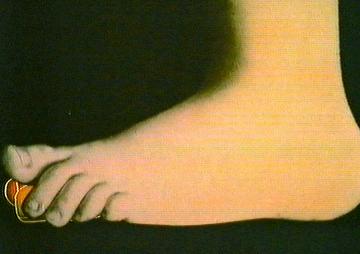
Wait just a darn second...it's February 29...and you know what that means...
...It's the leap-feast of St. Flutius of Bologna! That is, the (utterly fictitious) patron saint of the left ankle and origin of the the (surreal) rationale behind the Shrine's equally surreal name. Break out the ankle chaplets and mortadella! It may be Lent, but this is a huge excuse to par-tay! Happy Anklemas, everybody, and let's not forget to sing our favorite Flutius Carols:
Here we go a-Whapping
Among those trees so bare,
Here we go a singing,
That what they did to Flutius simply ain't fair.
Good Metatarsils to you,
And a happy Whapping too,
And St. Flutius keep you and free you
From all athlete's foot,
And St. Flutius keep you
From all athlete's foot.
Incidentally, this reminds me of my favorite Ash Wednesday Carol, ascribed to our favorite priest-turned-chimney-sweep St. Rodney. Here's one modern translation Becket and I worked out from the fourteenth-century Middle English:
I'm dreaming of a purple Lent
Just like the Lents I used to know,
When ashed foreheads glisten
And confessors listen
To hear crotalii in the pews, the pews...
Okay, time to take my medication.
Mary's Fiat

Fr. Jim already blogged this new classic from
The Curt Jester, but it was so good I had to include it again here. I especially appreciated the rosary over the rear-view mirror.
Fr. Jim already blogged this new classic from
The Curt Jester, but it was so good I had to include it again here. I especially appreciated the rosary over the rear-view mirror.
Saturday, February 28

The Highest Praise the Shrine Has Received to Date
It wasn't from Commonweal, or from Fr. Sibley or even Fr. Jim, but from fellow Hapsburgophile Mr. Otto Hiss, who, in an expansion of my post of il Superpapa which uncovers as-yet-unknown papal hijinks from the Pacelli years, memorably calls us "an Ultramontane Monty Python troupe." Jawdrop! When we redesign the sidebar, trust me, that's going in there next to earlier lauds like Scipio's "In der katholischen Weblog-Szene hat sich blitzschnell," which is equally Germanic but slightly more incomprehensible.
Friday, February 27
More Quotes Recorded by my Arkie Friend S.
Amusements heard in Rome:
Deacon Dave: What was your paper on infant baptism called?
John the Seminarian: [It was] Burn, Baby, Burn.
Prof. Duarte on the Society of Jesus:
“Jesuits know how to have fun.”
“Given the decoration of this church, it is safe to say God was a Jesuit.”
(I won’t dignify that last one with a response.)
“This week’s class theme was ‘places St Andrew’s head has been.’ ” (S. describes Duarte’s class.)
“I keep expecting Padre Pio to tell Luke to use to the force.” (Me, on the subject of the seer of Pieceltrina’s eerie resemblance to the late Sir Alec Guinness)
Prof. Duarte: Does anyone know what ‘Alhambra’ means?
Student: Rug?
Prof. Duarte: Close, but ‘Red Fortress.’ They both start with R.
First Student, after misreading some church iconography: St. Peter was a Nazi?
Second Student: No, the Etruscans were Nazis.
“This is typological brooding artist bullshit. He killed himself and burned his drawings. What a dumb-ass.” (Prof. Duarte commits sacrilege against the name of Borromini)
And lastly, on the matter of how to properly celebrate the Solemnity of the Immaculate Conception:
Me: I love being Catholic. You get to paaaaaaaaaaaartaaaaaaay.
Alejandro: You say potato, I say vodka.
Me: I mean come on, Catholics invented beer.
Well, it’s true.
Amusements heard in Rome:
Deacon Dave: What was your paper on infant baptism called?
John the Seminarian: [It was] Burn, Baby, Burn.
Prof. Duarte on the Society of Jesus:
“Jesuits know how to have fun.”
“Given the decoration of this church, it is safe to say God was a Jesuit.”
(I won’t dignify that last one with a response.)
“This week’s class theme was ‘places St Andrew’s head has been.’ ” (S. describes Duarte’s class.)
“I keep expecting Padre Pio to tell Luke to use to the force.” (Me, on the subject of the seer of Pieceltrina’s eerie resemblance to the late Sir Alec Guinness)
Prof. Duarte: Does anyone know what ‘Alhambra’ means?
Student: Rug?
Prof. Duarte: Close, but ‘Red Fortress.’ They both start with R.
First Student, after misreading some church iconography: St. Peter was a Nazi?
Second Student: No, the Etruscans were Nazis.
“This is typological brooding artist bullshit. He killed himself and burned his drawings. What a dumb-ass.” (Prof. Duarte commits sacrilege against the name of Borromini)
And lastly, on the matter of how to properly celebrate the Solemnity of the Immaculate Conception:
Me: I love being Catholic. You get to paaaaaaaaaaaartaaaaaaay.
Alejandro: You say potato, I say vodka.
Me: I mean come on, Catholics invented beer.
Well, it’s true.
Just in time for the Lenten festivities, everybody's favorite Hohenzollern (or is it Hapsburg?) posts T.S. Eliot's grand Ash Wednesday over at Otto-da-fe.
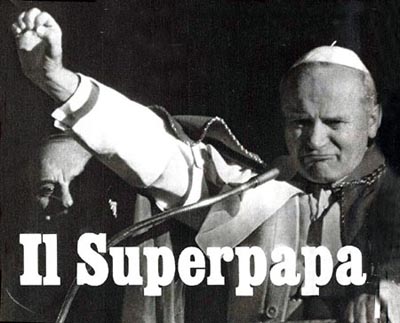
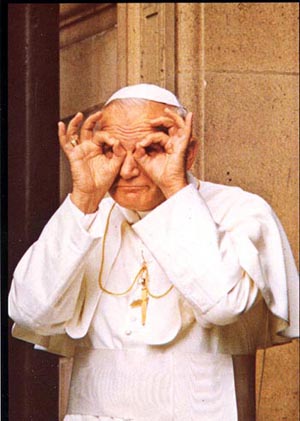
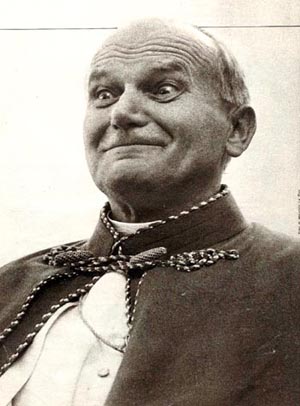
Super Pope: Need I Say More?
Okay, while the folks at Tradition in Action are somewhat on the humor-impaired side (jaw-drop!), I still have to give them kudos for digging up the wonderful photograph posted above. Even if their intent wasn't quite as benevolent as mine is now (oh come now, so what if His Holiness is enjoying Himself?), I forgive them. Primarily because they seem to like my ancestor Blessed Charlemagne and my favorite Brazilian Monarchist, Prof. Plinio Corrêa de Oliveira. While you're at it, have a look at these delightful shots of the Sovereign Pontiff. Hey, it may not be the Pacelli touch, but it's still just as cool. JP Two, we love you!
Thursday, February 26

Brother Martin's Problem
The indispensable Cardinal Ratzinger Fan Club Blog features a salutary article on Luther's scrupulosity, the forgiveness of sins and trust in God's mercy. It makes for fascinating reading, especially given my schizophrenic relationship with Luther.
I'm as triumphalist as Trent but yet I enjoy a Lutheran hymn as much as the next Lake Wobegonian--and may I remind you, a seventeenth-century Lutheran service had more Latin in it than an American Catholic mass today. But it's not just a matter of music or liturgical aesthetics. I've always felt Luther was more of a sad figure than a contemptible one, for all the troubles he brought upon his Mother, the Church.
In some sense, he couldn't help himself. He had a dark and gloomy Teutonic mind obsessed by superstition, werewolves and scatological diatribes. Some people paint him as the first modern, but I think he was, in his own strange and sad way, the last medieval. I should elaborate on that and say his was the mind of the plague-ridden, death-obsessed fifteenth century rather than the glorious, gilded, Thomstic thirteenth; his was the dank halloween Gothic of twisted dead trees rather than the gaudy carts and rainbow robes of the great Mystery Plays.
Considering Luther belonged to neither time and had the bad luck as a man out of time to be stranded in the hedonistic and Machiavellian High Renaissance, his sad rending of the Church's unity takes on a sense of tragedy rather than malevolence. It seems Luther, poor, pitiable Luther took Ein feste Burg ist unser Gott to mean God's warm embrace was as comfortable as sitting on cold stone, not that the Lord as permanent and mighty as a mountain. "Divine mercy trumps divine justice," as the ingenious gentleman Don Quixote de la Mancha said once.
While perhaps there's those of us who need to remember God's justice, the flip side of the coin is just important lest we think God's oceanic grace insufficient to heal us. While I'm not suggesting we kick off our shoes, stuff ourselves silly or put our feet up on the ottoman this Lent, it's still an infinite comfort amid the sackcloth and ashes. To quote Luther himself, grasping for the truth even amid his own personal nightmares:
And though this world, with devils filled, should threaten to undo us,
We will not fear, for God hath willed His truth to triumph through us:
The Prince of Darkness grim, we tremble not for him;
His rage we can endure, for lo, his doom is sure,
One little word shall fell him.
Perhaps what he didn't realize is sometimes that little word is simply Confiteor.
Wednesday, February 25

Looking for Borromini
Part II: Solomon’s Seal, or the Cube and the Sphere
Matt continues his meandering journey through the life of the tragic architect Borromini, his great obsession with Solomon’s Temple and other the artistic and theological issues of the Counter-Reformation.
The next day at the library, it rained, and I strolled around campus inhaling the sweet smell of damp grass, pleasant decay and ozone. Ferns clustered on the overhanging live-oak limbs, while off in the distance above the red-brick Gothic campus buildings, a gash of blue sky had opened. I found my mind wandering.
I’d spent the previous summer working on a vast watercolor rendering of the Temple of Solomon commissioned for a book on church architecture. I’d come to the FSU library as part of my search. The reconstructions I’d finally selected showed a remarkable Assyro-Babylonian fantasy of scarlet winged cherubim and lapis-lazuli tile, crowned by a vast tiered porch almost two hundred feet high. It looked more like a ziggurat out of Abraham’s Ur than the humble abode familiar to us from protestantized Bible illustrations.
There are about a million different versions of what Solomon’s Temple might have looked like. None of the modern archaeologists agree, naturally, and neither did the artistic greats and antiquarians who’ve tackled the problem over the centuries. Designs range from the prosaic to the bombastically ludicrous, some with steeples that look like St. Martin’s-in-the-Fields or others with vast above-ground sub-basements out of Bladerunner. Yet others, less imaginative and more archaeological, are unpromising pseudo-Egyptian affairs stuffed with random cherubs that seem too dryly accurate to be real.
The version I’d selected as the basis for my drawing had been drafted with beaux-arts precision for, of all things, a Biblical theme-park planned for 1920s Philadelphia. It seemed to square with the biblical descriptions, had some historic kudos behind it, and the elaborate iconographic program seemed suitably Catholic enough. Plus, the copyright had presumably run out by now.
But seriously. Solomon’s Temple, home of the old covenant, might seem an esoteric place to begin the study of church architecture, but for the architects of Borromini and Borromini’s generation, the complex fascination with this strange and wonderful structure was the be-all and the end-all. The Solomonic problem was the union of two great Renaissance obsessions, transformed but perhaps not wholly pietized by the mission of the Catholic Reformation.
The hierarchy, that sea of bobbing white mitres sitting enthroned in the stark duomo in Trent, was faced, in church after church, with the last two hundred years’ attempt to baptize antiquity. Had this conversion of the spoils of paganism allowed, in that infamous turn of phrase, the smoke of Satan to mingle with the incense gathering beneath della Porta’s great dome at St. Peter’s?
The Council fathers turned momentarily to austerity, recalling the simple icons of early Christianity. The vast, travertine churches that began to rise over the tiled rooftops of Rome were austere preaching-halls for the new orders of Theatines, Jesuits, Barnabites, the purity of the ancient church recalled in their simple stone Christograms and intertwined martyr’s palms. Offensive and exhibitionist plans with their centralized and a-liturgical dispositions were banished in favor of the simple Latin cross, with its prominent altar and grand processional nave.
Yet, the world of the classical, the world of the divine sphere rather than the divine trinity, lingered even in the forms of the Corinthian pilasters that decorated the dour facades of so many of these new basilicas, remained suspect even in its simplest form. The rising generation to which Borromini would belong would rediscover ancient classicism in a new and different light, cleansed by the flames of the Holy Ghost that would be depicted in stucco and gilt in so many frescoed lanterns of the next hundred years. Strangely enough, though, the ultimate roots of that new purgation would come from an unexpected and perhaps suspect corner of the Western mind.
While its roots were ostensibly Biblical, there was another influence, that of the world of the alchemist, the esotericist who revered the divine cube of the new Jerusalem of Revelation, the nine-square taxis of Solomon’s Temple.
The Christian intellect in history has sometimes had an uneasy relationship to its Judaic origins. St. Jerome befriended rabbis in his scrupulous search to discover the significance of every last yod as he transmuted Hebrew into the Vulgate at his hermitage in dusty Bethlehem, but not long after, St. Augustine had only felt it necessary to use Latin in his pursuit of the truth.
As the Renaissance approached, intellectuals threw off, for better or worse, medieval decorum and caution and turned once again to the calligraphic black flammules of the Hebrew alphabet. A small group of ecstatic rabbis, scattered across Spain, Provence and Germany, had long proclaimed that the very shapes of the letters were sacred and contained the secrets of the universe revealed to Adam, Seth and Abraham. Kabbala, they called it, meaning tradition, from the handing-down of this secret teaching through the centuries. Supreme power might be theirs, if only they could find the correct combination, the correct sequence of yods and taus and alephs that made up God’s secret name.
Gentiles started to listen to this group on the fringe of Judaism. There was always the deep-down feeling that perhaps the wandering, homeless Jews hadn’t quite told them just everything about their secret and sacred tongue, presumed by many to be the language Adam had spoken in paradise—or perhaps its simplified offspring from which the new and perfect tongue could be resurrected. Babel might have broken that linguistic ideal, but Zion could reanimate it by the kabbalistic power of the letters.
Christian scholars thus went back to the original Hebrew. Sometimes it was for sincere reasons of translation and truth, but just as often it was for disturbing and nearly magical purposes. The pseudo-scientists of Germany ransacked Hebrew lore for talismans and studded their weighty tomes with Solomonic seals and sinister pentagrams that had supposedly passed down through a chain of obscure and heterodox adepts from the hand of shadowy and suspect figures like the spurious Archangel Raziel. Surreal linguistic gymnasts set out to prove spurious etymologies, trying to claim that Kabbala actually meant the name of Jesus Christ in Hebrew. In sunny and seemingly sane Italy even Pico della Mirandola’s attempt to Christianize the Kabbala resulted instead in a Kabbalization of his Christianity.
The Judeomania of the sixteenth and seventeenth centuries bore more wholesome fruit as well. While brooding and dark Philip II of Spain had been touched by the alchemical gold-bug, the specter that had lingered behind Paracelsus’s ravings and Cornelius Agrippa’s tables of astrological signs, in his case it became something far more grand and sane and Catholic in the form of the Real Monasterio de San Lorenzo de la Escorial. It was the monastery of St. Lawrence of the Gridiron, conceived in the image of the God-given plan of Solomon’s Temple.
The sordid Gentile occultists of Trier and Prague might have scrambled to find dark double-meanings in the simple sanity of language, but Philip had simply trusted and taken scripture at its word in the description of Solomon’s real temple and Ezekiel’s visionary sanctuary. Indeed, four hundred-odd years later, Errol Flynn would die at the Escorial while filming a grand black-and-white biblical epic entitled Solomon and Sheba. Philip’s great reproduction had become, in a weird pre-post-modernist twist of fate, the thing itself.
Here was a true new beginning, a true divine font for the architecture that Rome was struggling to re-Christianize. After all, it came neither from suspect occultists nor hedonistic demi-pagans. It was the mother taxis, confirmed by God’s own word.
In Part III, we return to the Escorial, chat with a bishop on the fringe of the Church who wrote rules on how to break the rules, and walk amid the seraphim of Borromini’s greatest achievement, the Solomon-inspired Lateran Basilica, an achievement tainted by a brutal beating and murder—at Borromini’s own hands.
For the Italian in All of Us
Italians vs. Europeans
Matt, this one's for you. And for anyone who hasn't been to Italy or doesn't know any Italians, take my word for it: these are all so true it's scary. Ma scherzo cari, scherzo.
Italians vs. Europeans
Matt, this one's for you. And for anyone who hasn't been to Italy or doesn't know any Italians, take my word for it: these are all so true it's scary. Ma scherzo cari, scherzo.
Saint Rodney, Patron Saint of Ash Wednesday

Saint Rodney distributes penances to the children of London on a snowy Ash Wednesday morning.
Everyone loves Ash Wednesday, but who knew it had its very own patron saint? Saint Rodney, you see, was an English priest in the 14th century who doubled as a chimneysweep in order to raise funds for his poor parish. Thus, it is unsurprising that he would have been associated with Ash Wednesday, especially considering his major miracle, the "multiplication of the ashes" at a church running short of the important sacramental. Now, legend has it that if one is really contrite to start off Lent, Saint Rodney will come and hear his confession, and if it is a good one, will give him a BIG penance! (Like getting a pony for Christmas!) And if you don't have a chimney, don't you worry, because Saint Rodney, like his pal Saint Nicholas, is quite happy to use the door, if necessary.
Let us all praise Saint Rodney in song (To the tune of "From All Thy Saints in Warfare"):
All Praise to you, Saint Rodney, you were a Chimney Sweep,
You Heard the guy's Confession, when he was in too deep.
And now you come Ash Wednesday to hear us tell our sins,
So that we might be holy and purified within.
Saint Rodney distributes penances to the children of London on a snowy Ash Wednesday morning.
Everyone loves Ash Wednesday, but who knew it had its very own patron saint? Saint Rodney, you see, was an English priest in the 14th century who doubled as a chimneysweep in order to raise funds for his poor parish. Thus, it is unsurprising that he would have been associated with Ash Wednesday, especially considering his major miracle, the "multiplication of the ashes" at a church running short of the important sacramental. Now, legend has it that if one is really contrite to start off Lent, Saint Rodney will come and hear his confession, and if it is a good one, will give him a BIG penance! (Like getting a pony for Christmas!) And if you don't have a chimney, don't you worry, because Saint Rodney, like his pal Saint Nicholas, is quite happy to use the door, if necessary.
Let us all praise Saint Rodney in song (To the tune of "From All Thy Saints in Warfare"):
All Praise to you, Saint Rodney, you were a Chimney Sweep,
You Heard the guy's Confession, when he was in too deep.
And now you come Ash Wednesday to hear us tell our sins,
So that we might be holy and purified within.
Tuesday, February 24
The Question We All Ask...
Do Sundays in Lent count??
A fair, balanced perspective by Fr. Hamilton.
I say they do. Leaking out on Lenten sacrifices is for the weak ; )
Do Sundays in Lent count??
A fair, balanced perspective by Fr. Hamilton.
I say they do. Leaking out on Lenten sacrifices is for the weak ; )
In the News
Annuntio vobis gaudium magnum. Habemus scaenam!
I was paging through the latest edition of Commonweal, only to discover an article entitled St. Blog's Church, by one Rachelle Linner, commenting on the proliferation of Catholic blogdom. A quick quote:
"Given that their generation has little fear of technology, numerous college students maintain blogs; of note is the Shrine of the Holy Whapping by 'Catholic Nerds' at Notre Dame."
9 months ago, I don't think any of us anticipated a citation in one of the most circulated Catholic periodicals..!
Reading the article, however, one notices an unfortunate bias with which Linner paints St. Blog's -- essentially calling the vast majority of blogs a reactionary phenomenon. In this I think she is being somewhat dismissive; at any rate, I hope that label is not confused with our Shrine by association.. We've blogged more about the power of Cheese than Church politics. Yet one gets the impression that Ms. Linner would be a bit stunned that a member of St. Blog's would even have a subscription to Commonweal. Despite, in my opinion, her tendency to create an exagerated dichotomy in the Church (does a preference for, say, incense, truly constitute a "Catholic culture war"?), it was still quite interesting to read about St. Blog's on the printed page.
Annuntio vobis gaudium magnum. Habemus scaenam!
I was paging through the latest edition of Commonweal, only to discover an article entitled St. Blog's Church, by one Rachelle Linner, commenting on the proliferation of Catholic blogdom. A quick quote:
"Given that their generation has little fear of technology, numerous college students maintain blogs; of note is the Shrine of the Holy Whapping by 'Catholic Nerds' at Notre Dame."
9 months ago, I don't think any of us anticipated a citation in one of the most circulated Catholic periodicals..!
Reading the article, however, one notices an unfortunate bias with which Linner paints St. Blog's -- essentially calling the vast majority of blogs a reactionary phenomenon. In this I think she is being somewhat dismissive; at any rate, I hope that label is not confused with our Shrine by association.. We've blogged more about the power of Cheese than Church politics. Yet one gets the impression that Ms. Linner would be a bit stunned that a member of St. Blog's would even have a subscription to Commonweal. Despite, in my opinion, her tendency to create an exagerated dichotomy in the Church (does a preference for, say, incense, truly constitute a "Catholic culture war"?), it was still quite interesting to read about St. Blog's on the printed page.

Looking for Borromini
Part I: Narwhal Spires on the Road to Babel
It’s a bit ironic to travel four thousand miles in order to research the history of a building two minutes walk away from your school-desk, I thought as I headed to Strozier Library. Strozier faces a big, grassy quad in the heart of Florida State University in my very own home of Tallahassee. And I was spending the first weekday of my vacation here to uncover the arcane secrets of Sant’ Ivo della Sapienza, the meerschaum-white church whose narwhal-cum-Dairy Queen spire slips past me almost every day in Rome as I walk from my hotel to our studio in the Via Monterone.
It was, for all the redundancy of my visit, a beautiful morning. The sun was dappling on the grass, the air was alive with the sound of construction equivalent and there was even a pleasant homeliness to the uninteresting brick buildings that stood half-hiding behind nests of Floridian foliage. It’s strangely therapeutic to be around so much green after two months in Rome’s travertine jungle.
Rome’s a city of stone and stucco, and the slightest invasion of sap and branch seems strangely scraggly against the white-marble acanthus of so many Corinthian columns. They seem fig-leaves against Rome’s heroic antique nudity, masking some gap in the urban fabric, some Mussolinian disembowelment or Savoyard imitation Champs-Elysees. They seem faintly comic, like the weeds that must have grown in the Forum when it was known, as on the eighteenth-century Nolli plan, simply as the Campo Vaccino, the cow pasture.
FSU, on the other hand, runs riot with real foliage. Sometimes it’s covering up the fact that the buildings on this side of campus are ugly red-brick Miesian contrivances, lacking the crocketed and floriate Jacobethan nicety of the older dorms. Still, today I’m inclined to smile on this architectural dubium. I don’t know what it is, but I’m liking this place.
I find myself glad to be back on campus, even if it isn’t my own. For one thing, I’m finally old enough not to get weird stares from the students in the copy-room when I haul down my research to the sacrosanct Xerox sanctuary on the second floor of the ungainly and anti-classical brick box that FSU uses to imprison its sacred texts.
I hauled my parents over here once in eighth grade to dig up info, of all things, on Pope Pius VII for a novel that I planned to write and which never got beyond about chapter six—and on top of that, I’d never gotten to starting chapters two or three in between. I’d largely forgotten about the place until last year when I’d ferreted out info on Solomon’s Temple for an architectural rendering I’d been asked to deal with over the summer.
And now I’m back. Something about the monologue running in my head and the eager young minds flashing past me en route to class or clustered around the steel-tubing picnic tables makes me feel like I’m at the beginning of a movie or a WB sitcom. Maybe I’m the comic relief; I’m not normal enough to be the everyman hero. Come to think of it, though, the library’s not American Gothic enough to be in a movie. Even in Rudy they used the Law Library when good old Notre Dame’s Hesburgh Library with its trippy sixties Diego Rivera-meets-Vasco de Gama mosaics didn’t prove photogenically hoary and academic enough.
The computer lab seems to be almost completely full. An Chaldean-looking young woman in a loud headscarf is reading a website detailing Islam’s doctrinal bloopers, while another coed has something up with the mysterious sub-heading of “Get Sexual.” I choose not to enquire and find an empty seat around back. After ransacking the electronic card-catalogue, the first sentence of the relevant tome I find in the NA 1100s shelf will ask me, “Why read a book on Borromini?”
It’s a reasonable question. Borromini. Francesco Borromini, 1599-1667: Italian Swiss by birth, Roman by death. Stonecutter by necessity, architect by vocation and pride. Cavaliere of the Order of Christ. Killed by his own hand, absolved of his sin before he bled to death. Buried in consecrated ground at San Giovanni dei Fiorentini near the end of the old Via Giulia. His body rests under a simple marble slab a few feet away from the altar and the grave of his mentor Carlo Maderno. Generally called a Gothic barbarian by his contemporaries, a madman by scholars, and the greatest architect of the Roman baroque by history.
Something about this man’s tortured life and effortless genius fascinates me, whether for morbid or wholesome reasons, I can’t say. Even back before I could tell him apart from the other nebulous panoply of goateed genius that surrounded settecento Rome I was clumsily copying the bizarre snail-shell spiral of the church of Sant’ Ivo, his greatest work, in grandiose sophomore projects.
In short, before I knew Borromini, I was Borrominian.
We have a strange sort of friendship, Francesco and I. His troubled brown eyes and aristocratic mustache stare down at me from a postcard taped up over my desk, the crusader’s knightly cross displayed on the silken folds of his mantle. No matter where I wander in Rome, Borromini’s mathematical and deviously exhibitionist curves eventually catch up with me. His Solomonic cherubim gaze down curiously at me from beneath a high undulating cornice as I walk to school. On my weekly stroll up the Via XX Settembre, the bizarrely contorted front of his church of San Carlino lurks over my shoulder at the Quattro Fontane. His memory haunts even the closest evening mass to my hotel, the vast dome of Sant’ Andrea delle Valle designed by his hand. Sometimes, despite the rushed penitence of his death, I wonder if perhaps his soul still dogs my steps.
On the other hand, the card-catalog entry on the computer in front of me is not helping much. Old Borromini is, for once, evading me. I was hoping to find art-historian (and, apparently, Soviet spy) Anthony Blunt’s great work on the man here, but it appeared to be on loan until March 8. Perhaps they have it at Patrice Lumumba U in Moscow.
Meanwhile, as I scan down the 15 titles on the menu, I’m faced with irrelevant extravagances with German jawcracker names like Fünf Architekten aus fünf Jarhunderten: Zeichnung von Hans Vreideman de Vries, Francesco Borromini, Balthazar Neumann, Hipoyte Destailleur, Erich Mendelson: Katalog zur— Oh never mind. He’s in there, but only if you can pry him out with a Teutonic crowbar. There’s also a book by Borromini himself, but it’s also equally unpromising, as it’s also only available in a German translation. On the other hand, he was born in Switzerland, after all.
Even more extraordinary is another title I find, a pamphlet dated 1669 (by one Elizabeth Atkinson, curiously enough) with the occult and conspiratorial title of Breif and plain discovery of the labourers in mistery, Babilon, generally called by the name of Quakers with a discription of how the subtile serpent deceived them and made them proud boasters, calling the tower of Babel, which they are building in their imagination, Mount Zion, and so on and so forth for what seemed like pages. It seems apparent to me that the FSU web catalog was not my friend in my endeavor.
Or was it?
Proud boasters. Babylon. Tower of Babel. Mount Zion. Occult and conspiratorial. Atkinson’s work might not have a direct connection to Borromini, but she, however unconsciously, had brought together the two great symbols of his life. Zion—Jerusalem—Temple. Temple Mount. The Temple of Solomon, the object of Borromini’s greatest obsession. And Babel, the mount of human futility and despair, the despair that killed the great artist. And thereby hangs a tale of theological mystery, esoteric experiment and even a murder, that, in the end, would enfold all the courts of Europe and direct the fate of the Catholic Church.
Read on in Part II as Matt discovers the Solomonic problem, meets two eccentric and long-dead Jesuits, pays a mental visit to the Escorial and finds out what Philip II of Spain, Errol Flynn and St. Lawrence have in common.
Quotes from Rome
My friend S. has been compiling various amusing remarks overheard over the last semester or so among fellow arkies, professors and our various seminarian pals. Here’s a representative sampling. Names have been changed to protect the guilty.
“To collect the strange animals was trendy.” (Prof. Marconi, on ancient Roman pets)
“He’s an Italian-American seminarian gigolo.” (John the Seminarian, on a classmate)
“Italian grocers are genetically deficient.” (The inimitable Fr. O.)
“Are any of you ordained Jesuits?” (Prof. Duarte, being charmingly irrelevant)
Prof. Marconi discusses politics: And if you look to your left you can see the ugly facist building.
“Jesuits know how to have fun.” (Prof. Duarte)
Prof. Duarte: I’ve never seen an episode of The Simpsons.
Student: But, but, but...how do you know anything, then?
Prof. Duarte: Who told you I know things?
John the Seminarian on his calling: I’m a seminarian. That means I have a big long title, lots of ugly clothes, and very few responsibilities.
“The Counter-Reformation was similar to Notre Dame recruiting.” (Prof. Duarte)
And lastly, for the wall of shame, this anonymous quote:
“Being in Italy is like living in Olive Garden.”
My friend S. has been compiling various amusing remarks overheard over the last semester or so among fellow arkies, professors and our various seminarian pals. Here’s a representative sampling. Names have been changed to protect the guilty.
“To collect the strange animals was trendy.” (Prof. Marconi, on ancient Roman pets)
“He’s an Italian-American seminarian gigolo.” (John the Seminarian, on a classmate)
“Italian grocers are genetically deficient.” (The inimitable Fr. O.)
“Are any of you ordained Jesuits?” (Prof. Duarte, being charmingly irrelevant)
Prof. Marconi discusses politics: And if you look to your left you can see the ugly facist building.
“Jesuits know how to have fun.” (Prof. Duarte)
Prof. Duarte: I’ve never seen an episode of The Simpsons.
Student: But, but, but...how do you know anything, then?
Prof. Duarte: Who told you I know things?
John the Seminarian on his calling: I’m a seminarian. That means I have a big long title, lots of ugly clothes, and very few responsibilities.
“The Counter-Reformation was similar to Notre Dame recruiting.” (Prof. Duarte)
And lastly, for the wall of shame, this anonymous quote:
“Being in Italy is like living in Olive Garden.”
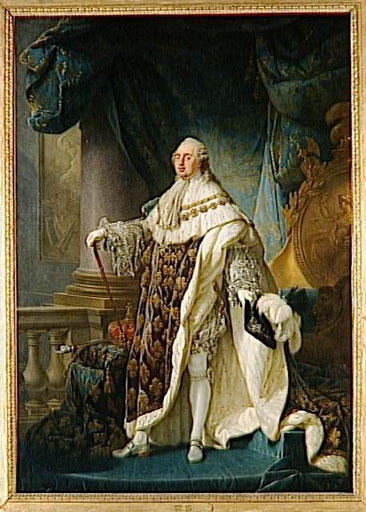
Monarchists and St. Ann's
Maybe it's proof of globalism or just head-spinning coincidence, but it's more than a little surprise not two weeks after a chance meeting with Mr. Theodore Harvey, monarchy- and music-enthusiast, while waiting in the dark in front of San Gregorio in Rome for a Latin Mass that turned out to have been cancelled, that I should discover everyone's favorite Rooseveltian conservative, Mark Sullivan, praising Theodore's monarchist reporting on Irish Elk, regarding the fascinating history and sad closure of St. Ann's Armenian Cathedral in New York.
(I dare someone to diagram that sentence.)
Anyway, perhaps I'm a less fervent royalist than I was in tenth grade, when my political affiliation was not so much Republican than Carlist. Sort-of. Or during freshman year at Notre Dame when I used to wear the Sacred Heart of the Vendée to parties and sing the Legitimist Marsellaise as I marched to class. Nonetheless, I still am perfectly happy to drink a toast to the true king over the water, make fun of Louis-Philippe's umbrella and wear a white cockade on Bastille Day. Le sangue des bleus rougira nos sillons, and all that. So, then, have a gander at Theodore's Royalty and Monarchy Page; anyone who likes kings and things and is a fellow Floridian has got a lot going for him already. And while you're at it, check out his story on the Requiem for Louis XVI at old St. Ann's, with a guest appearance from our friends at the Society of King Charles the Martyr and a Hapsburg archduke. Come now, we've all got a little monarchist inside of us, don't we?
Monday, February 23
You Know the Sibleys, but do you know the 2004 Victor is Awesome Awards?
As the Catholic blogosphere's resident Hiberno-Hispanic knight-errant, I resent not receiving the Most Quixotic award.
As the Catholic blogosphere's resident Hiberno-Hispanic knight-errant, I resent not receiving the Most Quixotic award.
Home Again
Well, so the architecture program three-week spring break begins. I'm spending the first two weeks back in Florida with my family; a well-deserved rest in the ancestral manse sitting by the fire and catching up on my blogging, writing, drafting and other projects academic, intellectual and pleasantly mundane. I won't say it isn't disorienting to see English labels on the Nutella in the pantry or realize the teller won't accept the Euros in my wallet, but I will say I'm glad to be back in familiar surroundings, if only for a little while. I've already done the inaugural bike-ride, nine miles. Great way to shake off the jet lag.
And so afterwards, it's back to Rome, where some of my blogging confreres (and consoeur Emily) and other representatives of Notre Dame's extensive Catholic Nerd community will be joining me for a wild and cuh-razy week of Roman church-hopping and gelato-consumption in the Eternal City. Yes, I know it'll be Lent, so we'll only eat purple ice-cream. Until then, it should probably be a quiet couple of weeks on this end, though I'm going to be on the blog plenty: expect follow-ups on my Roman adventures and posts on the down-home pleasures of the Florida panhandle. Also, I expect to be communing with my carnivorous side and eating plenty of that American red meat which seems to be so thin on the ground in fair Italia. Yum.
Well, so the architecture program three-week spring break begins. I'm spending the first two weeks back in Florida with my family; a well-deserved rest in the ancestral manse sitting by the fire and catching up on my blogging, writing, drafting and other projects academic, intellectual and pleasantly mundane. I won't say it isn't disorienting to see English labels on the Nutella in the pantry or realize the teller won't accept the Euros in my wallet, but I will say I'm glad to be back in familiar surroundings, if only for a little while. I've already done the inaugural bike-ride, nine miles. Great way to shake off the jet lag.
And so afterwards, it's back to Rome, where some of my blogging confreres (and consoeur Emily) and other representatives of Notre Dame's extensive Catholic Nerd community will be joining me for a wild and cuh-razy week of Roman church-hopping and gelato-consumption in the Eternal City. Yes, I know it'll be Lent, so we'll only eat purple ice-cream. Until then, it should probably be a quiet couple of weeks on this end, though I'm going to be on the blog plenty: expect follow-ups on my Roman adventures and posts on the down-home pleasures of the Florida panhandle. Also, I expect to be communing with my carnivorous side and eating plenty of that American red meat which seems to be so thin on the ground in fair Italia. Yum.
Thursday, February 19

The Skull on Jumping Jack Flash’s Prie-Dieu
It’s de rigeur, if I remember my awards banquet etiquette, to give a lengthy and sanctimonious speech whenever you get your little statuette. While my golden image of a knife-wielding Fr. Sibley must have gotten lost in the Italian postal system, it seems only appropriate to keep up the tradition in some form, being a stickler for propriety. Oh yes, and be sure to check out my green ribbon supporting the plight of the endangered aborigines of the Transylvanian rainforest. Aren’t I wonderful because I’m promoting awareness?
Never mind.
Writing for the Shrine has been a wonderful roller-coaster ride through my own slowly-maturing psyche and through about half-a-dozen other people’s minds. The Blog has really become a part of me, a cozy and familiar part of me. When we started out, it was fun. Just fun, for me, at least—a real lark, a jolt, an opportunity to have a go at sacred guerrilla theater among the big names like Fr. Sibley and Herr Doktor Viktor Lams. Like jumping Jack Flash, it was, as they say, a gas, gas, gas. We introduced the world to the cult of St. Flutius, the clerical rock group Vatican Airplane, and promoted Groucho Marxism. We even got censored. All in a good cause, of course.
There was a serious side to it all, of course, but it took me a while for it to sink in. I wrote plenty of cultural reviews, meditations on liturgy, and thoughts on theology, of course. Though it was always a sideline to something else, a divertissment, not part of some great plan. As the summer drew to a close and Rome began to loom large on the horizon, I realized, though, the Shrine could be something more, a real slice of my life to give back to my friends—and most importantly, my family, who would not see me for nearly three months straight as I roamed around the Italian peninsula. And a slice of life to give back to me to remember what I’d seen and done in this year abroad.
I’m slowly realizing I’ve changed this year in ways I have yet to fully realize. I’ve said before I skipped adolescence to some degree, long before I officially turned twenty-one. But it’s still taken me a long time to mature, and I know I have a long and hard road still ahead of me. But the Shrine taught me that I could do more with my talents than just amuse myself, It was providential—though I hate to use such a loaded and holy word—that the Shrine came into my life the year I spent abroad in Italy, away from family and my closest friends. I had to learn to live with myself, as well as with others.
I slowly learned that my little quirks, those enjoyable little gossipy vices and minor vendettas that we all struggle with, don’t have to be part of me. Some are harmless—like my very occasional and largely self-ridiculing participation in royalist politics—but some, perhaps, are more dangerous than they look. It takes a humility I still have yet to master to stop admiring them like the idiosyncratic and crotchety contours of the personality of a character in a novel or the comic relief in a play. I finally realized, at long last, that the fact I knew so many jots and tittles of obscure and arcane information, wasn’t worth a single cent on its own. It’s difficult, sometimes, and you risk falling in love with pure knowledge, or enjoying your gifts for their own sake rather than for Who Gave them to you. I still don’t pretend to have all the answers, or even all the questions, but at least I know I’m at the beginning and nowhere near the end.
It’s a start, anyway.
The Shrine has done so much good for me. It’s opened up new doors, found me new friends—sometimes more email buddies than this poor young fellow has time for—and reawakened my love of the romance of ordinary life. I used to love writing stories of mysteries and conspiracies, swordsmen and miracles, envying Borges’s weird corridors of thought and Umberto Eco’s contorted labyrinths of prose. I still love them and hope some day to return to those fertile—if gothick—intellectual stomping-grounds, but now, well, I long for something else, something sweeter and funnier, brighter and more mundane. Walking around Rome will do that. It’s easy to tell a tale of heroes and duellists, but it’s hard to capture the simple delight of a bell sounding the hours. You can lapse into clichés and toss in reams of Eliot and scraps of Latin, but I’m not sure that still gets us anywhere.
I have long called myself a Chestertonian, but I never drank deep enough of his great love of logic amid paradox. Perhaps I enjoyed the paradox too much, enjoyed the shadows and wild sunsets and the sharply-cut shadows, but I sometimes forgot the real logic at the head—and heart—of shabby little Father Brown which is the logic and romance of order and ordinary life, of things going right for a change. Sometimes I find myself wishing I could do something small rather than grand, write a short story in a paragraph or ape the simplicity of Garrison Keillor rather than my own baroque redundancy.
Though even then, Rome’s taught me to see the method amid the madness I so love, the geometry that manic Borromini wove in amid his curves and countercurves. The frosting’s fun, too, but it’s not much good without a cake underneath it.
In short, this strange conjunction of the Shrine and the shrines of Rome have slowly started to teach me to love things for their own beauty, not just because I happen to love them. I can’t say I’ve succeeded as yet, or know quite where to go or how to do it, but time (and God’s will, I hope) will tell.
Writing—and writing not just for myself, but for an audience—has enlarged me. I couldn’t close this meandering monologue without a word of thanks for everyone who has helped me, or who has let me help them. First, my parents, Michael and Silvia, and my grandmother, Rosy. Ironically enough, this long absence has brought me much closer, in a mature and enduring way, to them then I’d ever been before. Sharing with them my adventures, even at a distance, has made a deep relationship even deeper than I could have imagined. Second, all my friends on the Shrine, Dan, sweet Emily, Andy, and our two absentees Becket and Rich; while perhaps circumstances have not allowed us to spend the year together, the Shrine’s been a tether back to Alma Mater, which is in this case Alma Mater Redemptoris, Notre Dame.
The Shrine has kept old friendships, but it’s also given me new ones. I admired Fr. Sibley and Fr. Tucker, but now they’re my own confreres. Such high praise that they’d take notice of us is exciting, but it’s also more than just mere pride, I think. It gives me renewed faith in the catholicity of Catholicism, and, more importantly, the Church’s infinite variety, that out on the web you could find, united by faith, a priest who praises Marse Robert and listens to Corsican chant, a singer-songwriter family man-funny man, lovely Catholic musicians, a crotchety dead Athenian with a Matrix fixation, and a Theodore Roosevelt smells-and-bells Tory.
That I could trade words and ideas—be influenced, as well as influence—with this gallery of wonderful and varied types, has been an infinite treasure. And it’s not just been my fellow bloggers, but my various comments-box friends, who have enriched my life. The Shrine brought me together with a wise old veteran in Canada, and more closer afield, to a seminarian in my own adopted home town of Rome who, for all his proximity, I would have never met. A year ago, I would have said, thanks for letting me talk to you, but I thank you now, all of you, for talking back to me.
I know, it’s terribly mushy and navel-gazing, but someone’s got to do it. The Shrine’s still perhaps a bit of a Vanitatis vanitatum for me, and perhaps I need to keep a skull on my desk like the monks of old, for ascetic rather than aesthetic reasons—but it’s also been a great force for Providence in my life. Not too bad for something that’s just a gas, gas, gas.
Oh yeah, and I almost forgot. Let me draw your attention to this other ribbon on my lapel, the white one, which is protesting the plight of the starving French royalist émigrés of Southwark Borough—
Wednesday, February 18
There is no substitute for victory........

.............At least in the Saint Blog's Awards or "Sibleys," in which we took home "Best Presentation" and "Best Group Blog." Stay tuned for the underwhelming spinoff blog and the messy breakup.

Is the Holy Whapping destined to be critically acclaimed but unpopular?

Or will some members' support of Gregory XVII lead to another Western Schism?
Stay Tuned..............
.............At least in the Saint Blog's Awards or "Sibleys," in which we took home "Best Presentation" and "Best Group Blog." Stay tuned for the underwhelming spinoff blog and the messy breakup.
Is the Holy Whapping destined to be critically acclaimed but unpopular?
Or will some members' support of Gregory XVII lead to another Western Schism?
Stay Tuned..............

Notre Dame loves birettas: Our founder, Fr. Edward Sorin, CSC.
Latin under the Golden Dome?
Fellow Domer Mike Roesch asks, why not a regularly-scheduled Latin Mass for Notre Dame? This is more of a question for the current ND students who read this blog, but whaddaya think? Would anyone be willing to sign a petition? I know once I get back, I'd be willing to pitch in, especially if someone buys me a server's cassock and surplice. And sunglasses so I can occasionally say, "I know kung-fu." Wait, forget I said that, that's the Neo Ordo, not the Novus. Any aspiring acolytes out there besides me? Oh yeah, and a celebrant would be nice.
Seriously, an indult for the Tridentine mass would be a dream come true. It's not unprecedented: St. Elizabeth of Hungary Parish in South Bend has one every third Sunday of the month, I'm told. But that's probably too much too soon.
Still, even your basic non-indult Novus Ordo rite would be lots of fun and maybe we could even convince the sacristan to trot out some of those great old vestments gathering dust in the Basilica cupboards... After all, there's nothing forbidding birettas, sacring bells, ad orientem altars and lots of candles from the new rite, whatever the language. Pleasepleaseplease?
Twas the week before Lent...
and in preparation,
A 7-day,high-caloric feast --
to survive the starvation.
54 tickets were hung
on the bulletin board with care,
In hopes that Mel's The Passion
soon would be there.
And I in my hurry,
running hither and hence,
was caught quite off guard --
"What's this year's penance??"
And what to my wondering mind should occur,
but to ask "what do you sacrifice?"
of the entire blogosphere.
and in preparation,
A 7-day,high-caloric feast --
to survive the starvation.
54 tickets were hung
on the bulletin board with care,
In hopes that Mel's The Passion
soon would be there.
And I in my hurry,
running hither and hence,
was caught quite off guard --
"What's this year's penance??"
And what to my wondering mind should occur,
but to ask "what do you sacrifice?"
of the entire blogosphere.
Tuesday, February 17

English Catholic (not Anglo-Catholic) Eye Candy!
The Latin Mass Society of England and Wales kicks it up a notch with their new website. All your Tridentine, Anglophile needs in one convenient package.

Theological Arguments for Vote Fraud
Well, the hours are ticking down to the conclusion of the Sibleys. Mille grazie to everyone who voted for The Shrine--and those who still haven't made it to the polls, go forth and show the flag!
My fellow Roman (or ex-Roman) Don Jim just needs 2.8 points more to pull ahead of Father Sibley in the Best Blog by a Priest or a Religious category. They're both great guys. Tough choice, but may the best man win! Come to think of it, Fr. Bryce's own 0.6 point lead in Most Humorous could stand a little bit more of a boost! Never hurts. Come on now, folks, make sure that St. Blog's top padres come away with their very own statuette!
Though I'm a bit worried about that whole Sibley-Lams suicide pact...hmmm, vote for Herr Doktor Viktor too, while you're at it, just to be safe. That skateboarding Franciscan has to be a cry for help.
And if you feel like voting for us again, well, I won't complain. If you insist. And because of our belief in the resurrection of the body, well, we don't have any problem with dead people on the electoral rolls, either! (God forgive me).

A Bad Pope and a Resurrected Body at Dappled Things
Fr. Jim posts an astute homily from this last Sunday on the glorified body at the end of time. An excellent examination of our God-given and redeemed flesh. Also, be sure to read an entertaining excerpt from a new book on the Medici detailing Leo X's bellicose (and highly uncanonical) love of the hunt. Check it out. Oh yeah, and drop by cybercatholics.com and give him your Sibleys vote!
Monday, February 16

A Seacoast in Bohemia
Shakespeare, The Winter’s Tale, iii.3
I’m about as Slavic as the Dominican archaeologist Fr. Mullooly, but when I heard that the good Irish priests of San Clemente and the Colegio Nepomuceno, the old Bohemian Seminary, would be combining forces to celebrate the feast of St. Cyril and St. Methodius in the grand Roman manner, I suddenly felt in the mood to get in touch with my inner Czech.
Anyway, they were having refreshments afterwards. It beat having to join the dateless-and-depressed clique of arkies mooning about the studio that evening. Nobody else I could get hold of was interested in having an evening out with the Lord Cardinal Spidlik, S.J., however. Really, that’s what it said on the program, Signore Cardinale. More reason to like the old feller.
But I suppose the 95-year-old author of Fasting is the Prayer of the Body does not strike the average young adult as a party animal.
The feast of St. Cyril is the object of one of my little jokes. I’ve given up on Valentine’s Day myself; the martyr of Terni disappeared into the collective unconscious ages ago. I figure that all those eastern nationalities need their own ethnic holiday. Everybody’s a Slav on St. Cyril’s Day. All those pink roses, well, you could give them to your favorite Polish girl. We could serve vodka with red food dye in them and wear “Kiss Me, I’m Croatian” buttons (with inscriptions, naturally, in Old Church Slavonic).
Hm. Maybe not Croatian, that doesn’t sound right. Ukraine. Yes, Ukraine girls are much cuter. Ahem. Well, those Ukraine girls really knock me out / They leave the West behind / And Moscow girls make me sing and shout / That Georgia's always on my mind, mind, mind. Thus McCartney and Lennon. Look, you knew that was coming, right?
Rome’s full of these high-energy, high-liturgy parish festivals. Only last week I’d dropped by Santa Maria in Aquiro for Cardinal Innocenti’s celebration of Our Lady of Lourdes. The parish has the historic first image of the apparition to be venerated in Rome, and venerate it they did, with incense and a flock of white-surpliced assistants surrounding the Cardinal with a highly pre-Conciliar cloth-of-gold mitre flashing above his face. The thing had to be at least three times as big as his head. Great stuff.
Spidlik may be the only non-episcopal member of the Sacred College, but San Clemente rose to the challenge. Anyway, he still got to wear a mitre, a tasteful white-and-gold Norman affair. It suits him, I think.
I was slightly late, as usual, and found myself slipping in through the side-door of the ancient basilica. Wall-to-wall Slavs, old, young and medium. It was amazing, jaw-droppingly amazing. Incense shrouded the lofty sanctuary beyond the elaborately-marbled cosmatesque choir enclosure.
It also meant I would have to stand for an hour if I couldn’t snag a pew.
There were a few unclaimed benches in the choir, and plenty of laymen for camouflage. Next thing I knew, I was sitting directly beneath the ambo, surrounded by some impressively black-robed monks (Minims, I think), some bearded Slavic professor-types in overcoats and ties, and a flock of church ladies, some still beakily magnificent and others puffily red-eyed. Nuns with florid age-scored faces. And a very odd looking old gentleman with enormous and faintly entomological sunglasses and a Pace rainbow flag knotted around his neck like a scarf. I think he was slightly cracked, as he started gesticulating crankily at the fact I’d crossed one leg over my knee. Maybe a bit too casual for being in the presence of a cardinal, come to think of it.
The scene—oddball interlopers aside—was spectacular. The cardinal, in all his wizened, smiling glory, moved towards the great cathedra high in the apse beneath faded Byzantine apostles with faces like Romano-Egyptian tomb portraits standing beneath paradisical palm trees. The porphyry columns of the baldacchino were shrouded with incense, the chancel lined with ranks of white-robed clerics and surpliced clerks in immaculate surplices. The brown hoods and white capuces of Franciscans and Dominicans peeped above the necks of scarlet-orphreyed chausibles.
And then there were more exotic hints of the Oriental world that St. Cyril had brought into the fold of the Church among the dozens of concelebrants gathered beneath the whirling green mosaic tendrils of the great apse. I could glimpse long, Aramaic hair and wild mandrake beards, exotic and unfamiliar embroideries flashing gold and white, black robes and gold-encrusted stoles.
And up in the apse, standing at the Cardinal’s right hand was an Eastern hierarch, glittering with all the glory of heaven. His sakkos and broad pallium were richly brocaded, half-baroque and half-Chinese, gold and silver and sparkling stones. The gems and enameled saints of his domed mitre threw off dazzling sparks with every turn of his head. He looked like a mobile Fabrege easter egg or Tsar Nicholas II dressed as a disco ball. Or Christ the Great Archpriest, crowned like a king.
It was all fluttering and Byzantine, grave and glorious, rather than lacily baroque like Cardinal Innocenti’s mass had been, and wholly apropos to revivifying the memories of the eastern saint we had come to do our homage to at the court of heaven.
Soon, the Gospel came, the schola of the Bohemian College singing a deep-voiced and intricate hymn in Czech attributed to St. Cyril himself as the deacon and two taperers and a thurifer mounted the great marble ambo, light sparkling on his gold-spattered dalmatic. The censer seemed to resonate, ringing almost harmonically as metal clanked on metal and great clouds of smoke canopied the tribune. The candlelight flickered pinkly on the gleaming foreheads of the black-surpliced clerks crowding the ambo steps.
Spidlik gave the homily from the altar, lapsing into sharp-edged Czech about midway through, to the tittering of a couple of the Slav professors behind me. It’s strange to think it now, this convergence of history and grace in this little church, a successor to the apostles standing and preaching above the tomb of another successor to the apostles, St. Clement, whose proclamation of the Gospel—the Gospel we’d just heard—had landed him in the salt mines of the Crimea and earned him a watery grave in the murky depths of the Black Sea. And whose body had been brought back to his see of holy Rome by St. Cyril himself, buried beneath us, far beneath us, in the vaulted darkness of the crypt. Overhead, the old pope watched us wielding his fluked anchor with St. Lawrence with his exotic scarlet slippers warming themselves on a burning grid-iron ottoman and those even more ancient witnesses Peter and Paul, labeled in cosmopolitan Greek-Latin as Agios Petros and Agios Pavlos.
The Colegio Nepomuceno, the Nepomucenum, is named after St. John of Nepomunk, the Bohemian priest who defended the seal of the confessional with his life. He was thrown off a bridge, they say, for refusing to tell the King the confession of his Queen, and in art he is shown with a padlock through his lips. Death by water was all around us with its baptismal gleam, the anchor of San Clemente on the pilot-house-like baldacchino standing above me.
(Phlebas the Phoenician, a fortnight dead, / Forgot the cry of gulls, and the deep sea swell / And the profit and loss. / A current under sea / Picked his bones in whispers. As he rose and fell / He passed the stages of his age and youth / Entering the whirlpool. / Gentile or Jew / O you who turn the wheel and look to windward, / Consider Phlebas, who was once handsome and tall as you. Thus Eliot.)
I’d been here before. With another inheritor of apostolic grace, the genial Australian Cardinal Pell, the ex-rugby player saying mass above the foundations of a Mithraic temple, a temple for gladiators. He and Spidlik had been given the red hat at the same consistory. Now a Slavic cardinal was venerating the grave of his spiritual forefather, who in turn had venerated a pope who had preached the faith to the shedding of his scarlet blood, just like the oath that Spidlik had taken before the Holy Father himself.
We were together, in a vast hagiographic time warp. Like the sacred anachronism of the Mass, intersecting Bethlehem, Calvary and Easter Sunday all at once, watching St. Clement be hurled from that dread boat into the chill and deadly waters, watching St. Cyril resurrect him, watching cautiously from the coast with the Cardinal of a landlocked nation. Bohemia, like in great Shakespearean geographic chimera, had gained a sea coast which drained the Tiber.
The mass ended soon enough, and a procession formed up. Cross, candles, smoking censer and dozens of attendant priests. Dominican rosaries rattled under chausibles as the black-robed Ukrainian cleric fingered his pectoral cross on a no-nonsense steel chain. The disco-ball bishop’s mitre gleamed like a helmet of mirrors, the stiff embroidered lozenge swinging at his hip like a knight’s shield slung for the march. And then we went down into those vaults whose memory had so filled the liturgy, the crypt of the tomb of Cyril.
(The crypt that Fr. Mullooly, incidentally, had found. Go Irish.)
After an incongruous and short interlude passing through the closed-down gift-shop, we began to burrow into the earth, under pale stony arches and past faded frescoes of St. Clement’s legendary tomb beneath the waves. It had stood visible at low tide on the shores of the Crimea and the images showed processions back and forth full of candles, gleaming lamps and mitred pomp, just as we were doing. An amusement to postmodernists, life imitating art—but for us it was simply life as usual, the endless interwoven Celtic-knotwork world of Catholicism where history and reality blurred into one seamless whole.
Rather like heaven, I suppose.
Soon, we were clustered before the tomb, priests and clerks crowding in concentric ranks on the cardinal and the bishop as the cold blue electric light gleamed on vestments and bald pates. Around them, studding the flinty walls, hung commemorative tablets wild with foreign calligraphy, stone-cut Cyrillic and Roman Romanian, verdigrissed copper reliefs of St. Cyril and his fellow-worker St. Methodius in a monkish hood, massive mosaics and simple burnished bronze. And over the cool white marble slab of the altar, a portrait of the saint himself with age-bitten cheeks, with beard and high-domed head, and the most extraordinary eyes, searing and fierce and strangely serene all at once, like Byzantine Pantocrators were meant to be but never were. They read a chapter from the life of St. Cyril, full of praise and pious death, and after a hymn in melodious Czech—seemingly sung from memory—the cardinal and the bishop dismissed us with pontifical blessings, one Latin and simple, the other a complex and Byzantine two-handed gesture, magnificent and martial and ancient as Cyril himself.
And then we made our way up to the atrium, the old colonnaded atrium that stands beneath the church’s baroque façade and seems as welcoming and antique as the cloister of a California mission. The Colegio Nepomuceno was in charge of the spiritual banquet, but it had also been in charge of more physical sustenance afterwards. I’d been told that there’d be refreshments, but this was an understatement. Slavs of all ages crowded around four immense tables set up beneath the darkened arcades filled with vast spreads of breaded chicken, sweets, three or four oriental subspecies of poundcake, pastry-wrapped shards of sausage, wine, water (fizzante, bah!) and orange juice, apples and oranges. I slipped a Bohemian banana into my coat-pocket and got down to business.
I thought for a while I was the only American there. Everywhere were Easterners of all sizes and shapes: old and weathered; young and beautiful—including a mysterious olive-skinned young woman lurking melancholically amid the pillars (kiss me, I’m Slovak?)—clerical, lay, monastic. I fell in with a bilingual Czech in a cassock, a deacon who I’d recognized from San Gregorio’s Latin Masses, and traded precisely-worded comments back and forth until I ran out of food and energy. I excused myself and suddenly blundered into a North American College lector and his Ukranian seminarian buddy cheerfully sampling the wine.
It was wonderful, the fun only increased by the arrival of a Philippine student in training with the Minims—those impressive black-cloaked monks I’d seen earlier. All black, from hood to scapular even down to their cinctures. We bounced conversation off each other for hours, eagerly making return visits for more chicken and wine and cake. By the end of the evening, we were eating leftovers from a tray held by a laughing monoglot nun who seemed like an extra off of a Hungarian version of Father Ted. Now, what’s Magyar for Go on, go on, go on. Oh go on. More sandwiches?
Well, it’s a sin to waste food, my father always said.
Seriously, it was one of those great Catholic moments where the vastness and the smallness of the world collapse in on each other like a black hole and you trade jokes about Cardinal Ratzinger and Bishop Spong and Hans Küng at the pearly gates and everybody gets the punchline. Or you get fascinating stories about far-away hijinks on church-renovation scaffolds. Or you discover that you have a friend in common—albeit one that your new acquaintence met, not in Rome or Indiana but Lviv in the Ukraine, not far from the churning waters of St. Clement’s death.
Meanwhile, Spidlik sat in the corner under his red skullcap, cheerfully holding court.
I was expecting to be back by seven-thirty at the latest, but the time we parted ways as the last bits of pastry were devoured and the cobbled courtyard began to clear, it was almost ten o’clock.
I think I could get used to being Czech in Rome, at this sacred feast on the windblown Bohemian seacoast.
Sunday, February 15
Coming Attractions
Expect a full report on my adventures partying in the high Roman manner with the seminarians of the old Bohemian College and my main man the Lord Cardinal Spidlik on SS. Cyril and Methodius's Day. Gosh, those Slavs know how to put out a spread! Also, some meditations on my recent trip to the ruined Greek temples at Paestum, with a UFO sighting (uhh, sort-of) thrown in for good measure!
Expect a full report on my adventures partying in the high Roman manner with the seminarians of the old Bohemian College and my main man the Lord Cardinal Spidlik on SS. Cyril and Methodius's Day. Gosh, those Slavs know how to put out a spread! Also, some meditations on my recent trip to the ruined Greek temples at Paestum, with a UFO sighting (uhh, sort-of) thrown in for good measure!
Late, but in honor of St. Valentine's Day...
Professors' Definitions Of "What is a Kiss?"
My contribution:
Theology Professor - A kiss is an earthly foreshadowing, rooted in the almost sacramental experience of that nuptiality of the body which is so constituative of a true communio personarum, of the eschatological destiny of man with God.
Professors' Definitions Of "What is a Kiss?"
My contribution:
Theology Professor - A kiss is an earthly foreshadowing, rooted in the almost sacramental experience of that nuptiality of the body which is so constituative of a true communio personarum, of the eschatological destiny of man with God.
Saturday, February 14
I put this up in a comment box on Mark Shea's blog, and thought it worth sharing here.
P.S. Sorry for the light posting lately, 'twill resume when I'm a little less ... beleaguered here.
In answer to where the Whapsters are (in addition to what Andy said), the answer is, too busy with this to be blogging at the moment. The Queer Film Festival just "happens" to be timed to coincide with The Monologues, so it's been keeping alot of the solid Catholic students around here pretty busy between extra Rosaries, hanging up fliers, writing editorials, engaging in discussions, and basically anything we can do to change hearts. Your prayers for the effectiveness of our work are, of course, much needed in all of this.
Notre Dame has an amazing influence on American Catholicism, and the devil knows it. He can't afford to let this place go, and there is a real battle for the soul of this University underway. I think the homosexual community (not just here, but nationally) has taken our #1 "Alternative Lifestyles Not an Alternative" rating as a challenge: if they can corrupt this place, they can take almost anywhere. As always happens in spiritual warfare, even while morality is slipping on several fronts, the Faith is springing up stronger than ever. As a '78 alum told me the other day, "There were never people like you around when I was here."
So, I'd ask you all to pray for us here at ND, especially tomorrow (2/14) night, when we'll be praying a Rosary outside the VM performance for an end to violence against women. And remember that no matter what CNS lists we're on, there are still very many students here who remember that the Lady on top of the Golden Dome is crushing that snake.
P.S. Sorry for the light posting lately, 'twill resume when I'm a little less ... beleaguered here.
In answer to where the Whapsters are (in addition to what Andy said), the answer is, too busy with this to be blogging at the moment. The Queer Film Festival just "happens" to be timed to coincide with The Monologues, so it's been keeping alot of the solid Catholic students around here pretty busy between extra Rosaries, hanging up fliers, writing editorials, engaging in discussions, and basically anything we can do to change hearts. Your prayers for the effectiveness of our work are, of course, much needed in all of this.
Notre Dame has an amazing influence on American Catholicism, and the devil knows it. He can't afford to let this place go, and there is a real battle for the soul of this University underway. I think the homosexual community (not just here, but nationally) has taken our #1 "Alternative Lifestyles Not an Alternative" rating as a challenge: if they can corrupt this place, they can take almost anywhere. As always happens in spiritual warfare, even while morality is slipping on several fronts, the Faith is springing up stronger than ever. As a '78 alum told me the other day, "There were never people like you around when I was here."
So, I'd ask you all to pray for us here at ND, especially tomorrow (2/14) night, when we'll be praying a Rosary outside the VM performance for an end to violence against women. And remember that no matter what CNS lists we're on, there are still very many students here who remember that the Lady on top of the Golden Dome is crushing that snake.
Friday, February 13

The Alchemy of Modesty
Campania: Day Two, Part II
Many seek the Stone and know not what it is. The definitions which I know they give of it do furnish me with matter of laughter and compassion. To explain the effects of a thing is not to define it, one must declare the nature which produces those effects. That I may not leave you in this common error, I will let you know in what this essence does consist. The Philosophical Stone is a substance of the mineral kind, the most perfect that can be having in itself a most perfect mixture of the elements.
—Jean Albert Belin, The Adventures of an Unknown Philosopher, Paris, 1646.
It’s now a museum, with a ticket office built into the polished wood bussola set over the entrance. But the Sansevero Chapel, the work of the strange and genial Raimondo Sangro, Prince Sansevero, one-time Mason, alchemist and polymath, was meant as a place of prayer and contemplation amid the sepulchers of his ancestors.
It’s a nervous, hyperactive, baroque sort of concentration, suggesting a tumult of violins pressed to an impossible limit, a tiny space crowded with the twisting veins of amber-gold marble and undulating Corinthian capitals. And ivory-white putti bobbing weightlessly around solemn medallions of the Prince’s family, stonework spiritualized and transfigured—but never bodiless.
It’s transmuted, like one of the Prince’s strange and hidden alchemical experiments, gleaming polished marble incarnated as great splashes of angelic feathers, tangles of impossible and extraordinary netting, folds of flying cloth, taut heroic muscles and—and most extraordinary, the thinnest, most frail of veils. The veil over the entombed Christ, capturing within its folds the last breath of God.
They say the mysterious prince created his macchine anatomiche, his impossibly precise anatomical figures by a mysterious formula that petrified the living flesh of two unfortunate servants; it seems here that with the Veiled Christ of Giuseppe Sanmartino that the process has been thrown into reverse. Like all things baroque, it is a glimpse of a very physical, very real, very sensual paradise.
Et expecto ressurrectionem mortuorum et vitam venturi saeculi.
The great Canova said he would have given away ten years of his life if he could have been the sculptor of the Veiled Christ, and it seems worth giving up that time simply for the privilege of spending ten minutes gazing upon it in the swirl of tourists that crowd the tiny family chapel. His head slumps back on a tasseled cushion, miraculously worked in stone, His heavy-lidded eyes lost amid the gathering, intricate folds of the cloth that drapes Him from head to toe, clinging, perhaps bloodily, to the brutal gashes of His stigmata that one can barely glimpse beneath the gauzy pall. The tassels and the great sharp-spiked crown of thorns that coils like a dead serpent at one foot, shaded by impossibly deep shadows, are no less miraculous.
Beneath one nostril, both vague and perfectly-realized beneath the veil, the cloth momentarily leaps up, as if catching a tiny, incredibly tiny gust of air. Consummatum est.
The body of Christ is real. What we see before us as we lean over the rail—ignoring the signs not to lean over the rail—is the greatest argument against Docetism ever conceived, but not in words but stone. Only appropriate as Christ was a Word in flesh.
A few days ago, back in Rome, Vera headed up the first session of a Theology of the Body study-group, covering the Pope’s teachings on God and sex. It drew quite a crowd, as we traded thoughts back and forth on the body of Christ and the body of man, love and lust and spirituality. It’s a shock to some people to hear that the Church glorifies the body of man and the body of woman just as She adores Christ’s own incarnation. It’s a good shock, though.
Inevitably, though, the question of American prudery and European prurience comes up and circles round the room. Living half-a-year among Rome’s self-proclaimed—and highly voyeuristic—ladykillers, where photographs of nudes in impossible geometric positions are used to advertise clothes—go figure—and where obscenity lurks on every newsstand, you’re left with quite a few thoughts on the subject. There’s the old chestnut that Europeans are simply more comfortable with their bodies. It’s just those suppressed Puritan monomaniacs, up to no goodas usual, are dirtying something beautiful and completely normal. Full stop, plus a Gallic shrug for good measure.
I have my doubts that it’s so chauvinistically cut-and-dried. Though I’m no disembodied gnostic either. I feel wonderfully at home amid the incredible physicality of the feminine baroque beauty of Rome’s myriad churches. One of the most meditative mornings I spent in Rome was doing a life-drawing session in charcoal for an art class, and I found myself scribbling elaborate Latin tags on the tops of my drawings, Venite exultemus Domino. The human body, when seen with the eyes God wishes us to see it with, is almost blindingly glorious.
Maybe it makes me sound like a sacred lecher, but it’s all true.
It was a startling change from the worst afternoon of my life two years before, trying to do some sketches for a watercoloring course with a nude model who bulged in the most inappropriate places. My Latin motto for the day was Vanitatis vanitatum, if you’re interested. Ironically, the priest who taught us was probably the most relaxed person in that tense room.
Or perhaps not ironically. After all, isn’t one of the Papacy’s greatest treasures the Sistine Chapel, emblazoned heraldically with the heroic nudity of Michelangelo? In the Last Judgment, it is Christ, as gloriously embodied as a pagan Apollo, who is the hero, and Satan the villain, Satan the pure spirit. Spiritual things are sometimes dangerous things, vicious things. Powers and principalities, not mere flesh.
But yet, once we stand on this threshhold, imagining ourselves at the marble altar-step of Prince Raimondo’s fairyland sepulchre, we must pause and kneel as in the old rite of Trent. Does God want us to be comfortable with our bodies? Has prudish-Protestant America been beaten out by worldly-wise Europe once again?
No. God does not want us to be comfortable with our bodies. He desires something far better and beautiful: for us to be reverent with our bodies. And, more crucially, truthful.
There’s an unbridgeable gap between the chaste Christ enshrouded behind us and the vulgar pornography of the European newsstand. The body is a temple of the Holy Ghost, not a cocktail lounge. Sacred things are wonderful things, are beautiful things, are holy things. But when Christ asks if we can drink of the chalice that He drinketh from, He doesn’t expect us to take it home and sip our morning coffee out of it. The marital embrace is holy; parodying it is a blasphemy that endangers the primordial sacrament of Adam and Eve.
Raimondo is a strange figure to stand by as you contemplate this mystical web of theology. Prince Sansevero was educated by the Jesuit Fathers at the Clementine College and excelled in a thousand fields, from literature to law, heraldry to pyrotechnics, mathematics to philosophy.
And alchemy, of course. He delved into secret paths, into the anatomy of the body and into the ground beneath his feet as he compiled a Dictionary of the Earth. He even was granted permission to read books placed on the Index. In between all this, he invented an amphibious carriage and wrote a strange work entitled The Letter of Apology which reeked of the brimstone of heresy. His acession to the position of Grand Master of the Masonic Temple of Naples led to his excommunication by Benedict XIV. He somehow had his dread punishment revoked and returned to the Church’s maternal embrace.
A curious man to raise such a monument, but truth sometimes comes from strange quarters, from men who don’t even know they speak it. Perhaps.
Professor D. spoke up as we roamed around the chapel, full of noise and wonder, and pointed our gaze towards an ineffably beautiful figure of richly-shadowed white marble, shrouded and mysterious with the same aura of gauze draped from head to toe over an achingly graceful pose. Her head is tilted to one side, ever so slightly back, eyes almost pensive almonds glimpsed with precise vagueness through the shroud that clings humidly to the curves and hollows of her perfect classical figure.
She is the image of Modesty. The figure stands atop the cenotaph of Prince Sansevero’s mother, Cecilia Gaetani dell’Aquila d’Aragona, sciulpted with a relief of Christ appearing to Mary Magdalene, confident, distant and upright, the gardener’s shovel in his hand carried as triumphantly as a scepter. Noli me tangere.
Modesty. Hm.
Professor D. was skeptical, asking us with grand rhetoric whether perhaps this was merely a libidinous display of masked voluptuousness, but there was more here than mere baroque voyeurism. After all, wasn’t one of the chapel’s most delighted visitors the grotesque Marquis de Sade?
Modesty. She is the most fleshly of beings, but yet it would be a sacrilage to look upon her with unchaste eyes. There is the untouchable modesty of death and resurrection, the transfigured body of Christ more real than corruptable earthly flesh, of Platonic solidity and Thomistic aeviternity. Here, the resurrected body has become more solid than stone, enduring beyond time itself. Prince Sansevero may have only recalled the distant specter of his mother, beyond him in a youthful death that left her beauty untouched in his mind’s eye; but here, in this chapel, standing beside the turbulent altar-relief of the Entombment and beyond the effigy of the dead Christ, her image becomes something more, a sign pointing both to itself and outside of itself.
Sansevero, legend has it, created an ever-burning lamp in the true immortality-obsessed spirit of the alchemists. But it seems here, this irregular Catholic and part-time Mason might have just stumbled across the shadow of the true Philosopher’s stone. It’s not so farfetched. The Veiled Christ, while now displayed in the chapel, was originally meant to lie in the crypt, the heart of the earth which represents the alchemical mystery. Now the creepy macchine anatomiche stand there instead. Perhaps even Raimondo thought of it as he danced amid his steaming alembics, his sal armoniack and idolatrous azoth. For, in one of those antique alchemical texts that he might have read, the Adventures of an Unknown Philosopher, the last lines run thus:
See here, sirs, all my adventures in the search of the great work; you may if you please make your benefit of them, without its being necessary to write you any more. Farewell then, and permit me to go into my solitude, to think of nothing more but to die, to live in eternal day, and there to find another Stone, infinitely more rich, and more fortunate. Petra Autem Erat Christus.
Which means:
But the Stone was Christ.
Thursday, February 12
Bishop D'Arcy takes a stand on the Monologues!
"...Notre Dame on a number of issues, several of them related to Catholic teaching on sexuality, has taken positions which have often gone against the dominant university culture, and which have not always been emulated by other major Catholic universities. This makes the present decision all the more difficult to understand and, indeed, more painful. I wish to honor those earlier decisions and to entreat Notre Dame to bring the same convictions of courage, truth and consistency to this matter."
"...Notre Dame on a number of issues, several of them related to Catholic teaching on sexuality, has taken positions which have often gone against the dominant university culture, and which have not always been emulated by other major Catholic universities. This makes the present decision all the more difficult to understand and, indeed, more painful. I wish to honor those earlier decisions and to entreat Notre Dame to bring the same convictions of courage, truth and consistency to this matter."
Tuesday, February 10

Small Miracles in Sacred Naples
Campania: Day Two: Part I
The sign outside the hotel advertised it had a carpark; if you took the electrified totem at face value, we would have been staying at someplace called the Hotel Prato Garage. Uh huh. Another reason not to have much confidence in our lodgings was our complementary breakfast was on the fifth floor. It consisted (I was told) precisely of one roll and some juice, probably measured out in thimbles. Metric thimbles, probably, which are smaller than the Imperial kind. So, feeling neither athletic nor ascetic, I went around the corner and picked up a biscotto amarena and ate it gleefully in the charmingly shabby lobby as my classmates drifted down from the feast upstairs.
Then we split into groups and got down to the serious business of trying to see as many churches as possible in the space of a morning. I’m something of an expert in that field. One memorable spring break spent with my cronies Dan and Andy in New York resulted in the three of us seeing at least sixty churches in the vertigo-inducing span of a week. Roaming around the Eternal City, which has got nine hundred of their own at last count, has further strengthened my resolve. Lesser men might go cross-eyed after seeing so many cherub derrieres fluttering amid the organ lofts, but not me. Bring on the hanging baldacchini and curvilinear altar rails, I say.
Of course, crazy old Naples is a premium place to test your mettle as an urban church-crawler. It rivals Rome for the number of baroque oratories crammed into every conceivable urban space. Warped pediments and curving pilastered facades pop up on cobbled squares and off laundry-hung alleyways, facing grand streets or rising atop curvilinear stairways. Hole-in-the-wall chapels face each other across piazze or sit next to each other a stone’s throw apart.
This manic frenzy of baroque sacred space reaches a surreal climax at one of Naples’ most pleasant intersections. From the high balustraded podium of San Paolo Maggiore—itself rising atop the plinth of an ancient temple—you can see the facade of San Lorenzo (also Maggiore) and the delicate onion-domed bell tower of the convent of San Gregorio Armeno. In terms of numbers, this has got to set a pound-for-pound scenographic record.
But there’s more to the vista than meets the eye. There’s the additional Neapolitan grace-note of the fact that San Gregorio’s campanile actually straddles the street. It becomes a rococo casaponte soaring over that famous and crowded alley of nativity scene vendors, transforming the panorama into a hyperrealist nexus of local color unbelievable outside the world of film. Considering that Totò—festooned in his sieve-epaulets and Gilbert-and-Sullivan drum major headgear—has begun to worm his way into the expansive supporting cast of the Neapolitan presepio, this circular game of life and art seems strangely appropriate.
Sadly, so many of these little gems, with their settecento squiggles and melting gelato convex-concave fronts , are deconsecrated or shut up behind ornate ironwork grills, their altars dusty and their pews rotting. As I walked past San Paolo, I saw the saddest sight of all. In the corner of a cluttered antique shop full of gilded picture-frames and dirty Russian icons, I saw a shadow-box full of relics. And I bent down, running my eyes over the tiny parchment scraps marked with their names—names that even I have begun to forget—and it seemed the cruelest thing about a city already famous for its criminal cruelty.
Yet, strangely enough, Padre Pio still smiled back from every street-corner and shop-window, in statues and holy-cards. It’s hard to break the habit, but whenever I see him, even highlighted against the neon light of an overgrown wall-shrine, I expect he’s going to tell Luke to use the force and whip out a light-saber instead of a rosary. It’s the brown robe, I suppose. I also saw a street shrine that appeared to have a picture of a soccer player inside rather than the Madonna, though perhaps there was some bit of explanation I missed.
Anyway. The Duomo is grand and vast, with a lofty apse set with glowing oeil-de-boeuf windows that tint the air an ancient, dusty old-gold hue. The treasury of San Gennaro is crowded with ranks of silver reliquary busts looking soulfully up towards the hidden sanctuary of the saint’s boiling blood. It also has a Paulist bookstore next door and plenty of religious article shops around it crowded with baroque candelabra and silken vestments to recommend it. And the Gesù Nuovo has by far the strangest church facade ever conceived, all black-stone facets and fierce rustication, a fortress-cathedral for the soldiers of St. Ignatius. A few volutes on the upper register pay a sort of last-minute tribute to the archetype of their mother church in Rome. In all fairness, the thing used to be a palace.
However, it’s San Gregorio, tucked away on a narrow street and highlighted by an acrobatic bell tower , that seems the archetypal Neapolitan church. It’s densely baroque but strangely serene, and just grimy enough to be comfy. It has enough decoration to exhaust even the most ritalin-deprived pilgrim, and yet all I felt was perfect harmony; that clash of illogical logic, that hidden harmony that is the hallmark of Naples.
We had the advantage of getting the behind-the-scenes tour first. Professor D. has some pull with the convent, I was told, and we were marched abruptly down a frescoed corridor and suddenly found ourselves—
Well, it was dark and full of swirling gilt and the flesh-pink faces of cherubim and dark wooden choir stalls. And then it hit me. We were in the nun’s choir, the cloistered nun’s choir, hidden high above the nave of the church behind an ornate iron grill, a magnificent sight that few outside the convent—much less an average and conspicuously male personage like myself. Below, the dilapidated church’s nave sparkled like a rusty rococo fairyland. I tried to sketch and scribble and scrawl as I futilely tried to record sections, elevations, something, anything, and my pen simply failed. It was too glorious a moment.
And then we were outside again in the cloister, the lofty high-arcaded cloister rich with foliage and golden-yellow stucco. All was silence and the serene sobriety of Renaissance arches. An undersized sister tolled a bell marking eleven o’clock in the morning, and I could understand, in however shallow and sentimental a way, what these little sisters, these consecrated virgins, saw in this oasis of silence packed into a tiny block in the middle of the loudest city in the world.
We eventually made it down to the lower church, a wild and wonderful fantasy of Neapolitan invention, but I kept glancing back up beyond the grill and remembering with pleasant smiles those five minutes in a hidden world. Though there was plenty to down below, like the shrine of St. Patricia’s tomb off on one side-chapel. A three-foot tall nonna, in striped head-scarf and scowl was guarding the ornate glass-sided sepulchre. The world’s shortest Italian grandmother. Another record for Naples.
I’d picked up a pamphlet dedicated to her during our whirlwind convent tour, and I discovered after I slipped it into my sketchbook that it was two stuck together by accident after they’d spilled out onto the pavement. Strange enough until I found yet another days later. The miracle of the multiplication of the holy cards. A small and silly wonder, I suppose.
Amelia herself ended up with six, which has to count for something, too.
St. Patricia’s one for miracles big and small, though. She was a Byzantine princess of some sort who turned nun and ended up in Naples back when the city was still a Greek outpost rather than an Angevin conquest. Her blood boils just like San Gennaro’s on her own feast-day, though her shrine hasn’t got the publicity team that the Duomo possesses. Her miracles may never get televised, but they’re just as real.
I was traveling with someone who was virtually living proof, or at least a first-person witness to the saint’s intercession. Professor D.’s connection with the Mother Superior was rather an unusual one. He and his wife Jane, a self-described “repentant” lawyer-turned-art historian, owed the birth of their sweet little Anna Magdalena to the Byzantine nun. A packet of blessed rose petals dropped on the tomb did the trick. A small miracle, I suppose, if you must go by mere pounds and ounces (or even kilograms), but a real one all the same.
We broke for lunch, and I wandered up and down looking in on crowded tangles of Christmas props in the nativity shops, frothy-watered mill-races with recycling electric pumps, and the more incongruous and secular souvenirs of satanic satyrs dressed as Pulcinella and busts of Totò in a Charlie Chaplin bowler. No escaping that man.
I suddenly realized that I was exhausted and my stress was through the roof, even though I had a satisfying stomach-full of suave gnocchi alla sorrentina and I was on one of the quaintest streets in the world. Then suddenly, it hit me and everything was better.
Something was different. Some unplaceable it.
The noise had stopped. The omnipresent noise that had seeped into my subconscious since I’d set foot in the city, it simply stopped. There were no motorini buzzing by. No oversized, American-sized station-wagons plowing their way through pedestrian crowds to a fanfare of car-horns. No bums shouting at you incomprehensibly in the Galleria. No venders stepping brazenly onto the funicolare to loudly shill their improbable wares—a demented screwdriver, in this case—with the Italian equivalent of “It slices and dices.” Nothing. Just the subtle hum of people, real live people quietly going about life in the shadow of siesta-time. And it was perhaps the most wonderful feeling I’ve ever felt on a journey.
Another small miracle, even if St. Patricia doesn’t want to claim it.
Tune in tomorrow for Matt’s continuing adventures in Naples, including that promised run-in with the socialists, the Veiled Christ of Sansevero the alchemist, and a terrifyingly close brush with two-thousand year old Roman smut.

Liquescent Neumes Are Not Soft Drinks
As a lover of chant who can't read sheet music to save his life, this site looks rather illuminating. Also, Don Jim has put together an interesting list of Christian references in mainstream music. Is it just me, though, or would Iñigo Girls be a great name for a female Jesuit rock band?
Yes, just as I thought, it's just me.
Monday, February 9

Pure Complexity
Campania: Day One
Naples is a city of simple pleasures and unadulterated flavors—mozzarella on rich-crusted pizza, grated parmesan on steaming-hot gnocchi sorrentina, and the uniquely local thrill of joyriding to work on a manic motorino. When the Germans say “See Naples and die,” it might refer to the traffic. But it’s simple, this natural, grubby ebullience. Here, in the city where the dignified baroque of Rome turned into something far more densely, wildly, melodramatic, life is so simple, so hot-blooded and black-and-white, it’s incredibly complicated.
Nobody except the Neapolitans have the caffeine-powered, high-octane artistic insanity to understand Naples. It’s the boiler room of Italy, full of loud shouts, smoke and chaos and bright firelight, a marvelous industrial opera of orange sparks and coal smut. It’s the city that gave us both the bloody Camorra and Italy’s frowny-faced clown, Totò. It’s not supposed to make sense.
It’s the romantic seamy underbelly of Italy we all yearn for. Yet, for all its modern-day plebeian pretensions, the city of comic Antonio de Curtis is the city of enlightened Carlo di Borbon. Naples was one of the most cultured cities on the peninsula for centuries, easily outstripping pilgrim-burdened Rome where cows grazed between fissured travertine. Now it’s a bit more seedy, but its spoiled gentility has a certain charm to it. Venice might be the trashed palazzo, but a lot of money goes into making sure it’s impeccable in its grime. Naples is, mercifully, the real thing and its fantastic grime is strangely delightful as a consequence.
Maybe one could compare this recursive dilemma to the operas that Naples made famous at the Teatro San Carlo, Italy’s second-favorite musical mecca after La Scala in epicene Milan. Nothing’s simpler than the world of opera, where the villain’s dragged down to hell and the young lovers embrace in triumph, and yet somehow in between, we all despair at untangling the singularly rococo skeins of one of those impossible plots full of masks and daggers and ridiculous names. When it comes down to it, it’s just the clash of simple passions that unspool in the most unpredictable ways.
It doesn’t matter, though, since at least Figaro and Susanna or Rinaldo and Armida or Bastien and Bastienne know how it goes, and we can sit on the sidelines and be content to watch the kissing and carnage. Or the traffic on the Via de Toledo.
For all the hyper-colored toy-theater landscapes that spring to mind when one speaks of Naples, we set off from Rome on a dour and northern morning through a landscape that seemed more like the inside of Tim Burton’s troubled mind than the wholesome lechery of a Scarlatti opera. Trees with spindly medusa tentacle-branches, still burnished by fall, crowned crests of hills ringed with low-hanging fog, umbrella trees rising disembodied from the clouds. It seemed a world that was strange, beautiful and breathtakingly odd. And preternaturally still, a bizarre counterpoint to the inferno of noise into which we’d soon plunge.
Stranger still was the sight of a whole Italian hill town that had seemingly strayed from Tuscany rising from the sunrise-stained pink clouds, stucco tinted rose and crowned by a massive bulbous water-tower that seemed more like a prophesy of Sicilian onion-domes.
And soon we were in Naples. Looking down on the outskirts spreading towards the hazy bay below, it seemed maddeningly vast and fascinatingly ugly, a never-ending counterpane of cheap tenements with beautifully garish stucco set against the great swathes of green draping the rising hills beyond. We rumbled down a tangle of flyover highway junctions that looked like they’d been designed by a committee of demented Mexican socialists—or optimistically gravity-defying Italians—and found ourselves within walking distance of the Certosa di San Martino.
The old Carthusian charterhouse of Naples stands below the massive golden-brown bastions of the fortress of Sant’Elmo, now crowned with spikes of telecommunications equipment. It’s reached by a tangle of Italian hill-town streets named after famous artists and lined with mediocre high-rises, and when you step across the threshold of its great renaissance portals, you enter a whole other Naples, just as wild and idiosyncratic as the one below, but twice as beautiful, the jewel in the rough, the rose among thorns.
But first, we turned and looked out over the humming city below at our feet and discovered, rather alarmingly, that Mount Vesuvius had seemingly vanished, shrouded in that omnipresent fog. But then we still looked down, eyes mesmerized by the view below. The garish tenements had become beautiful, studded now by rusty church domes and colorful tiled cupolas, patinaed with a ratty elegance. And I looked down a little too far and saw the slope beneath us was littered with around five hundred beer bottles.
Mrs. C., the young wife of one of my (also young) professors was standing along the wall next to me, and I turned in astonishment to point out the junk piled up at our feet, and I saw she was smiling warmly to herself as she studied the city. I decided she didn’t have to hear about the discarded Heinekens.
I’d filled two pages of my notebook half-an-hour into our visit to the Certosa. It was a manic monastic funhouse, ironic for all the dour northern gloom that seems to hang over this most ancient and most strange of orders. I’m only faintly acquainted with the austere razor-edged spirituality of the Charterhouse, a world of titanic and anonymous humility which has never once changed in the last thousand years. Carthusians simply vanish into their monasteries—never has a stricter cloistering been enforced.
Though if the Charterhouse is like any of their other foundations, I can’t blame them. We passed through dark wood-panelled sacristies lined with frescoes of white-robed monastic allegories, in and out of an amazing chapel, a controlled riot of simple complexity in the full-blown Neapolitan manner. It was all the work of the premier baroque architect of the era, a character who gloried in the wonderfully evocative name of Cosimo Fanzago. With a name like that, he had to be Neapolitan and baroque.
Around us, marble curled and contorted in seashell whorls that seemed as malleable as stucco, ironwork whipping over rococo grilles with the nimbleness of flame and foam, white stone capitals glittering amid the inlaid intaglio polychromy, whole fields of flowers encased within the shaft of a pilaster. The floor patterns alone could take decades to study. And perhaps the monks that had chanted their lengthy office in those halls might have done just that.
Seems cynical to us today, perhaps, and all these wild colors and rich stones seem perhaps less evocative of heavenly purity than an over-sweet soufflé. But this was the church, the domain of God—and as we passed into the simple courtyard, into the stark domestic world of the monks’ cells, even for the ornate effigies of bishops and saints that crowned so many doors amid tangles of guttae and dog-eared volutes, you could see that behind those walls, the cells were stark as death.
And behind us was that death itself, the tiny old monastic cemetery, ringed with a simple balustrade crowned with no other decoration but a series of stone skulls where finials would have normally been. One was crowned with laurels. Sic transit gloria mundi, indeed. A simple iron cross rose on a solomonic column. There were no other markers, neither names nor dates. The public face was one of color and beauty, the common treasure of the community that was open to all, from the lowest novice to the abbot himself, and on the inside there was nothing but simple mortification. Thus, beauty itself became an act of charity. And somehow Fanzago had done both here, seeming sacred schizophrenia that was actually perfect balance, the juggling act of a Neapolitan tragic clown.
So, we wandered amid Neapolitan nativity figures—Naples is capital of the Christmas crèche, among other things—pleasant little puppets of Moorish musicians heralding the coming of Gaspar or Balthazar or perhaps Melchior, delightful papier-mâché angels on strings, seedy streetcorner types, some almost as old as the United States of America. Neapolitan families, acting with Carthusian dedication, spend decades collecting all of them, from the Christ-Child and those gaudy astrologers with their purple velvets and plumes to the lowest, sootiest chimney-sweep. A perfect hobby for a city that thrives on impatience.
Pure complexity, I tell you. It makes no sense.
Soon, the sky began to darken and our day out in Naples drew to a close. We wandered through the pale stuccoed halls of the Royal Palace, argued with sacristans at the vast and slovenly Pantheon look-alike church across the square, and meandered amid the pastry shops of the grand Galleria Umberto Primero with its commercial-ecclesiastic glass dome.
The hotel was by the train station, and did not bolster my confidence by noting that it had a garage on the large sign out front. The room was serviceable, if odd, with barely enough room for the twin beds and a window that was only reachable by cutting a strange cubby-hole in the wall. The bathroom was decorated with baby’s-first-potty-looking tilework.
There wasn’t much chance of walking back downtown to dig up some of the city’s culinary history, like Pizzeria Brandi, the site of that historic moment where an Italian chef first decided to put cheese on pizza and christened his creation the Margherita after the foreign Savoyard queen enthroned in Rome or the trattoria headquarters of Naples’ latest attempt to put a quality-control mark on its food, the fruit of an eccentric plan to guarantee the absolute authenticity of the pizza you were eating.
Too far away. We’d have to improvise.
So, I hunted down Amelia and Maureen (Vera had wandered off to some Charismatic evening prayer service half-an-hour’s walk away), and we set out on grubby streets to find someplace to eat. Maureen’s sweet, tall and plain-spoken and enjoys making fun of France despite being part French herself, so she’s good company at dinner.
At least that was half of the Maenads, anyway. The dynamic duo of Amy and Vera had succeeded in missing the bus that morning, much to everyone’s surprise and had been forced to take the train instead. While I’d like to shake my head and say that Vera’s freewheeling free-spirited habits had finally taken their toll—after years of somehow always getting it right, mind you—but it probably had to do with their third roommate coming down with a cold more than anything else.
So, we started to wander. The night was cold and dank. Shops were closed and dark, and I was hoping that the lack of any major credit cards on my person would talismanically discourage muggers. We turned a corner and suddenly we were in front of a well-lit and cheery hole-in-the-wall pizzeria amid the darkened shops. An avuncular bald cook and very cheery motherly woman were beckoning us in and asking us with loud Neapolitan extravagance whether we wanted to eat.
I was skeptical, but on the other hand, pizza is pizza.
Amelia looked at Maureen, and Maureen looked at Amelia, and the next thing we knew, we were inside, basking in the heat of a wood-fired pizza oven that nearly filled up half the place. It was a tiny, stark, no-frills establishment (save for the fuzzy TV set buzzing atmospherically—soccer, what else?), but the handful of tables that crowded the place were full, and full of locals. The owner—and a handful of staff sitting desultorily at a table stuffed in the back—seemed to be immensely excited to have this rare opportunity to practice his English. Between the three or four of them, we managed to have a halfway half-witted conversation, more hindered by our lack of Italian than whatever their own linguistic skills were.
It was marvelous, and toasty warm, and got even better when I discovered the menu, rather than being some plastic-coated excrescence with studio photographs of food on it was instead written rather vaguely on graph paper. It was going to be a fun—and goshdarn authentic—evening.
They loaded the girls’ pizze margherite into the steaming oven and slid them out, and soon my pizza capprichosa—how Neapolitan a name, capricious pizza—had joined them on the table, molten-hot, white-hot in its abstract purity. Perhaps it was not the heaven of the Carthusian mystics, but it was as full-bodied and baroque a paradise as a Neapolitan Catholic could desire. On a shelf overhead, a tangle of rosaries, the omnipresent Padre Pio and a grubby-faced Our Lady of Grace blessed our discovery.
Capricious pizza. Olives, prosciutto, sausage, artichoke, tomatoes, mozarella. But it wasn’t capricious—it was a collision of purities, like opera and like Naples, so many ideal flavors weaving together and vying for my attention like gilded whorls of a rococo altarpiece or motorini jockeying for position at a streetlight.
I was tasting Naples, and it was good, because, precisely because it was pure, pure confusion and pure complexity.
Tomorrow, read on as Matt gate-crashes a cloistered nuns’ choir, sees the world’s shortest Italian grandmother, wanders through a socialist demonstration while singing Men of Harlech and visits the tomb-chapel of an ex-Masonic Catholic alchemist. Stay tuned.









![[SMMMHDH]](http://www.mgilleland.com/music/smmmhdh.png)