Friday, March 19
New Line Art from Matthew Alderman
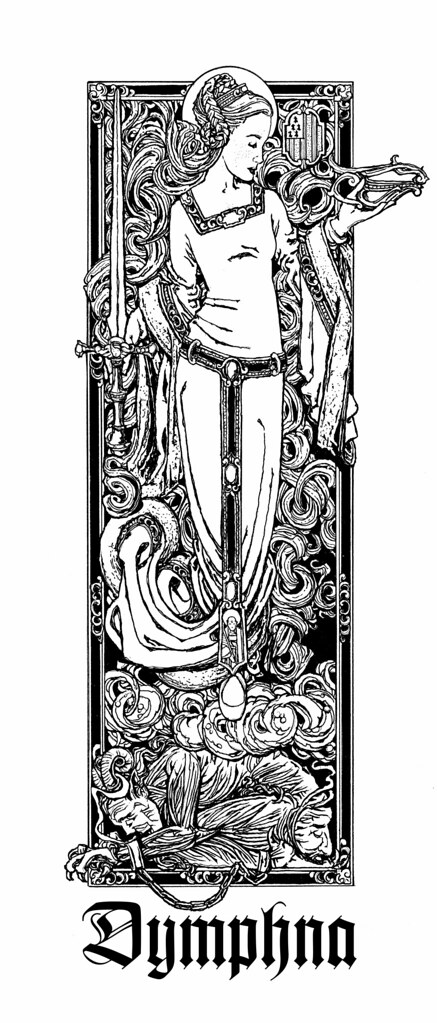
Matthew Alderman. S. Dymphna of Gheel. Private Collection, Minnesota. January 2010.
From the Catholic Encyclopedia:
There are at Gheel fragments of two simple ancient sarcophagi in which tradition says the bodies of Dymphna and [her confessor and fellow martyr] Gerebernus were found. There is also a quadrangular brick, said to have been found in one of the sarcophagi, bearing two lines of letters read as DYMPNA. The discovery of this sarcophagus with the corpse and the brick was perhaps the origin of the veneration. In Christian art St. Dymphna is depicted with a sword in her hand and a fettered devil at her feet. Her feast is celebrated 15 May, under which date she is also found in the Roman martyrology.(More).
From time immemorial, the saint was invoked as patroness against insanity. The Bollandists have published numerous accounts of miraculous cures, especially between 1604 and 1668. As a result, there has long been a colony for lunatics at Gheel; even now there are sometimes as many as fifteen hundred whose relatives invoke St. Dymphna for their cure. The insane are treated in a peculiar manner; it is only in the beginning that they are placed in an institution for observation; later they are given shelter in the homes of the inhabitants, take part in their agricultural labours, and are treated very kindly. They are watched without being conscious of it. The treatment produces good results. The old church of St. Dymphna in Gheel was destroyed by fire in 1489. The new church was consecrated in 1532 and is still standing. Every year on the feast of the saint and on the Tuesday after Pentecost numerous pilgrims visit her shrine. In Gheel there is also a fraternity under her name.
Tuesday, February 26
New Line Art from Matthew Alderman

Our Lady of Guadalupe. Ink on vellum. January 2008. Commissioned for the ordination mass card of a new priest. The inscription, common in images of Our Lady of Guadalupe, means "He has not done so for any other nation," and is derived from the Psalms.
Tuesday, November 11
New Line Art by Matthew Alderman
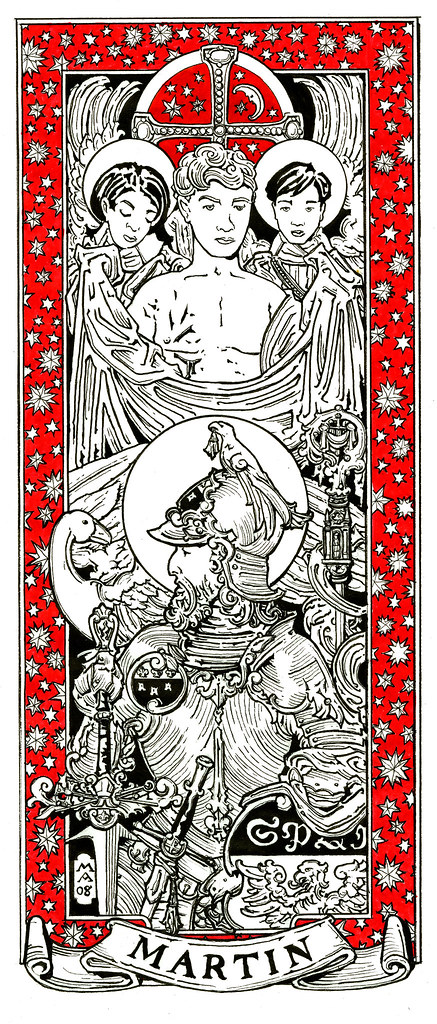
Matthew Alderman. The Dream of S. Martin. 4.6" x 10.8", Ink on Vellum. Commissioned by a medical gentleman in Wales. October 2008. Private Collection, Great Britain.
"In a winter time as Martin passed by the gate of Amiens, he met a poor man all naked, to whom no man gave any alms. Then Martin drew out his sword and carved his mantle therewith in two pieces in the middle, and gave that one half to the poor man, for he had nothing else to give to him, and he clad himself with that other half. The next night following, he saw our Lord Jesu Christ in heaven clothed with that part that he had given to the poor man, and said to the angels that were about him: Martin, yet new in the faith, hath covered me with this vesture. Of which thing this holy man was not enhanced in vain glory, but he knew thereby the bounty of God."
~Bl. Jacobus de Voragine, O.P., The Golden Legend, or, the Lives of the Saints, Englished by William Caxton, 1483
Monday, November 27
Liturgical Thunder from Down Under
An Unfortunate Renovation Afoot at St. Mary's, Sydney
Sydney possesses one of the few truly spectacular bits of the Gothic Revival on the Australian continent. Its massive cathedral was begun by the Puginesque convert William Wilkinson Wardell after fire claimed the previous church on the site in 1865, and not fully completed until the turn of the following century. At the moment, the rich and coherent fabric of the edifice is at risk through a well-intentioned but essentially misguided renovation of the chancel planned to coincide with the Pope's visit for World Youth Day 2007.

A view of the Cathedral's current main altar, in the context of its historic chancel.
Unlike most previous cathedral renovations, such as the complete liturgical Armageddon that Archbishop Weakland dropped on Milwaukee before his departure, the unfortunate of the design is not immediately apparent. Nor is it the result of a patently heterodox agenda; the theology behind it is hardly of the radical variety. Indeed, it's rather painful for me to criticize the design at all, being under the aegis of one of my personal heroes, Vox Clara's very own ex-footballer-turned-Cardinal, George Pell, who I once had the honor to meet at a reception in the headquartes of the Knights of the Holy Sepulchre.
Let me make it clear that my remarks here are not a criticism of Cardinal Pell, this noble man, this strong and great prelate, who has toiled long and hard for the sake of the Church in the Antipodes. This work should not be construed as a comment on his long history of service, his unimpeachable orthodoxy, or his strong support of the proper translation of the Mass. Nor should that Most Eminent Lord be blamed for the individual, unsupervised choices of his designers. Any man who knows Cardinal Pell's work knows his devotion to the liturgy, both in its present-day and classical forms.
That being said, the choices being made in His Eminence's name, if not by him, are unfortunate. In the end, the renovation remains unnecessary. However, to undertake a renovation of a historic cathedral on short notice, and particularly during a time where the fate of the liturgy is once again up for grabs, seems at the very least imprudent. The problems of the design stem not from bad theology but from a misapprehension of the architect's original intention and a general inability on the part of the designers, rather than their patron, to grasp the essence of Gothic revival. Cardinal Pell deserves better from those he has charged to undertake this design.
Essentially, the problem is that there is no problem to solve. Nothing needs to be done to this church to make it perfect for the Pope's arrival.

View towards the sanctuary with the east window.
At first glance, the design apparently has much to recommend it. A broad new chancel, parclose screens, an altar with a proper footpace, and a new bronze ambo to be designed by a well-known artist, Nigel Boonham. However, God is quite typically in the details, and the details are sadly insensitive to the context they've been placed in here.

The wall-like partition of the new choirstalls risks relegating the old high altar to unjustifiable obscurity.
The original focus of the church, the window and its high altar, are poorly served by the massively beefed-up choirstalls that sever any connection between the old high altar and the new freestanding one. The placement of the choir behind the altar where clergy attending in quire formerly sat is a dubious liturgical proposition at best. The massive wainscoted stall-ends only succeed in turning the old chancel into an irrelevant appendix. Should the liturgical climate change in the near future, the new choirstalls would render the hemmed-in old high altar virtually impossible to use.

The proposed Altar of the Entombed Christ in perspective: the breadth of the altar, as well as its minimal footpace, suggest a future traffic-flow problem to be inevitable.
Another puzzling detail are the crude screens that surround the old ambulatory. I am, by nature, fond of the mystery brought by screens and liturgical curtains, but these new additions run counter to the openness prized by Wardell's design. They're Disneyland pseudo-Gothic. Up to a certain point one should applaud the designers for trying a little, at least; but we are reaching a stage in the liturgical renewal when more really has to be demanded from our architects. If screens are deemed necessary, a very handsome and transparent effect could be achieved by the use of gilded and wrought iron in harmony with the existing altar-rail. Proper seating within the chancel should also be provided for concelebrants and assisting clergy, and this should be considered first before the implementation of screens of any sort.
The basic outline of a screened chancel with substantial choirstalls could be achieved without destroying the original context by substituting iron for wood and adaptively re-using the existing benches with new pew-ends and a discrete stepped base that would leave enough of a passage between the main and high altars to create an appropriate visual link. Any new choirstalls should be designed to minimize the amount of platform-space in order to best show off the chancel's splendid mosaic floor, one of the cathedral's undoubted treasures.

Plan of proposed chancel re-ordering. The excessively narrow connection between the old high altar and the new main altar effectively makes any future ad orientem masses virtually impossible.
In addition to the layout of the new chancel, the iconography of the altar and ambo and their relationship to the sanctuary's other furnishings is muddled. One might well question the need for a freestanding altar at all; at the very least, the existing main altar has the virtue of being properly vested in a frontal, with an accompanying crucifix and candlesticks of appropriate substance atop the mensa.
The new design is to be applauded for including a predella--a broad platform or step round the base--but nonetheless this footpace is entirely too small to be of real liturgical use. It does not permit the circling of the altar at the incensation, and would make any attempt to celebrate ad orientem masses impossible. The extreme width of the altar, while otherwise unlikely to excite comment, is likely to cause problems of liturgical traffic-flow in the narrow sanctuary.

The altar proposed is liturgically unsuitable.
Decorated sculptural altars are already difficult to properly vest with antependia in the accepted liturgical fashion; furthermore, if the conceptual art is true to life, the abstracted sculptural decoration, especially the pillars and the mandorla around the figure of the Dead Christ, lacks the subtlety of similar works in the church.

The Pelican Ambo: a baffling exercise in misplaced and unduly novel symbolism.
The Pelican ambo, while likely to be beautiful piece of metalwork, nonetheless is equally symbolically awkward, and, as with most modern ambos, misnamed, as it is essentially a glorified reading-desk. The pelican's Passion imagery is alien to the long iconographic tradition of ambos. Furthermore, the iconography--which depicts a family of pelicans representing a Christian family living under the Gospel--shifts the emphasis from the proclamation of the Word to our reception of it, and exchanges the Christological symbolism of the pelican for a more horizontal one. Even when one sets aside the question of symbolic propriety, the Christian pelican is a creature of myth and legend and to depict it with the gawky zoology of the real thing divests it of its sacrificial majesty.

The cathedra: architecturally naive and not in line with current rubrics.
One final criticism concerns the cathedra. The proposed canopy has since been discontinued, and while I am quite fond of canopies, one has to face up to facts and admit they're no longer allowed. More to the point, putting a canopy over the bishop's chair when the altar stands naked, would be a remarkable display of symbolic insensitivity; in this instance, it can be chalked up to the superficial sort of Gothic being practiced by the renovators. (Sadly, a tester over the new main altar is probably also impossible.)
It would also be better, to stress the linkage of the cathedra to the altar, for it to be made of stone. Wooden cathedras are appropriate in churches where the choirstalls seat a cathedral chapter, but St. Mary's has none, and since the chancel is likely to house a robed lay choir, a wooden throne would be unsuitable.
Cardinal Pell is a great and good man, and one of the lights of the Church under the Southern Cross. He should not be blamed for these bad artistic choices, and indeed, for having the vision to consider Gothic forms at all in his renovation, he should be thanked. However, the Cathedral does not really need any changes at this point in history, and indeed, may be rendered redundant in a few decades. If the design must continue, the designers must more fully the challenge they have been given and seriously study the Gothic that Wardell derived so much beauty from in his original project.
The design has been undertaken at breakneck speed, to spruce up the church for the arrival of the Vicar of Christ. Still, this does not mediate the lesser quality of the work proposed, nor the lack of proper attention paid by the designers to certain liturgical questions. In this time of continued liturgical flux, my advice to the Cathedral is to wait a century or two, see which way the priest is facing, and then start worrying about redecorating. Otherwise the work may prove to be an intrusive addition to this most historic of Australia's precious and small patrimony of church architecture. Cardinal Pell, his cathedral, and Australia, deserve better.
Sydney possesses one of the few truly spectacular bits of the Gothic Revival on the Australian continent. Its massive cathedral was begun by the Puginesque convert William Wilkinson Wardell after fire claimed the previous church on the site in 1865, and not fully completed until the turn of the following century. At the moment, the rich and coherent fabric of the edifice is at risk through a well-intentioned but essentially misguided renovation of the chancel planned to coincide with the Pope's visit for World Youth Day 2007.
A view of the Cathedral's current main altar, in the context of its historic chancel.
Unlike most previous cathedral renovations, such as the complete liturgical Armageddon that Archbishop Weakland dropped on Milwaukee before his departure, the unfortunate of the design is not immediately apparent. Nor is it the result of a patently heterodox agenda; the theology behind it is hardly of the radical variety. Indeed, it's rather painful for me to criticize the design at all, being under the aegis of one of my personal heroes, Vox Clara's very own ex-footballer-turned-Cardinal, George Pell, who I once had the honor to meet at a reception in the headquartes of the Knights of the Holy Sepulchre.
Let me make it clear that my remarks here are not a criticism of Cardinal Pell, this noble man, this strong and great prelate, who has toiled long and hard for the sake of the Church in the Antipodes. This work should not be construed as a comment on his long history of service, his unimpeachable orthodoxy, or his strong support of the proper translation of the Mass. Nor should that Most Eminent Lord be blamed for the individual, unsupervised choices of his designers. Any man who knows Cardinal Pell's work knows his devotion to the liturgy, both in its present-day and classical forms.
That being said, the choices being made in His Eminence's name, if not by him, are unfortunate. In the end, the renovation remains unnecessary. However, to undertake a renovation of a historic cathedral on short notice, and particularly during a time where the fate of the liturgy is once again up for grabs, seems at the very least imprudent. The problems of the design stem not from bad theology but from a misapprehension of the architect's original intention and a general inability on the part of the designers, rather than their patron, to grasp the essence of Gothic revival. Cardinal Pell deserves better from those he has charged to undertake this design.
Essentially, the problem is that there is no problem to solve. Nothing needs to be done to this church to make it perfect for the Pope's arrival.
View towards the sanctuary with the east window.
At first glance, the design apparently has much to recommend it. A broad new chancel, parclose screens, an altar with a proper footpace, and a new bronze ambo to be designed by a well-known artist, Nigel Boonham. However, God is quite typically in the details, and the details are sadly insensitive to the context they've been placed in here.
The wall-like partition of the new choirstalls risks relegating the old high altar to unjustifiable obscurity.
The original focus of the church, the window and its high altar, are poorly served by the massively beefed-up choirstalls that sever any connection between the old high altar and the new freestanding one. The placement of the choir behind the altar where clergy attending in quire formerly sat is a dubious liturgical proposition at best. The massive wainscoted stall-ends only succeed in turning the old chancel into an irrelevant appendix. Should the liturgical climate change in the near future, the new choirstalls would render the hemmed-in old high altar virtually impossible to use.
The proposed Altar of the Entombed Christ in perspective: the breadth of the altar, as well as its minimal footpace, suggest a future traffic-flow problem to be inevitable.
Another puzzling detail are the crude screens that surround the old ambulatory. I am, by nature, fond of the mystery brought by screens and liturgical curtains, but these new additions run counter to the openness prized by Wardell's design. They're Disneyland pseudo-Gothic. Up to a certain point one should applaud the designers for trying a little, at least; but we are reaching a stage in the liturgical renewal when more really has to be demanded from our architects. If screens are deemed necessary, a very handsome and transparent effect could be achieved by the use of gilded and wrought iron in harmony with the existing altar-rail. Proper seating within the chancel should also be provided for concelebrants and assisting clergy, and this should be considered first before the implementation of screens of any sort.
The basic outline of a screened chancel with substantial choirstalls could be achieved without destroying the original context by substituting iron for wood and adaptively re-using the existing benches with new pew-ends and a discrete stepped base that would leave enough of a passage between the main and high altars to create an appropriate visual link. Any new choirstalls should be designed to minimize the amount of platform-space in order to best show off the chancel's splendid mosaic floor, one of the cathedral's undoubted treasures.
Plan of proposed chancel re-ordering. The excessively narrow connection between the old high altar and the new main altar effectively makes any future ad orientem masses virtually impossible.
In addition to the layout of the new chancel, the iconography of the altar and ambo and their relationship to the sanctuary's other furnishings is muddled. One might well question the need for a freestanding altar at all; at the very least, the existing main altar has the virtue of being properly vested in a frontal, with an accompanying crucifix and candlesticks of appropriate substance atop the mensa.
The new design is to be applauded for including a predella--a broad platform or step round the base--but nonetheless this footpace is entirely too small to be of real liturgical use. It does not permit the circling of the altar at the incensation, and would make any attempt to celebrate ad orientem masses impossible. The extreme width of the altar, while otherwise unlikely to excite comment, is likely to cause problems of liturgical traffic-flow in the narrow sanctuary.
The altar proposed is liturgically unsuitable.
Decorated sculptural altars are already difficult to properly vest with antependia in the accepted liturgical fashion; furthermore, if the conceptual art is true to life, the abstracted sculptural decoration, especially the pillars and the mandorla around the figure of the Dead Christ, lacks the subtlety of similar works in the church.
The Pelican Ambo: a baffling exercise in misplaced and unduly novel symbolism.
The Pelican ambo, while likely to be beautiful piece of metalwork, nonetheless is equally symbolically awkward, and, as with most modern ambos, misnamed, as it is essentially a glorified reading-desk. The pelican's Passion imagery is alien to the long iconographic tradition of ambos. Furthermore, the iconography--which depicts a family of pelicans representing a Christian family living under the Gospel--shifts the emphasis from the proclamation of the Word to our reception of it, and exchanges the Christological symbolism of the pelican for a more horizontal one. Even when one sets aside the question of symbolic propriety, the Christian pelican is a creature of myth and legend and to depict it with the gawky zoology of the real thing divests it of its sacrificial majesty.
The cathedra: architecturally naive and not in line with current rubrics.
One final criticism concerns the cathedra. The proposed canopy has since been discontinued, and while I am quite fond of canopies, one has to face up to facts and admit they're no longer allowed. More to the point, putting a canopy over the bishop's chair when the altar stands naked, would be a remarkable display of symbolic insensitivity; in this instance, it can be chalked up to the superficial sort of Gothic being practiced by the renovators. (Sadly, a tester over the new main altar is probably also impossible.)
It would also be better, to stress the linkage of the cathedra to the altar, for it to be made of stone. Wooden cathedras are appropriate in churches where the choirstalls seat a cathedral chapter, but St. Mary's has none, and since the chancel is likely to house a robed lay choir, a wooden throne would be unsuitable.
Cardinal Pell is a great and good man, and one of the lights of the Church under the Southern Cross. He should not be blamed for these bad artistic choices, and indeed, for having the vision to consider Gothic forms at all in his renovation, he should be thanked. However, the Cathedral does not really need any changes at this point in history, and indeed, may be rendered redundant in a few decades. If the design must continue, the designers must more fully the challenge they have been given and seriously study the Gothic that Wardell derived so much beauty from in his original project.
The design has been undertaken at breakneck speed, to spruce up the church for the arrival of the Vicar of Christ. Still, this does not mediate the lesser quality of the work proposed, nor the lack of proper attention paid by the designers to certain liturgical questions. In this time of continued liturgical flux, my advice to the Cathedral is to wait a century or two, see which way the priest is facing, and then start worrying about redecorating. Otherwise the work may prove to be an intrusive addition to this most historic of Australia's precious and small patrimony of church architecture. Cardinal Pell, his cathedral, and Australia, deserve better.
Tuesday, June 8
David Clayton Profiles My Work!

I apologize for the long hiatus in entries. The last few months have been hectic, even by my usual rather stringent standards, while last week I rejoiced in the quiet (if somewhat foggy) arcadia of Acadia National Park off the Maine coast with my family, where I hiked, feasted on large quantities of helpless lobsters, and read most of the late Michael McCarthy's handsomely-illustrated last treatise on ecclesiastical heraldry. In any case, things have quieted down somewhat back at GHQ in Wisconsin and I hope to resume with daily postings here and over at The New Liturgical Movement.
In any case, this item is about a week overdue, but will be of interest to our readers in any case. David Clayton, who I have written of in these pages before,and who is a talented iconographer and artist of considerable experience, very kindly wrote up a thoughtful article on my own graphic design and illustration work. He comments:
He talks about his art as though its just a hobby on the side, but I find it interesting. He has, in my opinion, a natural sense of composition and his lines flow gracefully and rhythmically. He fills up the space without it being too cluttered. [...]I appreciate his compliments, as well as his critique, and I agree from my own perspective, my art is rather hard to pigeonhole. David considers it through the lens of illustration, which delights me, as ultimately I consider myself more of an illustrator than a fine artist--though I also consider Dürer, Harry Clarke, Martin Travers, and Alphonse Mucha, some of my primary influences in style though not always content, to be primarily illustrators as well. David himself comments that:
Although I can say with certainty I like his work, I find it difficult to pigeonhole as well. Clearly, the subject matter reflects his faith, featuring lots of saints (and he has Catholic figures such as Dante there too). [...] it [draws] me in and make me curious about the personality of the person depicted. These seem to me to be just the qualities that are needed in illustrations, which accompany text. I wonder, Matt, do you get any requests in this regard?
Much of the quality artwork of the last century has come from illustrators. This point was made to me years ago when I was working as a lowly freelance sub-editor at the The Sunday Times in London. The art critic, Frank Whitford (who was a charming gentleman) always used to include reviews of illustrators’ art exhibitions in his weekly round-up. I can remember him reviewing a show of the work of E.H. Shepherd, for example, the creator of the images of the characters in the Winnie the Pooh books. I asked him why he included so many illustrator’s shows. He said it was because illustrators were, in contrast to most artists nowadays, trained in the skills of drawing and painting and were directing their skills i conformity to an external purpose (rather than self-promotion). Consequently they very often produced the most interesting and original work aroundThis is something I have found myself--aside from the intrepid handful of traditional painters and artists like David and my other artist friend Anthony Visco, the only true advances in art these days are coming from children's book illustration. (Just as, outside of the classical world, probably the most interesting bit of architecture undertaken in the last twenty years were the computer-animated sets for the second round of Star Wars movies, which almost makes up for the dialogue, plot, acting, and bad theology. Almost.)
As to David's question, I have in the past come close to doing book illustration, but unfortunately the stars have never quite aligned. My work is becoming less and less of a side hobby these days and is now rather in the line of a small subsidiary business, so I hope I will have the opportunity to take on larger projects like this in the future.
I would like to respond, though, to David's comment that he is not sure he could use my work in a devotional or liturgical context, while thinking them well-suited to illustrative work. I do understand what he is getting at, as there is always a tension between the devotional and the decorative, and that balance is hard to achieve. I appreciate that he is nonetheless able to appreciate the illustrative and technical quality of my work in spite of this. I am always still learning. Certainly, ink illustrations cannot be used as decoration in a church, and my style might need some adaptation in that context, but in addition to being illustrative, I do see a devotional function it as well. I hope in time to provide inexpensive prints of my work similar in function though better in quality to the old holy-card style prints, oleagraphs and woodcuts, that hung in people's houses as ensigns of popular piety.
I think part of David's reticence lies in the perceived similarity to the work of Aubrey Beardsley in my own style, which has been remarked on in the past. When someone told me that, I went and looked at some of his designs and actually, with the exception of his use of blocks of black, I didn't find much I liked (his cherubs always look kind of sinister, among many other things). I am also now experimenting with less black backgrounds, for the sake of variety, though I choose them mostly because they help the delicate linework stand out better.
My own style, while definitely strongly influenced by Art Nouveau, derives much more from other artists and illustrators of the same period, as well as, in lesser amounts, medieval and early Renaissance precedents, Liturgical Movement graphics, a little bit of Baroque decorative ornament, and about a dozen other things. (Though more and more, as it all blurs together, it is becoming very hard to tell where I get what from who anymore). But in any case, I do appreciate his comments and his great generosity in writing such a kind, complimentary and thoughtful review of my own work, especially as I am still quite new in this field and lack his own considerable experience! I am still developing and there is much room to grow.
To those of you who may be considering commissioning work, please remember I am always in the market for such projects, and this summer it looks like I will have a good bit of free time to devote to them. I look forward to hearing from you.
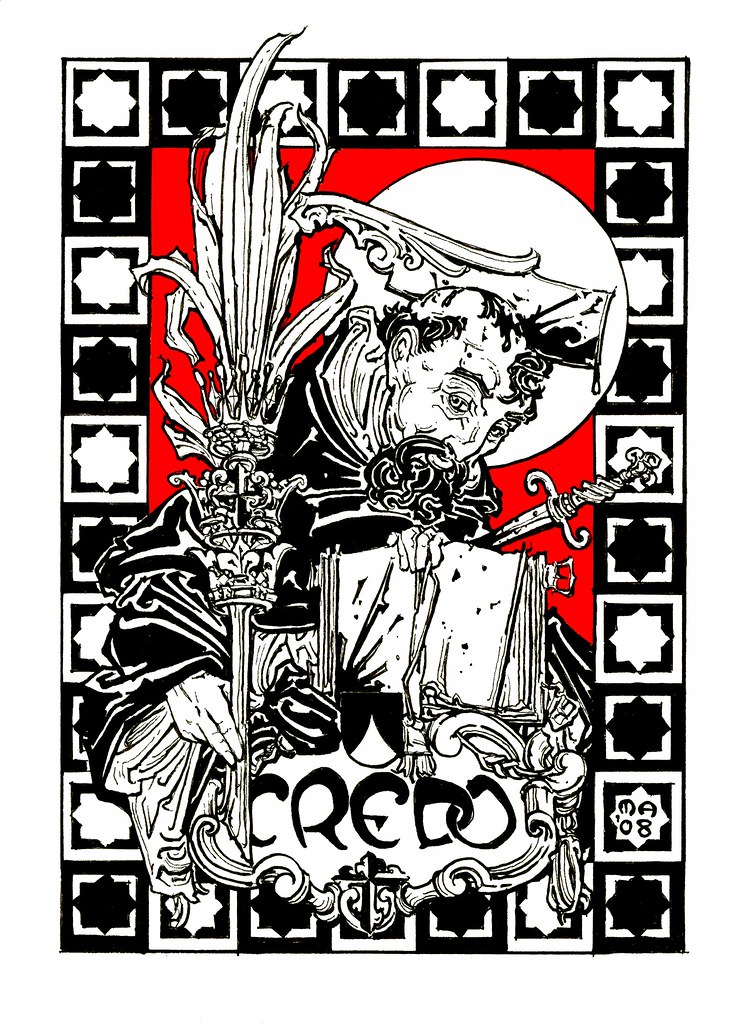
Saturday, May 9
New Line Art: S. Michael

Matthew Alderman. Michael Psychopompus. Ink on Vellum. April-May 2009. Artist's Collection.
Tuesday, November 25
New Line Art from Matthew Alderman

Matthew Alderman. S. Katherine among the Philosophers. 4" x 5", ink on vellum with marker. September 2008. Artist's Collection.
Monday, March 3
New Line Art from Matthew Alderman

Santa Bárbara, Patrona de la Artillería. Ink on Vellum. February 2008. Artist's Collection.
The original precedent for this image was an illustration of S. Barbara as protectress of the second battalion of the first royal Bavarian artillery regiment during the Great War, where she is shown wearing a modern steel military helmet and leaning on a cannon. Such imagery is rare, but not unknown, due to the saint's role as patroness invoked against sudden death, artillerymen of all nationalities, and for all who work with munitions. (Indeed, in Spanish, a powder magazine is called a santabárbara.) I can think of at least one side-chapel in Rome which is bedizened all over with cannon-barrels and similarly explosive insignia.
I have freely adapted the design but preserved the basic attributes of this somewhat unconventional model; a careful inspection of the drawing will show, nonetheless, the more traditional emblems of the saint--tower, lightning-bolt, sword--embossed and blazoned across of much of the great martyr's equipment.
Tuesday, July 8
New Line Art from Matthew Alderman

Cassian of Imola, Patron Saint of Parish Clerks and of Mexico City. Commissioned for a holy card. 4.5" x 6.5", ink on vellum. July 2008. Artist's Collection. (Click on image for larger version).
Lord Jesus Christ, give to us the patience of St. Cassian of Imola, who endured a hundred small wounds because of his love for You. Help us to endure the daily trials of life, and attentive to our duties, keep our hearts focused on loving You and serving Your people with the joy of those who acclaim You as our Savior. We ask this in Your Holy Name. Amen. (Prayer for private use only.)
Tuesday, November 24
New Line Art from Matthew Alderman

Matthew Alderman. The Servant of God Frederic Ireneus Baraga, First Bishop of Sault Saint Marie. October 2009. Private Collection, Michigan.
Friderik Irenej Baraga (1797-1868), a Slovene aristocrat-turned-missionary, was educated in Vienna and ordained in Ljubljana and some years later, volunteered to serve as a priest to the fledgeling diocese of Cincinnati with its vast swath of Indian mission territory. A gifted linguist, he mastered the Ottawa and Ojibway languages and authored or translated theological texts (including the first book written in Ottawa and the first Biblical translation into Ojibway) in both tongues. Known as the "snowshoe priest" for his work during the harsh winters of Wisconsin and Michigan, he also worked hard to save his Indian charges from being relocated. In 1853, he was consecrated bishop and became the first bishop of Sault Saint Marie, now the diocese of Marquette. He continued to travel via snowshoe well into his sixties, and letters of his exploits may have inspired St. John Neumann to come to the fertile mission territory of the United States. He died January 19, 1868, and his body is buried in the crypt of his cathedral. A state park, a village, a township, and a county have all been named in his honor.
This image is owned by a young priest in the Upper Peninsula of Michigan and was commissioned as a gift by his seminarian friends. During the patron's time in the seminary, he did a great deal of missionary work among the Indians of Central America, hence the intrusion of the Guatemalan [correction: actually it is the national bird of El Salvador] torogoz bird (at lower left) into the snowscape. The diocesan arms are shown next to the torogoz, while the Bishop is shown holding his snowshoe (which is swiftly becoming his hagiographic attribute) and holding a copy of his translation of the Scriptures into Ojibway. The rustic framework is inspired by local vernacular architecture. A small figure in the distance, following the bishop's footsteps, shows the many priests who followed in the path of this trailblazing missionary of the north woods.
You can find out more about Bishop Baraga's cause for canonization here.
Monday, May 18
New Line Art - S. John Kemble

Matthew Alderman. S. John Kemble, Priest and Martyr. March 2009. Private Collection, Kansas.
For those of you wondering why he is smoking and drinking, see this article from the Catholic Encyclopedia:
Martyr, b. at Rhydicar Farm, St. Weonard's, Herefordshire, 1599; d. at Widemarsh Common, Hereford, 22 August, 1679; son of John Kemble, formerly of Kemble, Wiltshire, afterwards of Llangarren, and of Urchinfield (now part of the parish of Hardwicke), and Anne, daughter of John Morgan, of The Waen, Skenfrith, Monmouthshire. His uncle, George Kemble, of Pembridge Castle, Welsh Newton, was the father of Captain Richard Kemble, who saved Charles II at the battle of Worcester. Ordained priest at Douai College, 23 February, 1625, he was sent on the mission 4 June, and in his old age lived with his nephew at Pembridge Castle. Arrested there by Captain John Scudamore of Kentchurch, he was lodged in Hereford Gaol in November, 1678, and condemned under 27 Eliz. c. 2 at the end of March following. Ordered to London with Father Charles Baker, he was lodged in Newgate and interviewed by Oates, Bedloe, and Dugdale. Sent back to Hereford, the aged priest spent three more months in gaol. Before leaving for his execution he smoked a pipe and drank a cup of sack with the under-sheriff, this giving rise to the Herefordshire expressions "Kemble pipe", and "Kemble cup", meaning a parting pipe or cup. Sir John Hawkins in a note to "The Compleat Angler" turns Kemble into a Protestant in Mary's reign. One of the martyr's hands is preserved at St. Francis Xavier's, Hereford. His body rests in Welsh Newton churchyard.
Thursday, November 27

Gaudi on Thanksgiving
We're doing a Thanksgiving dinner tonight, with not one but two types of turkey, the good ol' American kind and some newfangled stuffed roll that is allegedly more Italian. So they told me, anyway. The whole studio is filled with mingling aromas, some familiar, some exotic, and I carried the memory in my head after I finished my cereal and left.
We've got today off, and so following the prompting of a sign on the side of a bus and the bilingual directions of the slightly-confused cashier at the Spanish bookshop in Piazza Navona, I turned up at the Chiostro de Bramante next to Santa Maria della Pace to have a look at the new art and architecture exhibition Gaudi e il modernismo catalano.
Gaudi is one of my favorite architects, a sort of free-form art nouveau genius or roccoco medievalist. He simply defies description; trying to link him to Catalan modernismo is somewhat of a tenuous leap, for he himself seems to have felt a closer allegiance not to up-to-the-minute urbanity but medieval guildsman and the ancient classical traditions of the Mediterranean. I can't help but agree, even though sometimes it's hard to figure out where to plug the saintly old architect into the classical canon. That doesn't make it any less true.
It's hard to say what in his architecture makes this believable, but it's there, somewhere, in the drip-castle Gothic impressionism of the Sagrada Familia, the cubist morisco flourishes of his early works or the hallucinogenic Sesamee Street dragonscale dreamscape of his apartment blocks. Nonetheless, he had his followers, and it is a delight to see his work in context.
Professor D., who is picky with his exhibits, would have probably considered it a bit "lame" (his own words) given he would have probably expected a few more models of Sagrada Familia and maybe a dancing bear or two. I found it delightful, walking through the spare Renaissance rooms of the cloister as if in a trance. Semester's end and urban life and a thousand other things had worn me a little thin over the last week and here I seemed finally to find soporific comfort.
It was, like a dream, a wondrous mix of familiar and unfamiliar; simple things well-designed and well-designed simple things. There were some of the old standards I'd seen before in glossy photographs, like the stupendous wrought-iron gateway of Casa Vicens with its palm leaves and undulating spikes, or dozens of new surprises in the form of works on paper, drawings, posters, bookcovers all so full of fresh art nouveau life and industrial Catalan spunk. So many virginal cousins of pre-Rapheaelite women, and so many well-dressed, smiling bourgeois daughters of Barcelona. Both were part of Gaudi's world, the timeless and the secular. Sometimes the two came together, though.
For then there was The First Communion. It is, by far, the most ambitious piece of terra-cotta ever produced. I went back three times to gaze upon it in my semi-stupor, to try and sketch at least one visual sliver of it. The sculptor's name was Josep Llimona, and nobody has heard of him, it seems.
It shows two young girls, two unearthly and pure young girls, though they were probbaly the daughters of some merchant or industrialist or whatever. One has just bent in to receive the Host on her tongue, showing a rim of pearly front teeth between parted lips. The other demurely looks down. It's almost life-size, showing them from the shoulders up, their hands and backs seeming to dissolve into the trailing draperies that cover their hands and heads and even the rail and one girl's prayerbook. Neither my drawings or the catalogue photo even hope to do it justice.
Eventually, I took a final turn out into the upper story of the cortile proper, pausing for a minute on one of the cold marble seats set into the base of the delicate Bramante columns. It's a wonderful, serene, cool little space, so rigorous in line and yet so natural in feel, a counterpoint to the theatrical effect that art nouveau produced with its undulating, vegetal curves. But both are wonderful to behold.
The sky was cloudy and grey above one side, but over the great octagonal dome of Santa Maria della Pace (of Peace!), it began to be veined with blue and silver-gilt. A little out-of-place Gothic spire, perhaps that of Santa Maria dell' Anima (of Souls!), the old German church, rose up next to it. It seemed almost the work of Gaudi with its delicate tilework roof and elaborate wrought-iron eagle finial. And yet it all harmonized. Peace and souls, perfect.
The sun was coming out, and there were many things to be thankful for. And, as strange as that may sound, I can't think of a better way to celebrate today.
Monday, September 4
A Few Remarks on Classical Architecture Today
Some weeks ago, I wrote here on the cause of the use of good architecture in illuminating the more quotidian and utilitarian bits of our daily lives--whether it be a visit to the car wash, the supermarket, a drive-through at the bank's outdoor window, or a trip to the liquor store in search of that perfect bottle of wine as a gift. I say good rather than classical, or traditional, or traditionalist, or any of that other overlapping constellation of related terms used within the umbrella of the modern classical movement, principally because they are unlikely to mean anything to the man in the street. Also, in this case, such terms of art may not only be meaningless, but misleading. I say "baroque Qwik-e-Mart," and people, not knowing of the simple vernacular Roman barochetto, assume I'm about to dump several crateloads of cherubim on them and create the world's first Esso Station with Corinthian columns. Such is an offense against decorum; it would be equally problematic to design a massive city bank on the lines of a half-timber Tudor hovel.
But there's always a precedent, somewhere, and the past's constant self-referentiality and building upon itself, provides a solution to each problem--a solution which, by its very referencing, is transformed by the situation to become something quite new. As one architectural historian put it, "If nothing is original, then much originality is possible." The classical tradition, defined at its broadest extent to include everything up to the traumatic break with the past that marks some aspects of Gropius and Corbu's work, and even a few bits after that break, includes a good deal of humbler, astylar work, not high-style or even strictly speaking classical in the sense understood by the American public.
Before I go on, I will admit that some will criticize my audaciously vague definition of "classicism" as essentially everything before, say, 1925, and everything after as some sort of modernism. However, it's hard to avoid the fact that the schism wrought by the Bauhaus and all its empty works was deeper and far more traumatic than anything before it. There was always some appeal to historic authority--whether or not you agree it was well-conceived or not--in the innovations of Alberti, of Bernini's gilding and Laugier's primitivism, or even Gottfried Semper's fanciful theories of carpet architecture. Now, an unyielding archaeologism or primitivism never really satisfies, but neither does mere whim: we need both dour Vitruvius and that wonderful exhibitionist Dinocrates in his leopard-skin. (Dinocrates is famous for oiling himself up like an athlete, putting on a Hercules costume and waltzing into Alexander the Great's camp with his wildly imaginative but technically misbegotten plans to terraform Mount Athos into a giant statue of the conqueror, incidentally). The key is balance.
I'm focusing on modernism of the Bauhaus variety simply because it's easy to define and has evident rules and ideals, and because many of its unconscious principles, translated into bottom-line accountancy, still rule the building trades; and their universality in the postwar universe also accounts for much of the death of craft. Postmodernism is more of an elaborate practical joke on the consumer, and I wouldn't even know where to begin with the likes of Zaha Hadid, whose projects resemble nothing so much as a crashed Millenium Falcon. Though the Bauhaus shares with these more contemporary projects an equal desire to constantly re-invent the wheel and a certain ignorance or indifference to ornament.
One needn't slather a facade with Manueline corkscrews and rocaille for it to have ornament--but some sort of meditation, incarnation, expression of the building's inner, unseen self, is necessary. It's not my place here to mediate between the different interpretations of that ornament, which some say is an expression of the building's techtonics, and others call iconographic, and still others say is some blend of both. But the notion of mediation remains; even old Corbu couldn't get away with it in spite of himself. You can't escape history. The more we consider Modernism, the less original it seems in this regard, and the more it becomes just another passing movement no different from the rest, and a rather lackluster one at that. Walter C. Kidney, in his curious, sometimes wrongheaded but also intriguing book The Architecture of Choice, detailing what he terms the "eclectic architecture" of the turn of the last century, points out that "structural honesty" in the modern sense, is largely a chimera:
In today's world of insulation, wiring and more, even the remote possibility of modernist "structural honesty" is utterly gone. Sadly, however, while history could have tolerated such adolescent posturing as just another silly fad, Mies, Gropius and co. effectively were not satisfied with shutting out the past, but the universality of their faintly ridiculous idea also ensured the death of craft. It was possible to build a grand and well-detailed structure on par with the productions of the American Renaissance as late as 1959, the date of the construction of Our Saviour's in Manhattan with its extravagant woodwork and monolithic sanctuary columns. (Even the modern churches built then aren't so bad due to that high residual use of craftsmanship, good materials, precious materials, in fact, and also the retention of the orthodox Tridentine liturgical structure of the altar.) Now, it's virtually unthinkable except with an unlimited budget and limitless time. This can change. There's nothing to say we can't undo this cultural hecatomb.
What is needed is a revival of good craftsmanship and handywork, which exists in other countries and even in small isolated pockets here and there. What is needed is to push the envelope, and demand better from contractors, plasterers and the like. Even then, more can be done than we think if we are clever about our design. I am notorious for my extravagant architectural concoctions, but I've also boiled down my hypothetical designs to more manageable productions before. Simplicity is only possible after exploring the complete package of the complex.
It is simply a matter of prioritizing detail on the places where it can't be skimped, or using good materials simply, or using a style--Romanesque, Low Baroque, art deco, or a clever but budgeted classicism--which is suited to a plain interpretation. There are simple baroque doorframes and simple baroque shapes that can enliven an otherwise very austere facade and give a bit more zip to it. Borromini, the ultimate cheapskate master builder, excelled with such projects. The assumption need not be that whole historical eras should be cordoned off because of their budgets. There were poor churchmen in Baroque Rome, too.
A reappraisal of our materials today is also crucial. What makes most of the budget-Bauhaus buildings or botched pseudo-traditional churches even more awful than their predecessors is a simple inability to use good, permanent materials. Many building practices today are designed with a twenty-year lifespan for our buildings, and new buildings get older far quicker than ancient ones do. Good materials are often not cheap, but sometimes building cheap doesn't entail using rotten stopgaps. There may also be new materials worth developing in labs and test facilities which may have the best of old and new alike.
There are also the possibilities inherent in laser-cutting, three-dimensional computer sculpting and other industrial technologies which may place good ornament, even custom-made ornament, within the reach of Everyman, or every parish. I can't speak from experience, but I know such technologies exist out there somewhere, and remain unmined by the classicist. The problem is, the right people aren't talking and putting their heads together. The average builder has very little interest in classical theory, while the high-budget nature of most classical buildings today makes such experiments unnecessary in the current state of things. I'm not complaining--it's just the way things work. But someone somewhere needs to think about such things and get the ball rolling if we're going to make the classical--or the Gothic, or Romanesque, or some new style equal in beauty if not quite the same, for that matter--as hip, as popular, and as ubiquitous as it used to be.
But there's always a precedent, somewhere, and the past's constant self-referentiality and building upon itself, provides a solution to each problem--a solution which, by its very referencing, is transformed by the situation to become something quite new. As one architectural historian put it, "If nothing is original, then much originality is possible." The classical tradition, defined at its broadest extent to include everything up to the traumatic break with the past that marks some aspects of Gropius and Corbu's work, and even a few bits after that break, includes a good deal of humbler, astylar work, not high-style or even strictly speaking classical in the sense understood by the American public.
Before I go on, I will admit that some will criticize my audaciously vague definition of "classicism" as essentially everything before, say, 1925, and everything after as some sort of modernism. However, it's hard to avoid the fact that the schism wrought by the Bauhaus and all its empty works was deeper and far more traumatic than anything before it. There was always some appeal to historic authority--whether or not you agree it was well-conceived or not--in the innovations of Alberti, of Bernini's gilding and Laugier's primitivism, or even Gottfried Semper's fanciful theories of carpet architecture. Now, an unyielding archaeologism or primitivism never really satisfies, but neither does mere whim: we need both dour Vitruvius and that wonderful exhibitionist Dinocrates in his leopard-skin. (Dinocrates is famous for oiling himself up like an athlete, putting on a Hercules costume and waltzing into Alexander the Great's camp with his wildly imaginative but technically misbegotten plans to terraform Mount Athos into a giant statue of the conqueror, incidentally). The key is balance.
I'm focusing on modernism of the Bauhaus variety simply because it's easy to define and has evident rules and ideals, and because many of its unconscious principles, translated into bottom-line accountancy, still rule the building trades; and their universality in the postwar universe also accounts for much of the death of craft. Postmodernism is more of an elaborate practical joke on the consumer, and I wouldn't even know where to begin with the likes of Zaha Hadid, whose projects resemble nothing so much as a crashed Millenium Falcon. Though the Bauhaus shares with these more contemporary projects an equal desire to constantly re-invent the wheel and a certain ignorance or indifference to ornament.
One needn't slather a facade with Manueline corkscrews and rocaille for it to have ornament--but some sort of meditation, incarnation, expression of the building's inner, unseen self, is necessary. It's not my place here to mediate between the different interpretations of that ornament, which some say is an expression of the building's techtonics, and others call iconographic, and still others say is some blend of both. But the notion of mediation remains; even old Corbu couldn't get away with it in spite of himself. You can't escape history. The more we consider Modernism, the less original it seems in this regard, and the more it becomes just another passing movement no different from the rest, and a rather lackluster one at that. Walter C. Kidney, in his curious, sometimes wrongheaded but also intriguing book The Architecture of Choice, detailing what he terms the "eclectic architecture" of the turn of the last century, points out that "structural honesty" in the modern sense, is largely a chimera:
The modernists, of course, affected to believe that the new constructinal methods and materials should be used "frankly," and regarded any attempt to cover or coax them into conformity with the Styles [sic] as dishonest... As we have seen, though, engineering is indifferent to geometrical elegance; and expedient balance of performance, time and money is what counts... For that matter, not all machinery surfaces were presentable, around 1930, at the Museum of Modern Art. Functional beauty, then, is an occasional coindicence in modern engineering (and often due to the hand of the industrial designer) rather than the necessary result of letting the engineer have his own way. To obtain that beauty infallibly, artistic judgment, not severe practicality, is needed. Moreover, architecture--including that admired by and produced by the modernists--has always presented an edited version of constructional facts. Japanese frame architecture, seemingly so straightforward, abounds in small shams introduced for the sake of finish. The Gothic cathedral dramatizes its structure with shafts, clustered around the piers, that support absolutely nothing and ribs that are often totally unnecessary.Kidney goes on to mention several modernist "shams" of sorts, none of which are particularly shocking to an old classicist such as myself, but seem to put the lie to the tiresome prayerwheeling of modernist principles, which are really more aesthetic choices than constructional principles, and rather shallow ones at that.
In today's world of insulation, wiring and more, even the remote possibility of modernist "structural honesty" is utterly gone. Sadly, however, while history could have tolerated such adolescent posturing as just another silly fad, Mies, Gropius and co. effectively were not satisfied with shutting out the past, but the universality of their faintly ridiculous idea also ensured the death of craft. It was possible to build a grand and well-detailed structure on par with the productions of the American Renaissance as late as 1959, the date of the construction of Our Saviour's in Manhattan with its extravagant woodwork and monolithic sanctuary columns. (Even the modern churches built then aren't so bad due to that high residual use of craftsmanship, good materials, precious materials, in fact, and also the retention of the orthodox Tridentine liturgical structure of the altar.) Now, it's virtually unthinkable except with an unlimited budget and limitless time. This can change. There's nothing to say we can't undo this cultural hecatomb.
What is needed is a revival of good craftsmanship and handywork, which exists in other countries and even in small isolated pockets here and there. What is needed is to push the envelope, and demand better from contractors, plasterers and the like. Even then, more can be done than we think if we are clever about our design. I am notorious for my extravagant architectural concoctions, but I've also boiled down my hypothetical designs to more manageable productions before. Simplicity is only possible after exploring the complete package of the complex.
It is simply a matter of prioritizing detail on the places where it can't be skimped, or using good materials simply, or using a style--Romanesque, Low Baroque, art deco, or a clever but budgeted classicism--which is suited to a plain interpretation. There are simple baroque doorframes and simple baroque shapes that can enliven an otherwise very austere facade and give a bit more zip to it. Borromini, the ultimate cheapskate master builder, excelled with such projects. The assumption need not be that whole historical eras should be cordoned off because of their budgets. There were poor churchmen in Baroque Rome, too.
A reappraisal of our materials today is also crucial. What makes most of the budget-Bauhaus buildings or botched pseudo-traditional churches even more awful than their predecessors is a simple inability to use good, permanent materials. Many building practices today are designed with a twenty-year lifespan for our buildings, and new buildings get older far quicker than ancient ones do. Good materials are often not cheap, but sometimes building cheap doesn't entail using rotten stopgaps. There may also be new materials worth developing in labs and test facilities which may have the best of old and new alike.
There are also the possibilities inherent in laser-cutting, three-dimensional computer sculpting and other industrial technologies which may place good ornament, even custom-made ornament, within the reach of Everyman, or every parish. I can't speak from experience, but I know such technologies exist out there somewhere, and remain unmined by the classicist. The problem is, the right people aren't talking and putting their heads together. The average builder has very little interest in classical theory, while the high-budget nature of most classical buildings today makes such experiments unnecessary in the current state of things. I'm not complaining--it's just the way things work. But someone somewhere needs to think about such things and get the ball rolling if we're going to make the classical--or the Gothic, or Romanesque, or some new style equal in beauty if not quite the same, for that matter--as hip, as popular, and as ubiquitous as it used to be.
Tuesday, January 26
New Line Art from Matthew Alderman
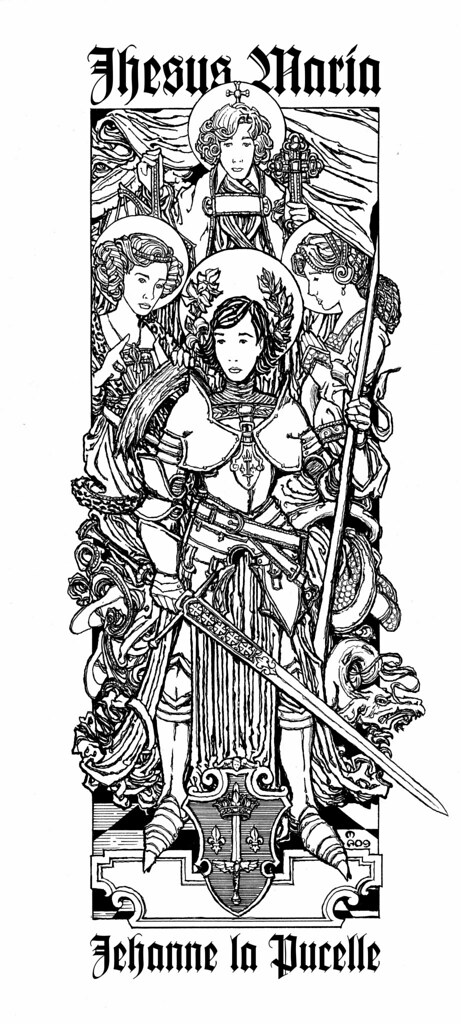
S. Joan of Arc with her Voices: SS. Michael, Katherine and Margaret. Ink (text added electronically here; original with text in ink), December 2009. Private Collection, Washington, D.C.
S. Joan of Arc would, on the surface, be an iconographic cakewalk: sketch a little dark-haired girl in armor, throw in a few fleurs-de-lys, her unmistakeable Jhesus Maria banner, a few angels, rinse and repeat. Yet, within that basic framework there are dozens of variations, some justly ubiquitous, and some which have embedded themselves in the pious mind without much logic in her personality or symbolic justification. Many second-rate holy cards show her as an irritatingly soulful Victorian heroine, and films like to show her as tall, feminine and stately--or in the case of the horrible The Messenger, as tall, psychopathic and androgynous. A good deal of evidence suggests the Maid of Orleans was rather on the short side, and while she managed to be both mystical and strangely street-smart in terms of commonsense, she was a commander and tactician, not a sword-slashing beserker. (She seems to have used the weapon she unearthed under the altar of Ste.-Catherine-des-Fierbois, after a vision guided her there, more as a field marshal's baton than an offensive weapon). She was also unmistakably female, if perhaps not always visibly feminine. Her armor and cropped hair were, after all, assumed out of convenience than preference: it is perhaps best to think of her as looking a bit like a college sophomore wearing her football player brother's equipment--sure of herself, sensible, level-headed, but just ever-so-slightly out of place.
So I tried to pick up on as much of this as I could in this image--making her strong yet young, maidenly yet military, and never just a St. George with a slightly different anatomy. Women can be as courageous and hardy as men, but they always bring something different to the table when are called on by God and circumstances to roll their metaphorical sleeves up. My first inclination was to try to avoid the swoony soft heroine we all know from chipped plaster statues--long hair, and often wearing a skirt over her armored legs, improbably considering her assumption of male dress off the field for both the protection of her chastity and as an effort to be taken seriously by the king and his knights. Not to mention the safety risk it might have posed. Certainly she might have worn a surcoat, and probably a rather rich one. But I was unsatisfied with the results, and opted for a modified bit of drapery, more for symbolic and artistic reasons--as a reminder that her strength and her identity as a woman are harder to separate than some revisionists might assume.
There are numerous other details scattered throughout the work alluding to her story--laurel leaves of victory paired with lillies of virginity round her halo, a somewhat operatically exaggerated version of the sword of St. Catherine with its five crosses, and the arms granted to her brothers that are still borne by the family to this day. These are shown at her feet and repeated on the breastplate of her armor, which also continues the laurel motif. I considered ornamenting her armor further, but wished to have it convey a beautiful practicality suited to her own personality and spirit.
I had the most fun in devising the figures of SS. Katherine and Margaret floating just over her shoulders. They are accompanied by their usual symbols of the broken spiked wheel and the trampled dragon. Their clothing repeats their story in more discrete ways. To the left, note the wheel-like braids of Katherine's hair, her royal crown, the lily of purity repeated at a medallion at her neck, the wedding ring of her mystical espousal, even the oratorical gesture of her right hand, suited to the expert rhetorician she was. The fur edging her tunic has a cheetah's spots, an animal (along with the panther) associated with Christ in the bestiaries and suggesting her exotic noble background, if perhaps in a roundabout mediaeval sort of way. Margaret's own costume repeats the dragon-scales of the serpent she triumphed over, as well as the pearls associated with her own name, which expand out into a number of other marine references, such as the net covering her hair). Her belt repeats the waves of smoke and water from one stage of her martyrdom where she was thrown into a boiling cauldron without result. (Note that she has rather calmly tucked the dragon's tail under her arm, a businesslike way of keeping the animal under control reminiscent of earlier depictions where she is shown with the animal on a leash.) Michael is shown above in the conventional manner, with his scales and the crossed stole and cope of an archpriest, a common dress for medieval angels showing their assisting role in the heavenly liturgy. Last but not least, we find overhead the words Jhesus Maria, the motto inscribed on S. Joan's famous banner.
Seeing S. Joan for what she was, more than just a Hollywood action girl, makes for a far more compelling story: it is hard not to find something to love and learn from in this subtle, clever, prayerful and even rather earthy young woman who, while possessing great physical courage in the thick of battle, was more than just a warrior.
Thursday, June 26
Corsica and Eden: Recent Work from Matthew Alderman
 The Authoress Dawn Eden. Commissioned for her website. Ink on vellum with marker. June 2008. Click for larger version.
My new portrait of Dawn Eden, specially commissioned for her weblog, is now up at the Dawn Patrol. Because it was a portrait rather than a liturgical illustration, and because Dawn is one of the hippest people I know--and I mean that in the good sense--I decided to experiment a bit stylistically. I sought to give it a more "graphic," simplified feel without resorting to straight-out modernism. The art deco-cum-Beuronese Sacred Heart medallion complements this mood, principally set by the background, which has a touch of Gustav Klimt in terms of composition and Mondrian in color. Yes, when Matt wants to be modern, he references artists who died respectively in 1918 and 1944. Make of that what you will.
My first portrait of Dawn, which has since been rendered obsolete by a new hairstyle, was one of my more ambitious drawings when I first started out, and is probably the largest work I've done in ink to date; while it had some difficulties as a portrait--for one thing, it looked a bit too much like a piece of religious art--it seems to have had its own fans over at Dawn's site. I hope they'll enjoy the new one, which, while smaller and simpler than the last portrait, was a lot of fun to create and, in its own way, reflects a bit of the subject's distinct spunk.
 S. Alexander Sauli. Commissioned as a confirmation gift. Ink on vellum with marker. June 2008.
 I was recently asked to do an image of the unjustifiably-obscure Counter-Reformation bishop-saint, Alexander Sauli, known as the Apostle of Corsica. S. Alexander was a Lombard aristocrat by birth who, after joining the Clerks Regular of S. Paul, the Barnabites, became variously a professor at the University of Pavia, superior-general of his congregation, and finally bishop of the ancient see of Aleria in Corsica, where he nearly single-handedly revived the island's derelict faith. He died after being made bishop of Pavia, in 1591, and somehow, amid all this, served at some point as S. Charles Borromeo's spiritual director.
While we know what S. Alexander looked like (his face is distinctive enough in the few portraits I've seen), he has a fairly indistinct iconography, the usual episcopal tropes: bishop's habit, book, crozier, mitre, biretta, the like. The one unique emblem I was able to find was a bit inexplicable: he's shown either accepting or spurning a pallium proferred to him by a cherub in a 19th century holy-card. The gesture is equivocal--I can either assume he served as an archbishop at some point, or perhaps refused such an offer out of humility. The relatively short turn-around time on the project meant I didn't have the opportunity to dig too deep here, unfortunately. At the very least, there is still a precedent, and worse comes to worse, it's up there with St. Agatha's, er, bells.
While my first sketches simply showed a standard Tridentine bishop-saint with an angel bearing his crozier behind him, I changed it to incorporate the pallium and the bishop's somewhat ambivalent response, as it was more distinctive symbolically, and also led to a more interesting composition. A few more discrete emblems can be glimpsed in the drawing: the face of the Man of Sorrows on his large pontifical morse, a pun on his name, which means "Saviour of Mankind" in Greek and the emblem of the Barnabite order.
The profile of the mitre could have been rendered a bit more smoothly, and, as always, there are a fair number of things I'd like to change--anatomical gaffes, line-weights, missed possibilities for more symbolism--but I'm fairly pleased with the result; furthermore, this is the first time I've managed to (successfully) incorporate a large amount of another color besides red into one of my works. The possibilities are endless.
Wednesday, February 17
From the Archives: Set Apart: A Meditation on Ash Wednesday
An oldie but a goodie, written one Ash Wednesday during my New York years. I hope you will forgive us going into reruns for the occasion:

There is a deep, dark black smudge the size of a thumbprint on my forehead, which makes me look even paler than usual. It is more of a dot than a cross, though if you look carefully you can see the transverse stroke. The effect is of a particularly morbid boddhisava. I've been wandering around the city with this thing since this morning. Nobody else in the office has got, one, not even the other Catholics, who will probably get their ashes in the evening, if they go at all. I've not gotten many strange looks, though, maybe because it blends in with my hair.
I have, with a mixture of curiosity and vanity, checked myself in the mirror at least once to see if it's still there, and it is, big and black. On one level, I know my little prideful "Super Catholic" moments of self-examination--the bathroom mirror, the brass of a doctor's nameplate-- are going against today's pericope to not "disfigure [your] faces so as to show others that [you] are fasting" in taking a little perverse pride in this last vestige of the more severe and straightforward Lent of ages long past. The Church clearly sees no contradiction with our call to "put oil on your head and wash your face," with this ancient penitential practice--otherwise She wouldn't have picked that reading in the first place. There's a world of difference between a ceremonial smudge and purposefully neglecting to bathe just to give off an appropriately holy aroma.
I'm not saying it doesn't cause more than a justifiable double-take, but sometimes we're too quick to jump on the inconsistency bandwagon about things like this--about the two creations of man in Genesis, about calling priests Father, about Christ's cousins, sisters and aunts, about what the heck to do with Mary, looming disconcertingly large to our skittish Protestant brethren--forgetting the Church has been there from the start, sifting scripture, defining canons, shaping culture, and She's heard it all before. It's all of a piece.
(For the record, aspiring professional fasters sometimes applied makeup to look hollow-eyed and pulled long faces for maximum pathetic affect in Christ's day.)
Chesterton once imagined a long procession of mysterious priests with their strangely-shaped mitres, hooked croziers, their incense and bells, and their sacred books--what possesses us to leap upon them, disregarding everything else, and seize the Bible from their hands, crying out for sola scriptura, when they, with all their antique ways of mind and worship, were the first to call it sacred? There's always a deeper logic there, if we dig, or if we simply choose to trust in the vast and occasionally cobwebby mansion that is both Tradition and tradition. Public penitence--whether flamboyantly physical or merely simply passing on the cheesecake--is part of the Catholic landscape, and the Catholic imagination. (And I won't pretend that can't get disturbing sometimes, but there it is, no apologies--though the Church has always stressed moderation). We're no angels. We're not supposed to be. While the best thing is a chastened soul, sometimes the only way to get there is via the body. No dessert menus, thanks. Check, please?
Still, as with all great art--and the corpus of the liturgy is truly the highest art--there's a dramatic tension between our outward ashes and the call to rend our hearts rather than our garments. Perhaps on one level, it's the oddity of our American praxis. In Italy, rather than New York, the marks on our foreheads--giant schmutzes or tiny daubs--do get odd and even frightened looks. A friend of mine once got smeared, American-style, at Santa Suzanna in Rome, and came out to find the rest of the city still pagan and brazenly bare-foreheaded. Turns out in Italy, they merely give you a dusting on the top of the head with the old Adam.
So many subspecies of ashen crosses. Heading to church in the grey morning, I see a couple in comfortable middle-age with faded smudges heading out the other way, the balding gentleman sports a vague squiggle that could almost be Arabic calligraphy. I spot a well-dressed, undersized Rory Gilmore clone in Grand Central, a gigantic trapezoidal cross filling her little forehead. An old man with grey-black whisps who could have been Indian, Black or a dozen other ethnicities, a generic American everyman. A blonde young walkure, all icy-white and gold, with a reticent but crisp black tilak smack in the center. The priests up at the altar today, crisp, with the polished air of Opus Dei, haven't gotten theirs yet. Do they do each other?
John Zmirak, with his usual wit, labels today "Catholic Mating Identification Day," and includes a recipe for a helpful dish called "Hey, I think You're Kind of Hot" Cross Buns. I will admit to having been distracted at times past by a coy lass or two with this anti-sign of Cain on her brow, but "Hey, we both have the same black smudge on our forehead" an even less successful subway pickup line than the last one I heard recounted by a female friend, "Hey, isn't that AM New York you're reading?" (The equivalent of asking the gal next to you in Coach if she's a fan of Skymall.)
But maybe he's on to something. In one of the prophet Ezechiel's visions, he receives the call to "Mark Thau [the letter T, Greek Tau, Hebrew Tav] upon the foreheads of the men that sigh, and mourn for all the abominations that are committed in the midst thereof," marking them as the saved, free from the impending doom of God's destroying angels. The Tav--the origins of today's Tau cross--in time became a symbol of Judaism a little before the time of Jesus, eventually adhering itself to the centinarian Anthony the Abbot and the Franciscans. The Apocalypse speaks in a similar way of the seal of the living God saving His people from destruction. The blood of Passover--also said to be cruciform--is probably at the back of all of this. It is no coincidence Our Lord ended up on a cross.
(I'm told in New York, the smudge doesn't really turn heads; just like random heathens turn up on Palm Sunday for freebees, sometimes an occasional Muslim or Jew slips in to get smudged. St. Agnes finds itself so popular on this fast-day that they have priests in the vestibule distributing ashes to folks coming in off the street. Other denominations imitate us. The Anglicans have their Solemn Liturgy of Ash Wednesday with all the usual choral trimmings, and even the Presbyterians--never one for mid-week liturgics--engage in a bit of smearing. Subsconsciously, we all want to be Catholic.)
I've got this black smudge on my brow, and it says I belong to God, whether I want to, or not. On the purely social level, this may get you stared at like a circus freak (especially in the South, where I come from, and the traditional white ethnics of Catholicism are comparatively thin on the ground), you might as well have a gigantic target on your back--hardly the sort of pats-on-the-back the extravagant hunger artists of Christ's day were looking for.
But beyond that it reminds us we're set apart, and we're supposed to behave that way. No shoving in the subway, no f-bombs, no "Hey, I'm walking here," no stuffing your face when you're supposed to be fasting, no surreptitious ogling of the espresso boy or the cute brunette down at the front of the bus (unless, I suppose, they've got the mark on them, too, and then, gents, please, keep it above the shoulders and ladies--well, I don't know where you look anyway, so just behave yourselves). It reminds you your name is Christian, your surname Catholic, and you're supposed to act that way. It's a uniform. For one day a year, you haven't got a choice in the matter, or you bring the whole Church in on your tacky behavior.
For one day you get to feel the way priests feel all day long under those collars of theirs. It's a bit humbling, isn't it?
One early Church Father, of a Platonist bent--perhaps Clement of Alexandria, I forget--once tried to sell Christianity to his proto-post-modern pagan audience by explaining of the exquisite manners and civic virtue of the ideal Christian--no burping gluttony, no hurtful jokes, no getting the help pregnant. Today's sybarites aren't much different from his audience--though their table manners are worse, and nobody knows how to fold a toga anymore. But they do respond to kindness. Don't disgrace the uniform today.
There is a deep, dark black smudge the size of a thumbprint on my forehead, which makes me look even paler than usual. It is more of a dot than a cross, though if you look carefully you can see the transverse stroke. The effect is of a particularly morbid boddhisava. I've been wandering around the city with this thing since this morning. Nobody else in the office has got, one, not even the other Catholics, who will probably get their ashes in the evening, if they go at all. I've not gotten many strange looks, though, maybe because it blends in with my hair.
I have, with a mixture of curiosity and vanity, checked myself in the mirror at least once to see if it's still there, and it is, big and black. On one level, I know my little prideful "Super Catholic" moments of self-examination--the bathroom mirror, the brass of a doctor's nameplate-- are going against today's pericope to not "disfigure [your] faces so as to show others that [you] are fasting" in taking a little perverse pride in this last vestige of the more severe and straightforward Lent of ages long past. The Church clearly sees no contradiction with our call to "put oil on your head and wash your face," with this ancient penitential practice--otherwise She wouldn't have picked that reading in the first place. There's a world of difference between a ceremonial smudge and purposefully neglecting to bathe just to give off an appropriately holy aroma.
I'm not saying it doesn't cause more than a justifiable double-take, but sometimes we're too quick to jump on the inconsistency bandwagon about things like this--about the two creations of man in Genesis, about calling priests Father, about Christ's cousins, sisters and aunts, about what the heck to do with Mary, looming disconcertingly large to our skittish Protestant brethren--forgetting the Church has been there from the start, sifting scripture, defining canons, shaping culture, and She's heard it all before. It's all of a piece.
(For the record, aspiring professional fasters sometimes applied makeup to look hollow-eyed and pulled long faces for maximum pathetic affect in Christ's day.)
Chesterton once imagined a long procession of mysterious priests with their strangely-shaped mitres, hooked croziers, their incense and bells, and their sacred books--what possesses us to leap upon them, disregarding everything else, and seize the Bible from their hands, crying out for sola scriptura, when they, with all their antique ways of mind and worship, were the first to call it sacred? There's always a deeper logic there, if we dig, or if we simply choose to trust in the vast and occasionally cobwebby mansion that is both Tradition and tradition. Public penitence--whether flamboyantly physical or merely simply passing on the cheesecake--is part of the Catholic landscape, and the Catholic imagination. (And I won't pretend that can't get disturbing sometimes, but there it is, no apologies--though the Church has always stressed moderation). We're no angels. We're not supposed to be. While the best thing is a chastened soul, sometimes the only way to get there is via the body. No dessert menus, thanks. Check, please?
Still, as with all great art--and the corpus of the liturgy is truly the highest art--there's a dramatic tension between our outward ashes and the call to rend our hearts rather than our garments. Perhaps on one level, it's the oddity of our American praxis. In Italy, rather than New York, the marks on our foreheads--giant schmutzes or tiny daubs--do get odd and even frightened looks. A friend of mine once got smeared, American-style, at Santa Suzanna in Rome, and came out to find the rest of the city still pagan and brazenly bare-foreheaded. Turns out in Italy, they merely give you a dusting on the top of the head with the old Adam.
So many subspecies of ashen crosses. Heading to church in the grey morning, I see a couple in comfortable middle-age with faded smudges heading out the other way, the balding gentleman sports a vague squiggle that could almost be Arabic calligraphy. I spot a well-dressed, undersized Rory Gilmore clone in Grand Central, a gigantic trapezoidal cross filling her little forehead. An old man with grey-black whisps who could have been Indian, Black or a dozen other ethnicities, a generic American everyman. A blonde young walkure, all icy-white and gold, with a reticent but crisp black tilak smack in the center. The priests up at the altar today, crisp, with the polished air of Opus Dei, haven't gotten theirs yet. Do they do each other?
John Zmirak, with his usual wit, labels today "Catholic Mating Identification Day," and includes a recipe for a helpful dish called "Hey, I think You're Kind of Hot" Cross Buns. I will admit to having been distracted at times past by a coy lass or two with this anti-sign of Cain on her brow, but "Hey, we both have the same black smudge on our forehead" an even less successful subway pickup line than the last one I heard recounted by a female friend, "Hey, isn't that AM New York you're reading?" (The equivalent of asking the gal next to you in Coach if she's a fan of Skymall.)
But maybe he's on to something. In one of the prophet Ezechiel's visions, he receives the call to "Mark Thau [the letter T, Greek Tau, Hebrew Tav] upon the foreheads of the men that sigh, and mourn for all the abominations that are committed in the midst thereof," marking them as the saved, free from the impending doom of God's destroying angels. The Tav--the origins of today's Tau cross--in time became a symbol of Judaism a little before the time of Jesus, eventually adhering itself to the centinarian Anthony the Abbot and the Franciscans. The Apocalypse speaks in a similar way of the seal of the living God saving His people from destruction. The blood of Passover--also said to be cruciform--is probably at the back of all of this. It is no coincidence Our Lord ended up on a cross.
(I'm told in New York, the smudge doesn't really turn heads; just like random heathens turn up on Palm Sunday for freebees, sometimes an occasional Muslim or Jew slips in to get smudged. St. Agnes finds itself so popular on this fast-day that they have priests in the vestibule distributing ashes to folks coming in off the street. Other denominations imitate us. The Anglicans have their Solemn Liturgy of Ash Wednesday with all the usual choral trimmings, and even the Presbyterians--never one for mid-week liturgics--engage in a bit of smearing. Subsconsciously, we all want to be Catholic.)
I've got this black smudge on my brow, and it says I belong to God, whether I want to, or not. On the purely social level, this may get you stared at like a circus freak (especially in the South, where I come from, and the traditional white ethnics of Catholicism are comparatively thin on the ground), you might as well have a gigantic target on your back--hardly the sort of pats-on-the-back the extravagant hunger artists of Christ's day were looking for.
But beyond that it reminds us we're set apart, and we're supposed to behave that way. No shoving in the subway, no f-bombs, no "Hey, I'm walking here," no stuffing your face when you're supposed to be fasting, no surreptitious ogling of the espresso boy or the cute brunette down at the front of the bus (unless, I suppose, they've got the mark on them, too, and then, gents, please, keep it above the shoulders and ladies--well, I don't know where you look anyway, so just behave yourselves). It reminds you your name is Christian, your surname Catholic, and you're supposed to act that way. It's a uniform. For one day a year, you haven't got a choice in the matter, or you bring the whole Church in on your tacky behavior.
For one day you get to feel the way priests feel all day long under those collars of theirs. It's a bit humbling, isn't it?
One early Church Father, of a Platonist bent--perhaps Clement of Alexandria, I forget--once tried to sell Christianity to his proto-post-modern pagan audience by explaining of the exquisite manners and civic virtue of the ideal Christian--no burping gluttony, no hurtful jokes, no getting the help pregnant. Today's sybarites aren't much different from his audience--though their table manners are worse, and nobody knows how to fold a toga anymore. But they do respond to kindness. Don't disgrace the uniform today.
Tuesday, August 19
New Dappled Things out!
Shrine friend Bernardo, president of Dappled Things magazine, writes to remind us that there another issue out of this fine new literary journal out for your amusement and edification:
It is a pleasure to inform you that the SS. Peter and Paul 2008 edition of Dappled Things has just been published online.Also, from the good news department of Dappled Things, free magazines!
[Okay, me posting this announcement is about a month too late, but it's been a long summer. And there's the possibility of free stuff, see below. --Matt]
[...]
The final installment of Eleanor Donlon's Magdalen Montague is here at last! In Part V: "The Triumph of Magdalen Montague," you will read the conclusion of this complex story of redemption, spanning forty years of correspondence. Learn the fates of the loquacious letter-writer "J", his virulently anti-religious recipient "R", the silently holy Domokos Juhász, and the long-absent Magdalen. As fitting a collection of letters, a belated Prologue and corresponding Epilogue now appear—but only the former can be found online. Fear not! Instructions for obtaining a copy of the printed issue are included below.
[...]
Other important features include a chilling monologue and poignant expression of human suffering, a vivid and unflinching poetic exploration of modern dreams of progress, the adventures of a half-pint cowboy hero, a thought-provoking essay on love, sex, and our "second selves", two meditations upon the Providential benevolence and beauty of the sacrament of marriage, and a striking array of black and white photography, principal amongst them Patrick Anderson's image of the concrete Angel, terrible in its beauty (now gracing the cover of the print issue), as well as many, many more excellent fiction pieces, essays, poems, book reviews, and works of art. I hope you will enjoy this powerful new issue!
As noted above, the final chapter of "Magdalen Montague" will not be available online while the author seeks a publisher for the series in book format (discerning publishers, take note!), so if you are aching to finish the series, and have, in the blind innocence of prosaic distractions, allowed your subscription to lapse—fear not! Today you can purchase a retroactive subscription or a single copy of this issue (at the astonishing rate of $8!). You will find our mailing address in our subscriptions website. Make sure you mention the vital necessity of finishing the Montague series, and let us know that you want to begin your subscription with the SS. Peter & Paul 2008 edition. And send your cheque today (payable to Dappled Things Magazine)—supplies are limited and demand is high!
We have a limited supply of copies of the new printed edition of the magazinethat we would be willing to send (at no cost) to any of your readers who are interested. [...] Send an e-mail to dappledthings [dot] cybulski [at] gmail [dot] com, with "SAMPLE ISSUE" written in the subject line and their name and mailing address in the body. We will not spam people who send us their information, nor will we sell their precious data to spammers or any other nasty thing of that sort.What are you waiting for?
Copies will be allotted on a first come, first serve basis, while supplies last.
Sunday, June 5
Piercing Rays of the Living Sun-Christ
Guarini’s Capella del Sindone as Building and Reliquary
Part II: The Reliquary as Building
The question of scale arises here. When a building is miniaturized as a reliquary, the result is surpassingly odd. [10] This issue can also be found in the Tempietto at San Pietro in Montorio, an actual chapel sometimes viewed as a miniaturization of larger architectural forms. Speaking from personal experience, it is often a disorienting experience to first view it, expecting a far larger structure judging only from photographs. This miniature quality gives it a memorial quality: it exists solely as a monument, a marker for meaning, as Lotz has noted, citing Serlio’s curious quote that the building was “not big, but was erected solely in memory of St. Peter the Apostle.” [11] Most reliquaries and tabernacles, thus, are not exact models of larger structures but evocations of them.
What distinguishes most architectonic reliquaries is not their to-scale replication of existing buildings but that their whole “structure” becomes an icon deep with specific meaning rather than relying on applied fresco and iconographic schemes to make that significance manifest. [12] Most non-architectonic reliquaries of the Middle Ages were designed to resemble heads or arms, [13] a specific figural statement about the relic inside; the architecture of architectonic reliquaries and other church furnishings has an equal potential to become figural. A few examples will suffice: the font-cover of the Lateran Basilica engages in this game of figural fantasy architecture by combining an architecturally perfect broken pediment topped with a finial in the shape of a literal rendition of the papal tiara and keys impossible in a larger architectural composition, as is the extraordinary cherub-festooned tabernacle at Santa Maria in Vallicella with its remarkable “onion dome” constructed out of volutes. [14]
In such compositions, the whole architecture becomes figural, iconographic, as with the cherubs and the papal tiara. Such literal and specific iconography in architectural forms seems to be unprecedented in larger pre-Baroque compositions. While authors such as the medieval William Durandus sought to impute a wealth of meanings to architectural elements—columns, arches, vaults, pavement, walls, even the mixing of cement—it never becomes literal. When Durandus suggests that the columns represent the bishops, no Gothic church has its triforium supported by pontifical atlantes. [15] Such literalism was possible with the head and hand reliquaries of his age, but was not seen in larger structures. Indeed, whatever symbolic content seems largely restricted to sculptural and artistic additions; in the few instances where it is worked into the fabric of the building—as in the Christologically cruciform shape of the church or the perfection of a round Renaissance dome, the iconography is general rather than site-specific as with the papal tiara atop the Lateran’s baptismal font.
However, by Guarini’s time, Borromini had already done the impossible at Sant’ Ivo della Sapienza. The whole building is a symphony of fantastically figural architecture both in plan and in elevation, a Solomonic house of wisdom (ædes sapientiæ) perfectly allied to its purpose as a university chapel. [16] The plan is a star of David, while the spiraling spire is an academic lighthouse and a tower of Babel—here linked to Pentecost’s miraculous inversion of Babel through the gift of tongues. Never was a marble tabernacle as extravagantly figural in its structure. At the ædes Sapientiæ, architecture has become a-techntonic, exuberantly plastic, fantastic, symbolic, just as it would become at the ædes regiæ, as the royal Shroud chapel was known. While it would be difficult to characterize Guarini as a follower of Borromini though he was of the generation following him, the two of them certainly would have been kindred spirits. [18]
Scott’s analysis of Guarini’s peculiar design is refreshingly practical, seeing the logic behind the monolithic death-mask of eccentricity that art history has forced down on the theologian-mathematician-architect priest’s heterogeneous work. That being said, Scott seems to take his thesis to almost absurd proportions, refusing to see the whole of Guarini’s design as conditioned by iconographic logic. Certainly, the unprecedented triangular arrangement of the rotunda was conditioned by existing conditions in the site, [19] but save for a few passing references here and there, Scott remains entirely uninterested in the obvious Trinitarian symbolism of the complex; furthermore, he seems reluctant to impute much iconographic significance to the extraordinary figural space of the dome save to “ ‘please the senses’ of the viewer” in a miraculous way, and continue the triangular (and thus, presumably, Trinitarian) scheme of the floor plan. [20] Considering he goes into exhaustive detail about the mixture of unconventional and conventional iconographic treatments of the column capitals, exotic passion-flowers, Arabic boxes, reliquary chests and excursions into Jesuit geometrical experiments proving the efficacy of Christ’s passion, [21] he seems to contradict himself when he says that the imagery is “rather commonplace” and need not bother us excessively. As we sit and stare up into the infinity of Guarini’s black-marble heavens, it cannot strike us this is by far one of the silliest statements in the entire history of art. [22]
Tomorrow, Part III: The Building as Reliquary
Footnotes
[10]. Schloeder’s new tabernacle at St. Thérèse in Collinsville, Oklahoma, is an example of this design issue.
[11]. Wolfgang Lotz, Architecture in Italy, 1500-1600 Yale UP, 1974, p. 12. An earlier parallel is afforded by the miniaturized Holy Sepulchre (complete with half-size door) at the Ruccelai chapel in Florence.
[12]. Private conversation with Michael Djordjevitch, February 2005.
[13]. Thurston, n.p.
[14]. Jennifer Montagu, Roman Baroque Sculpture: The Industry of Art, p. 85-89, figs. 103, 109.
[15]. See Durandus, Rationale Divinorum Officiorum.
[16]. John Varriano. Italian Baroque and Rococo Architecture. New York: Oxford UP, 1986.
[17]. Anthony Blunt, Borromini, Cambridge, Mass: Harvard UP, 1979, pp. 111-128.
[18]. Varriano, p. 214.
[19]. Scott, p. 124.
[20]. Ibid., p. 137; 153.
[21]. Scott claims that these geometric proofs would have been well-known to most contemporary preachers and thus an attempt to seek anything more than obvious symbolism in the design is wrong-headed. Considering Bettini’s diagrams (p. 157-9) were intended for use by the Jesuits in China, not Turin, this seems a rather puzzling line of argument.
[22]. Guarini is bedeviled by such statements. Argan, whose excesses are criticized by Scott, argued that Guarini’s iconography was not just superficial but utterly irrelevant! Argan was influenced here by his allegiance to modernist internationalism, infamous for its particular hatred of anything symbolic and obsession with the mechanical (Scott, p. 195).
Guarini’s Capella del Sindone as Building and Reliquary
Part II: The Reliquary as Building
The question of scale arises here. When a building is miniaturized as a reliquary, the result is surpassingly odd. [10] This issue can also be found in the Tempietto at San Pietro in Montorio, an actual chapel sometimes viewed as a miniaturization of larger architectural forms. Speaking from personal experience, it is often a disorienting experience to first view it, expecting a far larger structure judging only from photographs. This miniature quality gives it a memorial quality: it exists solely as a monument, a marker for meaning, as Lotz has noted, citing Serlio’s curious quote that the building was “not big, but was erected solely in memory of St. Peter the Apostle.” [11] Most reliquaries and tabernacles, thus, are not exact models of larger structures but evocations of them.
What distinguishes most architectonic reliquaries is not their to-scale replication of existing buildings but that their whole “structure” becomes an icon deep with specific meaning rather than relying on applied fresco and iconographic schemes to make that significance manifest. [12] Most non-architectonic reliquaries of the Middle Ages were designed to resemble heads or arms, [13] a specific figural statement about the relic inside; the architecture of architectonic reliquaries and other church furnishings has an equal potential to become figural. A few examples will suffice: the font-cover of the Lateran Basilica engages in this game of figural fantasy architecture by combining an architecturally perfect broken pediment topped with a finial in the shape of a literal rendition of the papal tiara and keys impossible in a larger architectural composition, as is the extraordinary cherub-festooned tabernacle at Santa Maria in Vallicella with its remarkable “onion dome” constructed out of volutes. [14]
In such compositions, the whole architecture becomes figural, iconographic, as with the cherubs and the papal tiara. Such literal and specific iconography in architectural forms seems to be unprecedented in larger pre-Baroque compositions. While authors such as the medieval William Durandus sought to impute a wealth of meanings to architectural elements—columns, arches, vaults, pavement, walls, even the mixing of cement—it never becomes literal. When Durandus suggests that the columns represent the bishops, no Gothic church has its triforium supported by pontifical atlantes. [15] Such literalism was possible with the head and hand reliquaries of his age, but was not seen in larger structures. Indeed, whatever symbolic content seems largely restricted to sculptural and artistic additions; in the few instances where it is worked into the fabric of the building—as in the Christologically cruciform shape of the church or the perfection of a round Renaissance dome, the iconography is general rather than site-specific as with the papal tiara atop the Lateran’s baptismal font.
However, by Guarini’s time, Borromini had already done the impossible at Sant’ Ivo della Sapienza. The whole building is a symphony of fantastically figural architecture both in plan and in elevation, a Solomonic house of wisdom (ædes sapientiæ) perfectly allied to its purpose as a university chapel. [16] The plan is a star of David, while the spiraling spire is an academic lighthouse and a tower of Babel—here linked to Pentecost’s miraculous inversion of Babel through the gift of tongues. Never was a marble tabernacle as extravagantly figural in its structure. At the ædes Sapientiæ, architecture has become a-techntonic, exuberantly plastic, fantastic, symbolic, just as it would become at the ædes regiæ, as the royal Shroud chapel was known. While it would be difficult to characterize Guarini as a follower of Borromini though he was of the generation following him, the two of them certainly would have been kindred spirits. [18]
Scott’s analysis of Guarini’s peculiar design is refreshingly practical, seeing the logic behind the monolithic death-mask of eccentricity that art history has forced down on the theologian-mathematician-architect priest’s heterogeneous work. That being said, Scott seems to take his thesis to almost absurd proportions, refusing to see the whole of Guarini’s design as conditioned by iconographic logic. Certainly, the unprecedented triangular arrangement of the rotunda was conditioned by existing conditions in the site, [19] but save for a few passing references here and there, Scott remains entirely uninterested in the obvious Trinitarian symbolism of the complex; furthermore, he seems reluctant to impute much iconographic significance to the extraordinary figural space of the dome save to “ ‘please the senses’ of the viewer” in a miraculous way, and continue the triangular (and thus, presumably, Trinitarian) scheme of the floor plan. [20] Considering he goes into exhaustive detail about the mixture of unconventional and conventional iconographic treatments of the column capitals, exotic passion-flowers, Arabic boxes, reliquary chests and excursions into Jesuit geometrical experiments proving the efficacy of Christ’s passion, [21] he seems to contradict himself when he says that the imagery is “rather commonplace” and need not bother us excessively. As we sit and stare up into the infinity of Guarini’s black-marble heavens, it cannot strike us this is by far one of the silliest statements in the entire history of art. [22]
Tomorrow, Part III: The Building as Reliquary
Footnotes
[10]. Schloeder’s new tabernacle at St. Thérèse in Collinsville, Oklahoma, is an example of this design issue.
[11]. Wolfgang Lotz, Architecture in Italy, 1500-1600 Yale UP, 1974, p. 12. An earlier parallel is afforded by the miniaturized Holy Sepulchre (complete with half-size door) at the Ruccelai chapel in Florence.
[12]. Private conversation with Michael Djordjevitch, February 2005.
[13]. Thurston, n.p.
[14]. Jennifer Montagu, Roman Baroque Sculpture: The Industry of Art, p. 85-89, figs. 103, 109.
[15]. See Durandus, Rationale Divinorum Officiorum.
[16]. John Varriano. Italian Baroque and Rococo Architecture. New York: Oxford UP, 1986.
[17]. Anthony Blunt, Borromini, Cambridge, Mass: Harvard UP, 1979, pp. 111-128.
[18]. Varriano, p. 214.
[19]. Scott, p. 124.
[20]. Ibid., p. 137; 153.
[21]. Scott claims that these geometric proofs would have been well-known to most contemporary preachers and thus an attempt to seek anything more than obvious symbolism in the design is wrong-headed. Considering Bettini’s diagrams (p. 157-9) were intended for use by the Jesuits in China, not Turin, this seems a rather puzzling line of argument.
[22]. Guarini is bedeviled by such statements. Argan, whose excesses are criticized by Scott, argued that Guarini’s iconography was not just superficial but utterly irrelevant! Argan was influenced here by his allegiance to modernist internationalism, infamous for its particular hatred of anything symbolic and obsession with the mechanical (Scott, p. 195).
Wednesday, February 6
Set Apart: A Few Thoughts on Ash Wednesday
There is a deep, dark black smudge the size of a thumbprint on my forehead, which makes me look even paler than usual. It is more of a dot than a cross, though if you look carefully you can see the transverse stroke. The effect is of a particularly morbid boddhisava. I've been wandering around the city with this thing since this morning. Nobody else in the office has got, one, not even the other Catholics, who will probably get their ashes in the evening, if they go at all. I've not gotten many strange looks, though, maybe because it blends in with my hair.
I have, with a mixture of curiosity and vanity, checked myself in the mirror at least once to see if it's still there, and it is, big and black. On one level, I know my little prideful "Super Catholic" moments of self-examination--the bathroom mirror, the brass of a doctor's nameplate-- are going against today's pericope to not "disfigure [your] faces so as to show others that [you] are fasting" in taking a little perverse pride in this last vestige of the more severe and straightforward Lent of ages long past. The Church clearly sees no contradiction with our call to "put oil on your head and wash your face," with this ancient penitential practice--otherwise She wouldn't have picked that reading in the first place. There's a world of difference between a ceremonial smudge and purposefully neglecting to bathe just to give off an appropriately holy aroma.
I'm not saying it doesn't cause more than a justifiable double-take, but sometimes we're too quick to jump on the inconsistency bandwagon about things like this--about the two creations of man in Genesis, about calling priests Father, about Christ's cousins, sisters and aunts, about what the heck to do with Mary, looming disconcertingly large to our skittish Protestant brethren--forgetting the Church has been there from the start, sifting scripture, defining canons, shaping culture, and She's heard it all before. It's all of a piece.
(For the record, aspiring professional fasters sometimes applied makeup to look hollow-eyed and pulled long faces for maximum pathetic affect in Christ's day.)
Chesterton once imagined a long procession of mysterious priests with their strangely-shaped mitres, hooked croziers, their incense and bells, and their sacred books--what possesses us to leap upon them, disregarding everything else, and seize the Bible from their hands, crying out for sola scriptura, when they, with all their antique ways of mind and worship, were the first to call it sacred? There's always a deeper logic there, if we dig, or if we simply choose to trust in the vast and occasionally cobwebby mansion that is both Tradition and tradition. Public penitence--whether flamboyantly physical or merely simply passing on the cheesecake--is part of the Catholic landscape, and the Catholic imagination. (And I won't pretend that can't get disturbing sometimes, but there it is, no apologies--though the Church has always stressed moderation). We're no angels. We're not supposed to be. While the best thing is a chastened soul, sometimes the only way to get there is via the body. No dessert menus, thanks. Check, please?
Still, as with all great art--and the corpus of the liturgy is truly the highest art--there's a dramatic tension between our outward ashes and the call to rend our hearts rather than our garments. Perhaps on one level, it's the oddity of our American praxis. In Italy, rather than New York, the marks on our foreheads--giant schmutzes or tiny daubs--do get odd and even frightened looks. A friend of mine once got smeared, American-style, at Santa Suzanna in Rome, and came out to find the rest of the city still pagan and brazenly bare-foreheaded. Turns out in Italy, they merely give you a dusting on the top of the head with the old Adam.
So many subspecies of ashen crosses. Heading to church in the grey morning, I see a couple in comfortable middle-age with faded smudges heading out the other way, the balding gentleman sports a vague squiggle that could almost be Arabic calligraphy. I spot a well-dressed, undersized Rory Gilmore clone in Grand Central, a gigantic trapezoidal cross filling her little forehead. An old man with grey-black whisps who could have been Indian, Black or a dozen other ethnicities, a generic American everyman. A blonde young walkure, all icy-white and gold, with a reticent but crisp black tilak smack in the center. The priests up at the altar today, crisp, with the polished air of Opus Dei, haven't gotten theirs yet. Do they do each other?
John Zmirak, with his usual wit, labels today "Catholic Mating Identification Day," and includes a recipe for a helpful dish called "Hey, I think You're Kind of Hot" Cross Buns. I will admit to having been distracted at times past by a coy lass or two with this anti-sign of Cain on her brow, but "Hey, we both have the same black smudge on our forehead" an even less successful subway pickup line than the last one I heard recounted by a female friend, "Hey, isn't that AM New York you're reading?" (The equivalent of asking the gal next to you in Coach if she's a fan of Skymall.)
But maybe he's on to something. In one of the prophet Ezechiel's visions, he receives the call to "Mark Thau [the letter T, Greek Tau, Hebrew Tav] upon the foreheads of the men that sigh, and mourn for all the abominations that are committed in the midst thereof," marking them as the saved, free from the impending doom of God's destroying angels. The Tav--the origins of today's Tau cross--in time became a symbol of Judaism a little before the time of Jesus, eventually adhering itself to the centinarian Anthony the Abbot and the Franciscans. The Apocalypse speaks in a similar way of the seal of the living God saving His people from destruction. The blood of Passover--also said to be cruciform--is probably at the back of all of this. It is no coincidence Our Lord ended up on a cross.
(I'm told in New York, the smudge doesn't really turn heads; just like random heathens turn up on Palm Sunday for freebees, sometimes an occasional Muslim or Jew slips in to get smudged. St. Agnes finds itself so popular on this fast-day that they have priests in the vestibule distributing ashes to folks coming in off the street. Other denominations imitate us. The Anglicans have their Solemn Liturgy of Ash Wednesday with all the usual choral trimmings, and even the Presbyterians--never one for mid-week liturgics--engage in a bit of smearing. Subsconsciously, we all want to be Catholic.)
I've got this black smudge on my brow, and it says I belong to God, whether I want to, or not. On the purely social level, this may get you stared at like a circus freak (especially in the South, where I come from, and the traditional white ethnics of Catholicism are comparatively thin on the ground), you might as well have a gigantic target on your back--hardly the sort of pats-on-the-back the extravagant hunger artists of Christ's day were looking for.
But beyond that it reminds us we're set apart, and we're supposed to behave that way. No shoving in the subway, no f-bombs, no "Hey, I'm walking here," no stuffing your face when you're supposed to be fasting, no surreptitious ogling of the espresso boy or the cute brunette down at the front of the bus (unless, I suppose, they've got the mark on them, too, and then, gents, please, keep it above the shoulders and ladies--well, I don't know where you look anyway, so just behave yourselves). It reminds you your name is Christian, your surname Catholic, and you're supposed to act that way. It's a uniform. For one day a year, you haven't got a choice in the matter, or you bring the whole Church in on your tacky behavior.
For one day you get to feel the way priests feel all day long under those collars of theirs. It's a bit humbling, isn't it?
One early Church Father, of a Platonist bent--perhaps Clement of Alexandria, I forget--once tried to sell Christianity to his proto-post-modern pagan audience by explaining of the exquisite manners and civic virtue of the ideal Christian--no burping gluttony, no hurtful jokes, no getting the help pregnant. Today's sybarites aren't much different from his audience--though their table manners are worse, and nobody knows how to fold a toga anymore. But they do respond to kindness. Don't disgrace the uniform today.

Tuesday, June 3
New Liturgical Line Art by Matthew Alderman

Our Lady, Queen of the Apostles, with an Attendant Angel (version I). Commissioned for the announcement of the entry of a young lady into the convent of the Benedictines of Mary, Queen of the Apostles. 4" x 6", Ink on Vellum, pieced together in Photoshop. April-May 2008. Artist's Collection.
There is not much of a fixed iconography built up around the Virgin as Queen of Apostles, besides an association with Pentecost. One seventeenth-century treatise cataloging her various titles and emblems shows a curious image in which she is shown twice--first on clouds, above, encircled by an enormous hoop marked with the signs of the Zodiac, and accompanied by an angel bearing a crown, and below, with the apostles at Pentecost. Another, more modern emblem consisted of a large closed royal crown surrounded by twelve tongues of flame.
Originally, I had intended to show Our Lady richly dressed, and crowned with an enormous diadem, surrounded by the twelve shields of the Apostles. It then occurred to me that while in images of her as Queen of Heaven and Empress of the Universe she should be shown dressed as splendidly as possible, the beatific poverty of the Apostles suggested she should be far more simply dressed, with the elaborate falling folds of drapery being all she needed to manifest her simple beauty in this particular instance.
Her hair modestly covered by her plain hood, and the only touches of ornament at her throat and wrists. The Virgin's hair is not, as it might appear at first glance, bobbed, but pinned up behind her head in the manner of Abbot Thayer's numerous allegorical females. Likewise, she does not wear her crown, but is accompanied by an angel bearing it; the diadem is topped by a cross holding a very small image of Christ enthroned in its center, and one of the four plaques on the rim contains one of the four zoomorphic emblems of the Evangelists. The flame of the Holy Ghost, her eternal spouse, hovers over her head, and appears again enclosed within her brooch. The arrangement of the Apostles' emblems is in itself symbolic, with Peter and Paul--who frequently replaces Matthias--on Our Lady's right, and the other ten on the other side, with John singled out as the only non-martyr. The "P" in APOSTOLORUM below also does double-duty as a Chi-Rho, the combined monogram of the first two letters of "Christ" in Greek.
This drawing was pieced together on Photoshop from two other drawings, after I discovered the dark reddish-brown backdrop for the Apostles' shields did not register very well in a JPG; but all the drawing is done by hand, and is original.
UPDATE, AND A NOTE ON DEBT RELIEF FOR NOVICES: The young lady who commissioned this work--on the occasion of her entrance into the splendid Benedictines of Mary, Queen of the Apostles, has a few extra comments over at her blog, including an iconographic key to the Apostles' emblems. Incidentally, like a number of other young ladies seeking entry into the convent, she is faced with the Sisyphean task of paying off her various college debts, a problem that is more common these days than one would suppose, for better or worse. (I've met one other young woman with similar problems in the same year: The age of dowries, albeit inadvertent ones, is not over.) Perhaps some of our learned readers can help her out in this worthy cause? Every little bit helps.









![[SMMMHDH]](http://www.mgilleland.com/music/smmmhdh.png)