Friday, February 26
You Know You're a Catholic Nerd When...
...You base your selection of cheap red wine for a friendly gathering solely on the fact the head of the winery producing the bottle is rumored to be a member of Opus Dei (dun dun DUUNNN), and indeed, the winery has had a few ludicrous conspiracy theories linked to it.*
*And that you know all this is because the only book you have ever read on wine was written by John Zmirak.
*And that you know all this is because the only book you have ever read on wine was written by John Zmirak.
Thursday, February 25
Edward Weber, the Unknown Architect
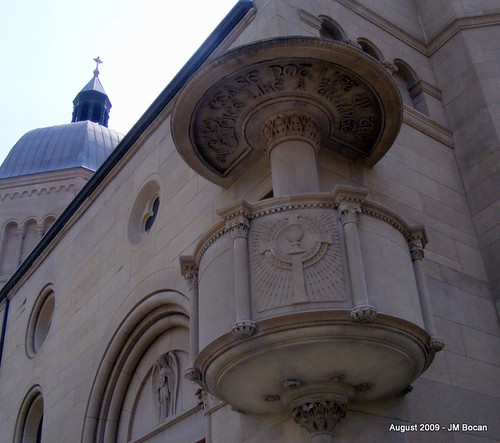
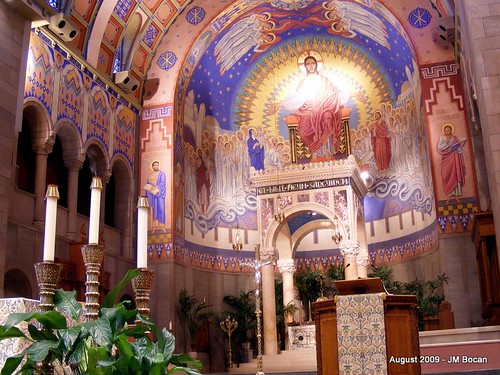
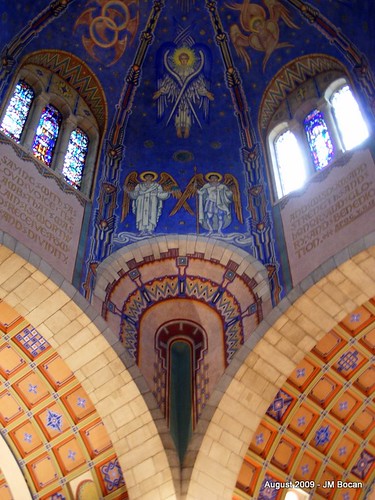
Edward Joseph Weber is, in many respects, the José Carreras of the early twentieth century Gothic Revival. You have Pavarotti, Domingo, and...the other guy, just as you have Cram, Goodhue, and...the other guy. Indeed, I would not have known of his existence had not he published two well-illustrated books on Catholic ecclesiology that often served as extremely thinly-veiled showcases of his work. (He seems to have had a hyperactive publicity machine, though I am not quite sure if it ever quite gained the traction he deserved. I know next to nothing of his actual biography, which says something already.) While his Gothic sketches often have a rather fantastic air to them--one shows an unbuilt modern cathedral with a crossing-tower about as big as a skyscraper--his greatest finished work was the Byzantino-Romanesque Cathedral of St. Joseph in Wheeling, West Virginia, a stolid structure with a rather bland exterior and a vividly-frescoed interior that shows a brilliant coloristic boldness and use of liturgical-eschatological symbolism never surpassed by his more famous confrères, with their own tendency to ornate but ultimately grey Gothic. Here are some stunning photos I found on flickr.com (credit: photographer JM Bocan):


Wednesday, February 24
Bertram G. Goodhue in Cleveland
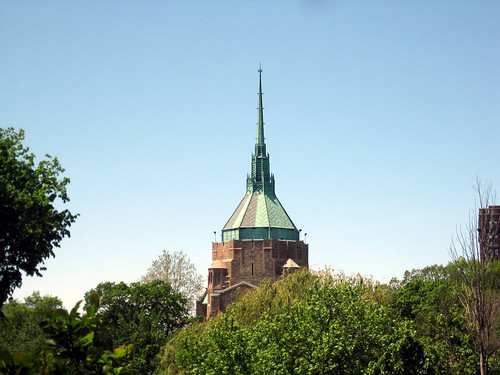
The great early twentieth-century architect Bertram G. Goodhue, Ralph Adams Cram's sometime business partner and the designer of the Nebraska State Capitol, St. Vincent Ferrer in New York City, and, with Cram, much of West Point, was also the progenitor of numerous minor masterpieces scattered across the country. I was quite surprised to discover one of his church designs can be seen in Cleveland, a city already almost freakishly well-endowed with beautiful ecclesiastical architecture. Jocularly called the "Church of the Holy Oil Can" (okay, I can see it)* Epworth-Euclid United Methodist is certainly one of his more expressive and impressive designs, as you can judge from these photos below, taken off flickr.com. It is especially striking to my eyes as I have never seen it documented in any work on the man's oeuvre, and shows his dexterous ability to develop Gothic far beyond its roots while remaining firmly true to both its spirit and letter.
*There was, at one time, a Unitarian "Church of the Holy Zebra" in 19th century New York, so nicknamed for its wildly Siennese-style striped exterior walls.
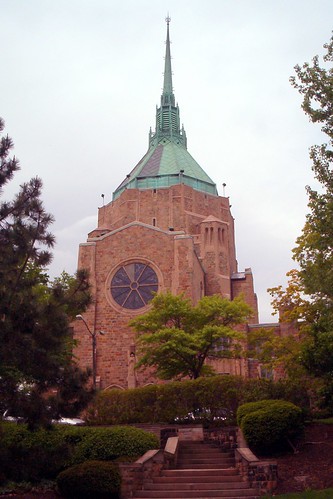
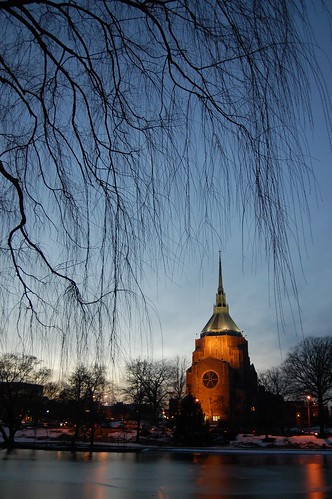
The Encyclopedia of Cleveland (yes, isn't the Internet wonderful?) notes:
In 1919-20 the Euclid Ave. and Epworth Memorial congregations merged, creating the Epworth-Euclid Methodist Church and constructing a large building between E. 107th St. and Chester Ave. (1907 E. 107th St.). Bertram Grosvenor Goodhue was commissioned to design the church shortly before his death in 1924. Plans were completed by Goodhue's firm in association with the Cleveland firm of Walker & Weeks. Construction began in 1926 and was completed in 1928. The building is a modern adaptation of Gothic themes. The exterior is ornamented with figures by New York sculptor Leo Friedlander. On the interior, the roof is supported by 4 great arches, with a large rose window, arched transept windows, and 4 small lancets in the tower, the only openings. T. Owen Bonawit and Howard G. Wilbert designed the stained glass windows. The entire structure is faced in Plymouth granite.The tower resembles, in Gothicized form, Goodhue's initial proposal for the "cimborio" (as he called it) or crossing-dome of St. Bart's on Park Avenue in New York City, the current, lower dome being an addition done by a successor firm after his death (mentioned here, and also in Christine Smith's excellent book on the structure, one of the first volumes I purchased at the Strand Bookstore when I was living in Manhattan). It also is interesting to compare it with another of Goodhue's more well-known works, Trinity English Lutheran in Fort Wayne, Indiana, which has a similar crossing-tower, though sitting much lower in the overall massing of the building, as can be seen here.
Tuesday, February 23
The School for Sinners
"No longer is being divine; now the divinity is first being and cause of all there is. [...]
"Why is this important? Because it radically transforms the way in which God is to be thought. Philosophically, it becomes required that God is the first cause, and the ground of all being, and of every particular being in its being. God is the summum ens, highest being. The nineteenth-century return to antiquity overturned this metaphysical settlement in ways we are still living out today. It is this conception of God that Nietzche proclaimed he discovered to have found dead. Insofar as this conception of God lives on, he does so only in the minds of some Christian, or at best theistic, theologians. Perhaps this above all explains the shrill imperative tone, the virulent rage, that infects some contemporary theological discourse: you will believe in God! Moreover, it explains the extreme moralism of much -- especially supposedly entirely 'orthodox' or 'conservative' -- contemporary theology, Catholic as well as Protestant. It is only by 'right thinking' and 'right living' that you can have access to God at all (which is to miss entirely the point of the Church as a school for sinners.)"
--Rev. Dr. Laurence Paul Hemming, deacon of the Archdiocese of Westminster, Worship as Revelation: The Past, Present and Future of Catholic Liturgy, 2008
"Why is this important? Because it radically transforms the way in which God is to be thought. Philosophically, it becomes required that God is the first cause, and the ground of all being, and of every particular being in its being. God is the summum ens, highest being. The nineteenth-century return to antiquity overturned this metaphysical settlement in ways we are still living out today. It is this conception of God that Nietzche proclaimed he discovered to have found dead. Insofar as this conception of God lives on, he does so only in the minds of some Christian, or at best theistic, theologians. Perhaps this above all explains the shrill imperative tone, the virulent rage, that infects some contemporary theological discourse: you will believe in God! Moreover, it explains the extreme moralism of much -- especially supposedly entirely 'orthodox' or 'conservative' -- contemporary theology, Catholic as well as Protestant. It is only by 'right thinking' and 'right living' that you can have access to God at all (which is to miss entirely the point of the Church as a school for sinners.)"
--Rev. Dr. Laurence Paul Hemming, deacon of the Archdiocese of Westminster, Worship as Revelation: The Past, Present and Future of Catholic Liturgy, 2008
Monday, February 22
A Thurible from the Church of St. Anthony, Padua

Source: Taken from the otherwise mediocre work Postwar Churchbuilding.
Friday, February 19
Blogging Jesuit, Hidden Tiger*
A pal from my New York days, scholastic David Paternostro, SJ., is now writing entries on a young Jesuit megablog offering daily retreat meditations inspired by St. Ignatius himself. (Scholastics are essentially Jesuits in priestly formation, and are addressed by the title of "Mister," as opposed to temporal coadjutors, who are called "Brother." Presumably one of our readers can explain better than me, who is basing this on a 30-second glance at Wikipedia). Come on down and have a look!
And yes, Paternostro is his real last name. This is especially funny as the New York archdiocese also has a priest whose first name is Deogratias, if I remember correctly (!).
*Insert Matteo Ricci joke.
And yes, Paternostro is his real last name. This is especially funny as the New York archdiocese also has a priest whose first name is Deogratias, if I remember correctly (!).
*Insert Matteo Ricci joke.
Thursday, February 18
The Athanasius Kircher Society Resurfaces

As many of our readers know, I have a great fondness for the Baroque Jesuit scientist Fr. Athanasius Kircher, the last man who knew everything. Kircher frequently got the wrong end of the stick (though not as often as one might think -- his universe was definitely a heliocentric one), but his work is so crammed with wonderful weirdness--a cat piano, a sunflower clock, dragon-shaped balloons with the words Fugite Divina ira inscribed upon them, and the most beautiful scientific diagrams to ever grace a page--it is easy to overlook them in an age when, for all its unfolding mysteries, science has all the fun of an Albigensian time-management seminar. Also, being a priest and a holy man, Kircher is sort of an unofficial patron saint of mine, and I even occasionally ask him to intercede for me.
I was, as a consequence, marvelous to discover the Athanasius Kircher Society, an institution dedicated not to the study of Kircheriana, but the kind of odd and exciting stuff he himself would have enjoyed studying himself, and sad to see its disappearance after a long and fruitful life as a website and even one extremely successful real-life meeting which featured a presentation of a scene from Romeo and Juliet in the international language of Solresol, a lecture by the Man Who Fell To Earth from Space (he was a test pilot or something), and a fellow whose brain made Rain Man look like Adam Sandler. But I was now delighted to discover that the Kircher society appears to be back--or at the very least, some successor group--under the name Atlas Obscura: Wondrous, Curious and Bizarre Locations Around the World, with entries on the beautiful Renaissance Villa Litta, the International Banana Club Museum, the British Lawnmower Museum, and a sphinx with Joseph Smith's face (which explains that whole "Reformed Egyptian" thing, I suppose.)
There is also a somewhat unnecessarily uncharitable entry on St. Bernadette (who we celebrate today on the 1962 calendar) and her incorrupt body, which seems a bit indignant that she currently has a wax face and hands, not realizing that is standard operating procedure for incorruptibles--miraculous doesn't always mean pretty. St. Rose of Viterbo, for instance, looks quite good for being 800 years old, but she's still missing her nose. On the other hand, she looks a lot better than the artifically-embalmed body of Mao, which I'm told has turned a rather unsettling Crayola-style shade of orange.
One other critique: I do think the automatic link generator at the bottom of the page needs some work as I really have no desire to see "Strange Photos from Russian Social Network," the top ten grossest foods, odd tattoos, faked Photoshopped photos, fake fake Photoshopped photos, that guy with a deformed skull (please, not during my lunch break), or off-color photographs of a tree shaped like something I can't discuss on a family website (even a rather dysfunctional family website like this one). I do like the Dubai elephant clock, though.
Incidentally, I see Kircher's monumental and profusely-illustrated 1675 work on Noah's ark can be found online, for those Latin buffs among us with too much time on their hands.
Fr. Vasily Explains it All: Lent Edition
From the incomparable (and possibly imaginary) Father Vasily at The Onion Dome:
Dear Fr. Vasily,Is (not) outrage!
I own a a tie that depicts milk chocolate that melts in your mouth and not in your hand. Is okay to wear this tie during Lent?
—M.M. from Memphis
Dear Memphis,
Is outrage! Father Vasiliy has seen this tie. You should be ashamed to be wearing this tie in any season, unless it was gift from your children. Then is most wonderful tie in world, and wearing during Lent is definitely okay.
—Father Vasiliy
I Speak From Personal Experience
Yesterday may well have been the worst (second worst?) day on the Christian calendar to have Victimae Paschali Laudes stuck in one's head.
Wednesday, February 17
From the Archives: Set Apart: A Meditation on Ash Wednesday
An oldie but a goodie, written one Ash Wednesday during my New York years. I hope you will forgive us going into reruns for the occasion:

There is a deep, dark black smudge the size of a thumbprint on my forehead, which makes me look even paler than usual. It is more of a dot than a cross, though if you look carefully you can see the transverse stroke. The effect is of a particularly morbid boddhisava. I've been wandering around the city with this thing since this morning. Nobody else in the office has got, one, not even the other Catholics, who will probably get their ashes in the evening, if they go at all. I've not gotten many strange looks, though, maybe because it blends in with my hair.
I have, with a mixture of curiosity and vanity, checked myself in the mirror at least once to see if it's still there, and it is, big and black. On one level, I know my little prideful "Super Catholic" moments of self-examination--the bathroom mirror, the brass of a doctor's nameplate-- are going against today's pericope to not "disfigure [your] faces so as to show others that [you] are fasting" in taking a little perverse pride in this last vestige of the more severe and straightforward Lent of ages long past. The Church clearly sees no contradiction with our call to "put oil on your head and wash your face," with this ancient penitential practice--otherwise She wouldn't have picked that reading in the first place. There's a world of difference between a ceremonial smudge and purposefully neglecting to bathe just to give off an appropriately holy aroma.
I'm not saying it doesn't cause more than a justifiable double-take, but sometimes we're too quick to jump on the inconsistency bandwagon about things like this--about the two creations of man in Genesis, about calling priests Father, about Christ's cousins, sisters and aunts, about what the heck to do with Mary, looming disconcertingly large to our skittish Protestant brethren--forgetting the Church has been there from the start, sifting scripture, defining canons, shaping culture, and She's heard it all before. It's all of a piece.
(For the record, aspiring professional fasters sometimes applied makeup to look hollow-eyed and pulled long faces for maximum pathetic affect in Christ's day.)
Chesterton once imagined a long procession of mysterious priests with their strangely-shaped mitres, hooked croziers, their incense and bells, and their sacred books--what possesses us to leap upon them, disregarding everything else, and seize the Bible from their hands, crying out for sola scriptura, when they, with all their antique ways of mind and worship, were the first to call it sacred? There's always a deeper logic there, if we dig, or if we simply choose to trust in the vast and occasionally cobwebby mansion that is both Tradition and tradition. Public penitence--whether flamboyantly physical or merely simply passing on the cheesecake--is part of the Catholic landscape, and the Catholic imagination. (And I won't pretend that can't get disturbing sometimes, but there it is, no apologies--though the Church has always stressed moderation). We're no angels. We're not supposed to be. While the best thing is a chastened soul, sometimes the only way to get there is via the body. No dessert menus, thanks. Check, please?
Still, as with all great art--and the corpus of the liturgy is truly the highest art--there's a dramatic tension between our outward ashes and the call to rend our hearts rather than our garments. Perhaps on one level, it's the oddity of our American praxis. In Italy, rather than New York, the marks on our foreheads--giant schmutzes or tiny daubs--do get odd and even frightened looks. A friend of mine once got smeared, American-style, at Santa Suzanna in Rome, and came out to find the rest of the city still pagan and brazenly bare-foreheaded. Turns out in Italy, they merely give you a dusting on the top of the head with the old Adam.
So many subspecies of ashen crosses. Heading to church in the grey morning, I see a couple in comfortable middle-age with faded smudges heading out the other way, the balding gentleman sports a vague squiggle that could almost be Arabic calligraphy. I spot a well-dressed, undersized Rory Gilmore clone in Grand Central, a gigantic trapezoidal cross filling her little forehead. An old man with grey-black whisps who could have been Indian, Black or a dozen other ethnicities, a generic American everyman. A blonde young walkure, all icy-white and gold, with a reticent but crisp black tilak smack in the center. The priests up at the altar today, crisp, with the polished air of Opus Dei, haven't gotten theirs yet. Do they do each other?
John Zmirak, with his usual wit, labels today "Catholic Mating Identification Day," and includes a recipe for a helpful dish called "Hey, I think You're Kind of Hot" Cross Buns. I will admit to having been distracted at times past by a coy lass or two with this anti-sign of Cain on her brow, but "Hey, we both have the same black smudge on our forehead" an even less successful subway pickup line than the last one I heard recounted by a female friend, "Hey, isn't that AM New York you're reading?" (The equivalent of asking the gal next to you in Coach if she's a fan of Skymall.)
But maybe he's on to something. In one of the prophet Ezechiel's visions, he receives the call to "Mark Thau [the letter T, Greek Tau, Hebrew Tav] upon the foreheads of the men that sigh, and mourn for all the abominations that are committed in the midst thereof," marking them as the saved, free from the impending doom of God's destroying angels. The Tav--the origins of today's Tau cross--in time became a symbol of Judaism a little before the time of Jesus, eventually adhering itself to the centinarian Anthony the Abbot and the Franciscans. The Apocalypse speaks in a similar way of the seal of the living God saving His people from destruction. The blood of Passover--also said to be cruciform--is probably at the back of all of this. It is no coincidence Our Lord ended up on a cross.
(I'm told in New York, the smudge doesn't really turn heads; just like random heathens turn up on Palm Sunday for freebees, sometimes an occasional Muslim or Jew slips in to get smudged. St. Agnes finds itself so popular on this fast-day that they have priests in the vestibule distributing ashes to folks coming in off the street. Other denominations imitate us. The Anglicans have their Solemn Liturgy of Ash Wednesday with all the usual choral trimmings, and even the Presbyterians--never one for mid-week liturgics--engage in a bit of smearing. Subsconsciously, we all want to be Catholic.)
I've got this black smudge on my brow, and it says I belong to God, whether I want to, or not. On the purely social level, this may get you stared at like a circus freak (especially in the South, where I come from, and the traditional white ethnics of Catholicism are comparatively thin on the ground), you might as well have a gigantic target on your back--hardly the sort of pats-on-the-back the extravagant hunger artists of Christ's day were looking for.
But beyond that it reminds us we're set apart, and we're supposed to behave that way. No shoving in the subway, no f-bombs, no "Hey, I'm walking here," no stuffing your face when you're supposed to be fasting, no surreptitious ogling of the espresso boy or the cute brunette down at the front of the bus (unless, I suppose, they've got the mark on them, too, and then, gents, please, keep it above the shoulders and ladies--well, I don't know where you look anyway, so just behave yourselves). It reminds you your name is Christian, your surname Catholic, and you're supposed to act that way. It's a uniform. For one day a year, you haven't got a choice in the matter, or you bring the whole Church in on your tacky behavior.
For one day you get to feel the way priests feel all day long under those collars of theirs. It's a bit humbling, isn't it?
One early Church Father, of a Platonist bent--perhaps Clement of Alexandria, I forget--once tried to sell Christianity to his proto-post-modern pagan audience by explaining of the exquisite manners and civic virtue of the ideal Christian--no burping gluttony, no hurtful jokes, no getting the help pregnant. Today's sybarites aren't much different from his audience--though their table manners are worse, and nobody knows how to fold a toga anymore. But they do respond to kindness. Don't disgrace the uniform today.
There is a deep, dark black smudge the size of a thumbprint on my forehead, which makes me look even paler than usual. It is more of a dot than a cross, though if you look carefully you can see the transverse stroke. The effect is of a particularly morbid boddhisava. I've been wandering around the city with this thing since this morning. Nobody else in the office has got, one, not even the other Catholics, who will probably get their ashes in the evening, if they go at all. I've not gotten many strange looks, though, maybe because it blends in with my hair.
I have, with a mixture of curiosity and vanity, checked myself in the mirror at least once to see if it's still there, and it is, big and black. On one level, I know my little prideful "Super Catholic" moments of self-examination--the bathroom mirror, the brass of a doctor's nameplate-- are going against today's pericope to not "disfigure [your] faces so as to show others that [you] are fasting" in taking a little perverse pride in this last vestige of the more severe and straightforward Lent of ages long past. The Church clearly sees no contradiction with our call to "put oil on your head and wash your face," with this ancient penitential practice--otherwise She wouldn't have picked that reading in the first place. There's a world of difference between a ceremonial smudge and purposefully neglecting to bathe just to give off an appropriately holy aroma.
I'm not saying it doesn't cause more than a justifiable double-take, but sometimes we're too quick to jump on the inconsistency bandwagon about things like this--about the two creations of man in Genesis, about calling priests Father, about Christ's cousins, sisters and aunts, about what the heck to do with Mary, looming disconcertingly large to our skittish Protestant brethren--forgetting the Church has been there from the start, sifting scripture, defining canons, shaping culture, and She's heard it all before. It's all of a piece.
(For the record, aspiring professional fasters sometimes applied makeup to look hollow-eyed and pulled long faces for maximum pathetic affect in Christ's day.)
Chesterton once imagined a long procession of mysterious priests with their strangely-shaped mitres, hooked croziers, their incense and bells, and their sacred books--what possesses us to leap upon them, disregarding everything else, and seize the Bible from their hands, crying out for sola scriptura, when they, with all their antique ways of mind and worship, were the first to call it sacred? There's always a deeper logic there, if we dig, or if we simply choose to trust in the vast and occasionally cobwebby mansion that is both Tradition and tradition. Public penitence--whether flamboyantly physical or merely simply passing on the cheesecake--is part of the Catholic landscape, and the Catholic imagination. (And I won't pretend that can't get disturbing sometimes, but there it is, no apologies--though the Church has always stressed moderation). We're no angels. We're not supposed to be. While the best thing is a chastened soul, sometimes the only way to get there is via the body. No dessert menus, thanks. Check, please?
Still, as with all great art--and the corpus of the liturgy is truly the highest art--there's a dramatic tension between our outward ashes and the call to rend our hearts rather than our garments. Perhaps on one level, it's the oddity of our American praxis. In Italy, rather than New York, the marks on our foreheads--giant schmutzes or tiny daubs--do get odd and even frightened looks. A friend of mine once got smeared, American-style, at Santa Suzanna in Rome, and came out to find the rest of the city still pagan and brazenly bare-foreheaded. Turns out in Italy, they merely give you a dusting on the top of the head with the old Adam.
So many subspecies of ashen crosses. Heading to church in the grey morning, I see a couple in comfortable middle-age with faded smudges heading out the other way, the balding gentleman sports a vague squiggle that could almost be Arabic calligraphy. I spot a well-dressed, undersized Rory Gilmore clone in Grand Central, a gigantic trapezoidal cross filling her little forehead. An old man with grey-black whisps who could have been Indian, Black or a dozen other ethnicities, a generic American everyman. A blonde young walkure, all icy-white and gold, with a reticent but crisp black tilak smack in the center. The priests up at the altar today, crisp, with the polished air of Opus Dei, haven't gotten theirs yet. Do they do each other?
John Zmirak, with his usual wit, labels today "Catholic Mating Identification Day," and includes a recipe for a helpful dish called "Hey, I think You're Kind of Hot" Cross Buns. I will admit to having been distracted at times past by a coy lass or two with this anti-sign of Cain on her brow, but "Hey, we both have the same black smudge on our forehead" an even less successful subway pickup line than the last one I heard recounted by a female friend, "Hey, isn't that AM New York you're reading?" (The equivalent of asking the gal next to you in Coach if she's a fan of Skymall.)
But maybe he's on to something. In one of the prophet Ezechiel's visions, he receives the call to "Mark Thau [the letter T, Greek Tau, Hebrew Tav] upon the foreheads of the men that sigh, and mourn for all the abominations that are committed in the midst thereof," marking them as the saved, free from the impending doom of God's destroying angels. The Tav--the origins of today's Tau cross--in time became a symbol of Judaism a little before the time of Jesus, eventually adhering itself to the centinarian Anthony the Abbot and the Franciscans. The Apocalypse speaks in a similar way of the seal of the living God saving His people from destruction. The blood of Passover--also said to be cruciform--is probably at the back of all of this. It is no coincidence Our Lord ended up on a cross.
(I'm told in New York, the smudge doesn't really turn heads; just like random heathens turn up on Palm Sunday for freebees, sometimes an occasional Muslim or Jew slips in to get smudged. St. Agnes finds itself so popular on this fast-day that they have priests in the vestibule distributing ashes to folks coming in off the street. Other denominations imitate us. The Anglicans have their Solemn Liturgy of Ash Wednesday with all the usual choral trimmings, and even the Presbyterians--never one for mid-week liturgics--engage in a bit of smearing. Subsconsciously, we all want to be Catholic.)
I've got this black smudge on my brow, and it says I belong to God, whether I want to, or not. On the purely social level, this may get you stared at like a circus freak (especially in the South, where I come from, and the traditional white ethnics of Catholicism are comparatively thin on the ground), you might as well have a gigantic target on your back--hardly the sort of pats-on-the-back the extravagant hunger artists of Christ's day were looking for.
But beyond that it reminds us we're set apart, and we're supposed to behave that way. No shoving in the subway, no f-bombs, no "Hey, I'm walking here," no stuffing your face when you're supposed to be fasting, no surreptitious ogling of the espresso boy or the cute brunette down at the front of the bus (unless, I suppose, they've got the mark on them, too, and then, gents, please, keep it above the shoulders and ladies--well, I don't know where you look anyway, so just behave yourselves). It reminds you your name is Christian, your surname Catholic, and you're supposed to act that way. It's a uniform. For one day a year, you haven't got a choice in the matter, or you bring the whole Church in on your tacky behavior.
For one day you get to feel the way priests feel all day long under those collars of theirs. It's a bit humbling, isn't it?
One early Church Father, of a Platonist bent--perhaps Clement of Alexandria, I forget--once tried to sell Christianity to his proto-post-modern pagan audience by explaining of the exquisite manners and civic virtue of the ideal Christian--no burping gluttony, no hurtful jokes, no getting the help pregnant. Today's sybarites aren't much different from his audience--though their table manners are worse, and nobody knows how to fold a toga anymore. But they do respond to kindness. Don't disgrace the uniform today.
Tuesday, February 16
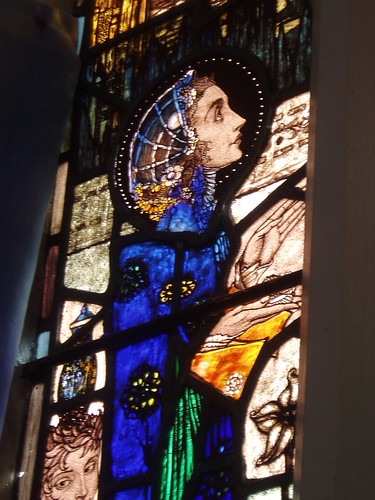
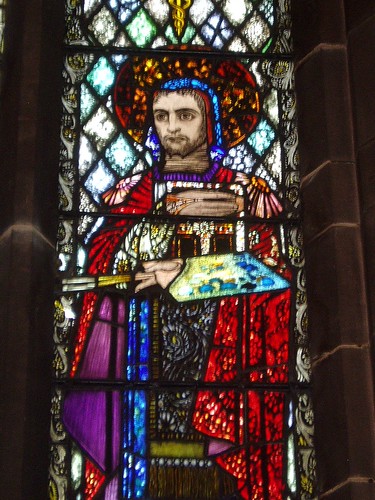
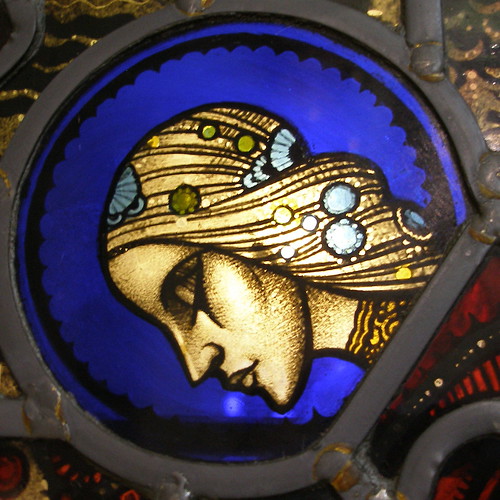
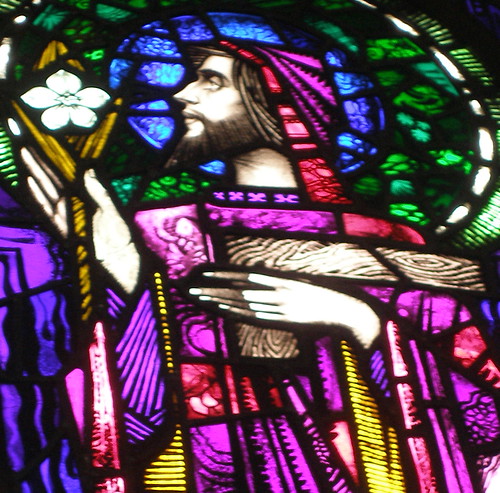
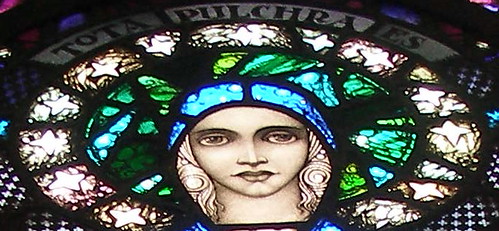
More Stained Glass by Harry Clarke and his Studio
Monday, February 15
The Disappearance of Childhood?
I have been reading, in one of those fits of academic whimsy that I am sure overtakes everyone at one time or another, a rather strange little book, the late Neil Postman's The Disappearance of Childhood, a 1994 reissue of his 1982 work dissecting the curiously adultish quality of most modern children and the equally odd childishness of most contemporary adults. (Postman, a Marshall McLuhan-ish cultural critic who died in 2003, is best known for his 1985 work Amusing Ourselves to Death, on television.) There is a lot of fodder for thought here, though there are also numerous puzzling gaps to and odd ramifications springing from his thesis; he also lays the blame in equally peculiar places. One might claim that our current spate of adult adolescence lies more in the exaggeration and final end of our age's own cult of youth-worship than in its negation.
One of these difficulties, dealing with his discussion of what might be termed the history of childhood, is his contention there were no children in the Middle Ages. This is not that he claims medieval man emerged fully-sprung from his mother's womb, but that the child was not recognized as a separate category of human individual. There is something to be said for this; there is also even more to be said to his contention we are sliding into the same state today under the infantilizing tendencies of modern media. At the same time the idea seems curiously off somehow. The problem is there is a sizable difference between predominantly childlike adults and adultish children as well as the usual anthropological problem of studying humans like insects, and forgetting they're still quite human.
He cites as evidence the fact no medieval artist seems able to properly draw a baby--making them look instead like little men--and the crude, dirty, shameless behavior of medieval tavern-dwellers who seem to have never heard their mother say, of their loutish actions, "Not in front of little Junior!" He claims that, while the ancient Romans recognized the child, the decline of literacy, and thus the need for formal schooling in the manner we recognize, brought about this curious breakdown of the boundaries between child and adult as civilization ostensibly collapsed.
The problem here, and in his discussion of modern culture, is that Postman seems unable to define whether he is talking about the disappearance of childhood or the disappearance of adulthood (though it would seem the two phenomena are related). His medievals are childish illiterates whose best scholars are so defeated by the intricate stylization of early calligraphy (in contrast to the eminent legibility of Roman script) that they must torturously mumble their way through a text of Augustine like a kid learning phonics. This is not medieval history, this is the plot of the film Idiocracy as performed by the cast of Monty Python and the Holy Grail.
While silent reading, when practiced, was considered something of a wonder, the verbal reading of medieval scholars certainly was not the stumbling, fumbling childish attempt he paints it as. Medieval calligraphy was highly ornamented, but certainly could be read by someone who was familiar with the script, as any medievalist could tell you. Could you imagine ten monks huddled around an enormous psalter trying chant and to decypher the letters in that fashion at the same time? Indeed, the Romans practiced verbal reading--the story of St. Philip and the Ethiopian eunuch, reading aloud the Old Testament to himself while sitting in his carriage, suggests as much.
Certainly medieval children were treated more like small adults, at least more so than their Rousseauian 18th century counterparts. (Their elders had more commonsense, for one thing.) But that does not mean they were not loved in a way different from their older peers. To suggest, as he does, citing another auctoritee (if we're going to get all medieval here) on the subject, that parental love of children in the modern sense only goes back to the seventeenth century boggles the mind in the face of the great tenderness of even the earliest icons of the Christ-Child and His Mother, as odd as the little old man-baby might have looked. The entire cultus of the Infant Jesus is a counterexample to such an extravagant claim. The past may be another planet at times, but its inhabitants were not space aliens.
He might have also pointed out, based on the same evidence, that in the Middle Ages that some houses were missing their exterior walls so as to see the scenes within, or that kings slept wearing their crowns, or that the Egyptians had eyes on the sides of their heads, if we are to take artistic evidence that literally. Furthermore, to pretend that medieval schools were a small matter, and no line separated child from adult, is a bit of a stretch in light of the fact the university (Cambridge, Oxford, Paris, Salamanca, Bologna) as we know it was invented in this period. Primary and secondary schools were probably of less consequence than today, but to ignore them at all is rather a remarkable gap in his thesis.
What Postman sees as the discovery of childhood during the Renaissance (which he ascribes to the printing-press and the growth of literacy, despite the fact that Gutenberg was rather a johnny-come-lately to the period, which was in full swing in Italy at least fifty years to a century before he put print to paper, depending on how one reckons it) might instead be termed the rise of the middle class, and the ability to apply the more luxuried upper-class notions notions of human behavior to a wider audience. That Erasmus would write manuals on manners for children suggests not that kings and princes behaved like slovenly teenagers during the Middle Ages, but that the peasantry did; and even then, that may be ascribable less to the absence of childhood than the absence of germ theory. Brueghel's shameless scenes of general rejoicing are probably less representative of an adult population acting as if it were on spring break in Brughes than typical Catholic boisterousness and a lack of manners wholly appropriate to their class, rather than their age group.
Certainly, the cosseted and rather silly 19th century notion of childhood was absent in past ages, and much of what happened in the artificial environment of schools happened at one's mother's knee or the equivalent of on-the-job training, but to say that child and adult were indivisible in fifteenth-century Flanders, is rather hard to take. As to his contention that childhood is disappearing today--and that, at the same time, so is adulthood--that is another matter entirely, and deserves another post.
One of these difficulties, dealing with his discussion of what might be termed the history of childhood, is his contention there were no children in the Middle Ages. This is not that he claims medieval man emerged fully-sprung from his mother's womb, but that the child was not recognized as a separate category of human individual. There is something to be said for this; there is also even more to be said to his contention we are sliding into the same state today under the infantilizing tendencies of modern media. At the same time the idea seems curiously off somehow. The problem is there is a sizable difference between predominantly childlike adults and adultish children as well as the usual anthropological problem of studying humans like insects, and forgetting they're still quite human.
He cites as evidence the fact no medieval artist seems able to properly draw a baby--making them look instead like little men--and the crude, dirty, shameless behavior of medieval tavern-dwellers who seem to have never heard their mother say, of their loutish actions, "Not in front of little Junior!" He claims that, while the ancient Romans recognized the child, the decline of literacy, and thus the need for formal schooling in the manner we recognize, brought about this curious breakdown of the boundaries between child and adult as civilization ostensibly collapsed.
The problem here, and in his discussion of modern culture, is that Postman seems unable to define whether he is talking about the disappearance of childhood or the disappearance of adulthood (though it would seem the two phenomena are related). His medievals are childish illiterates whose best scholars are so defeated by the intricate stylization of early calligraphy (in contrast to the eminent legibility of Roman script) that they must torturously mumble their way through a text of Augustine like a kid learning phonics. This is not medieval history, this is the plot of the film Idiocracy as performed by the cast of Monty Python and the Holy Grail.
While silent reading, when practiced, was considered something of a wonder, the verbal reading of medieval scholars certainly was not the stumbling, fumbling childish attempt he paints it as. Medieval calligraphy was highly ornamented, but certainly could be read by someone who was familiar with the script, as any medievalist could tell you. Could you imagine ten monks huddled around an enormous psalter trying chant and to decypher the letters in that fashion at the same time? Indeed, the Romans practiced verbal reading--the story of St. Philip and the Ethiopian eunuch, reading aloud the Old Testament to himself while sitting in his carriage, suggests as much.
Certainly medieval children were treated more like small adults, at least more so than their Rousseauian 18th century counterparts. (Their elders had more commonsense, for one thing.) But that does not mean they were not loved in a way different from their older peers. To suggest, as he does, citing another auctoritee (if we're going to get all medieval here) on the subject, that parental love of children in the modern sense only goes back to the seventeenth century boggles the mind in the face of the great tenderness of even the earliest icons of the Christ-Child and His Mother, as odd as the little old man-baby might have looked. The entire cultus of the Infant Jesus is a counterexample to such an extravagant claim. The past may be another planet at times, but its inhabitants were not space aliens.
He might have also pointed out, based on the same evidence, that in the Middle Ages that some houses were missing their exterior walls so as to see the scenes within, or that kings slept wearing their crowns, or that the Egyptians had eyes on the sides of their heads, if we are to take artistic evidence that literally. Furthermore, to pretend that medieval schools were a small matter, and no line separated child from adult, is a bit of a stretch in light of the fact the university (Cambridge, Oxford, Paris, Salamanca, Bologna) as we know it was invented in this period. Primary and secondary schools were probably of less consequence than today, but to ignore them at all is rather a remarkable gap in his thesis.
What Postman sees as the discovery of childhood during the Renaissance (which he ascribes to the printing-press and the growth of literacy, despite the fact that Gutenberg was rather a johnny-come-lately to the period, which was in full swing in Italy at least fifty years to a century before he put print to paper, depending on how one reckons it) might instead be termed the rise of the middle class, and the ability to apply the more luxuried upper-class notions notions of human behavior to a wider audience. That Erasmus would write manuals on manners for children suggests not that kings and princes behaved like slovenly teenagers during the Middle Ages, but that the peasantry did; and even then, that may be ascribable less to the absence of childhood than the absence of germ theory. Brueghel's shameless scenes of general rejoicing are probably less representative of an adult population acting as if it were on spring break in Brughes than typical Catholic boisterousness and a lack of manners wholly appropriate to their class, rather than their age group.
Certainly, the cosseted and rather silly 19th century notion of childhood was absent in past ages, and much of what happened in the artificial environment of schools happened at one's mother's knee or the equivalent of on-the-job training, but to say that child and adult were indivisible in fifteenth-century Flanders, is rather hard to take. As to his contention that childhood is disappearing today--and that, at the same time, so is adulthood--that is another matter entirely, and deserves another post.
Friday, February 12
Harry Clarke and Lourdes (I)
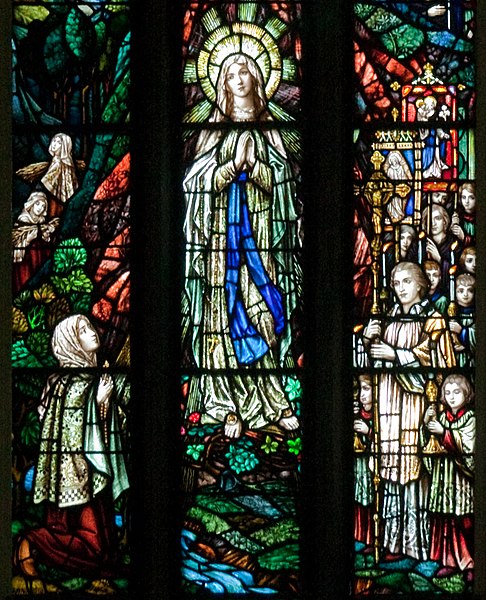
This is not the image I was thinking of (which I will post later), but I discovered the workshop of the illustrator and stained-glass designer Harry Clarke did a rather fine bit of stained glass of the apparition. This particular work was actually done by Joshua Clarke, his father, and is not quite as stylistically extreme as much of Harry's work, but nonetheless manages to work in a more conventional late 19th century style without by any means appearing stale. It is really quite wonderful, and the additon of the Lourdes procession in the right-hand light is a highly imaginative addition to the usual imagery associated with the event. One should also note the subtle pose of the Virgin herself, with her weight shifted carefully onto one foot, giving her iconic frontality a swaying, airy quality (though the turn of the other foot is somewhat troubling anatomically); the face is soulful without appearing stereotyped. It is good to see subjects like this can be treated without appearing, as one seminarian recently described it to me, like robes with hands and feet indifferently applied.
(Image source: Photo by Andreas F. Borchert, 14 September 2009 and published at Wikimedia Commons on 15 November 2009. This is a copyrighted photograph which is available under multiple free licenses.)
Thursday, February 11
It's Funny Because It's True. And Kind of Depressing at the Same Time.

A friend, quoting a priest she knew in college:
"I gave you folks this particular [Eastern iconographic] image of the Sacred Heart because if you look at a lot of the others and cover up everything but the eyes, it looks like a mascara ad."
We can do better than this, people.

Our Lady of Lourdes

Matthew Alderman. Our Lady of Lourdes, the Immaculate Conception. Ink, with digital additions. January 2008. Private Collection, New York City.
I did this some years ago as a late Christmas gift for a friend with a deep devotion to Our Lady of Lourdes. I later discovered, weeks after I had given the gift, I had given Our Lady thirteen stars rather than her traditional twelve. When I was approached by a client asking to use this image in advertisements for masses on Our Lady of Lourdes' feast day, I cleaned it up a little using Photoshop and corrected the offending detail. Unfortunately, due to circumstances beyond both our control, another, older image was used instead, but it provided a good opportunity to revise this image, one of my favorites--the Immaculate Conception surrounded by the votive tapers of her grotto shrine.
Our Lady of Lourdes is, along with the Sacred Heart, an image well-known to Catholics, and often due to its sheer repeatability comes dangerously close to a cliché, aided by the crude quality of many of her statues and holy cards. (It is interesting to note that other older images like Our Lady of Perpetual Help, however many times copied, seem immune to this iconography fatigue, for a number of reasons. That being said, the standard 19th century image of Our Lady of Lourdes is usually much better than the simpering Sacred Hearts that came out of the period.) It is interesting to note St. Bernadette never particularly liked the official images that came out of Lourdes. I am by no means saying this image is more accurate, but it does show that some range is possible within the framework of the traditional imagery surrounding the apparition. Later today or tomorrow I hope to post an image by the great Irish illustrator Harry Clarke, which partially inspired this drawing, to give another take on Our Lady of Lourdes different in style but not content from the conventional depictions of the event.
Wednesday, February 10
Here's a Gold Star for You, Warren G. Harding, Go Have a Cupcake

As the Shrine's resident curmudgeon, I'd like to point out that the holiday coming up next Monday is still, at least officially, Washington's Birthday, rather than the blander, imprecise "Presidents' Day," which makes him, a titanic, iconic figure in both history and the imagination, no better or worse than the rather checkered series of men who have governed our nation. As far as I'm concerned, it's right up there with National Chocolate Cake Day, Festivus, or that thing with the tanks and guys in goofy fur hats in Red Square in terms of invented festivals. (And at least Festivus has the airing of grievances). It is the historical equivalent of handing out gold stars to all the kiddies in the class. Lincoln, for his posthumous place in the American imagination, is the closest after Washington in being logically allocated a holiday, and after him nearly all the others are distant seconds and thirds (even my beloved John Adams, I have to admit. Though, sed contra: "Friendship and trust in the entourage is the most important thing. Like that HBO show... John Adams." Thus Tracy Jordan.)
Do we really need a holiday to remember nonentities like Warren Harding or William Henry Harrison, or klutzy warmongers like McKinley (whose administration's nitwit Platt Amendment soured relations with Cuba for decades)* or Woodrow Wilson, the sanctimonious racist schoolmarm who dismantled most of Catholic Europe at Versailles? Or, for that matter, James S. Polk? I'm quite glad we stretch from sea to shining sea, but let's face it, it's hard to explain how we got a good chunk of that real estate without at least a little national embarassment.
Certainly Washington and Lincoln's reputations were not spotless, but that they could inspire such a legend, and for so long, suggests something of permanence beyond the mere facts. Rushes to secular canonization produce dull civic gods--who remembers Garfield, the great martyr who loomed so high in 1885? That Washington is still remembered, if only for apple trees and wooden teeth, is at least a testament to persistence. (And that he was the only president to wear a court sword on public occasions, if I remember, suggests he had a sense of style and decorum denied to nearly the whole of the governing tradition he inaugurated. Jefferson met ambassadors while wearing carpet slippers, for crying out loud.) A holiday for all the presidents robs us of the specificity essential to memory; it is like offering incense up to a senate subcomittee on traffic-cones, manufactured and utterly devoid of a deeper, organic significance. And it just doesn't ring true in the snappy names department: culture needs specificity; great holidays are named for gods or heroes, not, as the French revolution would have it, random atmospheric phenomena, or, as we would have it, a class of very dull individuals in ties who only occasionally distinguish themselves, whether on the right or left. (And, frankly, I like my rulers dull. It's safer that way. I'm quite sure Vlad the Impaler and Charles the Mad were the life of the party, for better or worse.) It is very different from a holiday for all the saints, known and unknown--which is almost like a monument to the unknown soldier, mysterious and poignant. It is a textbook example of how today's culture continues to bleach all the interest, romance and rootedness out of life--whether on account of timidity or a false sense of fairness, I do not know.
*Essentially, it reads, "Yes, of course, we just gave independence to your nation, but we'll be able to send troops in to muck around with your personal national sovereignty whenever we need to borrow a cup of sugar." I don't doubt our republic's (hamfisted if more-or-less) good intentions in these cases, but really, doesn't anyone think this stuff through?
Do we really need a holiday to remember nonentities like Warren Harding or William Henry Harrison, or klutzy warmongers like McKinley (whose administration's nitwit Platt Amendment soured relations with Cuba for decades)* or Woodrow Wilson, the sanctimonious racist schoolmarm who dismantled most of Catholic Europe at Versailles? Or, for that matter, James S. Polk? I'm quite glad we stretch from sea to shining sea, but let's face it, it's hard to explain how we got a good chunk of that real estate without at least a little national embarassment.
Certainly Washington and Lincoln's reputations were not spotless, but that they could inspire such a legend, and for so long, suggests something of permanence beyond the mere facts. Rushes to secular canonization produce dull civic gods--who remembers Garfield, the great martyr who loomed so high in 1885? That Washington is still remembered, if only for apple trees and wooden teeth, is at least a testament to persistence. (And that he was the only president to wear a court sword on public occasions, if I remember, suggests he had a sense of style and decorum denied to nearly the whole of the governing tradition he inaugurated. Jefferson met ambassadors while wearing carpet slippers, for crying out loud.) A holiday for all the presidents robs us of the specificity essential to memory; it is like offering incense up to a senate subcomittee on traffic-cones, manufactured and utterly devoid of a deeper, organic significance. And it just doesn't ring true in the snappy names department: culture needs specificity; great holidays are named for gods or heroes, not, as the French revolution would have it, random atmospheric phenomena, or, as we would have it, a class of very dull individuals in ties who only occasionally distinguish themselves, whether on the right or left. (And, frankly, I like my rulers dull. It's safer that way. I'm quite sure Vlad the Impaler and Charles the Mad were the life of the party, for better or worse.) It is very different from a holiday for all the saints, known and unknown--which is almost like a monument to the unknown soldier, mysterious and poignant. It is a textbook example of how today's culture continues to bleach all the interest, romance and rootedness out of life--whether on account of timidity or a false sense of fairness, I do not know.
*Essentially, it reads, "Yes, of course, we just gave independence to your nation, but we'll be able to send troops in to muck around with your personal national sovereignty whenever we need to borrow a cup of sugar." I don't doubt our republic's (hamfisted if more-or-less) good intentions in these cases, but really, doesn't anyone think this stuff through?
Tuesday, February 9
If Regnal Numbers were Sequel Titles
I am told, though I believe the tale is apocryphal, that they retitled the film The Madness of King George III simply The Madness of King George because of the fears that the viewers of the lumpenbourgeoisie would assume this was the third in a trilogy. Inspired by this, I offer the following suggestions:
Elizabeth II: She's Mad and She's Got Corgies
Leo the 13th Part VII: Loisy Takes Manhattan (Sequel to Nightmare on Chalons Street)
Julius II: The Wrath of Rovere
Henry IV, Part Two: The Voyage Home
Henry V: The Frenchy Frontier
False Dmitri 2 1/2: The Smell of Fear*
Or just plain Pius X (with Denzel Washington as Giuseppe Sarto)
Alternately, one could replace regnal numbers with unnumbered sequel titles for a bit of fun:
Elizabeth: Reloaded
Henry the Live Free or Die Hard
Meanwhile, I can't wait until HWTN broadcasts Terminator: Soteriology.
*Considering at least one of the False Dmitris of Russia had his bodily remains loaded in a canon and fired back in the direction of Poland, the use of fractions seems fairly legitimate here.
Elizabeth II: She's Mad and She's Got Corgies
Leo the 13th Part VII: Loisy Takes Manhattan (Sequel to Nightmare on Chalons Street)
Julius II: The Wrath of Rovere
Henry IV, Part Two: The Voyage Home
Henry V: The Frenchy Frontier
False Dmitri 2 1/2: The Smell of Fear*
Or just plain Pius X (with Denzel Washington as Giuseppe Sarto)
Alternately, one could replace regnal numbers with unnumbered sequel titles for a bit of fun:
Elizabeth: Reloaded
Henry the Live Free or Die Hard
Meanwhile, I can't wait until HWTN broadcasts Terminator: Soteriology.
*Considering at least one of the False Dmitris of Russia had his bodily remains loaded in a canon and fired back in the direction of Poland, the use of fractions seems fairly legitimate here.
Monday, February 8
The Bad Vestments Blog [Warning: MY EYES! MY EEEYYYES!]

Exactly what it says on the tin. And much, much, much more:

Who knew the Sarum-rite custom of wearing yellow for the feasts of confessors had persisted so long...or been imported into the Use of Maui?
Even more alarming is the scary possibility that our Orthodox brethren, usually thought impervious to such things, have started to slip into faux-cuteness too, too. Talk about a canary in the coal-mine...
Friday, February 5
More Reliquary Busts

Reliquary Bust of St. Margaret the Virgin (c. 1465-1470), Nicolaus Gerhaerdt van Leyden. Art Institute of Chicago.

Reliquary Bust of St. Marinus the Martyr (c. 1590), anonymous. Los Angeles County Museum of Art.

Reliquary Bust (Unidentified Saint) (c. 1510), Los Angeles County Museum of Art. (More). A view of the back can be seen here.
Thursday, February 4
Matthew Alderman at Kenrick-Glennon Seminary, Candlemas Day
The good men of what I was told they call Kenrick-Glennon Industrial Light and Magic -- the seminary's AV experts -- have posted the three lecture and question-and-answer sessions from the day-long workshop I led for about sixty seminarians earlier this week. I hope to post a longer report on my visit, including my observations on the seminary's vibrant liturgical, devotional and spiritual life, and a few other adventures and scrapes I got into along the way. I cannot say enough good things about the prayerful, bright, and articulate men who are studying here--it is always good to see the bright future of the Church manifested so explicitly.
Session 1: Unto the Altar of God: Liturgical Planning is the talkiest of the three sessions, dealing with the intersection of liturgy and the built environment, and what distinguishes an authentic traditional architecture from, variously, modernist monstrosities and an aesthetics solely grounded in nostalgia--often good, but not good enough.
Session 2: The Beauty of Holiness: Aesthetics and Theology: This session was occupied primarily by a follow-up activity led mostly by the students (which is not recorded here, unfortunately), who responded to my lecture with intelligent and probing comments; I was also able to briefly touch on the theology behind the ordered aesthetics of classical and traditional design, which you'll hear here, along with one or two off-topic Monty Python references. (Unfortunately, the slides are not online, so you may have a little trouble following me without the pictures when I refer to them.)
Session 3: Unless the Lord Build the House: Architecture for the Parish Priest was something of a clean-up session, including a guided discussion of the difference between plaster statuary, truly traditional liturgical art, and self-indulgent modern self-expression, as well as a primer on what a parish priest needs to know when he starts on a building project, including comments on choosing and working with an architect, fundraising, and making beauty work on a budget.
Please have a listen--the students' comments are in many cases just as interesting as my own observations, and probably even more so!
Session 1: Unto the Altar of God: Liturgical Planning is the talkiest of the three sessions, dealing with the intersection of liturgy and the built environment, and what distinguishes an authentic traditional architecture from, variously, modernist monstrosities and an aesthetics solely grounded in nostalgia--often good, but not good enough.
Session 2: The Beauty of Holiness: Aesthetics and Theology: This session was occupied primarily by a follow-up activity led mostly by the students (which is not recorded here, unfortunately), who responded to my lecture with intelligent and probing comments; I was also able to briefly touch on the theology behind the ordered aesthetics of classical and traditional design, which you'll hear here, along with one or two off-topic Monty Python references. (Unfortunately, the slides are not online, so you may have a little trouble following me without the pictures when I refer to them.)
Session 3: Unless the Lord Build the House: Architecture for the Parish Priest was something of a clean-up session, including a guided discussion of the difference between plaster statuary, truly traditional liturgical art, and self-indulgent modern self-expression, as well as a primer on what a parish priest needs to know when he starts on a building project, including comments on choosing and working with an architect, fundraising, and making beauty work on a budget.
Please have a listen--the students' comments are in many cases just as interesting as my own observations, and probably even more so!
Wednesday, February 3
I'm Pretty Sure They Used This Plot on an Episode of Seinfeld
The Tudor jest-book, A Hundred Merry Tales, tells the story of John Adoyne, a Suffolk man who unwittingly terrifies his neighbours by wandering around the town in his demon's costume after a local religious play. The squire, on being told the devil is at his door, "marvelously abashed called up his chaplain and made the holy candle [i.e., one used at the Candlemas procession] to be lighted to be lighted and gat holy water," to conjure [sic] him away."
--Eamonn Duffy, The Stripping of the Altars, p. 17
--Eamonn Duffy, The Stripping of the Altars, p. 17
Tuesday, February 2
Liturgical Arts Quarterly Goes Bananas
Our gracious readers will be glad to hear my day of lectures and activities with the seminarians of Kenrick-Glennon went swimmingly. These guys are smart, perceptive, and quick on their feet--the future of the Church is in extremely good hands. This evening, while sorting through the bowels of the seminary library (literally a sub-sub-basement of it) I came across one of the final issues of Liturgical Arts Quarterly, a periodical which was magnificent in its first ten to twenty years, mediocre in its next period of life, and staggeringly, breathtakingly horrible as it went down in post-Conciliar flames in the 1970s. I have at hand as I type the fortieth anniversary edition of the magazine, published in November 1971, and it is a doozie. First of all, it is inexplicably dedicated to the theme "The Sea," and the general vibe is this is some sort of press material leftover from a film called The Life Aquatic with Teilhard de Chardin. It gets better. Here are some selected titles, many of which could make good rock band names:
"Triumphal departure of the BEA submarine chapel."
"A 'Batoid' Peace Ship, illustrated."
"Liturgy and Play in our Expanding Tele-Civilization."
Well, you get the feeling. The first one is actually a frontispiece, and looks like something Adolf Wölfli threw up. Its full title seems to involve something with the Indian takeover of Alcatraz.
A nugget of questionable wisdom from this quarter's edition: "In the stream of history, the possibilities of a chapel on the moon, illustrated in our November 1967 issue, could lead to an approachable reality in the twenty-first century. [Dude, where's my flying car? --MGA] In like manner, the underwater chapel, devoted solely to peace, illustrated in our fortieth anniversary number, is a posisble dream."
Random thought: Wasn't there a nuclear submarine named Corpus Christi?
More maunderings about this imaginary ecumenical submarine chapel and its imaginary voyages follow, in theory starting in 1976, and conclude with the very good question, "What has this all to do with liturgical arts?" Respondeo dicendum, the editor answers, "In a narrow sense, an underwater chapel may smack of the absurd..." Please, editor, I beg of you, stop there. It's just easier for us all. Of course, he does not, and follow a series of rather odd articles, including one with the following lines: "For the Vatican to show up spouting off Tierra del Fuego or submerging near Gibraltar [...], all this breathes of cinema..." and then goes on to start talking about God without remembering to capitalize the initial g of His name. Can the submersible Vatican be equipped with 32-pound guns? Can we elect Jack Aubrey pope, while we're at it?
Crackpot arcologist Paolo Solari gets, of course, a usual mention, and one page includes facing images of a map of Constantinople from the Liber Insularum Archipelagi of Cristoforo Buondelmonte, 1422, and some dolphins trying (it seems futilely from the caption, which describes the mammals as potential "ne'er-do-wells"), to be taught to sight-read sheet music of "Deep Side Blues," if that can be believed. There is a rather unexpectedly pretty image of a Dutch 72-gun warship named Gouda, 1665, all sails and Baroque stern curlicues, and precious little about liturgy.
Seriously, what were they putting on their cornflakes?
"Triumphal departure of the BEA submarine chapel."
"A 'Batoid' Peace Ship, illustrated."
"Liturgy and Play in our Expanding Tele-Civilization."
Well, you get the feeling. The first one is actually a frontispiece, and looks like something Adolf Wölfli threw up. Its full title seems to involve something with the Indian takeover of Alcatraz.
A nugget of questionable wisdom from this quarter's edition: "In the stream of history, the possibilities of a chapel on the moon, illustrated in our November 1967 issue, could lead to an approachable reality in the twenty-first century. [Dude, where's my flying car? --MGA] In like manner, the underwater chapel, devoted solely to peace, illustrated in our fortieth anniversary number, is a posisble dream."
Random thought: Wasn't there a nuclear submarine named Corpus Christi?
More maunderings about this imaginary ecumenical submarine chapel and its imaginary voyages follow, in theory starting in 1976, and conclude with the very good question, "What has this all to do with liturgical arts?" Respondeo dicendum, the editor answers, "In a narrow sense, an underwater chapel may smack of the absurd..." Please, editor, I beg of you, stop there. It's just easier for us all. Of course, he does not, and follow a series of rather odd articles, including one with the following lines: "For the Vatican to show up spouting off Tierra del Fuego or submerging near Gibraltar [...], all this breathes of cinema..." and then goes on to start talking about God without remembering to capitalize the initial g of His name. Can the submersible Vatican be equipped with 32-pound guns? Can we elect Jack Aubrey pope, while we're at it?
Crackpot arcologist Paolo Solari gets, of course, a usual mention, and one page includes facing images of a map of Constantinople from the Liber Insularum Archipelagi of Cristoforo Buondelmonte, 1422, and some dolphins trying (it seems futilely from the caption, which describes the mammals as potential "ne'er-do-wells"), to be taught to sight-read sheet music of "Deep Side Blues," if that can be believed. There is a rather unexpectedly pretty image of a Dutch 72-gun warship named Gouda, 1665, all sails and Baroque stern curlicues, and precious little about liturgy.
Seriously, what were they putting on their cornflakes?
An Instance of Late Medieval Catholic Nerd Humor
The early Tudor jest-book, A Hundred Merry Tales, has a story of a country curate "which was not very learned" who sent to a neighboring cleric on Easter eve to know what Mass to celebrate. His boy is told the Mass of the Resurrection, but forgets the word on the way home and can recall only it begins with R. [Q]uoth the priest, "I trow thou sayest truth, for now I remember well it must be 'requiem aeternam,' for God almighty died as on yesterday, and now we must say mass for His soul [!]."
--Eamonn Duffy, The Stripping of the Altars, p. 43
--Eamonn Duffy, The Stripping of the Altars, p. 43
Monday, February 1
The Great Matthew Alderman Catholic Nerd Traveling Medicine Show Hits the Road
Our loyal readers will be interested to hear that I am spending most of tomorrow giving three one-hour seminars on church architecture and liturgical planning to the seminarians of the excellent Kenrick-Glennon Seminary in St. Louis, a flourishing font of orthodoxy in one of America's more exceptional dioceses. Please keep me in your prayers that I may speak nobly and clearly on this most critical of subjects.
I Think I'm Turning Voynichese
Fr. Z. has a fun little post on the mysteriously-encoded(or just plain incomprehensible) Voynich manuscript (once owned, incidentally, by our pal Kircher). Possible culprits for its existence include: Cathars, Roger Bacon, assorted crazies and a forger with a weird sense of humor. (And probably Freemasons and little green men, too, but then, they're always th blame for this sort of thing. They must have lots of spare time.)
Father Kircher and the Hieroglyphic Tetragrammaton

Egypt always seems to get dragged into Old Testament archaeology, whether there's a good excuse for it, or not. Indiana Jones went hunting there for the Ark of the Covenant in Raiders of the Lost Ark, and Racinet, the voluminous costume historian, imagined the High Priest in Egyptianizing robes, though with the pharaonic uraeus replaced with, for equally obscure reasons, a fleur-de-lys. And when we imagine the Temple, it's always either lovingly ripped off from an Assyrian ziggurat, or a massively enlarged Temple of Dendur. The ancient Israelites were a rough-and-tumble desert people, masculine, uninterested in the niceties of art save when God forced them to be with all His talk of tassels, seraphim, and carven palm-trees, and sitting next to the vast and stereotypically mysterious land of Egypt--like Canada and the U.S.--it seems less work to simply imagine they did a bit of cultural borrowing. I suppose, given their long sojourn (at first voluntary, then less so) in the place, it makes a certain degree of sense. Maybe. Perhaps nomads are just better with poetry like the Psalms and sagas like the Book of Kings than bricks and mortar.
The seventeenth-century Jesuit Athanasius Kircher, the inventor of the cat piano and the last man who knew everything (really), reversed the flow of this argument in his vast and brilliantly demented encylopedia of all things Egyptian, Oedipus Ægyptiacus, where Israel's ambiguous status as Egypt's wacky next door neighbor allowed him digressions on Kabbalah, the Tetragrammaton, and a whole lot else besides. His erstwhile decoding of Egyptian hieroglyphics, colorfully and quite brilliantly imaginative (if largely wrong), also included asides on Chaldean astrology, Pythagorean mathematics, Arabian alchemy, and Latinate myth, all under the loose aegis of the whole universalizing mission of the Counter-Reformation. It didn't help that his Rosetta stone was no such thing (the real one hadn't been found yet). It was an item called the Bembine table, a knockoff filled with nonsense hieroglyphs produced for Romans who wanted something suitably exotic for the Triclinium. (Think of it as like those Chinese tattoos that purportedly say "Strength of Tiger" and really say "Meaty Meaty Soup Boy Ketchup." The stately, Baroque, almost Borgesian grace of Kircher's fantasy-world is the sole thing that saves it from absurdity: the translation of dd Wsr, "Osiris says," is rendered instead, like something out of Racine, as "The treachery of Typhon ends at the throne of Isis, the moisture of nature is guarded by the vigilance of Anubis." Even If Baroque Egypt never existed, I wish it did.
Kircher's digressions on things Hebrew include two quite wonderful items, a mandala-like sunflower diagram which encapsulates his much-Catholicized take on Jewish mysticism, and a very unique take on the Divine Name. At the time, as now, Kabbalah was very much in vogue, and often taken up by dippily enthusiastic Christians, whose faith started to shift in odd and unexpected directions as a result. (The rather undiscriminating humanist Pico della Mirandola, who consumed heterodox mystical texts like a goat does tin cans, and never found a guru he didn't like, comes to mind. Or perhaps Guillame Postel, who, Umberto Eco once joked in Foucault's Pendulum, read Kabbalistic texts like kids do Superman comics--without a dictionary.) A few more orthodox Christian apologists, writing under assumed rabbinical names, attempted to prove the mystical school in fact foretold the Trinity and Christ's divinity, by simply cutting a few etymological corners. The results, if perhaps historically dodgy are aesthetically interesting: the Tetragrammaton (YHVH), it was found, could be converted into a Pentagrammaton which sounded curiously like the divine name of Jesus by the insertion of the letter shin (YHSUH). Christ's coming revealed God the Father, and rendered the Tetragrammaton pronounceable. (This doesn't seem to be born out in the liturgy, where we are piously and prudently bidden to not sing out God's proper name, I don't care what Dan Schutte, another Jesuit, said) but, given the whole Logos-Word incarnation thing, it has a certain poetry to it. Actually, the person I know who freaks out the most when the Divine Name is pronounced is a Catholic, and I have picked up myself his discomfort with it.)

Kircher placed this pronounceable Pentagrammaton in the center of his sunflower, nestled in the crossbar of the Jesuit IHS. Around it radiated, in Hebrew, rings containing mostly conventional names for the Godhead; Kircher, as always the only man who could bring orthodoxy out of the most offbeat sources, safely steered clear of heresy by the fact his "purified Kabbalah" contained very little of its numerological, consonant-counting roots and was based mostly on secondary spurious works and his own fertile, highly-associative imagination. He piously denounced any superstitious or magical use of such practices, of course, unlike some of his Christian renaissance predecessors who were rather more impecunious in their magical dabblings.

(Don't try any of this at home. Please.)
Indeed, he opens it up, like the new dispensation, to the whole world--rather than the seventy-two names of God derived by permutational rabbinic letter-crunching, as in more traditional forms of this school of thought, the rays of his sunflower are composed of seventy-two four-letter names of God derived from the Biblical seventy-two peoples of the world. And rather than conventional Assyrians, Babylonians, Greeks and the like, this being an age of science and expansion, we have exotic typefaces and the names of God of far-flung tribes like the Mexicani (BOSA), the Scoti (GOOT), and Tatari (ANOT). Kircher being Kircher, the big picture and moralizing missionary message trumps details, and occasionally he fudges things a little. For example, we discover in his table that the English call the Divine Creator GOOD and not God, in order to keep up the four-letter Tetragrammaton parallel.
This encoding leads us to a second, less complex but more intriguing diagram. Kircher imagined Hebrew wisdom had trickled-down unknowlingly into the paganism of the Jewish people's surrounding neighbors: the four letters of the Tetragrammaton were encoded by allegory by Orpheus into the figures of Muse, Dionysius, Apollo, and Venus. And the Egyptian sages, from their encounters with the Hebrews, encoded it directly into a hieroglyph (below).

I am no expert, but given Kircher's track record, the form the Hieroglyphic Tetragrammaton takes must be considered with a grain of salt. Oddly enough, his idea was not too far off. At the Amun-temple in Soleb, Sudan, we find a stretch of hieroglyphics accompanying a series of reliefs of captive prisoners; one prisoner, called of the people of Shasou, thought by some to be the ancestral Hebrews, are described as “those of Yehoua," perhaps a toponym, or, more excitingly, a garbled version of YHWH, or possibly both. Far from being preserved by recondite Egyptian sages, it's part of a list of slaves. Kircher is a bit off the mark, but the thrill of seeing Israel pop up in the historical record makes it all worth the effort. Kircher has the virtue of making interesting mistakes, in an age which straddled Aristotle and the newer sciences, and, in Kircher's case, contained large analytical chunks of both.
Kircher's main point, despite all these klutzy linguistic shenanighans, is a wholesome one--the whole world is open to the message of Christ. God has placed in the hearts of his various peoples across the world little, unconscious splinters of the truth, those pagan echoes that gave us the Sybil of the Dies Irae and the pale-faced, human-sacrifice-forbidding Aztec Quetzalcoatl. In the end of course, this can only be taken so far, a fact he no doubt realized, even if occasionally revelling a bit too much in his own funhouse-mirror erudition. The Jewish revelation was unique in all the ancient world, and quite different from the table-scraps that fell into their neighbor's hands. Nor is it the hidden knowledge that does so well on the sales tables at Barnes and Noble, but a covenant open to all. However close the pagans got to the truth (and whether it came from an accidental brush with Moses on Sinai, or some common heritage from Adam--and the latter idea steers closer to occult heterodoxy than the former), it was not sufficient. The world cries out for Christ, whether it knows it or not. He was a Jesuit after all, the champion of the Holy Name, and his mission was to show the peoples of the world that these mythic pagan and Judaic echoes had been fulfilled in a real place, by a real Man, on a dusty hill outside Jerusalem under the reign of Augustus Caesar.










![[SMMMHDH]](http://www.mgilleland.com/music/smmmhdh.png)