Friday, April 30
Padre Pio and the Slightly Squashed Armadillo

(Suddenly, the pilgrim glanced up, alerted something horrible was about to happen from the approaching rendition of the Theme from Jaws.)
What is it these days with mod church architects and armadillos? The Taj Mahoney looks like a giant cubic space-armadillo from the Vogsphere, and now Renzo Piano's humble little gigantic slightly-smaller-than-St. Peter's shrine to Padre Pio in Puglia has been described--by a journalist in a glowing review, no less--as a "slightly squashed armadillo." I learned this fun fact (as well as the fact that St. Pio is best described as a "shaman," apparently) while reading up for an article I just finished writing on the subject and which will probably make it into the next edition of Sacred Architecture if they have enough room. I tried very hard to be objective, which is why the following phrases and sentences do not appear in the article. Think of this as the gag reel.
"Blaming the Masons for the church's design problems is, at the very least, unimaginative. For one thing, the Masons have better taste."
"It does not help the tabernacle resembles nothing so much as the scary black monolith in 2001: A Space Odyssey." It does, by the way, I'm not kidding.
"...and it will not work, unless we adopt a Eucharistic theology which is positively Lovecraftian to explain it..."
A reference to Elvis sightings, Roswell, and weather ballooms (it made sense in context, and then, on re-reading it, it didn't.)
"...resembling the shell of a turtle but with none of its organic charm."
"One reason the campanile is more successful is it appears to have accidentally wandered in from another building."
"I am afraid that altar cross is going to come to life and eat me in my sleep."
"...Piero Marini, the poster-boy for liberal liturgy and favorite chew-toy of traditionalists..." (including, despite my efforts to be charitable, myself)
I did, however, manage to find a way to fit in the phrases "medieval zoo" and "High Church Episcopalian pillow-fight," though the latter was a quote from a Boston Globe columnist concerning the fracas over Piano's successful attempt to get his mitts on the Isabella Stewart Gardner Museum's proposed expansion.
Thursday, April 29
Let's See if I Can Squeeze This In Before the Feast of St. Peter Martyr (1962 Calendar) Ends in About an Hour
A Matt drawing project from blog postings past:
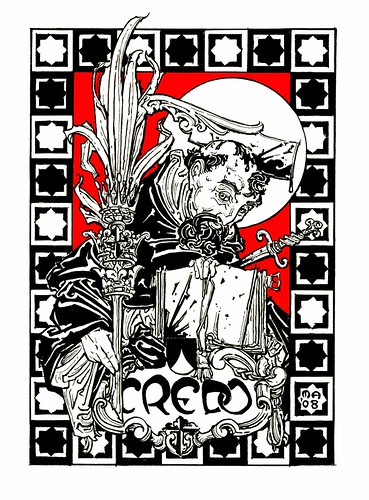
Matthew Alderman. S. Peter Martyr. 4" x 6", ink on vellum. September 2008. Private Collection, Virginia. (Click image for larger version).
A work commissioned by a client (and friend) in Virginia as a Christmas present for her younger brother, whose confirmation saint is S. Peter Martyr.
Her response: "A perfect balance of blood, awash with profundity and Dominicanism!" (She's a writer. They're allowed to say stuff like that.)
She reports on her brother's reaction: "He has been showing it off to anyone who will listen as 'the best gift of the entire year'!"
Which comes, not so much as a puff-up of pride, but a great relief! The artist always risks getting boxed up in his subjectivity if he is not careful. Admittedly, so long as it is directed by a properly-formed conscience and a deep artistic sense of decorum and precedent, this subjectivity is one of the artist's great assets. However, he always runs the risk of ruining that particularly valuable facet of himself by falling into egotism. Such comments, and such abilities to bring a little modicum of happiness, always come as a great relief as a result! Especially if the work, true to traditional iconographic form, involves a gory meatcleaver.
The story of S. Peter Martyr runs thus:
Peter's dying witness to the faith handed down to us by the Apostles later inspired a party snack of mine, incidentally. (Look, we're Catholic. Some of us think stigmata cookies are a good idea. We smile because the saints are joyous in heaven, and perhaps the ketchup reminds us we're called to nobler sacrifices.)
Back to the drawing. A finished work is never perfect, and the artist always feels his greatest project is the one next up on his drawing board. There are always problems, things you'd wish you'd been able to fix, rework, or study more carefully, as well. On the other hand, dissatisfaction or even failure can also be remarkably salutary as well, as while liturgical art can exhort and challenge the faithful to remember the suffering of the martyrs--and thus have a certain positive hagiographic shock value--you have to at least get your foot in the door first with beauty, tradition and a sense of psychological complexity when the subject demands it. Or perhaps, depending on the audience, the splatter comes first, and then the serenity.

Matthew Alderman. S. Peter Martyr. 4" x 6", ink on vellum. September 2008. Private Collection, Virginia. (Click image for larger version).
A work commissioned by a client (and friend) in Virginia as a Christmas present for her younger brother, whose confirmation saint is S. Peter Martyr.
Her response: "A perfect balance of blood, awash with profundity and Dominicanism!" (She's a writer. They're allowed to say stuff like that.)
She reports on her brother's reaction: "He has been showing it off to anyone who will listen as 'the best gift of the entire year'!"
Which comes, not so much as a puff-up of pride, but a great relief! The artist always risks getting boxed up in his subjectivity if he is not careful. Admittedly, so long as it is directed by a properly-formed conscience and a deep artistic sense of decorum and precedent, this subjectivity is one of the artist's great assets. However, he always runs the risk of ruining that particularly valuable facet of himself by falling into egotism. Such comments, and such abilities to bring a little modicum of happiness, always come as a great relief as a result! Especially if the work, true to traditional iconographic form, involves a gory meatcleaver.
The story of S. Peter Martyr runs thus:
Born at Verona, 1206; died near Milan, 6 April, 1252. His parents were adherents of the Manichæan heresy [ie, Cathars or Albigenses, those sexually-repressed, suicidal dualist weirdoes so beloved of sub-Dan Brown fictioneers], which still survived in northern Italy in the thirteenth century. Sent to a Catholic school, and later to the University of Bologna, he there met St. Dominic, and entered the Order of the Friars Preachers. Such were his virtues, severity of life and doctrine, talent for preaching, and zeal for the Faith, that Gregory IX made him general inquisitor, and his superiors destined him to combat the Manichæan errors. In that capacity he evangelized nearly the whole of Italy, preaching in Rome, Florence, Bologna, Genoa, and Como. Crowds came to meet him and followed him wherever he went; and conversions were numerous. He never failed to denounce the vices and errors of Catholics who confessed the Faith by words, but in deeds denied it. The Manichæans did all they could to compel the inquisitor to cease from preaching against their errors and propaganda. Persecutions, calumnies, threats, nothing was left untried.His murderer later became a Dominican laybrother himself, and is venerated as Blessed Carino of Balsamo. (It was a popular cult and it is unclear to me if it ever got approved by Rome, as the paperwork got lost at some point. Really.) His accomplice, Manfredo, lighted off for the Alps and took refuge with the Waldenses, an obscure proto-Protestant sect founded by one Waldo (really), who are now best known for renting out their space in their small number of Roman churches to touristy opera concerts.
When returning from Como to Milan, he met a certain Carino who with some other Manichæans had plotted to murder him. The assassin struck him with an axe on the head with such violence, that the holy man fell half dead. Rising to his knees he recited the first article of the Symbol of the Apostles, and offering his blood as a sacrifice to God he dipped his fingers in it and wrote on the ground the words: "Credo in Deum". The murderer then pierced his heart. The body was carried to Milan and laid in the church of St. Eustorgio, where a magnificent mausoleum, the work of Balduccio Pisano, was erected to his memory. He wrought many miracles when living, but they were even more numerous after his martyrdom, so that Innocent IV canonized him on 25 March, 1253.
Peter's dying witness to the faith handed down to us by the Apostles later inspired a party snack of mine, incidentally. (Look, we're Catholic. Some of us think stigmata cookies are a good idea. We smile because the saints are joyous in heaven, and perhaps the ketchup reminds us we're called to nobler sacrifices.)
Back to the drawing. A finished work is never perfect, and the artist always feels his greatest project is the one next up on his drawing board. There are always problems, things you'd wish you'd been able to fix, rework, or study more carefully, as well. On the other hand, dissatisfaction or even failure can also be remarkably salutary as well, as while liturgical art can exhort and challenge the faithful to remember the suffering of the martyrs--and thus have a certain positive hagiographic shock value--you have to at least get your foot in the door first with beauty, tradition and a sense of psychological complexity when the subject demands it. Or perhaps, depending on the audience, the splatter comes first, and then the serenity.
Wednesday, April 28
This is the Dictionary Definition of Awesome (Hint: It Involves Maltese Knights)

The Santa Anna: A 16th-century ironclad* warship belonging to the Knights of Malta. Not even ninjas could make this more awesome. There were also a windmill, three forges, and several ovens, as well as a garden on board, as well.**
*Okay, technically it's lead-clad. Shut up.
*Okay, technically it's lead-clad. Shut up.
**I'm not sure, I admit, that adds to the awesomeness unless perhaps there was a forest of topiary trees trimmed by roving bands of Maltese ninja gardeners. The topiary trees would be in the shape of bears, obviously.
Tuesday, April 27
"They're Always There"
As our readers know, I was in St. Louis, Missouri, a few months back, to lead a workshop on sacred architecture with about sixty of the seminarians at Kenrick-Glennon Seminary. (You can find recordings of the the lectures here.) If the Pontifical North American College is the Church's West Point, then Kenrick-Glennon must at the very least be its Annapolis. I hope eventually to set down my reflections on what I saw there, but one detail was particularly telling.
There was a small chapel directly across the hall from my guest room, a pleasant, dim little space where the Sanctissimum was reserved atop a simple but very traditional altar up against the wall that could have served as a textbook illustration for O'Connell or one of the other rubrical guides from before the Council--no gradines, the altar strong and clear in its shape and properly vested, God in His little round-sided house covered fully with a white veil, the tent of the presence, a little set of big six candlesticks and two low mass ones, if I remember correctly. A large, straightforward crucifix hung above it.
Wherever the Sacrament is, there is something of heaven, but I was particularly struck at how this well-known constellation of simple objects, with a bit of simple but subtle lighting and the power of memory and recognition, could transform a plain little room--and there was little on the walls save paint and, perhaps, a few icons here and there--into a true place of prayer. I was pleasantly surprised to hear the chapel had only recently been set up there, and was not, as one might assume, a relic of past ages.
This was, however not the detail that struck me. Several times I popped in to the chapel during my visit, a few times to pray and a few times in the hopes of taking a photo of this pleasant little sacred space for future inspiration should I ever need to design such a little chapel, and every time, well into the night, there were always at least two or three seminarians in there, kneeling and praying. I have to admit that, camera in hand, I was a bit annoyed--I didn't want to disturb them, but I did want a photo. It was by now nine-thirty at night and I was getting up the next morning at four-fifteen for the first flight back to Milwaukee. Forgive me, but it is hard to tell folks who design things--artists, architects and all the rest--that they're ever off duty. And, slightly and selfishly frustrated, the thought popped into my head: They're always there. But then I realized, yes, of course, they're always there, before the Eucharist.
I never did get a photo, but I left happy. This is why I have such high hopes for the future of the Church.
There was a small chapel directly across the hall from my guest room, a pleasant, dim little space where the Sanctissimum was reserved atop a simple but very traditional altar up against the wall that could have served as a textbook illustration for O'Connell or one of the other rubrical guides from before the Council--no gradines, the altar strong and clear in its shape and properly vested, God in His little round-sided house covered fully with a white veil, the tent of the presence, a little set of big six candlesticks and two low mass ones, if I remember correctly. A large, straightforward crucifix hung above it.
Wherever the Sacrament is, there is something of heaven, but I was particularly struck at how this well-known constellation of simple objects, with a bit of simple but subtle lighting and the power of memory and recognition, could transform a plain little room--and there was little on the walls save paint and, perhaps, a few icons here and there--into a true place of prayer. I was pleasantly surprised to hear the chapel had only recently been set up there, and was not, as one might assume, a relic of past ages.
This was, however not the detail that struck me. Several times I popped in to the chapel during my visit, a few times to pray and a few times in the hopes of taking a photo of this pleasant little sacred space for future inspiration should I ever need to design such a little chapel, and every time, well into the night, there were always at least two or three seminarians in there, kneeling and praying. I have to admit that, camera in hand, I was a bit annoyed--I didn't want to disturb them, but I did want a photo. It was by now nine-thirty at night and I was getting up the next morning at four-fifteen for the first flight back to Milwaukee. Forgive me, but it is hard to tell folks who design things--artists, architects and all the rest--that they're ever off duty. And, slightly and selfishly frustrated, the thought popped into my head: They're always there. But then I realized, yes, of course, they're always there, before the Eucharist.
I never did get a photo, but I left happy. This is why I have such high hopes for the future of the Church.
Friday, April 23
George the Victorious (and Bacon)

In honor of the great warrior-saint, protector of England, Greece, Catalonia, Aragon, Canada, Cappadocia, Ethiopia, Georgia, Lithuania, Palestine, Portugal, and Russia, the cities of Amersfoort, Arcole, Appignano del Tronto, Beirut, Fakiha, Bteghrine, Cáceres, Ferrara, Freiburg, Genoa, Ljubljana, Milan, Pomorie, Preston, Salford, Qormi, Rio de Janeiro, Lod, Barcelona, Moscow and the Maltese island of Gozo, patron invoked against leprosy, against plague, against skin diseases, against skin rashes, of agricultural workers, archers, armorers, Boy Scouts, butchers, cavalry, chivalry, Crusaders, farmers, horses, knights, saddlers, the Romanian Army, sheep and shepherds, Teutonic knights and fieldhands, I will repost this piece I did on the subject back in May 2004. I have added a few comments in brackets. It's one of my favorite posts:
A Bedtime Story for the Eve of St. George's Day
from the Shrine's Resident Knight-Errant
The historian Gibbon, with his usual lack of charity and clarity, calls him a corrupt bacon salesman and Arian bishop of Cappadocia. However, as much as the dark side in our consciences enjoys tripping up the occasional sanctoral legend, St. George's martyrial crown is here to stay. We know that for certain. Any other identifications (whether knight, martyred deacon or heretic bishop) are spurious.
Apart from the historical fact of his martyrdom, we have little else save for a decidedly fictitious Acta condemned by the Council of Nicaea for being too weird for words. His legend is, unsurprisingly, full of blood and wonder, with all sorts of apocryphal embroideries that tell of his four martyrdoms--cut-to-pieces, buried alive, consumed by fire, decapitated--his conversion of the Empress (and subsequent saint) Alexandra, timbers bursting into leaf, and the miraculous flow of milk from his severed neck. Despite all the well-meaning attempts by the medievals to remove any trace of credulity from the story of St. George [though, of course, today we too easily shout "legend," more so than our ancestors might shout "miracle." --MGA, 2010], he nonetheless survived the pruning of the calendar in 1969, and he still remains today one of the most beloved of saints. Admitted, the fairytale dragon and the beautiful princess perhaps helps his mythic appeal, but the reality of his ancient veneration is undisputable.
The early pilgrims record his shrine as well-established by as early as the sixth century, at Lydda or Diospolis, and one church dedication under his name at Thessalonica may go back as early as the 300s. San Giorgio in Velabro at Rome is another ancient dedication, while a monastery under his protection was founded by King Clovis in France in 512. A cultus like this doesn't spring up out of whole cloth. We're not talking about a sketchy old wive's tale like, say, St. Wilgefortis (the bearded lady of hagiography) or an incongruous Buddhist import like Barlaam and Josaphat.
But who was he?
Certainly that wonderfully odious foe, the dragon, bulks large in our minds. Sometimes it is spiky and Gothic and maddeningly insectoid, as in the Bosch-like fantasies of Swedish woodcarvers, while in canvases and panels from England to Greece (Ghiorghios ho megalomartyr), this red-cross knight in his meteor-black armor thrusts his lance down the gullet of everything from jeweled lion-headed bats to comical snail-like serpents looking like armored lengths of green intestine.
It's a rather late addition to the story, an apocalyptic Johannine pun on Diocletian or Dadianus, persecutors given the epithet of ho bythios drakon at their serpentine crimes. Some people prefer to see his dragon-slaying work as the mark of a Christianized Perseus, but his reputation as martyr, and even as martyr and knight, long predates the emergence of his legendary combat in folklore. [Which is a rather lazy trick of folklorists, one has to say, as if the Christian imagination could not put forth such flourishes on its own. --MGA, 2010].
Still, it's a story worth telling, even if Mother Church, tucking us into our beds, smiles and tells us not to fear, that there are no such things as dragons. Flesh-and-blood ones, anyway. Caxton, in his quaintly Englished version of Blessed Jacobus's Legenda Aurea Sanctorem popularized it in among the already Georgeophile English populace, adding the stunning green serpent to the pre-existing stark red and white cross of the British heraldic imagination.
(But on his breast a bloody Cross he bore,
The dear remembrance of his dying Lord,
For whose sweet sake that glorious badge we wore
And dead (as living) ever he adored. Thus Spenser.)
So, once upon a time, in illo tempore, a vicious dragon was terrorizing the country around Silene in the land of Libya, and the townspeople offered up to this beast two sheep to hold him at bay every day. And after a time, naturally the people discovered they were running low on sheep and sent a man and a sheep for the worm to gorge himself upon. So it happened that each time they offered a man, he would be chosen by lot, whether he be gentle or rude, rich or poor. This system also had some problems, as the King discovered when the lot chanced to fall on his beauteous daughter.
The king planned to backslide, but when a large number of his subjects showed up at the drawbridge of his castle with Where-is-the-evil-Dr.-Frankenstein torches and pitchforks and threatened to burn the place down, he reconsidered and sent his only child out into the slithering clutches of the great monster, garbed in the pure dress of a bride. This latter detail was something of a cruel joke, as the King had wept to think he'd never see his girl settle down with some nice fellow from Cyrenica and have enormous quantities of grandchildren for him to spoil.
Now, as this sorry state of affairs was about to pass, a young knight named George happened to be cantering by on his white palfry. His white charger was being led along behind him by his squire, no point in wasting a good horse on the road. His shining armor, as well, was packed up and he was simply dressed, as any sensible warrior would be on the road between jousts.
George, it being his vocation in life to save damsels in distress and also wondering why on earth someone would be tramping through the mud wearing a wedding dress, asked the girl what was going on and told her not to fear. She explained her sad predicament, while George suddenly exclaimed "Fair daughter, doubt ye no thing hereof for I shall help thee in the name of Jesu Christ!" And then she, being resigned to her fate to being flame-broiled, shot back, "For God's sake, good knight, go your way, and abide not with me, for ye may not deliver me."
While they were arguing about whether she would allow him to save her or not (she was, I presume, a very modern princess), the dragon prompty showed up and cut the conversation short. St. George, being Action Man, lept on his white charger and took up his sword and, as the Blessed Jacobus puts it, "garnished him with the Sign of the Cross." He then did some serious smoting with his lance and finally knocked the great beast to the ground.
The girl, being female and thus practical, suggested he should tie the beast up with her girdle, which the knight gallantly did. The dragon followed her, and was, in medieval-speak, "a meek beast and debonair." (To which St. George muttered to himself, "What is it with you people and that word 'debonair'? First Trajan is debonair, then St. Gregory is, and...oh, never mind.")
She led the beast in on her lead to her father's city and the townspeople naturally went nuts. St. George said, in his usual chivalric grand manner, which a knight is perfectly entitled to, "Ne doubt ye no thing, without more, believe ye in God, Jesu Christ, and do ye to be baptized and I shall slay the dragon!" And he did, lopping the beast's head off with one stroke. Ta da!
The darned thing was so big it took four carts to haul it out of the city, and doubtlessly the farmer whose land it was dumped on was uniquely annoyed. Though I am told on the best auctoritates that dragons make good fertilizer.
So, then, the King had a church built and dedicated to Our Lady and St. George (to which St. George murmured, "I'm not martyred yet, your Majesty") and a fountain of healing water sprung up in that place and many were cured of their sickness. While some people, like Mr. Spenser, like to say he got the girl in the end, like any good melodrama, I'd like to believe what Bishop Jacobus said. That he gave the King a few bits of good advice to follow as a newly-made Christian. Maybe he even got a rewarding (and chaste) kiss from the Princess (saying the Greek equivalent of "I'll never strigil this cheek again"), And so he rode off into the Libyan desert sunset in the grand tradition of the Western.
Then, of course, he ended up being martyred, but that's another story.
And what is the moral of all this, anyway, if it's just a bedtime story? The fantasist in me would like to believe that maybe, just maybe, there were dragons once, just as there were once giants in the earth, or ghosts, or longaevi like the centaurs [The story is a late addition to his biography, and hardly an essential part, but given how in every part of the world there are scores of tales of serpents and worms and dragons, one does wonder, just a little bit. Someone ring the cryptozoology squad... --MGA, 2010], but the truth is there are worse things out there than dragons, like the ancient serpent whose head was crushed by Our Lady and Her Child.
[In this day and age, though, I am frankly more worried about those who seem to scoff at the existence of knights-in-shining-armor; and as for evil dragons, we probably are more dangerously inclined to excuse their failings than deny their existence. --MGA, 2010]
And there are plenty of brides needing rescuing these days, menaced by serpents. Our Mother Church sticks out as the most important candidate at the moment, but there are plenty of others, like Lady Poverty, like Temperance, like Fortitude and Chastity, Justice and Peace. They're all cute, by the way, and are looking for husbands to live happily ever after with.
We may not know that much about St. George besides his undisputed historical existence. As Pope Gelasius put it in 495, he is one of those holy men "whose names are justly reverenced among men, but whose actions are only known to God." But why do we call him the Great Martyr (ho megalomartyr) and dedicate every cause and country to him from Greece, to Spain, to Boy Scouts and Catalans, to England (and always)?
The fact he slayed the dragon of sin in his martyrdom is alone enough to merit that crown. He is the Unknown Soldier of Christianity, the parfait gentil knight through his meekness, through his bending his neck to the executioner's sword, even if he never wielded a blade himself. We are all called to spiritual knighthood of some sort, whether as Knights of the Immaculate, as Legionaries of Mary or Christ, or a footsoldier in the forgotten Blue Army. The spiritual battle is even fiercer than the material battle, even in these days of missiles and terrorism.
Also, ladies, a word in your beautiful ears. St. Joan, dear, dear, practical, sensible, ornery little St. Joan (4'10" according to one source) has shown you can take care of yourself in good stead and are spiritual knights yourselves. But every now and then, will you let a gentleman in shining armor rescue you? We're good at that sort of thing. That and opening mason jars.
Saturday, April 17
A Couple of Observances to Remember
Yesterday, as you probably know already, was the 83rd birthday of our much-suffering domnus apostolicus, Pope Benedict XVI. I didn't have time to post anything, though I feel a great sadness for him at present, celebrating this happy moment in the midst of all that he is having to deal with within and outside the Church. Let us all pray for him, that God give him the strength to perservere.
Also, I don't know where the Tartarus (words chosen carefully) they're saying he looks "evil in photos." I've met him (well, for about five minutes in a receiving line). He's a lovable little fuzzball. Sort of the kittens-playing-with-yarn to Pope John Paul II's happy smiling dolphin and John XXIII's lovably cranky pizzeria owner. The guy looks like everyone's sweet, adorable grandfather, and if there are moments where he looks like the Emperor from Star Wars, well, there are some pretty gloomy, Marlon Brando-as-the-Godfather-ish Pantocrators out there. He looks intimidating, not bad--and I like it that he can still look intimidating when needed. God save the Pope, the great, the good.
Oh, and I find your lack of Faith disturbing.
*
Today, meanwhile is the date of the disastrous Bay of Pigs invasion. As I have written before, Cuban history can seem to vacilate between high tragedy and dark comedy, especially when viewed through the wrong end of the telescope that is the usual US view of Latin America. Unfortunately, in reality, this was simply a tragedy, and probably a particularly futile and perhaps even avoidable tragedy. The emblem of the exile brigade is a cross and a Cuban flag, a very telling and interesting bit of religiosity for a people that had perhaps in the past lacked the fervency of its Iberian mother.
I wrote about the invasion and its anniversary (which is, to the son and grandson of a Cuban exile family who had a relative among the troops, distinctly personal) some years ago:
Also, I don't know where the Tartarus (words chosen carefully) they're saying he looks "evil in photos." I've met him (well, for about five minutes in a receiving line). He's a lovable little fuzzball. Sort of the kittens-playing-with-yarn to Pope John Paul II's happy smiling dolphin and John XXIII's lovably cranky pizzeria owner. The guy looks like everyone's sweet, adorable grandfather, and if there are moments where he looks like the Emperor from Star Wars, well, there are some pretty gloomy, Marlon Brando-as-the-Godfather-ish Pantocrators out there. He looks intimidating, not bad--and I like it that he can still look intimidating when needed. God save the Pope, the great, the good.
Oh, and I find your lack of Faith disturbing.
Today, meanwhile is the date of the disastrous Bay of Pigs invasion. As I have written before, Cuban history can seem to vacilate between high tragedy and dark comedy, especially when viewed through the wrong end of the telescope that is the usual US view of Latin America. Unfortunately, in reality, this was simply a tragedy, and probably a particularly futile and perhaps even avoidable tragedy. The emblem of the exile brigade is a cross and a Cuban flag, a very telling and interesting bit of religiosity for a people that had perhaps in the past lacked the fervency of its Iberian mother.
I wrote about the invasion and its anniversary (which is, to the son and grandson of a Cuban exile family who had a relative among the troops, distinctly personal) some years ago:
On this day, April 17, 1961, four 2,400-ton chartered transports (named the Houston, Río Escondido, Caribe, and Atlántico) transported the 1,511 men of the Cuban exile Brigade 2506 to the Bay of Pigs on the southern coast of Cuba, where they came up against the soldiers of Castro's revolutionary army. Reports of what followed describe a full-scale tank engagement, with air attacks on the exiles leaving one transport damanged and other sunk. Despite a few preliminary air attacks in the days preceding the landing, promised U.S. air support was almost wholly denied, leaving the tiny Brigade 2506 virtually crippled, with 1,189 taken prisoner and 115 killed. A number were executed, while the remainder languished in prison camps under a thirty-year sentence for treason. Almost two years later, they were returned to the United States after a torturous series of negotiations.These are the facts. Remember them.
To this day, the communist government of Cuba refers to the exile warriors in their official propaganda solely as "mercenaries."
Friday, April 16
Martin Travers at RIBA
The excellent Royal Institute of British Architects image archive has some wonderful little tidbits of the work of English church furnisher (and the inventor of what is sometimes called Anglo-Catholic Congress Baroque) Martin Travers--memorial plaques, roods, stained glass, all delightful. Some highlights--and don't forget to click to enlarge, as it's definitely worth it:


Thursday, April 15
The Disappearance of Adulthood (or, perhaps, the Recrudescence of Adolescence)
"...back when there were children and there were schools..."
--Dr. Anthony Esolen
Continuing our postmortem (begun some months ago in this post) on the late Neil Postman's curious sociological text The Disappearance of Childhood, we turn now to the author's contention that childhood today has effectively vanished. It is important to note the author in fact wrote this book in the early eighties and mostly restricts his commentary to the cultural phenomena of that most peculiar of decades, the 1970s (id est: disco, polyester, and Watergate), effectively the sleazy late adolescence of the culture of puerile idealism that characterized the fourth quarter of the sixties. When the book was republished in the mid-nineties, right before the Internet lurched onto the scene, Postman felt no need to reassess his conclusions, it is important to note. Postman traces the collapse of childhood in his era back to Samuel Morse, of all people, he of the telegraphy and the anti-Catholicism (and the gorgeous daughter known to all habitues of the Metropolitan Museum from her portrait as the American Muse.) Well, actually he traces it back to the movies and television that eventually flowed from Morse, so it is somewhat less silly a point.
Still, like his conclusion childhood was "invented" by the Renaissance as an outgrowth of the printing press and the general spread of literacy, this is all a little too clever by half. As we discussed before, the Middle Ages certainly had a general conception of childhood, even without the threshhold requirement of general literacy, and even then, the cossetted, vacuum-sealed childhood he uses as the exemplar of the type would have been unrecognizable to all but the most sheltered of boys and girls, and belongs more to the Rousseauian sentimentality of the eighteenth century than anything before or after. Certainly Huck Finn would have been rather surprised by it.
Still, his point is worth considering. The general growth of literacy, in his conception, had imposed a longer period of schooling on children, and placed a more necessarily definable line between childhood and adulthood in the post-Renaissance period. One may question if that line existed in most quarters, though with different signposts (apprenticeship, Confirmation, physical prowess, etc.), but certainly in a few more privileged quarters childhood did become more sheltered and exclusive, if only because of the extension of upper-class comfort to the middle classes, a phenomenon he essentially ignores. Education, in this environment, came primarily from parents and teachers, and was clearly hierarchically defined, in Postman's opinion. One may rightly question if Postman has ever met any children before when he makes this assessment as surely children before Morse had their playground gossip, their prurient half-heard tales from older brothers and sisters (with wildly inaccurate speculations on the anatomy of the opposite sex), or from a misread encyclopedia or contraband penny-dreadful. So, the problem is not so much that electronic media disturbed this pristine hierarchical pedagogy, as it simply bored holes in a sieve that has always been more than a little leaky. It has always been so, I am sure.
The same is to be said of his contention that the invention of the telegraph and the television changed news. Ever since the invention of the broadsheet, news has been a commodity, and certainly gossip has always been the "news from nowhere" that is so exemplified from the sourceless, incessant broadcasting that Postman considers characteristic solely of modern media outlets. "While not necessarily wholly new, certainly it has increased radically in the past century, even more so with the coming of the internet and the blogosphere. It is the easiest thing now for a child to circumvent the parental and pedagogical net placed around them; no doubt Postman would boggle at the thought of toddlers surfing the internet, though I gather that is not too far from the truth nowadays. As someone who only learned to type in eighth grade, this is quite astonishing. Continuous coverage" means simply in the interests of satisfying the yawning maw of ratings, any taboo must be thrown out. And of course now you can get hot and cold running smut every hour of the night as well.
His analysis of television itself is also worth careful consideration. He sees it as a pre-literate medium--one needn't know how to read, or even think much, to really appreciate it. Its programs are limited to a half-hour or at most a full hour, and are turned into a hash by the series of bright and shiny non-sequiturs known as commercials. No wonder, one must conclude, we have trouble thinking critically today. He also comments on the problems of educational television, which do not cultivate the sort of concentration required to absorb a concept--something I can heartily agree with from my own experiences. Sesame Street mostly baffled me. I'd watch five minutes of animation composed of swirling hearts and someone singing Amor, Amor, Amor, and I'd think to myself, "What the heck was that?" (This is especially embarassing on my part as about 3/4 of the family members I spent most of my time around were native Spanish speakers!)
However, where he falters is where he claims that TV content is somehow a reflection of this infantilization. TV kids are "adultish" because people find this amusing and cute and unusual, not because it is a reflection of society. TV adults are "childish" because it is also funny. (Though I sympathize with him when he comments the only adult on television in this day and age is the finicky Felix Unger. I am also slightly frightened.) I would also question his contention that TV advertisements are anti-capitalist because they appeal to the emotions rather than engaging in a free exhange of goods and services, as it sounds like something only a man who has never had to try to sell something would say. (This, and his contention commercials are in fact a species of pseudo-religious literature--"The Parable of Ring Around the Collar"--is less strange than it sounds, but also seems like academic silliness for silliness's sake as well, and is not really worth digressing about here.)
Also, while perhaps more programs are watched by children and adults alike (like, say, the old Muppet Show), frequently the adults and kids laugh at different things. And, while the airwaves are lousy with kiddie sitcoms (an adult genre, in theory) they are just as loud, hyperactive and annoying as any oversugared little squirt could love. (Though I will grant on those occasions when I have had to sit through watching kid-coms on TV, I was exhausted and probably hallucinating mildly from exhaustion brought on by bouts of the flu or food-poisoning--and thus too tired to change the channel--so I could well be wrong here.)
The problem is his central thesis requires on assuming a sort of childhood dependant on a certain type of pedagogy and the witholding of certain secrets, like the mysteries of sex and death. Childhood is hardly dependant on that, nor historically has the Adult Conspiracy (as the old Nickelodeon show Pete and Pete, which would probably cause Postman's brain to overheat with its knowing slyness, might put it) been very good on keeping a lid on such things. Otherwise we wouldn't be hearding kids into confessionals at age 7.
Postman's adultish child is not so much an adult as a brat with too much information syndrome, and indeed, some cultural developments he cites to support his thesis, like the overscheduled, cutthroat world of little league actually seems to represent a strengthening of the hermetic bubble of childhood against the encroaching darkness of kidnappers, gangs, and crime.
However, he is definitely on to something when he speaks of the childish adult that our society has bred--the forty-year-old in sneakers, who has become even more common now than at the time of writing. Being an adult is no longer the fine thing it was in times past is hard to doubt, if only if one stands up Tom Cruise next to Cary Grant. Yet, I am not sure this has to do so much with television, which was still in its squeaky-clean, wobbly infancy (Leave it to Beaver, etc., as opposed to the sassy sitcom kids of later years) when these future childlike adults were presumably in diapers. Indeed, it seems more of an exaltation of childhood that can be blamed for such antics--the generation of the Sixties having been raised on the indulgent Dr. Spock as well as Theodore Cleaver. No wonder they had little desire to throw off childish things when they came of age, with that sort of upbringing. This is the ultimate growth, not of Morse playing with electricity, but with the Rousseauian apotheosis of childhood that is exemplified by Spock and now seems to have reached its apex with a nearly total abdication of parental authority among adults--whether to the state, the school, pop culture, or to nobody in particular, I'm not sure.
The result is not so much, though, a childish adult (as the youth culture of the Sixties didn't sit around playing with Legos, but with one another), but an elderly adolescent. Now everything seems to fall into place--what we have here is a puberty that starts about 8 and ends around forty in the fortunate, and with death with the rest. Adults acting like kids on TV are still funny because it is an anomaly. An adult acting like a huffy teenager is another thing, and actually would hardly be noticeable as abnormal today.
Adolescents flip awkwardly between being a child and desiring the freedom of adulthood. Given our age's mantra of "choice," that our culture's denizens can decide if they're thirteen or thirty every day of the week should come as no surprise. (I suspect Dr. Postman would have a field day with Michael Scott and Dwight Schrute if he were alive today--both adolescents of a sort, and characteristic of the faux-family environment that plagues many contemporary workplaces; and he could probably get a multivolume work out of Lorelei Gilmore and her Hello Kitty Waffle-Iron.)
Postman considers this development of the childish adult a bad thing, and while I dispute the causes of this outgrowth, and even perhaps some of its name and substance, I agree with his troubling assessment. It is especially chilling, thirty or forty years on that pretty much with the exception of Pope Benedict XVI and the Queen of England, most of the world is ruled by overgrown children in suits (and not even overgrown, if one factors in the relative heights of Kim Jong-Il and Dennis Kucinich). He offers no solutions, and certainly would probably consider my own view of the world to be rather medieval, but for me it comes down to the rediscovery of those hard and antiquated facts of honor and gentle authority. Mothers must be mothers, fathers must be fathers and not hesitant friends with car-keys. Yuppies must remember children are people, not projects or fads or substitutes for pets. Old men should demand to be called Mister, not Bob or Bill. Families--not insurance companies, or offices, or banks, or Caesar--must be families. Repentant hippies must face up that a little pseudo-hypocrisy never did much harm--"how can I tell little Muffin not to smoke you-know-what when I lit up every day when I was sixteen?" It is not their own personal integrity that backs them up here, but that of a whole civilization, or the ragged remainders of it, anyway. And while I'm certainly not going to stop chucking at The Muppet Show (which certainly has its grown-up jokes, sly or otherwise), maybe we could all watch, say, something in black and white with men wearing hats a bit more often. Or maybe just read.
In other words, man up (and woman up), people.
That being said, please don't bother me right now to start the crusade, it's milk 'n' cookie time and I have to draw the line somewhere.
--Dr. Anthony Esolen
Continuing our postmortem (begun some months ago in this post) on the late Neil Postman's curious sociological text The Disappearance of Childhood, we turn now to the author's contention that childhood today has effectively vanished. It is important to note the author in fact wrote this book in the early eighties and mostly restricts his commentary to the cultural phenomena of that most peculiar of decades, the 1970s (id est: disco, polyester, and Watergate), effectively the sleazy late adolescence of the culture of puerile idealism that characterized the fourth quarter of the sixties. When the book was republished in the mid-nineties, right before the Internet lurched onto the scene, Postman felt no need to reassess his conclusions, it is important to note. Postman traces the collapse of childhood in his era back to Samuel Morse, of all people, he of the telegraphy and the anti-Catholicism (and the gorgeous daughter known to all habitues of the Metropolitan Museum from her portrait as the American Muse.) Well, actually he traces it back to the movies and television that eventually flowed from Morse, so it is somewhat less silly a point.
Still, like his conclusion childhood was "invented" by the Renaissance as an outgrowth of the printing press and the general spread of literacy, this is all a little too clever by half. As we discussed before, the Middle Ages certainly had a general conception of childhood, even without the threshhold requirement of general literacy, and even then, the cossetted, vacuum-sealed childhood he uses as the exemplar of the type would have been unrecognizable to all but the most sheltered of boys and girls, and belongs more to the Rousseauian sentimentality of the eighteenth century than anything before or after. Certainly Huck Finn would have been rather surprised by it.
Still, his point is worth considering. The general growth of literacy, in his conception, had imposed a longer period of schooling on children, and placed a more necessarily definable line between childhood and adulthood in the post-Renaissance period. One may question if that line existed in most quarters, though with different signposts (apprenticeship, Confirmation, physical prowess, etc.), but certainly in a few more privileged quarters childhood did become more sheltered and exclusive, if only because of the extension of upper-class comfort to the middle classes, a phenomenon he essentially ignores. Education, in this environment, came primarily from parents and teachers, and was clearly hierarchically defined, in Postman's opinion. One may rightly question if Postman has ever met any children before when he makes this assessment as surely children before Morse had their playground gossip, their prurient half-heard tales from older brothers and sisters (with wildly inaccurate speculations on the anatomy of the opposite sex), or from a misread encyclopedia or contraband penny-dreadful. So, the problem is not so much that electronic media disturbed this pristine hierarchical pedagogy, as it simply bored holes in a sieve that has always been more than a little leaky. It has always been so, I am sure.
The same is to be said of his contention that the invention of the telegraph and the television changed news. Ever since the invention of the broadsheet, news has been a commodity, and certainly gossip has always been the "news from nowhere" that is so exemplified from the sourceless, incessant broadcasting that Postman considers characteristic solely of modern media outlets. "While not necessarily wholly new, certainly it has increased radically in the past century, even more so with the coming of the internet and the blogosphere. It is the easiest thing now for a child to circumvent the parental and pedagogical net placed around them; no doubt Postman would boggle at the thought of toddlers surfing the internet, though I gather that is not too far from the truth nowadays. As someone who only learned to type in eighth grade, this is quite astonishing. Continuous coverage" means simply in the interests of satisfying the yawning maw of ratings, any taboo must be thrown out. And of course now you can get hot and cold running smut every hour of the night as well.
His analysis of television itself is also worth careful consideration. He sees it as a pre-literate medium--one needn't know how to read, or even think much, to really appreciate it. Its programs are limited to a half-hour or at most a full hour, and are turned into a hash by the series of bright and shiny non-sequiturs known as commercials. No wonder, one must conclude, we have trouble thinking critically today. He also comments on the problems of educational television, which do not cultivate the sort of concentration required to absorb a concept--something I can heartily agree with from my own experiences. Sesame Street mostly baffled me. I'd watch five minutes of animation composed of swirling hearts and someone singing Amor, Amor, Amor, and I'd think to myself, "What the heck was that?" (This is especially embarassing on my part as about 3/4 of the family members I spent most of my time around were native Spanish speakers!)
However, where he falters is where he claims that TV content is somehow a reflection of this infantilization. TV kids are "adultish" because people find this amusing and cute and unusual, not because it is a reflection of society. TV adults are "childish" because it is also funny. (Though I sympathize with him when he comments the only adult on television in this day and age is the finicky Felix Unger. I am also slightly frightened.) I would also question his contention that TV advertisements are anti-capitalist because they appeal to the emotions rather than engaging in a free exhange of goods and services, as it sounds like something only a man who has never had to try to sell something would say. (This, and his contention commercials are in fact a species of pseudo-religious literature--"The Parable of Ring Around the Collar"--is less strange than it sounds, but also seems like academic silliness for silliness's sake as well, and is not really worth digressing about here.)
Also, while perhaps more programs are watched by children and adults alike (like, say, the old Muppet Show), frequently the adults and kids laugh at different things. And, while the airwaves are lousy with kiddie sitcoms (an adult genre, in theory) they are just as loud, hyperactive and annoying as any oversugared little squirt could love. (Though I will grant on those occasions when I have had to sit through watching kid-coms on TV, I was exhausted and probably hallucinating mildly from exhaustion brought on by bouts of the flu or food-poisoning--and thus too tired to change the channel--so I could well be wrong here.)
The problem is his central thesis requires on assuming a sort of childhood dependant on a certain type of pedagogy and the witholding of certain secrets, like the mysteries of sex and death. Childhood is hardly dependant on that, nor historically has the Adult Conspiracy (as the old Nickelodeon show Pete and Pete, which would probably cause Postman's brain to overheat with its knowing slyness, might put it) been very good on keeping a lid on such things. Otherwise we wouldn't be hearding kids into confessionals at age 7.
Postman's adultish child is not so much an adult as a brat with too much information syndrome, and indeed, some cultural developments he cites to support his thesis, like the overscheduled, cutthroat world of little league actually seems to represent a strengthening of the hermetic bubble of childhood against the encroaching darkness of kidnappers, gangs, and crime.
However, he is definitely on to something when he speaks of the childish adult that our society has bred--the forty-year-old in sneakers, who has become even more common now than at the time of writing. Being an adult is no longer the fine thing it was in times past is hard to doubt, if only if one stands up Tom Cruise next to Cary Grant. Yet, I am not sure this has to do so much with television, which was still in its squeaky-clean, wobbly infancy (Leave it to Beaver, etc., as opposed to the sassy sitcom kids of later years) when these future childlike adults were presumably in diapers. Indeed, it seems more of an exaltation of childhood that can be blamed for such antics--the generation of the Sixties having been raised on the indulgent Dr. Spock as well as Theodore Cleaver. No wonder they had little desire to throw off childish things when they came of age, with that sort of upbringing. This is the ultimate growth, not of Morse playing with electricity, but with the Rousseauian apotheosis of childhood that is exemplified by Spock and now seems to have reached its apex with a nearly total abdication of parental authority among adults--whether to the state, the school, pop culture, or to nobody in particular, I'm not sure.
The result is not so much, though, a childish adult (as the youth culture of the Sixties didn't sit around playing with Legos, but with one another), but an elderly adolescent. Now everything seems to fall into place--what we have here is a puberty that starts about 8 and ends around forty in the fortunate, and with death with the rest. Adults acting like kids on TV are still funny because it is an anomaly. An adult acting like a huffy teenager is another thing, and actually would hardly be noticeable as abnormal today.
Adolescents flip awkwardly between being a child and desiring the freedom of adulthood. Given our age's mantra of "choice," that our culture's denizens can decide if they're thirteen or thirty every day of the week should come as no surprise. (I suspect Dr. Postman would have a field day with Michael Scott and Dwight Schrute if he were alive today--both adolescents of a sort, and characteristic of the faux-family environment that plagues many contemporary workplaces; and he could probably get a multivolume work out of Lorelei Gilmore and her Hello Kitty Waffle-Iron.)
Postman considers this development of the childish adult a bad thing, and while I dispute the causes of this outgrowth, and even perhaps some of its name and substance, I agree with his troubling assessment. It is especially chilling, thirty or forty years on that pretty much with the exception of Pope Benedict XVI and the Queen of England, most of the world is ruled by overgrown children in suits (and not even overgrown, if one factors in the relative heights of Kim Jong-Il and Dennis Kucinich). He offers no solutions, and certainly would probably consider my own view of the world to be rather medieval, but for me it comes down to the rediscovery of those hard and antiquated facts of honor and gentle authority. Mothers must be mothers, fathers must be fathers and not hesitant friends with car-keys. Yuppies must remember children are people, not projects or fads or substitutes for pets. Old men should demand to be called Mister, not Bob or Bill. Families--not insurance companies, or offices, or banks, or Caesar--must be families. Repentant hippies must face up that a little pseudo-hypocrisy never did much harm--"how can I tell little Muffin not to smoke you-know-what when I lit up every day when I was sixteen?" It is not their own personal integrity that backs them up here, but that of a whole civilization, or the ragged remainders of it, anyway. And while I'm certainly not going to stop chucking at The Muppet Show (which certainly has its grown-up jokes, sly or otherwise), maybe we could all watch, say, something in black and white with men wearing hats a bit more often. Or maybe just read.
In other words, man up (and woman up), people.
That being said, please don't bother me right now to start the crusade, it's milk 'n' cookie time and I have to draw the line somewhere.
Monday, April 12
St. Josaphat's Monastery, Glen Cove, New York


It's always interesting to hear and see how they pick out locations for films. Some seem obvious, inevitable, even. Castle Howard doubled as Brideshead in both film versions of the book, for instance. And others have to do more with expediency, as it seems the entire world can be found within a 50-mile radius of, variously, Los Angeles, New York, and, increasingly, Vancouver.
I was particularly interested to see, as a correspondent pointed out, on this film locations-scouting company webpage this beautiful Byzantine Catholic monastery ensconced in a grand old Long Island Tudor mansion. Sadly there appear to be no shots of the chapel, though the elaborate wood screen at one end of one of the mansion's grander rooms would make a wonderful iconostasis with a bit of work. Also, they have, presumably inherited from the previous owners, a pool-table. (This should not shock you. Even Cistercians are allowed to play pool periodically.)


I am also relieved, and a little pleased, that the location people have carefully noted on their website that there is "NO NUDITY WHATSOEVER" permitted in film shoots out there. The fact that had to be brought up at all suggests in a nutshell a whole week's-worth of outraged letters to Fr. Vasily Vasilievich.

Friday, April 9
Beneventan Chant for Easter: Pascha Nostrum
Thursday, April 8
Victimae Paschali Laudes: Completely Bombastic Edition
(I mean that in the good sense, of course.)
Yes, I Know, Vidi Aquam is Probably More Correct Now

Courtesy Alert Reader Penny S., we have a shot of this candidate for automobile blessing by full immersion...
Update: A non-Catholic friend caught a glimpse of this picture on my desktop and thought it had something to do with Asperger's. Er. Um. No comment.
Wednesday, April 7
A Forgotten Setting of Victimae Paschali Laudes
...can be heard here, from the brilliant Mexican Baroque composer Manuel de Sumaya. While perhaps lacking the virile dignity of the old chant, it makes for delightful listening during Easter Week.
Sunday, April 4
The Easter Sermon of St. John Chrysostom

"Is there anyone who is a devout lover of God? Let them enjoy this beautiful bright festival! Is there anyone who is a grateful servant? Let them rejoice and enter into the joy of their Lord!
"Are there any weary with fasting? Let them now receive their wages! If any have toiled from the first hour, let them receive their due reward; if any have come after the third hour, let him with gratitude join in the Feast! And he that arrived after the sixth hour, let him not doubt; for he too shall sustain no loss. And if any delayed until the ninth hour, let him not hesitate; but let him come too. And he who arrived only at the eleventh hour, let him not be afraid by reason of his delay.
"For the Lord is gracious and receives the last even as the first. He gives rest to him that comes at the eleventh hour, as well as to him that toiled from the first. To this one He gives, and upon another He bestows. He accepts the works as He greets the endeavor. The deed He honors and the intention He commends.
"Let us all enter into the joy of the Lord! First and last alike receive your reward; rich and poor, rejoice together! Sober and slothful, celebrate the day!
"You that have kept the fast, and you that have not, rejoice today for the Table is richly laden! Feast royally on it, the calf is a fatted one. Let no one go away hungry. Partake, all, of the cup of faith. Enjoy all the riches of His goodness!
"Let no one grieve at his poverty, for the universal kingdom has been revealed. Let no one mourn that he has fallen again and again; for forgiveness has risen from the grave. Let no one fear death, for the Death of Our Saviour has set us free. He has destroyed it by enduring it. He destroyed Hades when He descended into it. He put it into an uproar even as it tasted of His flesh. Isaiah foretold this when he said, “You, O Hell, have been troubled by encountering Him below.”
"Hell was in an uproar because it was done away with. It was in an uproar because it is mocked. It was in an uproar, for it is destroyed. It is in an uproar, for it is annihilated. It is in an uproar, for it is now made captive. Hell took a body, and discovered God. It took earth, and encountered Heaven. It took what it saw, and was overcome by what it did not see.
"O death, where is thy sting? O Hades, where is thy victory?
"Christ is Risen, and you, O death, are annihilated! Christ is Risen, and the evil ones are cast down! Christ is Risen, and the angels rejoice! Christ is Risen, and life is liberated! Christ is Risen, and the tomb is emptied of its dead; for Christ having risen from the dead, is become the first-fruits of those who have fallen asleep.
"To Him be Glory and Power forever and ever. Amen!"
[A blessed Easter to all our readers. Now, that done, where did I put that package of cookies? --MGA]










![[SMMMHDH]](http://www.mgilleland.com/music/smmmhdh.png)