Monday, August 9

On a recent telephone call home, my mother pointed out to me this amazing depiction by that great Venetian Tiepolo of a usually rather gory scene, The Martyrdom of St. Bartholomew (1722). Quite stunning and extremely moving, if perhaps less, er, anatomical than most medieval depictions of the event.
Sunday, August 8
A Warm Welcome to Readers of Terry Mattingly's Column

I'd like to offer a warm welcome to readers of Terry Mattingly's syndicated column "On Religion", who was kind enough to cover in his most recent (August 8) piece [which can be found here and here] an article I wrote for this website, "Five Things Any Parish Can Do to Improve Sacred Space," which can be read below. It also appeared in the more scholarly context at The New Liturgical Movement, where I am the architectural correspondent, and where I post with greater frequency.

Just to introduce myself, I am a design consultant, church furnishing designer, and professional illustrator based in Milwaukee, Wisconsin, and a frequenly published writer and lecturer on liturgical matters. Some examples of my built work and my designs can be found at my website, Matthew Alderman Studios. I also sell prints of my illustration work. I am presently involved in the design of furnishings for a parish renovation and classical/traditional design consulting on a larger construction project, while proposals for my services under consideration by several local, out-of-state and international clients. I welcome inquiries about my services via email at matthew@matthewalderman.com. You can also find my business on Facebook and my work on flickr.com.

If you are interested in my thoughts on liturgical design beyond what Terry was able to include in his column, you might enjoy reading this scholarly article on church design I wrote for the journal Antiphon: A Journal of Liturgical Renewal last year, which was based on a lecture I gave at the national Society for Catholic Liturgy conference some years ago.
I'd like to expand on a comment I made to Terry when he interviewed me last week, regarding statuary in churches, simply because there's only so much one can fit into a column. I think the inclusion or addition of traditional statuary to newer churches is an important part of any renovation. But it needs to be placed in the interior with care and with an eye towards the bigger picture, and, while they should not be crudely modernistic, should at least be designed in such a way to find common ground with the architectural language of the interior. Old-style catalog statuary, unless it is of a very high quality, should be avoided. They should reinforce the primacy of altar and tabernacle, and also should not simply be plopped down in some convenient corner without a lot of thought.
I'd like to thank Terry for his sensitive and thoughtful and very sympathetic treatment of the subject of renovations and my ideas about the matter of renovations, and hope you will enjoy your visit to the site. Have a look round, poke into the archives, and don't forget to go over to matthewalderman.com, too!

From the Archives: Another St. Lucy

Matthew Alderman. Sancta Lucia. December 2008. Private collection, Iowa.
Most of you know this image already, but it's a favorite of mine, and some of our new readers may enjoy it. My red-and-black image of St. Lucy has proven particularly popular with patrons. I have done at least three original versions at various points in the past few years. This one (for a priest's niece in Iowa) I am particularly satisfied with, as it works out some of the problems that had found their way into my last two renditions of the subject. At some point in the future I may consider doing some other virgin-martyrs in a similar pose, to form a matched set, St. Casilda and St. Apollonia and other similar saints done in a very different style but in roughly the same processional posture and level of fanciful costume by Zurbarán in the 17th century. Also, another saint would be good as I am starting to run out of variant Lucy-related attributes for her to hold.
Thursday, August 5
An Amazing Resource for America's Golden Age of Building
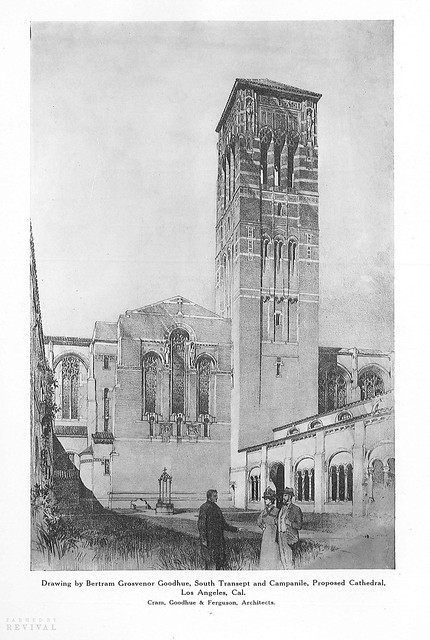
Cram and Goodhue's proposal for Los Angeles (Episcopal) Cathedral
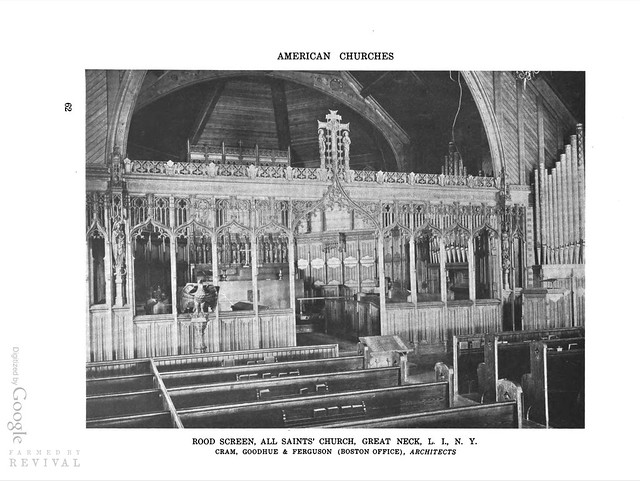
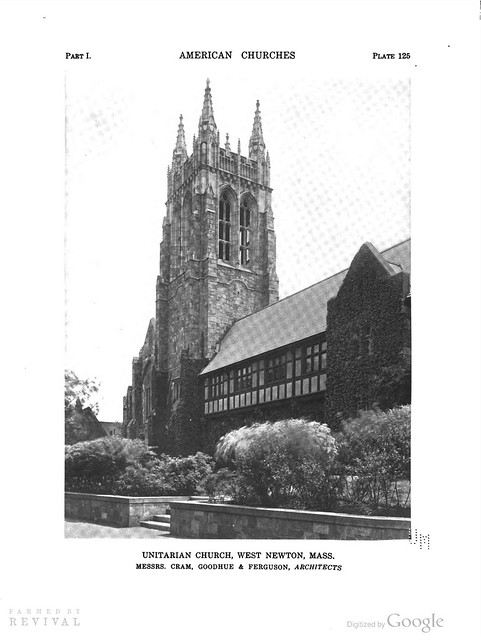
I recently stumbled onto a wonderful collection of scanned books and images posted on Flickr all pertaining to American architects and architecture of the early twentieth century, a period which may well have been the apex of our nation's cultural progress: Sargent and Whistler were painting, Cram building churches, Henry James novelizing, Cass Gilbert and Louis Sullivan trying civilize the skyscraper, McKim designing banks and pleasure-palaces and Stanford White getting shot on top of them. (Too soon?) Architecture had suddenly and rather abruptly cast off a quirky and rather provincial Victorianism and was rediscovering both authentic ancient precedent, and its imaginative and often innovative reuse. Here are posted numerous scans from books and magazines of the period, both secular and sacred, which will be of great interest to our readers. I include a few samples below, taken from, I believe, the two-volume Cram-edited American Churches. The image above, incidentally, is taken from a work entitled Drafting Room Practice.
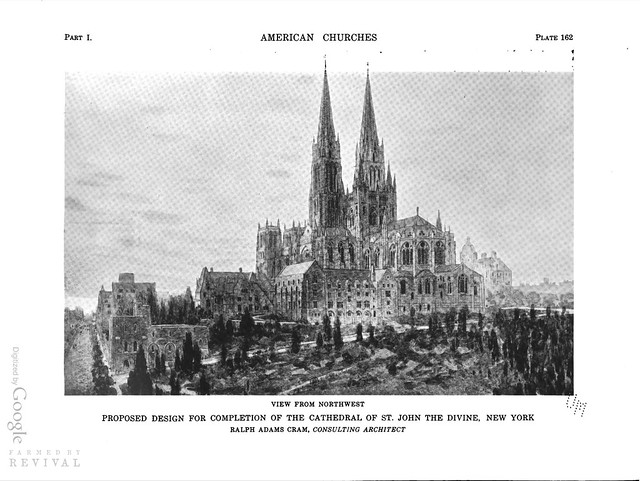
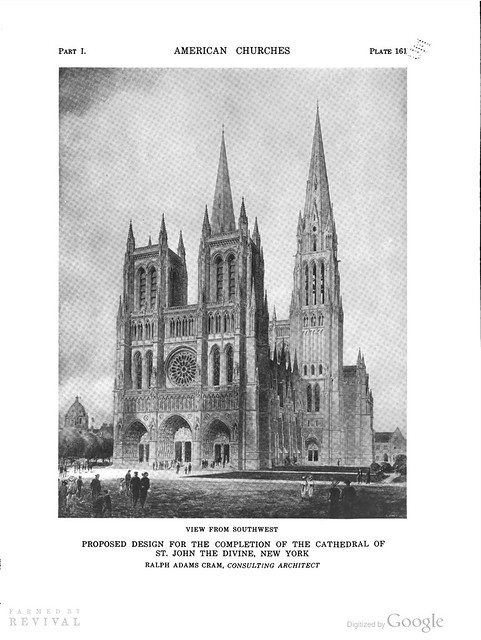
The two middle images are taken from one of Cram's many proposals for trying to bridge the cavernous crossing space of St. John the Divine in New York, which still remains one of the least resolved and most unsatisfactory aspects of the building in its present unfinished state. They are from what may well be the most intriguing proposal put forward, which placed two large spires directly before the north and south transepts, while capping the crossing with a rather low nondescript cube.
The design intrigues me, though I believe there is good reason it was superseded by other proposals. The arrangement is not as strong seen approaching the church from the rear, and would have been a bit more elegant had the towers been placed directly over the transepts, as in Scott's initial proposal for Liverpool Cathedral, and a large bridgelike space raised between them to cover the crossing. (A truly horrible rendering of Scott's otherwise competent first design can be found here; I have yet to find another online.) Furthermore, the contrast between the towers on the front facade and those at the crossing, while creating an interesting, almost Piranesian shift in scale, seems almost unsettling and combative on closer inspection, rendering the otherwise gigantic westwork puny and even toylike by comparison. It is still an interesting "what-if?" in the realm of American sacred architecture, and commendable in its mixture of boldness and precedent.
Wednesday, August 4
Cow Tools: Some Remarks on What Historians Do
I was recently talking with a friend who was raised Catholic, and had retained an amateur's interest in theology, and the conversation turned to religion--though in a quite affable sort of way. My friend asked, as we moved into the depths of the conversation, with quite cheerful curiosity, "But have they found any evidence any of this happened? Man, I had high hopes for the Shroud of Turin. Has anyone looked into any of this?"
Unfortunately, I wasn't able to frame a response for him, since our chat was interrupted--though I managed to comment the Turin Shroud had so many supremely odd things about it that the dubious radiocarbon results were hardly enough to disqualify it as an entrant in the authenticity sweepstakes. There are plenty of tales one hears of the whether the face of the Shroud matches that of the Veronica, or the Sudarium of Oviedo's bloodstains, or whether the spear-point of the holy lance fits its broken-off shaft, or whether the Holy House's foundations in Nazareth match up with its walls in Loreto. I am inclined to believe at least some of such stories, or at the very least to not disbelieve them (I find the long preservation of said objects often better evidence than the objects themselves as they existed in a vacuum, or even carbon-dating, which can easily stray into false positives and negatives; also, their numerous miracles, but that isn't exactly historical evidence), but mentioning them brings up the matter of what precisely can be called historical evidence, and the larger question of what historians actually do. Historical research is not so much a matter of CSI-style swoopy Science-with-a-capital S-and-exclamation mark as it is reading the laundry lists, receipts, and newspapers of our ancestors.
Which is to say that texts, often the least reliable bits of evidence in the popular mind, are considerably more useful to the professional "scientific" historian than the very tangible if inexplicable souvenirs of past epochs. Gary Larson once did a Far Side cartoon with a cow standing behind a series of lumpy, inexplicable domestic objects it had made. Naturally we, not knowing the context, are clueless as what the heck all these things do. (One of the reason relics do not really fall into this situation--with the exception of silly faddy things like the so-called "Jesus ossuary" is we usually have the paper trail, though sometimes only up to a certain point in some cases.)
In the popular mind, the historian is only a few steps away from being Indiana Jones. If he (or if the popular mind is trying to score with the 18-24 male demographic, she, i.e., Lara Croft, Holy Sepulchre raider) is pouring over ancient texts and dusty tomes, they are codices and scrolls he found deep in some cave in Upper Egypt. This isn't to say this doesn't happen, as astounding tales like that of the Dead Sea Scrolls or the discovery of St. Peter's tomb underneath the Vatican (exactly where we said it was this whole time, mind you--this comes of the problem of trying to treat a living faith as if it were the religion of the Pharaohs), do happen from time to time. But most of the time, a historian's work is sifting through old texts for things he or she (in this case, "she" is probably Caroline Walker Bynum rather than Lara Croft) might have missed or misinterpreted or trying to track down even older texts that might have gotten misfiled in some moldy monastic basement during the reign of Charlemagne.
Often it is something as simple as parsing linguistic tics. Admittedly, some of this can get a bit out of hand, as in the rather casual and highly theoretical habit of slicing up the Bible and tying the fragments to alphabetical authors on the basis of somewhat plausible if shifting evidence, which—though this sometimes it turns up something useful, as when we discover a certain bit of Paul is written in translation-style Greek, suggesting the interpolation of an even more ancient Aramaic Christian hymn addressed to Christ as God.
Much is made in the popular mind of the comparative paucity of evidence regarding Christ's life. Yet Christ's life is far better attested than that of Shakespeare's, and was written down (even with the latest dates) far closer to His life and death than that of the Buddha's, and few people would think to disbelieve either of these important historical figures were figments of someone else's imagination. Indeed, one scholar (whose name I have, unfortunately, and I admit, quite conveniently, forgotten) has commented we have more evidence for the historicity of Christ than we do for the world-spanning conqueror Alexander the Great.
Partially, this doubt comes through automatically disqualifying the Gospels on sectarian grounds, and partially through the fact that the popular mind has not caught up with the most recent scholarship. Or they don't realize there even is scholarship on the issue that goes beyond History Channel talking heads. People have been trying to find holes in the Gospel narrative for ages; such complaints and examinations are old hat to Catholics.
This is even more unfair than trying to write a biography of Shakespeare without admitting the existence of his plays as evidence. (Though a good deal of bad history has been written by psychoanalyzing those plays, I will grant.) Certainly it would not really be provable through the confines of secular historiography that Christ has died, Christ is risen, Christ will come again, but it is fairly settled scholarship, even in the secular sphere of serious Biblical scholars and historians that at the very least Christ had lived. The Jesus-Myth school of thought of the 19th century is now mostly extinct; considering its strongest arguments were between pagan agricultural myths and the death and resurrection of the Lord, and that Christ appeared in the one culture of the Mediterranean with little to no interest in such myths in their own system of belief, it is perhaps not a surprise. Even today, the most liberal Jesus Seminar folk admit He at the very least existed, and start with the canonical texts--even if they sift them by a voting method that just about every mainstream historian finds hard to take seriously.
In any case, I suspect this prejudice in the popular mind has much to do with our notions of science and history and what might be called "Science!" with an exclamation mark. Chesterton once said something to the effect that people think we know more about cavemen than about medieval man. The opposite is certainly true--a good historian would never think to identify the use of, say, even a potsherd, without some written evidence to back it up. Otherwise, we're looking at cow tools. While certainly we can make educated guesses about our distant ancestors, our more recent ones have, at least, the advantage of something close to real memory for us to tap into (that is, tradition and written records), which is, even allowing for lapses and legend, a truly living thing inscribed on parchment, rather than the dead bones of a nameless Neanderthal. The historic past is knowable.
Unfortunately, I wasn't able to frame a response for him, since our chat was interrupted--though I managed to comment the Turin Shroud had so many supremely odd things about it that the dubious radiocarbon results were hardly enough to disqualify it as an entrant in the authenticity sweepstakes. There are plenty of tales one hears of the whether the face of the Shroud matches that of the Veronica, or the Sudarium of Oviedo's bloodstains, or whether the spear-point of the holy lance fits its broken-off shaft, or whether the Holy House's foundations in Nazareth match up with its walls in Loreto. I am inclined to believe at least some of such stories, or at the very least to not disbelieve them (I find the long preservation of said objects often better evidence than the objects themselves as they existed in a vacuum, or even carbon-dating, which can easily stray into false positives and negatives; also, their numerous miracles, but that isn't exactly historical evidence), but mentioning them brings up the matter of what precisely can be called historical evidence, and the larger question of what historians actually do. Historical research is not so much a matter of CSI-style swoopy Science-with-a-capital S-and-exclamation mark as it is reading the laundry lists, receipts, and newspapers of our ancestors.
Which is to say that texts, often the least reliable bits of evidence in the popular mind, are considerably more useful to the professional "scientific" historian than the very tangible if inexplicable souvenirs of past epochs. Gary Larson once did a Far Side cartoon with a cow standing behind a series of lumpy, inexplicable domestic objects it had made. Naturally we, not knowing the context, are clueless as what the heck all these things do. (One of the reason relics do not really fall into this situation--with the exception of silly faddy things like the so-called "Jesus ossuary" is we usually have the paper trail, though sometimes only up to a certain point in some cases.)
In the popular mind, the historian is only a few steps away from being Indiana Jones. If he (or if the popular mind is trying to score with the 18-24 male demographic, she, i.e., Lara Croft, Holy Sepulchre raider) is pouring over ancient texts and dusty tomes, they are codices and scrolls he found deep in some cave in Upper Egypt. This isn't to say this doesn't happen, as astounding tales like that of the Dead Sea Scrolls or the discovery of St. Peter's tomb underneath the Vatican (exactly where we said it was this whole time, mind you--this comes of the problem of trying to treat a living faith as if it were the religion of the Pharaohs), do happen from time to time. But most of the time, a historian's work is sifting through old texts for things he or she (in this case, "she" is probably Caroline Walker Bynum rather than Lara Croft) might have missed or misinterpreted or trying to track down even older texts that might have gotten misfiled in some moldy monastic basement during the reign of Charlemagne.
Often it is something as simple as parsing linguistic tics. Admittedly, some of this can get a bit out of hand, as in the rather casual and highly theoretical habit of slicing up the Bible and tying the fragments to alphabetical authors on the basis of somewhat plausible if shifting evidence, which—though this sometimes it turns up something useful, as when we discover a certain bit of Paul is written in translation-style Greek, suggesting the interpolation of an even more ancient Aramaic Christian hymn addressed to Christ as God.
Much is made in the popular mind of the comparative paucity of evidence regarding Christ's life. Yet Christ's life is far better attested than that of Shakespeare's, and was written down (even with the latest dates) far closer to His life and death than that of the Buddha's, and few people would think to disbelieve either of these important historical figures were figments of someone else's imagination. Indeed, one scholar (whose name I have, unfortunately, and I admit, quite conveniently, forgotten) has commented we have more evidence for the historicity of Christ than we do for the world-spanning conqueror Alexander the Great.
Partially, this doubt comes through automatically disqualifying the Gospels on sectarian grounds, and partially through the fact that the popular mind has not caught up with the most recent scholarship. Or they don't realize there even is scholarship on the issue that goes beyond History Channel talking heads. People have been trying to find holes in the Gospel narrative for ages; such complaints and examinations are old hat to Catholics.
This is even more unfair than trying to write a biography of Shakespeare without admitting the existence of his plays as evidence. (Though a good deal of bad history has been written by psychoanalyzing those plays, I will grant.) Certainly it would not really be provable through the confines of secular historiography that Christ has died, Christ is risen, Christ will come again, but it is fairly settled scholarship, even in the secular sphere of serious Biblical scholars and historians that at the very least Christ had lived. The Jesus-Myth school of thought of the 19th century is now mostly extinct; considering its strongest arguments were between pagan agricultural myths and the death and resurrection of the Lord, and that Christ appeared in the one culture of the Mediterranean with little to no interest in such myths in their own system of belief, it is perhaps not a surprise. Even today, the most liberal Jesus Seminar folk admit He at the very least existed, and start with the canonical texts--even if they sift them by a voting method that just about every mainstream historian finds hard to take seriously.
In any case, I suspect this prejudice in the popular mind has much to do with our notions of science and history and what might be called "Science!" with an exclamation mark. Chesterton once said something to the effect that people think we know more about cavemen than about medieval man. The opposite is certainly true--a good historian would never think to identify the use of, say, even a potsherd, without some written evidence to back it up. Otherwise, we're looking at cow tools. While certainly we can make educated guesses about our distant ancestors, our more recent ones have, at least, the advantage of something close to real memory for us to tap into (that is, tradition and written records), which is, even allowing for lapses and legend, a truly living thing inscribed on parchment, rather than the dead bones of a nameless Neanderthal. The historic past is knowable.
Tuesday, August 3
Heaven Made Manifest

Gentle readers will be pleased to note that, due to the kindness of Fr. Kocik over at the Society for Catholic Liturgy and the generosity of Stratford Caldecott at Second Spring, my article "Heaven Made Manifest: An Architectural Solution for The Spirit of the Liturgy," which appeared last year in the scholarly periodical Antiphon: A Journal of Liturgical Renewal is now available in PDF form at the Second Spring article archive. I have also posted a link on my personal website. Enjoy!










![[SMMMHDH]](http://www.mgilleland.com/music/smmmhdh.png)