Wednesday, May 26
This Fellow Needs to Get Out a Bit More
From Balkan Ghosts, Robert D. Kaplan, p. 122:
In the cathedral lay the reputed bones of St. [Paraskeva] in a gold coffin whose lid was open. I watched a throng of Romanians wait in line to touch and kiss the skeleton. What struck me was the fervor and terror of the faces waiting in line. Not merely were the people repeatedly crossing themselves but they were doing so with knees on the floor, and some of them were sweating profusely. They were truly drenched in sweat, even though the air felt cooler in the cathedral than outside. Several worshippers scribbled notes to the saint--but not just one note. Each supplicant seemed to be writing as fast and intensely as he or she could, note after note after note. Only in Shiite holy places in the Middle East had I experienced such a charged and suffocating religious climate, rippling with explosive energy.After reading this, speaking as a Catholic nerd, I was tempted to add, "Or as we call it around here, just another Tuesday afternoon."
Tuesday, May 25
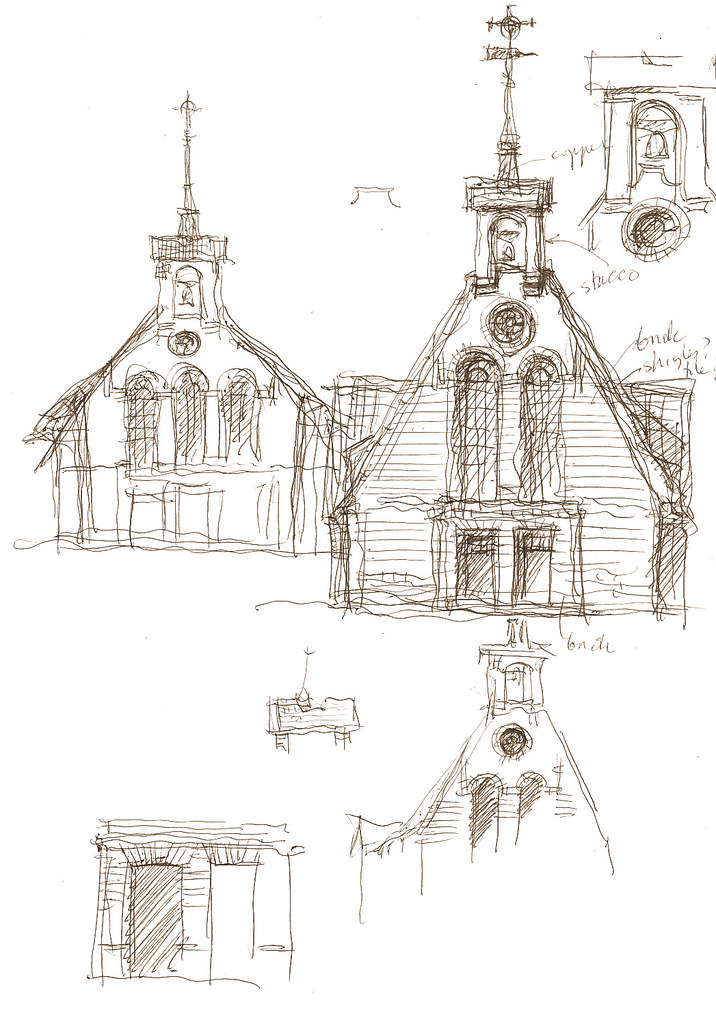
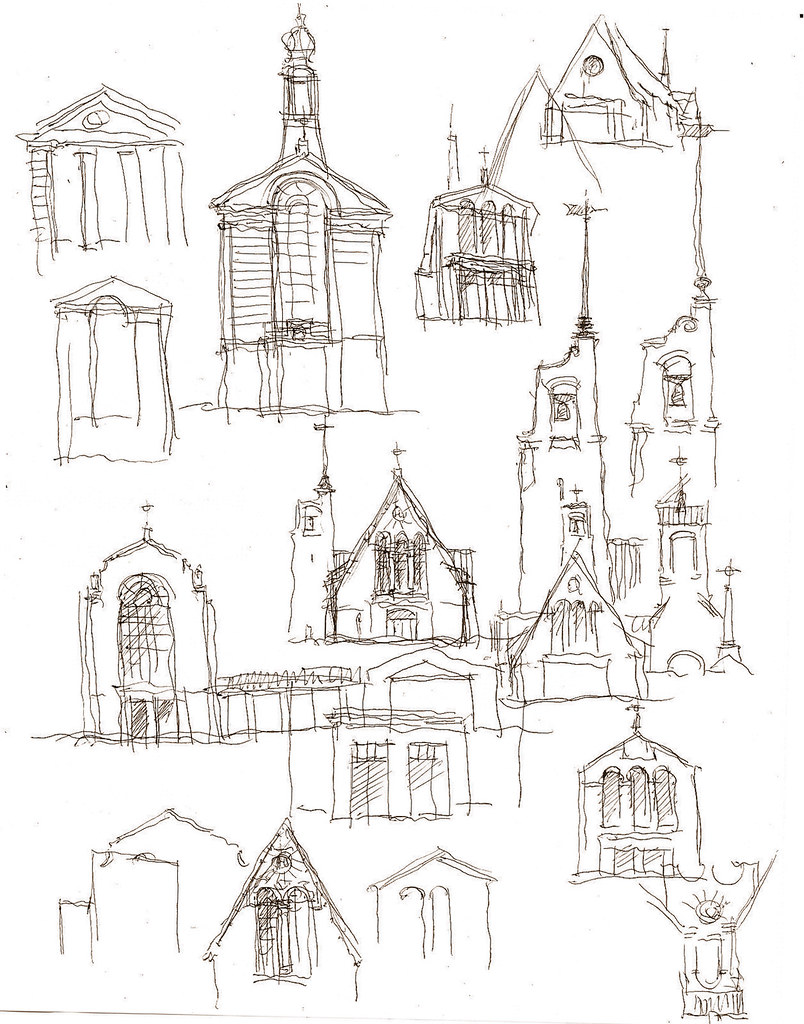
From the Sketchbook
A few loose sketches I whipped up to entertain myself this evening of a number of variations on a simple small church facade and a variety of bell walls, bell-cotes and other elements. A few are combinations of brick and stucco, simply stucco, or wood clapboard.
Monday, May 24
Denis McNamara on Sacred Architecture

I am currently beginning to write a magazine review of Denis McNamara's excellent new work on churchbuilding, Catholic Church Architecture and the Spirit of the Liturgy, and I was pleased to see that the excellent Institute of Catholic Culture had recently had him give a lecture on the subject, which is now available online at their website, along with the accompanying slide show. Dr. McNamara's talk is in many respects a capsule version of his book, and will be of particular interest to our readers in that while he often refers to both Gothic and classical precedents, he provides a deeper and more probing theological rationale by which any and all styles, ancient and modern, might be judged as suitable for ecclesiastical use.
The lecture, like the book, is possibly the best comprehensive analysis of the theology of church architecture and aesthetics I have seen all together in one place in quite a while. It is definitely worth your listening time. Something else significant which Dr. McNamara brings up (briefly here and at greater length in his book), is the issue of iconography in both the eastern and western context. Dr. McNamara challenges us to go beyond just plopping Mary and Joseph on either side of the crucifix and calling it "tradition," and instead seeking out a more ancient and truly liturgical precedent which turns the sanctuary into a representation of the heavenly liturgy, God among the saints and angels of the Book of Revelation. Incidentally, if you are unfamiliar with the Institute's work, this lecture is a fine introduction. They have been sponsoring a continuing series of lectures by a variety of distinguished Catholic speakers, mostly in parishes in the Arlington diocese in Virginia. They keep a free sound library of previous talks on their website. Previous speakers have included my liturgical colleague Fr. Kocik speaking on issues of liturgical reform, and a range of talks on Church and secular history by some of the faculty of Christendom College, including a delightful and at times rather witty series on the Crusades by Brendan McGuire. Readers may also appreciate Fr. Fessio's piece on the relationship between Pope Benedict's program for the liturgy and for the Anglican ordinariates, which may be found here. Photo source here.Tuesday, May 18
Good Proportion Does Not Cost Extra
I was privileged to meet David Clayton, the well-known painter spearheading the new sacred art program at Thomas More College, when I popped up to give a lecture at the place back in February of last year. (The weekend which followed included, in varying amounts, John Zmirak, John Singer Sargent, a beagle named after the late Austrian emperor Franz-Josef, drive-by Cram sightings, the movie Gran Torino, and the then-engaged, now-married POD power couple of a young Anglican vicar and his girl lawyer fiancee, both of whom are great fun and both of whom are probably reading this right now.) Mr. Clayton is both thoughtful and very talented, and, unusually for most Catholic artists, is both trained in traditional Byzantine iconography and the traditions of Renaissance classicism, two vital streams of Catholic thought which must be considered in any future restoration of Christian art. To ignore one would be an act of archaeological narrow-mindedness, to ignore the other would be to cut tradition off at the roots.
Mr. Clayton has recently started his own blog, in addition to having taken on the role as sacred art correspondent for The New Liturgical Movement, where he has posted a number of very intelligent essays in the past few months. One particularly good piece deals with proportion not just in sacred art, but in secular architecture--even quite humble secular architecture. He makes the point that even in the most workmanlike public housing and factory projects our Victorian forefathers paid attention to proportion, scale and (in appropriately limited amounts) ornament. Good proportion, as Cram once said, doesn't cost any more than bad proportions. It may even cost you less as David's article points out, as it adds considerable intrinsic value to a project. (And not only is good proportion pleasing to the eye, I think it affects us at even a subconscious level. There's a reason we feel troubled in triangular rooms, or that wide, low spaces oppress us.)
The article cites Victorian English structures, but I can think of some absolutely gemlike little workers' townhouses, simply ornamented but with fine proportions and well-thought-out brickwork, that I once ran across in Brooklyn when I lived out in New York. While probably intended for those on the lower end of the scale, I suspect today only the very wealthy can afford to live there. It is sad that today even low-end craftsmanship from days past is light-years ahead of even the highest of our high-end work. (Which is a thought that leads to another question--what the large-scale societal effects might be, or have been, of such skilled blue-collar craft jobs being reduced, for no good or logical reason besides minimalist fashion, to obscure niches. But that is a subject for another discussion.)
Anyway, read the piece here, and check back for updates!
Mr. Clayton has recently started his own blog, in addition to having taken on the role as sacred art correspondent for The New Liturgical Movement, where he has posted a number of very intelligent essays in the past few months. One particularly good piece deals with proportion not just in sacred art, but in secular architecture--even quite humble secular architecture. He makes the point that even in the most workmanlike public housing and factory projects our Victorian forefathers paid attention to proportion, scale and (in appropriately limited amounts) ornament. Good proportion, as Cram once said, doesn't cost any more than bad proportions. It may even cost you less as David's article points out, as it adds considerable intrinsic value to a project. (And not only is good proportion pleasing to the eye, I think it affects us at even a subconscious level. There's a reason we feel troubled in triangular rooms, or that wide, low spaces oppress us.)
The article cites Victorian English structures, but I can think of some absolutely gemlike little workers' townhouses, simply ornamented but with fine proportions and well-thought-out brickwork, that I once ran across in Brooklyn when I lived out in New York. While probably intended for those on the lower end of the scale, I suspect today only the very wealthy can afford to live there. It is sad that today even low-end craftsmanship from days past is light-years ahead of even the highest of our high-end work. (Which is a thought that leads to another question--what the large-scale societal effects might be, or have been, of such skilled blue-collar craft jobs being reduced, for no good or logical reason besides minimalist fashion, to obscure niches. But that is a subject for another discussion.)
Anyway, read the piece here, and check back for updates!
More Status Updates from Yours Truly
Apologies for the long blogging silence. In the hopes of distracting you, dear reader, from your disappointment, some slice-of-life humor from the singular world of Planet Matthew:
April 27: Lecturer: "If you really want to start an argument, ask someone their opinion about anything involving the liturgy." Everyone turns around and looks at me.
April 24: I am probably the only person who impulse-buys small statues of the Virgin Mary. Except probably at least 50% of the people I know on Facebook...
[And naturally, most of them replied with photos of their own. I love my friends]
April 21: I wonder what would happen if you put Charles Fort and G.K. Chesterton in a room together? It'd be entertaining to watch, if probably loud, argumentative and kind of weird.
April 20: Eusebius's Ecclesiastical History would make a great disaster movie; it's a bit like watching Nero stomp through a badly-made model of Tokyo while a soap opera plays in the background. The amazing thing is, it's all true.
[Okay, mostly true.]
April 14 Strategic North American Lego Supply would make a good name for a band.
[I'm omitting the update involving using incidents in 30 Rock as proof the subdiaconate ought not to have been abolished that generated a lengthy discussion among my friends and I as to whether John Knox and Vatican II existed in the in-show 30 Rock universe. One major flaw: to work, the theory we finally hashed out requires taking Tracy Jordan's outburst "I'll tell you why, because the Pope owns Long John Silver's" at face value.]
April 27: Lecturer: "If you really want to start an argument, ask someone their opinion about anything involving the liturgy." Everyone turns around and looks at me.
April 24: I am probably the only person who impulse-buys small statues of the Virgin Mary. Except probably at least 50% of the people I know on Facebook...
[And naturally, most of them replied with photos of their own. I love my friends]
April 21: I wonder what would happen if you put Charles Fort and G.K. Chesterton in a room together? It'd be entertaining to watch, if probably loud, argumentative and kind of weird.
April 20: Eusebius's Ecclesiastical History would make a great disaster movie; it's a bit like watching Nero stomp through a badly-made model of Tokyo while a soap opera plays in the background. The amazing thing is, it's all true.
[Okay, mostly true.]
April 14 Strategic North American Lego Supply would make a good name for a band.
[I'm omitting the update involving using incidents in 30 Rock as proof the subdiaconate ought not to have been abolished that generated a lengthy discussion among my friends and I as to whether John Knox and Vatican II existed in the in-show 30 Rock universe. One major flaw: to work, the theory we finally hashed out requires taking Tracy Jordan's outburst "I'll tell you why, because the Pope owns Long John Silver's" at face value.]









![[SMMMHDH]](http://www.mgilleland.com/music/smmmhdh.png)