They met at the University of Notre Dame. Now these "Catholic Nerds" share their thoughts on Catholic culture, spiritual life and other musings (or "moosings" as the case may be) with the rest of the world. Click here to return to Main Page.
Thursday, January 28
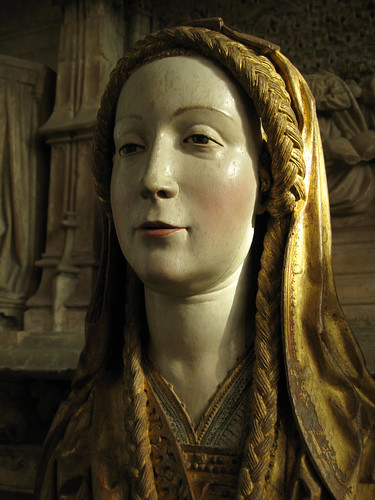
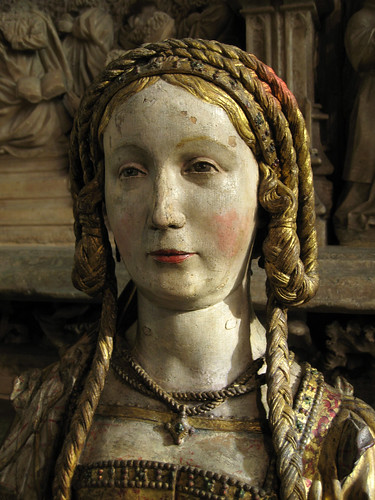
Three Reliquary Heads from the Cloisters, New York
These would seem to have been designed to hold relics of St. Ursula and some of her 11,000 martyred companions, and date from around 1525-1530, possibly from the Low Countries. Another bust, kept at the main branch of the Metropolitan Museum of Art and of a similar appearance and vintage (one of a set of 23) can be seen here.
Also, I do notice a join around the edges of the chin--one wonders if the face comes off, in terms of relic storage. Though there does appear to be a very clear relic container at their chests.
Polychrome statues are great. They're really more classical than all the white statues of Renaissance nostalgia, which were based on statues bleached by 2,000 years of rain.
They are lovely, aren't they? I'm quite fond of the hair and ornaments; a nice change from the identical long-haired girls in bedsheets that one finds on 19th century holy cards. I've become rather fond of (good) polychromy in recent years. (There's a lot of bad polychromy out there, too). I think there's a place for white marble statues which allow us to concentrate on the form rather than the color (I'd hate to see St Theresa in Ecstasy all painted up), but I find medieval and Spanish Baroque polychromy far more fun--and with a lot more potential for expression.
I'd also love to see a well-done reconstruction of a polychrome classical statue. Most of the ones I've seen lack both an artistic sense and the mixture of subtlety and panache one finds in medieval examples--I can't imagine the Romans were that klutzy. I *do* think many restorers can't tell the difference between bold and garish.

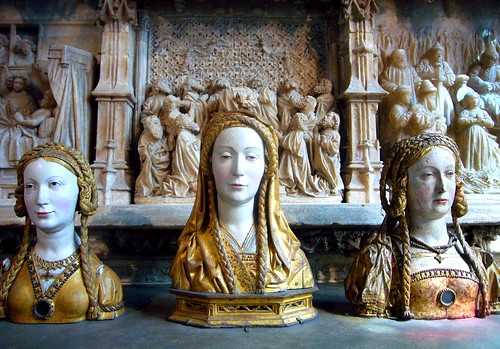
that third one seems to look a bit like you, Matthew... any relation?
ReplyDeleteI don't understand. Where would the relics be put? I don't see any obvious place for them...
ReplyDeleteThe ones on the sides have relic holders at the bosom.
ReplyDeleteMark R
I'd certainly love to claim descent from St. Ursula...but no such luck!
ReplyDeleteAlso, I do notice a join around the edges of the chin--one wonders if the face comes off, in terms of relic storage. Though there does appear to be a very clear relic container at their chests.
ReplyDeletesince St. Ursula was a virgin martyr, I don't think it would be good for someone to claim descent from her. :)
ReplyDeleteAhh...er...yes...good point. Was not thinking...
ReplyDeleteBeautiful faces!
ReplyDeletePolychrome statues are great. They're really more classical than all the white statues of Renaissance nostalgia, which were based on statues bleached by 2,000 years of rain.
They are lovely, aren't they? I'm quite fond of the hair and ornaments; a nice change from the identical long-haired girls in bedsheets that one finds on 19th century holy cards. I've become rather fond of (good) polychromy in recent years. (There's a lot of bad polychromy out there, too). I think there's a place for white marble statues which allow us to concentrate on the form rather than the color (I'd hate to see St Theresa in Ecstasy all painted up), but I find medieval and Spanish Baroque polychromy far more fun--and with a lot more potential for expression.
ReplyDeleteI'd also love to see a well-done reconstruction of a polychrome classical statue. Most of the ones I've seen lack both an artistic sense and the mixture of subtlety and panache one finds in medieval examples--I can't imagine the Romans were that klutzy. I *do* think many restorers can't tell the difference between bold and garish.