Friday, June 4

Waiting on the Via Crucis for a Green Light
The Lateran: Part II of II
If you had asked a medieval pilgrim the holiest spot in Christendom, the indisputable Sancta Sanctorum, he would have unshakingly referred you to a chapel, San Lorenzo, that stands at the top of a stairway in Rome called the Scala Santa. Along with the mosaick’d end-piece of Leo III’s dining room that now stands awkwardly grafted onto one side, it is the one remaining fragment of the sprawling Lateran palace that stood there for a thousand years from Constantine to the Babylonian captivity.
In spite of all this, it looks rather like a down-at-heels greenhouse myself in comparison with the great Lateran basilica and the barracks-like bombast of the vast nineteenth-century buildings that replaced the quaint inns of so many Piranesian vedute.
Most Catholics have heard of the Holy Stairs. I thought so, anyway. Or perhaps it’s become one of those sacramental memories that’s fallen into that vague Tridentine time warp that jams everything into one amorphous mess of the Holy Souls in flames and indulgences with years attached. Like St. John Lateran, it lacks the crowds of St. Peter’s, though every day somehow pilgrims find their way here, offering their prayers and sufferings for themselves and their beloved dead. You see them, young and old, beautiful and warty, male and female, backpacked student and burdened adult, climbing slowly up the warped, worn-down wood paneling that covers the ancient marble stairway, polished by hundreds of years of veneration.
You step into the narrow narthex, little more than a peeling Renaissance hallway vaulted over with an intricate and forgettable web of plasterwork and fresco grotesque. An abandoned porter’s bussola stands to one side, dark and dusty, seeming an odd, irreverent and almost despairing addition to the hushed hall, belonging more to the world of holographic Christs and gimcrack Davids that litter the single stall outside in the piazza. But then you move past stoic neoclassical marble images of Christ kissed by Judas, His fork-bearded head down-turned, with a face of subtle sorrow, and Christ in the garden, His eyes full of the agony to come, and look beyond and see the stairs receding into the motey, dusty darkness, the treads crowded with the repeated shape of the back of the dozen, two-dozen penitents that are slowly ascending the stair one step at a time. On their knees.
They are 28 in number, flanked by four other stairways added much later for pilgrims to descend. Legend calls them the steps of Pilate’s Praetorium which Christ ascended to receive His judgment from the lips of a mere mortal, and indeed, at three spots as you slowly climb up their treads, praying or meditating or just thinking, you can see dark blotches beneath the wood preserved beneath glass rondels, and you place your fingers on the dim circular reliquaries and think—are they, are they really spatters of the blood of God? Even the slightest possibility, no matter how tenuous the tradition, sets the mind afire with nameless wonder and sorrow.
Unlike the well-documented relics enshrined at St. Peter’s or down the tree-lined boulevard towards Santa Croce, historians can only date the stairs back to 844, when they were first mentioned in papal documents. Nonetheless, millions have made that devotional journey up the steps, from Martin Luther, who purportedly got up in the middle and walked down with conspicuous impiety, to Pius IX, who made his last journey up the steps on September 19, 1870, only a few hours before Garibaldi’s red-shirted troops broke past the last redoubt of Papal troops holding the Porta Pia. A large, sadly smiling marble effigy of Pio Nono stands off to one side of the narthex in memory of this final papal ascent of Calvary.
The devotion is still very much alive, and the black-robed Passionist priests that tend to the shrine are busy day in and day out in their ministry. Masses in the side-chapel that stands at the head of the southernmost of the four stairs that flank the Scala Santa are crowded and ubiquitous, the faithful packed in tight. They’re also given to less conventional vocations: one priest had an artist’s studio tucked away directly beneath the treads of the Holy Stairs, while one more astonishing rumor mentions the Chief Exorcist of Rome, that celebrity devil-wrestler Gabriele Amorth who writes like St. Bernard and looks and dresses like a particularly saggy cousin of Uncle Fester. It’s said that he holds his exorcisms there, by appointment only, in the dark depths of the early morning, deep within the complex of chapels that cluster close to the old Papal chapel of San Lorenzo. The room, I believe, is soundproof.
On the whole, Amorth’s room would be one of the sights in Rome I’d sooner pass on seeing.
I don’t remember much about climbing the twenty-eight steps, just the rumble and squeak of the worn wood under my knees, the aching, the pain, a looming fresco of the Crucifixion at the top of the stairs full of boiling clouds and the sorrow of Calvary's darkness. I do, however, remember that long half-hour I stood at the top of the stairs as I waited and prayed and watched my friends, visiting from Notre Dame, make their own ascent.
It’s the defining image I have of that holy, melancholic place, where it seems to be perpetually sunset. The blood-tinged sun, swimming with motes, spills in between the spindly bars of the ironworked portal below, suffusing the turgid storm-green frescoes with fiery orange gilt, alighting on the dark hair and smooth silent prayerful faces of young women, on the sunken wrinkles of old men, on all ages and races and types of the universal Church. There are Indians, women head-scarved and men with bristling mustaches spiking their prayers with fantastic gestures, drawn-faced Frenchwomen in veils and young German girls with bulging student backpacks.
And then there’s me, kneeling at the step of San Lorenzo, beneath the worn, cracked marble slot marked Elemosina. I look in through the heavy iron latticework grate closing off the chapel, the Holy of Holies hermetically sealed from mere mortals. Three windows with grills connect it with the Scala Sancta, but it remains locked and empty save for those on a special tour. It’s a lonely, misplaced Holy of Holies, hemmed in by a series of oratories that form an irregular ambulatory around it ringed with altars, quire stalls, Stations of the Cross and confessionals.
But why this, and why here? Why isn’t the Sancta Sanctorum beneath St. Peter’s amid the moldy dust of the Vatican necropolis, or somewhere amid the Lateran’s airy vaults? At the height of the Middle Ages, it was the papal household chapel of the now-destroyed Patriarchum. Then, it was accorded the grand title of the holiest spot in the world on account of the numerous relics that graced its pophyried walls. Indeed, one of the earliest reliquaries still in existence was traced to this spot. Nonetheless, the ostensories and urns are now gone, taken back to the Vatican in 1903 save for one image that hangs above the old altar. It’s a smoke-darkened Byzantine image, given, it is said, to St. Luke by the hand of an angel. It’s armored with an ornate winged silver frame that covers all but the dusky face. Long ago, it was carried in procession through the streets of Rome by the powerful and select Archconfraternity of the Most Holy Savior; now, it lies forgotten behind the grill.
The whole chapel is something of a Byzantine Sleeping Beauty: the 1913 Catholic Encyclopedia notes that nobody had seen any of the Sancta Sanctorum’s then-numerous relics since the reign of Leo X. Now, sadly gutted of these sacred souvenirs, it nonetheless seems to hold a heavy claim on the sacramental imagination, as if some trace of that ancient grace still clung to the chapel’s ancient walls like a poignant whiff of lingering incense. The old golden letters still declare, against the cobalt blue backdrop of the frieze over the altar There is not a holier place in the world, and Cosmatesque curls slither around the floors like Romanesque conveyor-belts. The thought that any place in the world, in these days after the destruction of the Temple, could be called holiest, has a hypnotic and shivering sort of fascination. Somehow whether or not the relics are here, whether or not even the stairs are authentic, doesn’t quite seem to matter, a realization which surprises me.
The Church has seen Her share of faked relics--the remains of the Maccabees once enshrined at San Pietro in Vincoli were discovered with horrific kosher irony to be pig bones--but Rome has plenty of the real, well-documented kind which date back to the earliest days of Christianity. Back when hanging on to a shard of Christ’s crib would have probably gotten you hauled up before a magistrate and sent off to be crucified in the circus. There wasn’t any profit back then in peddling off spurious bits of carpentry as the cross God died upon.
With the stairs, it’s more difficult to say whether they’re pious fiction or pious fact. The story, that St. Helena brought them back from Jerusalem, is certainly plausible enough. St. Helena’s archaeological expeditions are matters of historical record. The True Cross is enshrined down the street from the Holy Stairs on a church built on the site of her palace. Other myths have turned out to be just as true, when one remembers that the legends of the Vatican tomb of Peter were confirmed with startling accuracy less than one hundred years ago.
Still, the historian in me hesitates about the stairs: it’s certainly possible that Helena might have disassembled the stairs of the Praetorium--good Roman construction wouldn’t have gone anywhere in those two hundred and fifty years--and shipped them back to the Eternal City. Rome was rather good at that sort of thing, if the Egyptian obelisks that festoon the city grid are any indication. Yet, the first manuscript mention of them is merely in 844 AD, when the True Cross at Santa Croce had been a matter of common knowledge for centuries before.
But, perhaps in this one instance, I can afford to be credulous. The Church has a peculiar way of being right when you least expect it, in the little things as well as the great. And even so, there’s something holy about the place, just like all those piled-up relics rubbed off a bit of grace onto the now-bare walls of the papal chapel. Even if the God-Man did not walk upon these treads, plenty of men have done the same. There’s something dizzying to think of all the lives, all the miniature reenactments of salvation history, that are intersecting here beneath the dark gaze of St. Luke’s silvered icon. Even if it is a mere legend, the shared experience of faith and penitence that stretches back more than a millenium, from paupers to popes, is enough to make this place with all its sunset glory one of Rome’s most enduring holy sites. The stairs might be a pious fiction, but the prayers are real. And so Is the One they’re aimed at, staring piteously down from that stormy cross.
The last time I saw the Scala Sancta, it was a Friday in Lent, and a Stations of the Cross service in one of the upper chapels had just completed. A solemn mass would follow in the Basilica. A tide of pilgrims dripped slowly down the side-stairs, clustering in front of the humbly classical front of the shrine. Finally, they formed up into a procession, led by a layman in a windbreaker lofting a vast black cross bearing the crossed lance and sponge of Calvary. A black-robed Passionist walked alongside. They waited for a moment with their great cross and for a few astonishing minutes I was treated to the dubious spectacle of seeing a penitential procession stuck in traffic as they waited for the crosswalk light to turn green. The Lateran was cut off by a swirl of traffic.
But for all this modern incongruity, the Cross moved serenely onward, black against the deep warm blue sky, and soon they passed into the nave of St. John. They moved slowly through the immense bronze doors of the church, two-thousand-year-old doors that had once graced the portals of the Senate itself. I had never, not in all my months in Rome, seen them open, seen the Cross raised on high against the verdant green and pockmarked brown of suburbican Rome. The church’s great organ, the organ Handel had once played upon, began to sound, and we moved towards the gilded Gothic spike of the high altar like a crowd of medieval pilgrims. The doors were open, and the daylight was spilling in beyond the anthropomorphic silhouette of the Cross. The world was breaking into the church, the sanctuary was bleeding out into the world, and the veil of the Holy of Holies was torn in two.
Saturday, June 4

Piercing Rays of the Living Sun-Christ:
Guarini’s Capella del Sindone as Building and Reliquary
Part I: King of Relics
For your reading pleasure, we will be presenting extracts from a paper I wrote this semester on the subject of the chapel in which the Turin Shroud is kept, designed by one of the most brilliant and eccentric of the great architects of the Baroque, the Theatine priest Guarino Guarini.
It is the King of Relics. Even today, when skeptics prefer to remember comforting tales of medieval incredulities such as archangelic feathers, the multiple heads of John the Baptist, and the vial of air snatched from the Egyptian plague of darkness which still resides at the sacristy of San Marco in the Piazza Venezia, the Shroud of Turin retains its ability to fascinate, beguile, even inspire belief in some. [1] It even has a branch of science, sindonology (from sindone, the Italian for burial cloth), dedicated to its study. Scientists study its mosaic of mysterious patterns, scorchmarks and caches of dessicated pollen. Believers seek to look upon the face of God. And the occasional crackpot scholar tries to link it to the Templars, the Freemasons, Leonardo da Vinci or some seductively conspiratorial combination thereof. [2]
Amid all this devotional fervor, scientific scrutiny and semi-scholarly white noise, one important aspect of what might be termed the problem of the Shroud recedes surprisingly into the background: the place where it rests. It is a miraculous baroque waterspout of gilding and black marble murk conjured into existence by an eccentric polymath and priest working on the orders of a ducal house hoping to prop up its royal pretensions through the relic. [3] Guarino Guarini’s Capella del Sindone, located behind the high altar of Turin’s stark early-Renaissance cathedral of San Giovanni, is undoubtedly extraordinary, the intersection of liturgy, dynastic theater, and a uniquely architectural symbolic language. It is, perhaps, also, the world’s largest reliquary.
A recent study of the Capella del Sindone remarks on this heretofore unappreciated aspect of the chapel’s curious design, linking its purpose as a gigantic reliquary case to the elaborate geometrical coffering of the lower portion of the dome. John Beldon Scott notes the Shroud had been carried from its earlier resting-place at Chambéray across the Alps in a massive chest inlaid with mother-of-pearl in similar patterns.
While this might be perhaps coincidental, it is confirmed by the account of Amedeo di Castellamonte, a prominent courtier and architect closely connected with the chapel project, who calls it a “scrigno” or reliquary case for the “protection of that most holy Shroud...given miraculously…to the princes of this royal house.” [4] Scott notes this “comment has not received the attention it deserves;” indeed, save for a footnote citing the Sainte Chapelle in Paris as the prototype, he does not return to the subject himself. [5]
When one considers both the larger typological scope of reliquaries and the whole of the structure, rather than one isolated zone in the building and the casket, a boxy and distinctly un-architectural form of reliquary, the analogy operates in a far more comprehensive level. The whole design, with its spirit of fantasy, “the terror of architecture,” [6] becomes a commentary on the architectonic reliquary and the tradition of tabernacles and other miniature buildings in church furniture. Reliquaries and tabernacles have long imitated larger structures, functioning as miniature buildings.
Guarini would have been familiar with Bernini’s lapis lazuli tabernacle in the Chapel of the Blessed Sacrament at St. Peter’s inspired by Bramante’s Tempietto; of more later. [7] Medieval Christians reserved the Host in structures called, quite literally, “Sacrament Houses” or “Sacrament Towers,” while reliquaries in architectural form are even older. Thursdon notes a gabled shrine preserved in the sacristy of St. Maurice in Valais resembling—perhaps unintentionally—Noah’s Ark, as well as the reliquary of the Magi at Cologne, “a superb piece of silversmith's work resembles in outward form a church with a nave and two aisles.”[9] The author himself has seen a small reliquary of St. Thérèse in the sacristy of the Basilica of the Sacred Heart at Notre Dame, Indiana, designed in the form of the dome of that college’s Main Building.
[To be continued tomorrow, with Part II: The Reliquary as Building].
Footnotes:
[1]. For the designation “King of Relics” and sindonology, see John Beldon Scott, Architecture for the Shroud: Relic and Ritual in Turin. Chicago: University of Chicago Press, 2003 (p. 9-10). For the tenebrae aegyptorum see Bryce Sibley, “POD-ing Out,” A Saintly Salmagundi [available online]. http://britius.stblogs.org/archives/016286.html [March 23, 2005]. Also see “Gabriel Feather” in George Eberhart, Mysterious Creatures: A Guide to Cryptozoology, Vol. I. Santa Barbara: ABC-Clio, 2002.
[2]. Lynn Pickett and Clive Prince’s magnificently preposterous book Turin Shroud: In Whose Image? The Truth Behind the Centuries-Long Conspiracy of Silence is enough example for us here.
[3]. Scott, p. 5; 20-37; 10.
[4]. Ibid., p. 136.
[5]. Ibid., p. 136, fn. 35.
[6]. Ibid., p. 87.
[7]. Niccolò Suffi, St. Peter’s – Guide to the Basilica and Square, Libreria Editrice Vaticana, n.d., n.p., [online]. Available at http://stpetersbasilica.org/Altars/BlSacrament/BlSacrament.htm. [March 24, 2005]. Another example is the tabernacle borne aloft by bronze angels in the Sistine Chapel of St. Mary Major in Rome. See Steven Schloeder, Architecture in Communion, p. 98, fig. 4.42.
[8]. See also the new tabernacle at the Cathedral in Salt Lake illustrated in Schloeder, p. 97, figs. 4.40-41.
[9]. Thursdon, Herbert. “Reliquaries.” The Catholic Encyclopedia, 1908 ed. [Available online]. http://www.newadvent.org/cathen/12762a.htm [March 24, 2005].
Saturday, January 3

St. Anthony’s Tongue
more reminiscences from the Veneto, 2003
I owe St. Anthony an apology for what I did in Padua. When I went to venerate his tomb and venerate his relics late that evening before we embarked for Venice, it was with a group of semi-agnostic curiosity-seekers in tow.
There are only two ways Catholics can approach relics. Or perhaps not. My idiosyncratic acquaintance Vera (one of the so-called Maenads, who are actually remarkably sober) manages a third way, but I’ll come to that later. Either you embrace them vigorously as the theological fruit of the Incarnation, or you get, as Strongbad said so succinctly, the jibblies. Maybe not the jibblies, but at least you consider signing up for the Unitarians for a couple of months.
The Church’s long history of venerating the bodies of the saints fascinates me, perhaps because I believe it answers to a real human need to have tangible reminders of the past around us. The physicality of the Faith, which you encounter in a vivid and even graphic sense in Italy, is a great testament to Her truth. While perhaps somewhat unnerving to modern sensibilities, those golden reliquaries and the dozens of grinning skulls on black marble tombs stand as reminders of the General Resurrection.
It’s a call to be familiar with the body, either corrupted or glorified. For my part, I’ve given a nickname to the skeleton on the tomb at the church next door to Studio back in Rome. I think Mort’s rather suitable, don’t you?
On the other hand, there is some hint of that enjoyable head-game called “Shock the Agnostic.” Not that it’s too terribly hard.
Non-believers of a certain stripe are used to seeing religion as drab, dull, a little bit reticent. The province of silly old biddies of both sexes. At the very least, seeing that some of us still take the old traditions seriously, that someone would encase a sacred chunk of some saint in silver and gold—well, that might be enough to shock them out of their complacency.
There’s plenty of that in Italy, trust me—even an ordinary pilgrimage statue can be plenty weird, like the “Smiling St. Zeno” in Verona who has a fish dangling from his crook, and the strangeness factor is easily upped when you get to second-class relics—like St. Lawrence’s gridiron in Rome—and then, trumping it all are the body parts, sometimes very interesting particular body parts indeed.
Coming from Irish-Catholic America, evangelized by priests from a war-zone country where non-Protestant churches, much less an apostle’s finger, were rare, Europe and particularly Italy are powerful antidotes to the Cartesian temptation to see the Faith as exclusively spiritual, disembodied or even Gnostic. The teenager who throws Christ over for Buddha in search of “something more exotic” can’t possibly try that line of argument when he’s standing in front of a half-preserved jawbone of a medieval Franciscan preacher.
For that matter, it might remind him that the central pillar of the Faith, the Eucharist, is pretty wild stuff. And I mean that in all seriousness; a God that allows Himself to be touched, much less eaten—it screws with our cozy, comfy, half-inbred Deist notions.
I think that’s why I get so excited over bits of saints. To some extent the novelty of seeing two dozen waxy-looking local virgin martyrs at every turn is wearing off. I’m now holding out for the big guys, the Apostles and Doctors. Or at least some recognizable body parts as opposed to those tiny third-class bits that crowd every sacristy from Turin to Salerno.
So, maybe in retrospect, I had a good-enough reason to publicize my friends about the various portions of St. Anthony displayed at his shrine in Padua. At the best, it would be a teachable moment, and at the worst, apart from the gross-out factor, they’d have something weird to write home about. I mean, a sanctoral tongue, you wouldn’t want to miss that.
Incidentally, it’s not just the tongue. They have his vocal chords and also “the sacred chin,” which went missing for a time when it was stolen in 1991 by masked bandits who were working for a Venetian mobster who wanted it as leverage to get clemency.
That alone proves how universal Anthony’s appeal is, in a perverse sort of way. If you’re going to introduce someone to relics, maybe St. Anthony is a good place to start. Everyone loves St. Anthony; even the most execrably-catechized Catholic remembers the little rhyming prayer to him that their kindergarten teacher taught him: St. Anthony, St. Anthony, something is lost and needs to be found / Please come round. The fact he’s a Franciscan, a bit more cuddly in the popular mind than my edgier favorites, the firebrand Dominicans, also helps.
It was raining softly when the bus reached Padua. Some of the Maenads and I grabbed lunch at the local Brek, one of a strange Italian chain of budget restaurants that can only be described as Wolfgang Puck’s idea of fast food. They cook the pasta in front of you and the ingredients always seem to be fresh, so you don’t agonize over the contents of, say, the strangely tomato-free pomodoro sauce from the tourist menu or the vacuum-packed tramezzino from that culinary blasphemy, Mr. Panino. It’s cheap, reliable and the cafeteria setup and weird décor is a small price to pay.
Weird décor, yes. The room we were eating in seemed to be named after the circus strongman-turned-Egyptologist Belzoni, and was decorated with the requisite papyri and various miscellanea from Cecil Rhodes’s garage sale. Belzoni seems to be a local boy-done-good, but St. Anthony trumped everyone else easily. Incidentally, the cafeteria was the ugliest building on the piazza.
The girls went off to investigate shopping possibilities and I excused myself to stroll down the Corso Garibaldi towards the river. I passed a store display window decorated with dummies whose heads were covered in paper bags with smiley faces magic-markered on them, as well as another of those Giuseppe-slept-here statues of the redshirted liberator. Then there was a delicate little half-alpine baroque campanile and a newsstand selling not only next year’s Mussolini calendar but one with pictures of Che Guevara as well, in an attempt, it seems, to offend as many people as possible.
Padua’s architecture is a curious, if pleasant mix. The three main squares of the city are those of the Frutti, Erbe and Signori, the fruits, herbs and Lords, which respectively held markets and government buildings. A sensible enough arrangement.
The only eyesore is the palazzo de ragione, one of those monster town meeting halls that dot northern Italy with a roof like an overturned galleon hull. It resembles nothing so much as an idiot-medieval version of Palladio’s basilica at Vicenza. You can understand why the Vicentine city-fathers got Andrea to reface it. Still, the teeming market halls that cluster beneath it are a marvel, far more lively than the starchy, gentrified shops under the basilica. They’re full of fresh, fishy, salty, meaty smells, though I also spotted a rather tasteful signboard advertising Carne Equine, which gave me pause. The second one I’d seen that week.
The inside of the hall, which we glimpsed later at dusk, is a vast space roofed with a complex web of medieval beams. The frescoes are a medieval maze full of saints, bishops, tradesmen and allegories of the liberal arts, a sober riot of faded blue and gold. Unlike the exterior, I’d hate to see this hall classicized.
I spent a pleasant portion of the afternoon seated under a loggia in front of a closed theological bookstore sketching the quiet little Cathedral piazza, just down the street from the Piazza Signori. The sun was forgiving and warm amid the clearing clouds and chill air.
The Cathedral front is one of those endlessly-unfinished blank walls that are a testament to Domani and serve as the focus for a Beaux-arts cottage-industry for proposals to re-face it, naturally, none of which ever get taken up. Its silhouette is nonetheless complex, mysterious, almost irrational in its near-Venetian splendor. As you slowly move past the elaborate Romanesque cupolas and drums of the attached baptistery, you see a slow and stately procession of Venetian brick Gothic apses and a lofty lead-sheathed dome that is half San Marco, half Santa Maria della Salute rising over the crossing.
We saw the nave at twilight, whitewashed walls full of delicate dusky shadows as the transepts receded into the darkness. Its forms were massive and strong, Serlian delicacy transmuted into a prophesy of Edward Lutyens. The plan was, to put it mildly, curious, with not one but two crossings with transepts, a lantern over one and the dome over the other, but the idiosyncrasy was lost amid the building’s powerful, stark ornamentation.
Heavy, vigorously crude pietra serena capitals and cornices rose above us, a provincial memory of the great island churches of Venice that we would see in a few days’ time. A handful of ornamental sparks, gilt on the high altar and tasseled hanging baldacchini, gave a trace of life to this empty sepulcher. It was spare and solemn and powerful, a tribute to the Spartan myth of the Venetian republic that had ruled her terrafirma with an iron fist.
Old Venice’s memory is ubiquitous but not overpowering here. The University’s administration building is housed in the vast old capitanato with a blue-dialled zodiacal clock and a relief of the lion of San Marco. Another winged lion stands atop a high pillar, mimicking the column of the piazetta before the Doge’s palace.
Ah yes, the University. Padua’s the home of another of those anarchic, ancient Italian universities, just like her sister Bologna. Students periodically rose up in revolt against their professors. If I recall correctly, one time it happened when the faculty canceled vacation, preventing them from being able to attend the raucous Venetian carnevale.
There were dozens of semi-obscene satirical posters plastered all over the place poking fun at student leaders—we’d seen them in Vicenza as well—while the students themselves seemed to be engaging in another time-honored evening ritual of open-air striptease. A large crowd of them were watching a co-ed strip herself down in front of a block of academic offices. At least Professor Nessman told me it was probably a ritual. The woman seemed to be taking the lead, at least, but it still was a little unnerving. I decided to spare the catechesis, though I think I shouted something suitably indignant.
Holy tongues and studious strippers. Strange place, Padua.
St. Anthony’s tomb stood on the edge of the old city, and it was dark by the time we navigated our way through the twisty side-streets towards the wide piazza that fronts on the vast façade of the Basilica. It rises, half-oriental and Venetian, in a myopic dream of domes disappearing into the floodlit night.
Oh yeah, and they expected us to see it all in about ten minutes.
Despite the growing darkness, souvenir carts were still set up in the square, peddling the usual junk-drawer assortment of rosaries, brand-spanking-new icons and garish holy-card-quality plaques. More interestingly, large trays of banded candles were being peddled. They ranged between oversized baptismal taper to midget Paschal candle size, some tall, some small, some absolutely huge. I later discovered it was customary for the faithful to purchase one to leave behind in veneration at the saint’s tomb, finding large numbers of snuffed-out tapers lying in metal pans around the sepulcher.
The church was cavernous, suffused with a pale green subterranean gloom. Gothic arches and piebald striped pillars flanking dozens of frescoed saints ensconced in tromp l’oeil arches gave it an almost Moorish grandeur, seeming a backdrop out of Parzifal. The high altar was immense, bristling with tapers and gesticulating saints all gazing on a lofty crucifix. My reverie was interrupted by a small knot of my friends eager to get down to business. “So, Matty, let’s see about that tongue,” said one eagerly. I was all too happy to play tour-guide.
We flew past mosaick’d side-altars and medieval murals teeming with virgins and martyrs and found a well-lit fiberglass sign hanging oddly against the medieval surroundings that directed us to the Saint’s tomb, a vast altar of white marble gleaming in the floodlights. We followed the crowds of pilgrims, filing clumsily around the ambulatory, brushing our hands against the bronze plaque marking his body, perhaps out of reverence or faint confusion or a little of both. The ten minutes were ticking past, and besides my friends’ curiosity, for my own sake I didn’t want to miss the relic either.
Another nice, well-lit sign, like something you’d see in an airport, this time pointing me to the Chapel of Relics. And that was enough for us. We sped down the curve of the ambulatory, past darkened chapels, and there it was. The anticipation was driving me nuts—either this’d be a sacred moment, or my shot at seeing one of the greatest saints of the Franciscan Order would be marred by a bunch of hangers-on looking for a cheap thrill, and it would probably be largely my own fault. The oratory stood at the head of the basilica, directly on-line with the high altar, the apex of St. Anthony’s cultus.
The chapel was a curvilinear baroque riot of dappled rose marble and wild crowding cherubim. A raised ambulatory studded with statues ringed the vast reliquary reredos screening the entire back wall of the circular chapel, its three arches framing a complex tangle of gilt rococo strapwork supporting a jeweled constellation of dozens upon dozens of pinnacled ostensories and monstrances, gem-studded chalices and patens and ciboria. Inscriptions identified the complex web of sanctoral identities, crumpled parchment signatures of theologians framed in gold and everything from first to third class of a dozen more obscure virgins, martyrs and confessors. Overhead, a gilt sunburst framed the stucco dove of the Holy Ghost.
More touchingly, in a plain display-case below the curve of the ambulatory was the tattered grey-brown habit in which the saint’s holy body had been laid to rest centuries earlier, reverently removed from the tomb at the most recent of its canonical identifications in 1981. They had placed his cracked and worn bones in a plexiglass box and sealed it with ribbons and wax to preserve the preacher’s identity for another generation.
And then there was the star of the show, the fragments of holiness that justified this grand panoply of sacral gold and heavenly gems. In the crowded center arch, amid the whorls of gilding, at the lowest register laid a strange and unsettling reliquary, a great crystal ball flaming up from a bronze book, combining the saint’s attributes of fiery tongues and learned tomes. In the glass sphere, eerily fogged with perspiration and humidity, were St. Anthony’s incorrupt vocal chords, a testimony to his preaching that had only been discovered when the tomb was last opened.
At eye level was the eerie sacred chin, encased in a golden bust-shaped reliquary of almost Slavic, Byzantine opulence. Intricate lapis-blue enamel whorled around brow and shoulders, around the vast filigreed halo that ringed the head’s crown. And where the face would have been, the gentle, sweet face so familiar from so many preconciliar sentimental illustrations, was a glass dome, a sphere like a medieval spaceman’s helmet, the mottled, toothed jaw within a peculiar mottled brown-pink.
And above was the tongue. Enshrined in its pinnacled ostensory, it looked like some obscure spiny sea-invertebrate. Yet it was a miracle it still existed, shriveled or not, rather than having returned to dust epocha ago.
We filed around the horseshoe-shaped ambulatory, some staring, some asking me for explanations as I ran through the same little sermonette about five times, others simply nodding in serene puzzlement. A few Italians who had wandered in our group bothered to cross themselves. I paused by Professor Nessman, standing at the entrance. “It’s amazing,” I muttered, overcome with the weird wonder of it all. “Oh yes,” he concurred eagerly as he glanced back at me, though I realized he was busy fascinating himself with the ceiling plasterwork. I don’t think he got within ten feet of the sacred chin.
I sort of shrugged and went back to hovering on the edge, trying to see if I could turn this into a catechizable moment. Eventually I paused over by the worn wooden desk manned by a Minorite friar and mumbled how much it was for the pamphlets on the Shrine. He gently told me it was just a donation, and I started dropping coins into the slot. He quickly told me to stop and handed me the booklet. I whispered Pace back to him and smiled a farewell.
At least now I knew there was another person in that chapel who believed.
When I got back to the bus, I was eager to find out what Vera thought, shock, delight or mere puzzlement. She’d wandered off at some point and I’d missed her in the Chapel. She likes her saints in neat little tombs; she’s neither hot nor cold on relics, though, being an artist like myself, she understands perfectly the equilibrium of body and soul that Catholicism preaches. Though unlike me, she doesn’t quite go for the gory Latinate flourishes of gilded skulls, black Requiem chausibles or morbid memento mori tombs that I tend to see as the logical conclusion of that doctrine. So, none of the fun stuff. Naturally, I was curious to hear what her reaction would be. Plus, she’s so difficult to shock: I couldn’t miss out on a great opportunity like this.
Well, Vera is Vera—she’s the sort who colors outsides the lines and it still turns out like Rembrandt. She’d managed to avoid the whole problem entirely and had taken the opportunity to track down a Friar and go to Confession.
Perhaps she chose the better half. I tromped up the stairs to the second story of the bus, feeling completely foolish. Had anyone gotten anything out of this, or had I just simply made the Church’s pious customs look weird? Had my little plan backfired on me? I shrugged and tried not to think about it.
Then a funny thing happened. People piped up once the bus started rolling. Curious souls wanted to know what miracles the great saint had done, how he had earned that enameled halo that ringed the reliquary of the sacred chin. What had he preached? Why had he preached? And so soon all the popular tales of the sermon to the fish, of the donkey who knelt down before the Sacrament, of the miser’s lost heart were soon whirling through the imagination of all my friends, eagerly perusing the pamphlets they’d picked up on the way out that they might have sooner just discarded.
All that because of a dried-up tongue that looked like a sea urchin. It seems to me that St. Anthony, silenced by death, is still as great a preacher today as he was during those long-ago days of the early Franciscans. And so it should be.
Friday, May 21

A Lenten Magnificat
Reminiscences from Rome and Sicily
I began writing this entry while seated in the empty couchette compartment of a sleeper train speeding from Rome to one of the ancient cities of atavistic Sicily. Cefalú, a name that, when spoken, recalls all the primeval delights and terrors of the Stone Age. Something simple, chthonic, elemental.
There was something monkish about my little mobile cell, the regular hum of the tracks, the pale electric light, and my Carmelite-brown bathrobe hanging on a plastic excrescence later discovered to be a cup holder. And then there’s me, scribbling silently at a little fold-down table by the black window, glazed with the opaque iridescence of the night. Occasional sparks of distant cityscapes bob into view beyond the darkness. Orange light, white light, yellow-scarlet light. Perhaps, I thought, I’ll soon turn off the lights and watch them.
We would be in Sicily on a class trip that coincided with Holy Week, the eve of Palm Sunday to the night of Maundy Thursday, pulling into Rome on the tenebrous morning of Good Friday. The trip proved to be consumed with touring and watercoloring, but as the week passed, we would make close brushes again and again with the somber rites of the Passion. A minute here, a second there, little reminders like drops of blood falling from the Crown of Thorns. My notes from the trip are curiously stained with grey irregular gouttées of dried rain.
I was frustrated to be missing Palm Sunday in Rome. Still, as the train blazed further into the darkness, I consoled myself by remembering that the Old Rite set Passiontide’s beginning, not on Palm Sunday, but on the fifth Sunday of Lent, one week earlier. According to ancient custom, this is the day assigned to St. Peter’s among the Station Churches. There is one for each day in Lent, and when I visited it that morning, all the great reliquaries were heaped on the high altar beneath Bernini’s baldacchino, a blazing mound of jeweled caskets, ostensories, and golden papal busts.
Magnificat anima mea Dominum.
et exultavit spiritus meus in Deo salutari meo.
Customarily, a solemn mass is said by a Cardinal. I had once straggled into little San Nicola al Carciere, that tiny church that stands standing silently by the curve of the Theater of Marcellus, knowing I had missed the stational mass for that day but still choosing to linger and catch the thick scent of incense that hovered over the nave from the liturgy more than half-an-hour earlier. A poignant perfume.
My friend the Roman Seminarian, had been reminding me dutifully for weeks before that the ceremonies at St. Peter’s commemorating the occasion were once-in-a-life opportunities, gravely sinful—or at the very least, significantly venial—to miss. I listened in rapt excitement over pasta all’ arrabiata as he described the penitential procession around the church’s nave, and, most spectacularly, the display of the implements of Christ’s Passion, two of the four great relics in the pier-chapels of St. Peter’s. Bells would ring as Vespers concluded, and a purple-robed bishop would appear high above the congregation at the balcony, showing the miraculous Veil of Veronica amid swirling clouds of incense.
There was no way I could turn down an invitation like that.
So I barraged my friends Vera and Amelia about the upcoming rite and placarded the walls of the studio with grandiloquent notices in 48-point font about the VEIL OF VERONICA, all in caps, and other liturgical and pseudo-liturgical terminology about the SOLEMN VESPERS that everyone worth their study-abroad salt should attend.
Vera and Amelia, my long-time accomplices, of course rose to the challenge. I have yet to get either of them to a Tridentine Mass, or to completely stop singing We are called, we are chosen but relics are easier to get them interested in. Vera, of course, wanted to see this hallowed, mind-bogglingly hallowed, relic of her namesake. The Veronica. The True Image, the Greco-Latin vera ikon. Amelia, being her roommate and, as I like to think, her faithful, if sharp-tongued, squire, was perfectly happy to tag along. And so, loaded down with my notebook, a abbreviated Breviary I didn’t quite know how to use, and some spiritual reading to keep the girls occupied during the lengthy and Latin Vespers service, we set out for the Vatican that Sunday afternoon.
We weren’t quite late, but once we crossed the broad marble thresh-hold of St. Peter’s, we realized that we weren’t the first people to get there. The polished floor gleamed with the blazing, searing white klieg-lights that rimmed the gilded cornice far above, and the side aisles were packed solid with pilgrims. Threading our way through the thick crowds, we found ourselves at last by the glass-sided altar of John XXIII, craning our necks over the three-deep rank that stood between us and the main body of the church. I fumbled indecisively with the books cradled in my arms and tried to figure out what to do next. Vespers was minutes away, and we weren’t even close to the apse of the great Basilica.
Things, however, have a way of working out for my friends. Amelia and Vera (especially Vera) have a peculiar resourcefulness which flows from them, as I clearly saw a week later in Cefalú. We spent most of the morning wandering slowly through the pale, cool, half-deserted streets of the seaside town as I filled my sketchbook full of tangled black hatchings representing interlocking Norman-Moorish arches and aboriginal baroque doorframes. My memories are vague and peaceful, sun-drenched and shockingly cerulean blue.
The heraldic insignia of Sicily is a party per saltire quartering of her former overlords the Hohenstaufens and the Aragonese. However, there is nothing stronger and more symbolically colorful than the sharp-edged meeting of golden stone and startlingly blue sky you see everywhere across the island as summer begins to rise from the womb of spring.
The day had begun under a pale sky, viscous with mother-of-pearl clouds, but as we made our way closer to the long, low waterfront, it grew bluer and brighter. I have on my desk, as I continue this far away from the train, a stack of photographs from that day that tell the story with a staccato procession of light and stucco, wildflowers and smiling faces. I can see the blue sky above rows of cubical plastered houses with simple geometric iron balconies, the sun painting a cruciform shadow from the cross-topped church across the street. I can see the long, even, silver-blue sea stretching infinitely broad, the horizon narrow and fading blue between the ocean and the puffy, low-hanging clouds. And then there are Amelia and Vera, arm in arm. The mountains rise like green humps above the town’s enclosed harbor in the background, the sky bleached by the growing sunlight. Amy’s squinting, teeth bared in a self-depreciatory smile, pencil clutched at her side. Vera looks like she’s about to laugh, head tilted ever-so-slightly to one side, her small, blocky sketchbook clutched at waist-level. The scarlet page-marker tape flaps loosely in the wind.
The class tour finished much earlier than expected, and Professor Lessmann urged us to climb the verdant, craggy peak that loomed high over the town. It was forty-five minutes to the top. The sun was shining, the sky was clear, and I decided to join the two girls on the hike to the circle of crenellated ruins that clung to the little mountain’s green summit, flecked with spring wildflowers.
Both the girls were in their element on the switch-backed, steep path. Especially Vera, who had by this point taken off her shoes and was climbing the pebbly path barefood. She does things like that. It’s somewhat unnerving, but one learns not to stare. There’s something of a Charismatic Franciscan pure-child-of-nature streak in her genes which manifests itself at odd points. In Assisi, she’d gotten up in the cold pre-dawn and walked down to the church of the Porziuncola in the valley, sans shoes. At five AM. In the middle of a power failure.
Somehow, she survives these little adventures. Amelia has concluded she has some sort of blithely serene superpower immunity to danger.
She comes by it honestly, I discovered, as we made our way with exquisite slowness up the sunny slope. Down in the town far beneath us, by the coast that now looked as intensely blue-green as an aquamarine, there’s a little secluded courtyard walled in stained rose stucco where the townswomen used to wash. You approach it by curving, irregular steps, overhung by bracketed medieval stairways and the great black shape of a leafy tree. Low parabolic arches link it through a grate to the harbor beyond, a stone-lined channel flowing into shallow wash-pools. I was standing on one of the broad stepping-stones, wondering how cold the water was, when I heard Vera excitedly pipe up to Amy, “This is just the way my mother used to wash!”
Et exaltavit humiles.
As we climbed the mountain, amid the stiff, brown weed-grass and thick groves of green pine and olive, she told us more of the serene days of her childhood.
Her parents were of humble estate at that time (Quia respexit humilitatem ancillae suae?), choosing this simple cabin life out of a mixture of practicality and poverty. Paradoxically, her father was a mathematician and computer-expert, hard-wired into the twentieth-century by necessity rather than choice. But still, he and his wife and young daughter lived in a simple one-room house for the first few years of their life, surrounded by peaceful woods. Peaceful woods with no electrical hookups. While I’d often thought myself exceptional by remaining computer illiterate until seventh grade, one of my friends had grown up in a Laura Ingalls Wilder novel, quite literally. Little House in the Big Woods.
It was stunning, surprising, and yet strangely enthralling. It all seemed so uncontaminated, so simple. And yet I knew, as she spoke of her mother knee-deep in water with linens swirling around her as she fished them out and young Vera playing obliviously downstream, I knew that I would have been miserable in such a world for all the adventure it might have promised. And I thought about that for a long while as we walked up the mountain.
Dispersit superbos mente cordis sui.
A little more than a week earlier, we’d been at St. Peter’s, wondering what was going to happen next. I clutched and fumbled with my green leather-bound Breviary, anxiously craning my neck over the crowd of people, trying to grasp one insistent sliver of the great domed crossing of the Basilica. Faithful pressed close to the lamp-ringed confessio, while at the southwest pier, above the dramatic marble statue of a windswept St. Veronica, one of the chapel balconies was draped with rich scarlet velvet. Four candles were set upon the marble rail, while above them rose the twin vine-wreathed, spirally-twisted columns of the chapel’s aedicule. Within it, Bernini angels cavorted in heavenly play around a marble effigy of the veil that bore the face of God.
At the moment, however, the old legend that the columns might have come from Solomon’s Temple, or that they inspired the big bronze canopy over the high altar, did not give much consolation. Vera and Amelia were wading further and further into the crowd as my eyes clicked back and forth between the empty, gleaming nave and the north transept. Would it be so terrible if I hopped over the velvet rope that marked off the Confession chapel from the rest of the basilica? I couldn’t think of any other way to get round to the blazing bronze Cathedra Petri in time for Vespers.
Esurientes implevit bonis: et divites dimisit inanes.
Now the girls were chattering away with some woman, and I tried to bite down my frustration. The clock was ticking. It was less than five minutes to five. Vera waded back and I pushed my way forward. I could hear the grey-haired matron—maybe a nun—speaking. They’d let us through to the crossing after the procession finished. I stopped fumbling with my Breviary and breathed an easy breath. Maybe I was letting too much ride on this. I’d see what I was meant to see, and I had a whole book to read in the mean time.
However, as I soon discovered, there are few places better than St. Peter’s to spend five minutes—or even an hour—standing in eager anticipation. Soon, the organs sounded and the long Gregorian neumes of the Litany stretched solemnly across the inlaid pavement. Sancta Maria, ora pro nobis. I soon joined in, watching as the scarlet and purple of the penitential procession moved slowly down the edge of the nave, past the immense statues of mystics and founders stretching stony hands up to God. Sancte Petre, ora pro nobis.
Soon, Amelia and Vera had joined in, ora pro nobis. Before us, not a yard away, we saw clerks and priests move in profile, two-by-two, led by the thurifer, with a great silver crucifix and tapers just behind. Ora pro nobis. There must have been forty of them, in stark black and white, with only the numerous iterations of folds and trim and lace of their surplices to distinguish them. Ora pro nobis.
And I noticed, with a startled little laugh, my friend the Roman Seminarian move past in the procession, hands folded at his chest over his server’s cassock. He gets around.
Then came six or seven of the canons of St. Peter’s in their gleaming violet mantellete over their laced rochets, square purple-tufted black birettas carried at their breast. Bishops and even a scarlet Cardinal followed in choir dress. Ora pro nobis. Last came the hebdomary and his two assistants in penitential violet and priestly gold, heavy baroque copes armoring their backs. Omnes Sancti et Sanctae Dei, intercedite pro nobis.
And, as the chief priest and his attendants passed us by, all the crowd broke loose from their moorings and followed the procession into the apse, beneath the glowing gold alabaster window of the Holy Ghost. Up on the high altar, the great heap of reliquaries still gleamed magnificently, a sanctoral necropolis of gilt obelisks and sepulchres of happy, hallowed bone. (Et sanctum Nomen Ejus.)
The hebdomary ascended the steps of the sedilia beneath the billowing Cathedra Petri, his splendid coped figure dwarfed by the scale and history of the Basilica. We shuffled in somewhere to the back, a few ranks back from the last pew, and stood, watching as the priests and choir sung the Psalms back and forth across the chancel. Amelia and Vera listened to the Latin with me, sometimes understanding, sometimes not as I pointed to the scarlet and black of the rubrics and responsories outlined in my Breviary.
It is a world they have only begun to taste and scent in Rome, this elemental little universe of clouding incense and silver veins running in lightning tangles on black marble, a world more familiar to me, but only just. I carried such splendors in my head from reading books. Only in Rome did it become real to me as to them, as real and solid as the rough fabric of St. Veronica’s veil might have been long, long ago, before it was softened by the touch of holiness.
Quia fecit mihi magna qui potens est.
And up on that mountain hillside, we were in another unequally-shared world, me, the citified indoorsman and these two sturdy climbers. I’ve hiked before, felt the sun on my face, watched the light reflected bright as a mirror on a mountain lake, even carried relics to 10,000 feet in a surreal and somewhat exhibitionist Catholic Nerd stunt. But, it isn’t a world I can disappear into, not yet, and I know any tale of country comfort is just a fantasy. But it can be a pleasant escape, for an hour or two.
We sat on a small mound of broad, flat rocks amid the high, brittle grass, looking out at the cityscape far below as Vera fantasized excitedly and jokingly about fixing up the abandoned rocky hovel we’d passed on the way up here. It brought to mind thoughts of a simpler time, of candlelight and fireplaces, of families gathered close, of kerosene and farther back to Sicily’s ancestral memories of ancient Greek oil-lamps. And the thought that such a time had never existed outside of my fertile imagination.
She has left that world behind, too, as her family grew more prosperous, but she still dreams of it, I can be sure. Except hers was real, a real world of work, rather than something bred by one-too-many misreadings of The Hobbit.
The clouds were rising in a sky that was intensely blue at its zenith and faded slowly into a silver blue-grey along the sea-green horizon. The gnarled, knobby hills abruptly dropped below into a coastal plane, rich with green that soon broke suddenly into a maze of tiled roofs and church campaniles. The view grew more magnificent as we moved towards the summit, taking our time as we had hours until we had to reach the bus. Delightful, constructive indolence.
The hilltop was thick with green, with low-growing iridescent olive trees and sprouting silky-tufted weeds, with thick amorphous pines and ground studded with bright yellow wildflowers and bleached shards of boulder. Fragments of wall snaked along the edges, a few figures perched atop the ramparts in casual silhouette against the sky like characters from a Caspar David Friederich painting.
A clump of architecture students crouched relaxedly on a massive pile of rubble looking, I suppose, like the monkeys do on Gibraltar. Some of them started throwing rocks to see how far they could get, and another tried to see if he could get the shortest student in the class to climb into a rather deep well in the rock by offering him a bribe.
The mountaintop classicism of Sicily, windswept and blue and warm is a fine place to think of Rousseau and his natural man, bathing himself in sunlight as vividly-hued geckoes scurry amid the rock. But the fantasy never becomes reality, and the chthonic romance of these ancient places where archaic temples might have stood is soon clouded by the frightening memories of the darker turns of Greek myth, of bloodsoaked Hecate and the sacrifice of Ipheginia. Original sin crowds out our pastoral dream of some past pagan innocence.
My set of pastorelles was idle and Virgilian, the natural man dreamed up by someone who wouldn’t survive in the woods alone for a week, much less the natural stretch of his life. Yet Vera still sat there, a little ways down the rampart, as a rebuke to my thoughts. She was still barefoot. (Charismatics can be so puzzling). But tune that marked the time of her rural memories was not the Rousseauian scream of “Man is born free and everywhere is in chains,” but the simple firebrand Franciscan hymn of “All praise be yours, my Lord, through all you have made.” Nature was fallen, is fallen, but still remains a reflection of her glorious Creator, lit by the lamp of the Sun, a reflection of the face of the Sun of Justice.
And while her smile was genuine, nobody said that it was easy, living by the sweat of your brow. Beatitude is not happiness. An idle jaunt in the mountains one day could just as easily become a Via Crucis on another.
But, for the moment, anyway, I perched myself on the edge of one of the crenellations, looking down into the valley far below, and enjoyed the moment and the sunshine. Perhaps I recalled, however fleetingly, taking another of the photographs in my roll, a relief of Christ meeting His Mother on the road to Calvary, enclosed within the pointed Gothic arch of a humble church door.
Suscepit Israel puerum suum recordatus misericordiae suae. Sicut locutus est ad patres nostros Abraham et semini ejus in saecula.
And, beyond the doors of another church, locked deep in my memory, Vespers was drawing to a close. One final antiphon was chanted, and the choir rose the notes of the great Magnificat. I rummaged through my Breviary and pulled out a manila insert with the text in English, and handed it back to the two girls.
My soul doth magnify the Lord
And my spirit hath rejoiced in God my Savior
For He hath regarded the low estate of his handmaiden
For behold from henceforth all generations shall call me blessed
For He that is mighty hath done to me great things
And Holy is His Name
And His mercy is on them that fear Him from generation to generation.
He hath showed strength with His arm,
He hath scattered the proud in the imagination of their hearts
He hath put down the mighty from their seats
And exalted them of low degree
He hath filled the hungry with good things
And the rich He hath sent Empty away.
He hath holpen his servant Israel in remembrance of His mercy,
As he promised to our fathers to Abraham and to his seed forever.
My friend the Seminarian, who was up there somewhere tells me that sometimes the acolytes, through Providence, humor or bad taste, end up incensing the Cardinal when the choir gets to He hath put down the mighty from their seats. I imagine it’s a liturgical urban legend. I turned around and I noticed Amelia was smiling to herself as she read it, utterly, unconsciously, lost in the wondrous text. The next day she asked me if she could photocopy the page.
Soon, the procession was making its way in the midst of the people again, in perfect ecclesiastical order, circling the altar and its great canopy, until it coiled around itself in the south transept, the cross rising like a black silhouette against the grey stone. Billows of incense rose high, transfixing slants of afternoon light. And suddenly, a thousand or so heads turned as bells rang high in the balcony above us. The moment had come.
I had, perhaps, completely forgotten it that sunny afternoon on the mountain, but there was one thing, one image of the face of the Sun of Justice I had not forgotten. That morning, we had visited the Cathedral at Cefalu, a massive, blocky Romanesque structure with two stumpy towers crowned by pyramidal stone roofs. Ornate Saracenic arches festooned the façade, more ornamental than structural.
Within, amid porphyry columns crowned by tesserated capitals that looked like the cushions of a Constantinopolitan Patriarch, was possibly one of the most memorable things I’d seen that year, a magnificent Norman-Byzantine mosaic of Christ the Pantocrator hovering high in the apse. God’s face. I scribbled notes in my sketchbook, frantically trying to get the emaciated Eastern countenance of Christ just right, and simply gave up. It was unbearably beautiful, vastly different from the fearsome faces of so many reigning Judges of the World that were enthroned in so many Greek and Russian cathedrals. Christ had personified God’s Justice, and rightly so, but here, His humanity was softened, merciful, even poignant. Incipient iconographic wrinkles swirled on His brow. His dark Phanariot hair was streaked with Viking blond in comparison to His dark curling Arabic beard, His eyes staring, almost as if on the verge of tears, His lips trembling on the verge of a smile. He seemed on the edge of a fathomless lament, or a fathomless sigh of contentment. Gilt shadows bloomed on His kingly tunic, His hooked fingers curling into a blessing.
Blessing. The bells were ringing. High above us in St. Peter’s, flanked by attendants with lights, stood a bishop in violet choir vesture. He raised his hands, a golden box in them held up before the crowd. I clutched at my Rosary, at the relics in my wallet, thinking that I was in the presence of something even older than the Church, an eyewitness to the day God had died. He lowered the box, and picked up a heavy reliquary cross. The true Cross, soaked with Christ’s blood, a sign of ignominy made into a mark of triumph. Exaltavit humiles. He raised and lowered it in a cruciform blessing, and then bells rang again and he withdrew beyond the ornate iron grill of the chapel door.
Gloria Patri, gloria Filio, gloria Spiritui Sancto. Sicut erat in principio et nunc et semper et in saecula saeculorum. Amen.
We had just seen two of the holiest relics in Christendom. Perhaps it was a momentary glimpse: and all I could see was a vague rectangle of gold with a face-shaped cut-out to show the imprint on the holy cloth. But I like to think that the Face on the cloth, faded by history and the candle-smut of veneration, was the sorrowing face I had seen in Cefalú, on the day I stood on top of a mountain.
Tuesday, May 10
Raised to the Altars:
Side Altars as the Liturgical Consummation of Popular Piety
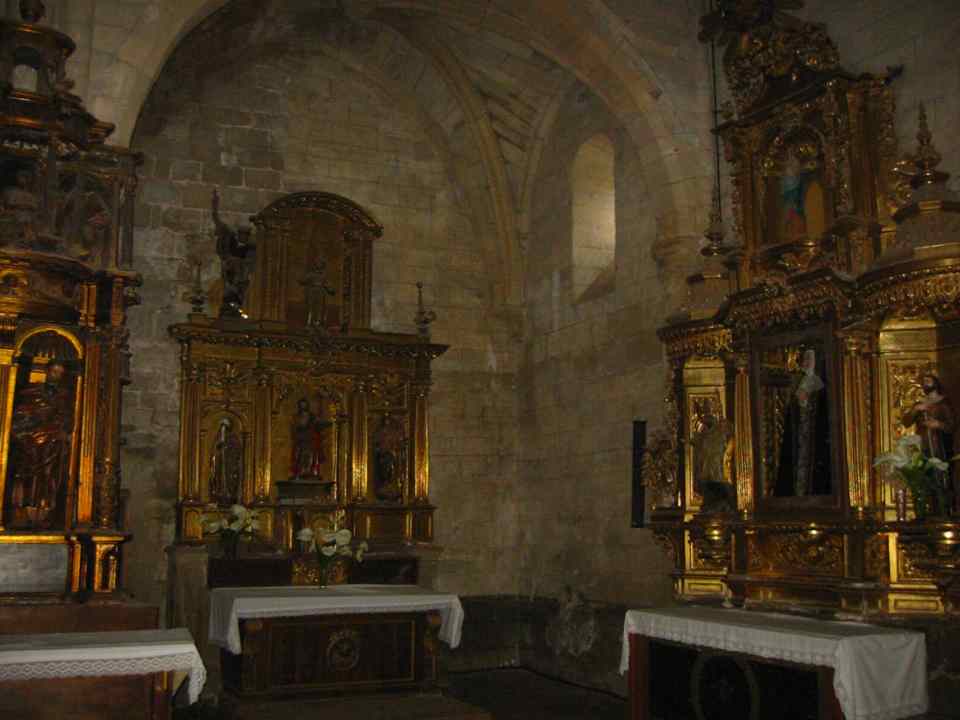
As those who know me know, I love side altars. And I love them for exactly the reason listed above--I believe they represent the liturgical consummation of popular piety which Vatican II prescribed. To this end, I wrote a paper for a class on exactly the subject. Excerpted here from that paper are some considerations on the history and development of side altars; it is not complete, particularly because I wrote a total of 18 pages for a 10 page paper, so I wasn't able to address how the cult of relics led to the rise of side altars (an important theory).
Much of what I know about our religion, I read in old books. The sort of books, for example, that use phrases like "such and such died in the odor of sanctity" or "was raised to the altars by Pope who-and-who." I always eally liked that phrase: “raised to the altars.”If the saints and the liturgy were well connected in the books I read, they were not in my lived experience of Catholicism or her liturgy. Time and again, devotions I read about in my books were totally alien to my parish life—enthralling, amazing, but alien. The Vatican has recently weighed in on the stark divide between liturgy and popular piety: “Following on the conciliar renewal… manifest and hasty abandonment of inherited forms of popular piety” and “unjustified criticism of the piety of the common people in the name of a presumed ‘purity’ of faith” have resulted “in a void not easily filled.”[1]
I argue that both a clear symptom and catalyst of this division is the neglect of liturgical side altars, which formerly served as the seamless intersection of popular piety and ecclesial liturgy. Contextualized within the history of their development, the present consideration seeks to demonstrate not only that the construction of side altars is permissible under current liturgical law, but in fact that their construction is necessary to recover a proper relation of popular piety and the liturgy.
So here is a history of their development. Tomorrow, I'll either post on the feasibility of constructing side altars under current Church law, or just skip straight to the conclusion. Either way, I hope you'll end up agreeing that side altars are a necesary component of liturgical renewal!
The History of Side Altars
The earliest Christian churches had only a single altar; in fact, in all times and places of Christendom, the importance of a single altar in a given church building has been stressed. The earliest type of altar “was a mere table copied after secular patterns,” consisting of “a rectangular and slightly oblong top, supported by one, four, or even five legs.”[2] The earliest altars were of wood, as shown by the high altar of St. John Latern—the mensa of which is the wooden table[3] upon which St. Peter the Apostle celebrated the Eucharist in his day.[4] While earliest evidence suggests the altar of the sub-Apostolic house-churches may have been built against a wall, subsequently the early Christian altar was “normally free-standing.”[5] Writing at the beginning of the second century, St. Ignatius of Antioch discusses the symbolic importance of a single altar: “For there is one flesh of our Lord Jesus Christ, and one cup in the union of his blood; one altar, as there is one bishop, with the presbytery and my fellow servants, the deacons.”[6] To this day, in Eastern rites, “only one altar is erected upon which only one Mass be celebrated in the same day.”[7]
As the monastic movement became clericized and the practice of concelebration declined, both in the early Middle Ages, the demand for altars increased with the number of priests. The Greek Church constructed small chapels or oratories, parecclesiae, around the main body of the church building for “those who desire to celebrate privately.”[8] Within the Western Churches, however, this pressure was answered by the construction of additional altars within a single church edifice: “the practice of celebrating private Masses caused other altars to be added.”[9] In addition to the simple increase in the percentage of priests, the practice of concelebration, which “during the first centuries had been a common custom,” became rare by the thirteenth century and was replaced by “separate private celebrations” of the Mass.[10] Through monasteries, the practice of private Masses spread to the whole priesthood, and it became common practice for each priest to say a private Mass each day.[11]
Other sources insist that the custom of the celebrating Mass for particular intentions “led to Mass being said every day by each priest” and “involved the building of many altars in one church.”[12] The celebration of the Mass for special intentions grew naturally out of the practice of Christian intercessory prayer. Pope Paul VI notes that “the Apostles themselves exhorted their disciples to pray for the salvation of sinners,” which the Church continues “particularly in the practice of penitents invoking the intercession of the entire community,” especially in those good works “which human frailty finds difficult.”[13] Just as Christians offered suffrages for various intercessions, they began also to offer the Holy Sacrifice for specific intentions.[14] Thus the use of the Mass as a culminating form of intercessory prayer also led the development of side altars.[15]
In addition to offering suffrages for particular intentions, the dead were also “assisted with suffrages, particularly through the offering of the Eucharistic Sacrifice.”[16] While forms of suffrage such as “prayers for the dead, giving alms, performing other good works, and applying indulgences” are recommended by Catholic authors for the relief of the Holy Souls, they always gave “first place to the Divine Sacrifice.”[17] To this end, individuals in the Middle Ages began to establish pious foundations, “fixed bequests of funds or real property, the interest or income from which is to procure the celebration of Mass for the founder” upon his death for the repose the soul after death and its deliverance from purgation.[18] The will of John le Coffrer from1305, for example, established such a foundation at the altar of St. Mary within the cemetery of St. Martin Pomary near his mansion.[19] Historical evidence “suggests that the chapel [of St. Mary] in the cemetery was… paid for by le Coffrer himself.” In fact, the specific saint honored by name the altar on which Masses were to be said was also significant: historical records indicate that the individual establishing a Mass foundation would specify a particular altar, by the name of the saint in whose honor the altar was erected, for the Masses to be said. The historical record therefore shows wills establishing a “chantry at altar of St John of Beverley” or “at the altar of St Mary Magdalen,” according to the individual’s personal devotion.[20] Thus, devotion to the holy souls directly fueled the construction of private chapels and side altars visible in European churches to this day.[21]
The practice of having Masses celebrated on the anniversaries of a loved one’s death, or for the holy souls in general, also indirectly contributed to the construction of side altars by increasing the demand for Masses and, therefore, increasing the need for additional altars.[22] Special altars set aside exclusively for the celebration of Masses for the dead were also built; these “privileged altars” constituted the ultimate synthesis of devotion to the Holy Souls.[23] An altar was said to be privileged “when, in addition to the ordinary fruits of the Eucharistic Sacrifice, a plenary indulgence [was] also granted whenever Mass [was] celebrated thereon.”[24] Therefore, Masses offered on altars which received this designation from the Holy See were “sufficient in themselves to free forthwith a soul from the pains of purgatory.” Both through the general increase in masses said for the souls of the faithful departed, and specifically through the institution of privileged altars, devotion to the Holy Souls contributed to the construction of side altars.
The most sought-after privileged altars were “altars of St. Gregory,” those dedicated to St. Gregory. All altars were dedicated or “titled” to a specific person or event; the altar became known by that name, for example, “the altar of St. Anne.” Canon 1201 of the 1917 code “imposes the strict obligation of choosing a title for every fixed altar.”[25] Formerly, “the Roman Pontifical prescribe[d] that the name or names chosen be mentioned in several places in the ceremonies of consecration.” These titles were restricted to the Holy Trinity, or one of the Divine Persons, or to Christ the Lord and any of mysteries or even sacred objects associated with His life, the Blessed Virgin and any mysteries and titles associated with her, the angels collectively or those individual angels whose names are known, or any Saint from the Roman Martyrology or well-known event in a Saint’s life.[26] The title of the main altar had to be “the same as the title of the church,” and no church could have two altars dedicated under the “same title."
The practice of titling altars continued, and they quickly became sites of petition, thanksgiving, and devotion to the saints to which they were dedicated. As a matter of simple psychology, the faithful devoted to a particular saint would, upon desiring to pray with that saint, travel to their shrine at the side of a local church; or, as pilgrims, should a member of the faithful encountering a side altar dedicated to the saint in a church, certainly he would pray there with special fervor. In its grant of an indulgence for visiting the “seven altars of St. Peter’s,” the Church asked that the faithful recite “any prayer they may choose in honor of the Titular Saint of the altar.”[27] Indeed, the phrase “praying at the altar of…such and such” has entered popular usage as a reflection of this practice.[28]
Masses petitioning God for a particular favor which were celebrated at a titled altar were understood to invoke a given saint’s intercession. Therefore, for example, medieval gilds would attend Mass at the altar of their Patron in order to call down the Saint’s intercession on their behalf:
"And so, all fairly clad, [the guild members] go in procession, with much music, to the church of the Friars Minor of Beverley; and there, at the altar of St. Elene, Solemn Mass is celebrated, and every one of the guild makes offering of a penny. The mass ended, and all prayers said, they go home; and, after dinner, all the guild meet in a room within the hall of the guild; and there they eat bread and cheese, and drink as much ale as is good for them..”[29]
This confidence that a Mass on the altar of a Saint invoked that Saint’s intercession was not only extremely strong in the minds of the faithful, but was taken for granted even in curial decisions of the Church.[30]
With intercession naturally comes gratitude, and here side altars occasioned the opportunity to offer thanksgiving. An anonymous account promoting devotion to St. Philomena recounts the conversion story of a man said to have been away from the sacraments for thirty-four years. He was “persuaded by his friends to join in a public novena to the St. Philomena” and, when his petition was answered, the natural culmination of the story is that he “afterwards received Holy Communion in thanksgiving at the altar of St. Philomena.”[31] To enable such devotion of prayer, petition, and thanksgiving before side-altar shrines, churches frequently constructed shrines to saints particularly popular amongst their congregations.[32]
In order to maintain the important Christian symbolism of a single altar in the midst of the multiplicity of altars which arose due to the four factors detailed above, a distinction arose between a principle or main altar (altare maius) and all other altars (altaria minora) constructed for reasons other than the celebration of a community’s principle daily or weekly Masses. A single major altar amidst the minor altars became the rule in Western churches. In this way the honor and importance of a singular altar was retained while the practical needs of the community were met.[33]
In addition to the four uses already discussed, other uses occasioned the construction of altaria minora. To accommodate Mass celebrated by a monastic community immediately after the celebration of Matins, a “matutinal altar” was constructed within monastic choirs.[34] Before the Tridentine reforms, some churches contained special altars apart from the main altar for the reservation of the Blessed Sacrament. “Pilgrim altars” were constructed behind the main altar of popular shrine churches for early-morning Masses attended by pilgrims. Within the Western tradition, altaria minora were freely constructed for a wide variety of purposes, though always with respect for the heavy difference towards the one main altar.
Citations
[1] Congregation for Divine Worship and the Discipline of the Sacraments. Directory on Popular Piety and the Liturgy: Principles and Guidelines. December 2001. para 1.
http://www.vatican.va/roman_curia/congregations/ccdds/
documents/rc_con_ccdds_doc_20020513_vers-direttorio_en.html
[2] Rev. P. Chas. Augustine, OSB, DD. A Commentary on the New Code of Canon Law (St. Louis: B. Herder Book Co, 1923) p. 85
[3] Exhibit 1
[4] The table has, however, been encased in marble on its sides.
http://www.newadvent.org/cathen/09014b.htm
[5] F.L. Cross, ed. “Altar,” Oxford Dictionary of the Christian Church. (New York: Oxford Press, 1997) p.46
[6] Letter to the Philadelphians, 3:3-4:1
[7] Nicholas Martin Bliley, OSB, JCL. Altars According to the Code of Canon Law (Washington, DC: The Catholic University of America, 1927) p. 16
[8] Nicholas Martin Bliley, OSB, JCL. Altars According to the Code of Canon Law (Washington, DC: The Catholic University of America, 1927) p. 16
[9] F.L. Cross, ed. “Altar,” Oxford Dictionary of the Christian Church. (New York: Oxford Press, 1997) p.46
[10] http://www.newadvent.org/cathen/09790b.htm
[11] Exhibit 2
[12] http://www.newadvent.org/cathen/09790b.htm
[13] Pope Paul VI, Indulgentiarum Doctrina, para. 6
[14] Cf. Pope Paul VI, Firma in Traditione
[15] Exhibit 3
[16] Pope Paul VI, Indulgentiarum Doctrina, para. 6
[17] Fr. F.X. Schouppe, SJ. Purgatory. (Rockford, IL: TAN Books, 1893 & 1986) p.234
[18] These are also known as “Mass Foundations” or “Chantries.”
http://www.newadvent.org/cathen/10006a.htm
[19] 'St. Martin Pomary 95/0: The parish church of St. Martin Pomary', Historical gazetteer of London before the Great Fire: Cheapside; parishes of All Hallows Honey Lane, St Martin Pomary, St Mary le Bow, St Mary Colechurch and St Pancras Soper Lane (1987), pp. 107-10
[20] http://www.british-history.ac.uk/report.asp?compid
=10458&strquery=chantry%20at%20altar%20of
[21] Exhibit 4
[22] Cf. Fr. F.X. Schouppe, SJ. Purgatory. (Rockford, IL: TAN Books, 1893 & 1986) p.228-229
[23] Exhibit 5
[24] Nicholas Martin Bliley, OSB, JCL. Altars According to the Code of Canon Law (Washington, DC: The Catholic University of America, 1927) p. 122.
[25] Nicholas Martin Bliley, OSB, JCL. Altars According to the Code of Canon Law (Washington, DC: The Catholic University of America, 1927) p. 119.
[26] Nicholas Martin Bliley, OSB, JCL. Altars According to the Code of Canon Law (Washington, DC: The Catholic University of America, 1927) p. 120.
[27] 1944 Preces et Pia Opere (“The Raccolta”), grant #711
[28] Some random examples found through popular search engines include: http://www.irishexaminer.com/text/story.asp?j=25490835&p=z549y67z&n=25491741 and
http://www.dixienet.org/dn-gazette/altar-st-martin.htm
[29] http://www.trytel.com/~tristan/towns/florilegium/community/cmevnt23.html
[30] Nicholas Martin Bliley, OSB, JCL. Altars According to the Code of Canon Law (Washington, DC: The Catholic University of America, 1927) p. 126.
The rulings here cited refer to “Gregorian Altars,” privileged altars dedicated to St. Gregory at which Masses are particularly said for the dead. St. Gregory the Great, owing to popular stories his visions of souls freed from purgatory, is heavily associated with suffrages successfully offered for the holy souls. A Mass offered on a Gregorian altar applied both “the autority of the Church and the intercession of St. Gregory,” in addition to the merits of the Mass itself, that “souls may be freed from the pains of purgatory.”
Cf. S.V. Indulg., 11 Mart. 1884, ad 2, Collectanea S. C. de Prop. Fide, II, n. 1613
[31] http://www.scborromeo.org/saints/philomen.htm
[32] Cf. USCCB. Built of Living Stones. (Washington, DC: USCCB, 2000)
This practice is taken for granted in paragraphs 135-138: for example, “It is important that the images in the church depict saints for whom devotion currently exists in the parish.
and Exhibit 6
[33] Nicholas Martin Bliley, OSB, JCL. Altars According to the Code of Canon Law (Washington, DC: The Catholic University of America, 1927) p. 15
[34] Nicholas Martin Bliley, OSB, JCL. Altars According to the Code of Canon Law (Washington, DC: The Catholic University of America, 1927) p. 15
Tuesday, January 16
SHRINE EXCLUSIVE! George Weigel Speaks!
A Pre-Dinner Address to the World Youth Alliance, November 28, 2006 - FIRST TIME IN PRINT!
Drew of the Shrine and I recently received permission to exclusively post the text of a recent address by by noted papal biographer and Catholic author George Weigel given on November 28th, 2006 at the World Youth Alliance Headquarters in New York. The WYA, which Weigel describes in great detail in his speech, is a global coalition of young people committed to promoting the dignity of the person and building solidarity among youth from developed and developing nations and is dedicated to showing young people how to affirm life at all levels of society. On their website, they list as their inspiration the work of John Paul II, Jacques Maritain and psychologist Viktor Frankl, and have spoken out in defense of the family as a "school of deeper humanity," against human cloning and abortion as "symptoms of a flawed understanding of the human person," as well as promoting issues of world health and international law. We are pleased to be able to reproduce the text of this speech by George Weigel, which we hope will serve as a fine introduction to their work. Ladies and Gentlemen of the web, Mr. Weigel:
Let me preface my remarks on what happens here, and elsewhere through the World Youth Allience, with what we might call “a tale of two cities.” Great title for a novel, that; someone should use it…
The first of these is Krakow, in Poland, the city of John Paul II, where for the past 15 years Michael Novak, Richard John Neuhaus, Father Maciej Zieba, and I have run a three week crash-course in Catholic social doctrine, primarily for students from the new democracies of Central and Eastern Europe, but each year flavored by 10 students from North America.
We were in the 10th year of the program, by which point one thinks that one has seen everything, but on our first night, in the Saint Hyacinth chapel of the Dominican Basilica in Krakow, there was something…new.
The Basilica dates to the Middle Ages. The chapel is where the relics of Saint Hyacinth, the first Polish Dominican, a man clothed with the Dominican habit by Saint Dominic himself, are entombed. (Well, most of them, anyway; I believe his head is in a different reliquary down in the sacristy.) It’s a very tight space, but we have the opening Mass there because we want our students, from the beginning, to be immersed in the religious history they’ll be living for the next 3 weeks.
So, everybody is cramped, and after receiving Holy Communion, I was looking down - I don’t know whether I was sitting or kneeling - but all I could see coming by me were shoes… and at the tail end of the line comes a pair of the most outrageous red patent leather shoes I’ve ever seen in my life… and I discreetly look up and there is this slight young lady with, if memory serves, a black mantilla.
I thought “This is interesting.”
So I said to my assistant on the way to the opening dinner, I said, “What’s with the red shoes and who let her in here?”
(audience laughs).
She said, “that’s our Canadian”. And I said “Oh. Maple leaf.”
The next day, after the opening lectures, we had our first seminars in which we break down into discussion groups to read John Paul II’s seminal social encyclical Centesimus Annus, which is the foundation of this whole enterprise. And I had Miss Red Patent Leather Shoes – although she wasn’t wearing them this time. And to tell you the truth, I was blown away by Anna Halpine. She had such a maturity, a knowledge, a political seriousness, a deep understanding of the philosophical and the deep theological roots of the problems of human dignity that express themselves in the assault on life in so many ways around the world, that I was sold within a day. And over the next three weeks, I tried to learn more from Anna about what she was doing.
And she told me a remarkable story – which has the added benefit of being true--it’s not just a good story, it’s a true story. She had come to New York to pursue graduate studies of music. And the cave of the winds over there on 1st Avenue (otherwise know as the UN) was doing its usual nonsense having to do with “reproductive rights.” The usual suspects had flown in the usual bought-and-paid-for kids from around the world to say “we, the young people of the world, want abortion on demand, we want same-sex marriage…”, and so forth.
And this music student said, “They’re not speaking for me.” So she and some friends organized themselves and started leafletting the UN saying, “These kids do not speak for the youth in the world, you need to talk to somebody else”. And out of that cut-and-paste initiative came the World Youth Alliance. This kind of an event could not have been imagined at that time.
But I think from there to here one can see the finger of Providence on this enterprise, which has been driven by great energy and great imagination but also I think – frankly - by prayer. This has been a work of the spirit in the fullest sense of the term.
If Krakow is the first of our two cities, the second city is Toronto, where, this past summer, the XVI World Aids Conference was going on. It got the usual cursory attention in the press: Bill Clinton, Bill Gates, and so forth. Yet in fact what was in fact going on was a kind of Saturnalia. The leading official representing the U.S. government at this conference is one of my oldest friends, a man who has seen a lot in his time. Yet he told me, a few weeks ago over lunch, that “I was physically ill at the conference.” Why? Because it was not, largely, about helping people with AIDS; it was about affirming the most bizarre expressions of human sexual willfulness, and doing so in public. My friend said, “I was just physically ill at this display of decadence.” The World AIDS Conference was not about compassion; it was not about caring; it was not about cure; it was about the assertion of the self. And in the midst of that horror show, there were Dr. Tim Flanigan and these World Youth Alliance kids standing for something else: standing for the true dignity of the human person made in the image and likeness of God.
That is another image that tells us something about the work of the World Youth Alliance and how important it is to support the possibility of raising a different kind of flag in very difficult circumstances.
Anna will give you tonight, when you leave, a list, a summary of what the World Youth Alliance and its various regional affiliates have been doing over the last year. Let me just highlight a few things, grouped in my own way around three headings:
The first thing that has being going on is what I would call reaching out and training young activists. Do take a copy of that WYA training manual with you tonight. This is like going to college again. This is a brilliantly compact crash-course in how to think about the human person, issues of human sexuality, the public sphere, etcetera, all between two covers.
The kids who are going through this training -- either online, or in WYA sessions around the world -- are coming out of this a batter education in being able to deal with their own country’s situation and the global situation than they would get in many of the colleges and universities.
So that’s something you really want to take a look at, and to understand that this is going on all the time, both through the internet and in person. These interns that you see, from all over the world tonight, are a microcosm of the enterprise; and how great it is that young people can come together, and discover each other, and learn together, now literally together, thanks to Villa Seabright here. This is a good sign for the future.
The second WYA “deliverable” takes us where this all started and that is lobbying. Which means going into the UN, going into the EU, going to Strasbourg, going to the UN agencies in Africa and Asia and elsewhere, and raising a different flag than the flag that has been raised in those agencies by bought-and-paid-for young people promoting what the late John Paul II called the “culture of death”.
This is not just a question of witnessing. The Alliance has helped those legislators who want to do the right thing to draft laws, to draft UN resolutions and EU resolutions. The Alliance works effectively with people who may want to do the right thing, but who frankly don’t know how to make the argument.
On your way out tonight, look at the credo on the wall by the front door. That was very carefully written, so that, as the papal social magisterium says “all men and women of good will” can read this and say, “Yeah, maybe this is something I need to be engaged with”.
So this is a genuine ecumenical and interreligious organization with a capacity to speak to the secular world that’s recognized by delegations to the UN, by the member states of the EU, and in national legislatures – a capacity to help those with legislative responsibility put a noble vision of the dignity of the human person into laws and resolutions.
And then, finally, there’s what we might call the World Youth Alliance’s participation in the war of ideas, which is so important around the world.
WYA sponsored a fine conference at the U.N. in March to mark the first anniversary of the death of John Paul II, with presentations on his contributions to thinking about the dignity of man, human rights and the pursuit of peace.
Senator Tatad was here, Habib Malik was here, Rabbi David Novak was there, I was there. And it was impressive to find ideas that you wouldn’t expect to see promoted in that environment being put very much into play.
The Alliance sent representatives to the International Solidarity Forum on Good Governance and Corruption… a very important topic. Because, as we all know -or should know- perhaps the most serious problem in the Third World, the greatest impediment to Third World development is corruption.
If these kids can build a critical mass of young people determined to live in a different way, determined not to live a lie in their public lives, that would be an enormous thing.
On the principle, be merciful as your heavenly Father is merciful, as it appears that no one is going to start eating let me bring this to an end, and then we can talk about whatever you want to talk about at the appropriate point after dinner.
In my view, there are two great threats to the human future on the horizon right now. The first is obvious, and that is the threat posed by jihadist Islam. But even as we address that threat, we can never lose sight of the threat posed by the assault on the dignity of the human person that’s embodied in the abortion license, that’s embodied in the redefinition of marriage, that’s embodied in the idea that we are just bundles of desires rather than men and women with intelligence and free will capable of knowing the good and grasping it and doing it.
This organization has been on the front line of that second great struggle. I commend its work to you, and I commend its people to you, as I commend all of us to the blessings and the mercy of God as we ask, if I may, His blessing upon this food: Bless us, O Lord, and these, thy gifts which we are about to receive, from Thy bounty through Christ our Lord. Amen.
Buon appetito, smacznego, et cetera, et cetera.
And, for your reference and edification, we append:
The World Youth Alliance Charter
The World Youth Alliance is composed of young men and women from every part of the world. In cooperation with other organs of the international community, primarily the United Nations and the European Union, the World Youth Alliance is committed to building free and just societies through a culture of life. That culture affirms the inalienable dignity of the person, defends the intrinsic right to life, nurtures the family, and fosters a social climate favorable to integral development, solidarity, and mutual respect.
We recognize that the intrinsic dignity of the person is the foundation of every human right. We believe this dignity is independent of any individual condition and that no human community can grant or rescind that dignity.
We are convinced that the intrinsic dignity possessed by every human being from conception to natural death is the foundation of everyone's right to life. We believe that this inalienable right to life is the basis of a free and just society and we believe that society through law and culture has an obligation to protect the dignity of the person and thus protect the right to life.
We affirm that the fundamental unit of human society is the family, where men and women learn to live in genuine freedom and solidarity, and where individuals are equipped to fulfill their social obligations. We believe that the political community at the local, national and international level is obliged to protect and nurture the family.
We believe that the authentic development of society can occur only in a culture that fosters integral human development - characterized by physical, spiritual, mental, and emotional growth, in a climate of respect for the human person and the family.
We invite all those who share these convictions to join us in affirming them and give them effect in public life at all levels.
Drew of the Shrine and I recently received permission to exclusively post the text of a recent address by by noted papal biographer and Catholic author George Weigel given on November 28th, 2006 at the World Youth Alliance Headquarters in New York. The WYA, which Weigel describes in great detail in his speech, is a global coalition of young people committed to promoting the dignity of the person and building solidarity among youth from developed and developing nations and is dedicated to showing young people how to affirm life at all levels of society. On their website, they list as their inspiration the work of John Paul II, Jacques Maritain and psychologist Viktor Frankl, and have spoken out in defense of the family as a "school of deeper humanity," against human cloning and abortion as "symptoms of a flawed understanding of the human person," as well as promoting issues of world health and international law. We are pleased to be able to reproduce the text of this speech by George Weigel, which we hope will serve as a fine introduction to their work. Ladies and Gentlemen of the web, Mr. Weigel:
Let me preface my remarks on what happens here, and elsewhere through the World Youth Allience, with what we might call “a tale of two cities.” Great title for a novel, that; someone should use it…
The first of these is Krakow, in Poland, the city of John Paul II, where for the past 15 years Michael Novak, Richard John Neuhaus, Father Maciej Zieba, and I have run a three week crash-course in Catholic social doctrine, primarily for students from the new democracies of Central and Eastern Europe, but each year flavored by 10 students from North America.
We were in the 10th year of the program, by which point one thinks that one has seen everything, but on our first night, in the Saint Hyacinth chapel of the Dominican Basilica in Krakow, there was something…new.
The Basilica dates to the Middle Ages. The chapel is where the relics of Saint Hyacinth, the first Polish Dominican, a man clothed with the Dominican habit by Saint Dominic himself, are entombed. (Well, most of them, anyway; I believe his head is in a different reliquary down in the sacristy.) It’s a very tight space, but we have the opening Mass there because we want our students, from the beginning, to be immersed in the religious history they’ll be living for the next 3 weeks.
So, everybody is cramped, and after receiving Holy Communion, I was looking down - I don’t know whether I was sitting or kneeling - but all I could see coming by me were shoes… and at the tail end of the line comes a pair of the most outrageous red patent leather shoes I’ve ever seen in my life… and I discreetly look up and there is this slight young lady with, if memory serves, a black mantilla.
I thought “This is interesting.”
So I said to my assistant on the way to the opening dinner, I said, “What’s with the red shoes and who let her in here?”
(audience laughs).
She said, “that’s our Canadian”. And I said “Oh. Maple leaf.”
The next day, after the opening lectures, we had our first seminars in which we break down into discussion groups to read John Paul II’s seminal social encyclical Centesimus Annus, which is the foundation of this whole enterprise. And I had Miss Red Patent Leather Shoes – although she wasn’t wearing them this time. And to tell you the truth, I was blown away by Anna Halpine. She had such a maturity, a knowledge, a political seriousness, a deep understanding of the philosophical and the deep theological roots of the problems of human dignity that express themselves in the assault on life in so many ways around the world, that I was sold within a day. And over the next three weeks, I tried to learn more from Anna about what she was doing.
And she told me a remarkable story – which has the added benefit of being true--it’s not just a good story, it’s a true story. She had come to New York to pursue graduate studies of music. And the cave of the winds over there on 1st Avenue (otherwise know as the UN) was doing its usual nonsense having to do with “reproductive rights.” The usual suspects had flown in the usual bought-and-paid-for kids from around the world to say “we, the young people of the world, want abortion on demand, we want same-sex marriage…”, and so forth.
And this music student said, “They’re not speaking for me.” So she and some friends organized themselves and started leafletting the UN saying, “These kids do not speak for the youth in the world, you need to talk to somebody else”. And out of that cut-and-paste initiative came the World Youth Alliance. This kind of an event could not have been imagined at that time.
But I think from there to here one can see the finger of Providence on this enterprise, which has been driven by great energy and great imagination but also I think – frankly - by prayer. This has been a work of the spirit in the fullest sense of the term.
If Krakow is the first of our two cities, the second city is Toronto, where, this past summer, the XVI World Aids Conference was going on. It got the usual cursory attention in the press: Bill Clinton, Bill Gates, and so forth. Yet in fact what was in fact going on was a kind of Saturnalia. The leading official representing the U.S. government at this conference is one of my oldest friends, a man who has seen a lot in his time. Yet he told me, a few weeks ago over lunch, that “I was physically ill at the conference.” Why? Because it was not, largely, about helping people with AIDS; it was about affirming the most bizarre expressions of human sexual willfulness, and doing so in public. My friend said, “I was just physically ill at this display of decadence.” The World AIDS Conference was not about compassion; it was not about caring; it was not about cure; it was about the assertion of the self. And in the midst of that horror show, there were Dr. Tim Flanigan and these World Youth Alliance kids standing for something else: standing for the true dignity of the human person made in the image and likeness of God.
That is another image that tells us something about the work of the World Youth Alliance and how important it is to support the possibility of raising a different kind of flag in very difficult circumstances.
Anna will give you tonight, when you leave, a list, a summary of what the World Youth Alliance and its various regional affiliates have been doing over the last year. Let me just highlight a few things, grouped in my own way around three headings:
The first thing that has being going on is what I would call reaching out and training young activists. Do take a copy of that WYA training manual with you tonight. This is like going to college again. This is a brilliantly compact crash-course in how to think about the human person, issues of human sexuality, the public sphere, etcetera, all between two covers.
The kids who are going through this training -- either online, or in WYA sessions around the world -- are coming out of this a batter education in being able to deal with their own country’s situation and the global situation than they would get in many of the colleges and universities.
So that’s something you really want to take a look at, and to understand that this is going on all the time, both through the internet and in person. These interns that you see, from all over the world tonight, are a microcosm of the enterprise; and how great it is that young people can come together, and discover each other, and learn together, now literally together, thanks to Villa Seabright here. This is a good sign for the future.
The second WYA “deliverable” takes us where this all started and that is lobbying. Which means going into the UN, going into the EU, going to Strasbourg, going to the UN agencies in Africa and Asia and elsewhere, and raising a different flag than the flag that has been raised in those agencies by bought-and-paid-for young people promoting what the late John Paul II called the “culture of death”.
This is not just a question of witnessing. The Alliance has helped those legislators who want to do the right thing to draft laws, to draft UN resolutions and EU resolutions. The Alliance works effectively with people who may want to do the right thing, but who frankly don’t know how to make the argument.
On your way out tonight, look at the credo on the wall by the front door. That was very carefully written, so that, as the papal social magisterium says “all men and women of good will” can read this and say, “Yeah, maybe this is something I need to be engaged with”.
So this is a genuine ecumenical and interreligious organization with a capacity to speak to the secular world that’s recognized by delegations to the UN, by the member states of the EU, and in national legislatures – a capacity to help those with legislative responsibility put a noble vision of the dignity of the human person into laws and resolutions.
And then, finally, there’s what we might call the World Youth Alliance’s participation in the war of ideas, which is so important around the world.
WYA sponsored a fine conference at the U.N. in March to mark the first anniversary of the death of John Paul II, with presentations on his contributions to thinking about the dignity of man, human rights and the pursuit of peace.
Senator Tatad was here, Habib Malik was here, Rabbi David Novak was there, I was there. And it was impressive to find ideas that you wouldn’t expect to see promoted in that environment being put very much into play.
The Alliance sent representatives to the International Solidarity Forum on Good Governance and Corruption… a very important topic. Because, as we all know -or should know- perhaps the most serious problem in the Third World, the greatest impediment to Third World development is corruption.
If these kids can build a critical mass of young people determined to live in a different way, determined not to live a lie in their public lives, that would be an enormous thing.
On the principle, be merciful as your heavenly Father is merciful, as it appears that no one is going to start eating let me bring this to an end, and then we can talk about whatever you want to talk about at the appropriate point after dinner.
In my view, there are two great threats to the human future on the horizon right now. The first is obvious, and that is the threat posed by jihadist Islam. But even as we address that threat, we can never lose sight of the threat posed by the assault on the dignity of the human person that’s embodied in the abortion license, that’s embodied in the redefinition of marriage, that’s embodied in the idea that we are just bundles of desires rather than men and women with intelligence and free will capable of knowing the good and grasping it and doing it.
This organization has been on the front line of that second great struggle. I commend its work to you, and I commend its people to you, as I commend all of us to the blessings and the mercy of God as we ask, if I may, His blessing upon this food: Bless us, O Lord, and these, thy gifts which we are about to receive, from Thy bounty through Christ our Lord. Amen.
Buon appetito, smacznego, et cetera, et cetera.
And, for your reference and edification, we append:
The World Youth Alliance Charter
The World Youth Alliance is composed of young men and women from every part of the world. In cooperation with other organs of the international community, primarily the United Nations and the European Union, the World Youth Alliance is committed to building free and just societies through a culture of life. That culture affirms the inalienable dignity of the person, defends the intrinsic right to life, nurtures the family, and fosters a social climate favorable to integral development, solidarity, and mutual respect.
We recognize that the intrinsic dignity of the person is the foundation of every human right. We believe this dignity is independent of any individual condition and that no human community can grant or rescind that dignity.
We are convinced that the intrinsic dignity possessed by every human being from conception to natural death is the foundation of everyone's right to life. We believe that this inalienable right to life is the basis of a free and just society and we believe that society through law and culture has an obligation to protect the dignity of the person and thus protect the right to life.
We affirm that the fundamental unit of human society is the family, where men and women learn to live in genuine freedom and solidarity, and where individuals are equipped to fulfill their social obligations. We believe that the political community at the local, national and international level is obliged to protect and nurture the family.
We believe that the authentic development of society can occur only in a culture that fosters integral human development - characterized by physical, spiritual, mental, and emotional growth, in a climate of respect for the human person and the family.
We invite all those who share these convictions to join us in affirming them and give them effect in public life at all levels.









![[SMMMHDH]](http://www.mgilleland.com/music/smmmhdh.png)