Saturday, July 31
Jesuit Art from my Pen for Today's Feast

Matthew Alderman. The Triumph of the Society of Jesus in the New World and the Orient. June 2008. Collection of the church of SS. Peter and Paul, Mankato, Minnesota. Commissioned to hang in the parish hall in honor of 150 years of Jesuit service in the parish. Click for larger.
Wednesday, July 28
Ralph Adams Cram and Our False Inevitability
 East Liberty Presbyterian Church, Pittsburgh, designed by Ralph Adams Cram (source)
Stuart Chessman has a great piece up on the St. Hugh of Cluny weblog about the great social critic Ralph Adams Cram, who is probably better known to our readers as the famous neo-Gothic architect Ralph Adams Cram. It is not a surprise that the builder of such masterworks as St. John the Divine and St. Thomas, Fifth Avenue, might hold that, "[i]n a way[,] the eleventh century may be considered one of the most marvelous centuries in all history," or that an Episcopalian of his Catholic leanings might consider the corruption of the Renaissance and the tumult of the Reformation to among history's great tragedies. Indeed, he describes it as a "weirdly assorted couple" in one instance--though later in life he came to appreciate the more contiguous and medievalizing glories of the Spanish Renaissance, if not its Italian cousin. And this was not mere table-talk among like-minded friends, but the substance of a stream of numerous and popular books and articles.
But what may startle you was this great traditional radical was on the cover of Time magazine in the late '30s, and considered at one point the pre-eminent architect and architectural theorist in the realm of academic and collegiate architecture, to the point he essentially invented the modern American college campus through his work at Princeton, Rice, and elsewhere. We're talking about a man who advocated a quasi-monastic organization for architecture schools, and yet was taken seriously by the faculty at MIT and was even made Vice-President of the American Institute of Architects at one point. (Today, more than a century after his death, he seems almost unimaginable to most critics, and his cultural contributions are either ignored, elaborately reinterpreted, or thinly psychoanalyzed away.) While even within that milieu, he was defiantly counter-cultural, the fact the culture at large was willing to give him a listen, suggests that the cultural dominance of modernistic thought, art and architecture, was hardly as assured or as easy a progress as we have been led to believe. We often read in books of the Liturgical Movement era of the coming golden age of Gregorian chant and popular participation, with the same inevitable assurance one heard in subsequent decades of Jetsons-style flying cars, neither one of which has come to pass.
For a time, though, it looked like the future was going to get medieval all over the culture. Cram's introduction to the 1929 publication of American Church Architecture of Today, speaks of a return to "the best types of the pre-Reformation art of Christianity," and contrasts it not only with the "curious fad of modernism," which he seems largely to ignore, but, more intriguingly, with the banal carpenter Gothic and catalog art of nineteenth-century Christianity. In our occasional idolization of the period, his (admittedly snarky) aside that "the Roman Catholic Church [in America] remained impervious to any infiltration of beauty and propriety" until comparatively late in the Gothic revival, ought to be remembered. And this, from a man, who for all his northern tastes, was Catholic enough to passionately love the art and culture of the Mediterranean, and often recommended in southern climes, even to his Episcopal clients, the use of the Spanish mission or even Baroque styles. Cram was radical in his love of tradition--going to the root and the heart of it--and never reactionary or narrow in his appreciation of the past and its application to the problems of today. In some respects as a social critic and diagnostician, he has the nuance and range that Pugin, painting with a broader brush in a coarser era, was denied. Some, used to a straw-men traditionalism in architecture, may find this baffling, but even we classicists are capable of subtlety.
Cram's comment on the "pathetic impudence" of "modernism," that it will never "obtain a foothold" in the United States, may seem dismissively and shortsightedly triumphalist, but it does show us that the great divorce between the modern age and history was not nearly as inevitable or as relentless as it has been painted--nor, given the cultural wasteland that Cram himself emerged from, and helped himself make into a blooming garden, is its continued triumph quite as assured as one might think. If we work hard enough, his description of the progress of his own time might apply, in a century or two, to our own future:
Stained glass has made surprising progress during the last twenty-five years, while the last five have witnessed the advent of at least three very able sculptors, at least one of which finds no rival during the past three centuries. [...] If the various religions in America will recognize the indispensable nature of good art, the essential wickedness of bad, and will demand the best, accept only the best, then there is no reason why the "Great Recovery" begun just half a century ago, should not go on to its high fruition in another fifty years.Admitted, when one turned on the television in 1979 one saw Bob Newhart ensconced in shag carpeting and plywood and not linenfold paneling, but the fact it might not have been, and was not supposed to be, is electrifying.
It is especially interesting to note that this "Great Recovery," while thoroughly Catholic in feeling, was a highly ecumenical venture. Cram the Anglican wrote numerous articles on art for Catholic publications and from a Catholic view, while congregations of Methodists, Presbyterians, Baptists and even Unitarians often put up splendidly medieval edifices of a surprising (if under-utilized) liturgical purity. The revival of an authentically Jewish synagogue architecture was also an important facet of this movement. Cram once commented that the only thing that was lacking to render the vast chancel of his masterful East Liberty Presbyterian Church in Pittsburgh ready for a high mass was the addition of six candlesticks and a crucifix. There is an image of the Mother of God in its stained-glass windows, though it is not entirely clear to me that the clients actually realized this. (By way of apology, I will comment some of the most morally faithful Christians, and the most enthusiastic Gothicists I have met and worked for, were Presbyterians!)
Such stylistic unity may seem superficial to us today, rather like the curious fad of "Anglo-Catholic Congress Baroque" architecture in Britain around the same time, that sought reunion with Rome through the strategic deployment of Continentally-inspired roccoco curlicues, but both in the case of Cram's Gothicism and of the Congress Baroque school, there was a real and sincere passion for a healing of Christendom. Cram's clients may have opted for Gothic as a way of reconnecting with the past, or simply because it was fashionable, but it did re-establish visual continuity in a way that is almost impossible to fathom today. In America, a century ago, the stereotype of the church building was the clapboard Puritan meeting-house; today, for all our sins, it is the liturgical Gothic edifice, if at least Hollywood is to be believed.
Admitted, in some instances, this old architecture was often allied with a new and novel religion (as in the instance of Riverside Church in New York, or the various Unitarian or Universalist societies that opted for the Gothic) but it also introduced numerous, formerly-iconoclastic denominations to the Catholic arts, however tenuously. Today, when groups of Anglicans are rallying to Rome and often we find ourselves with more common moral ground with the Eastern Orthodox, Presbyterians and Baptists than certain fellow Catholics, there is a lesson and a precedent here worth remembering. The Great Recovery, cut short by the Depression and the Second World War, may yet be re-started, if we but try.
Tuesday, July 27
Lawrence Klimecki Interviews Me on Art and Architecture
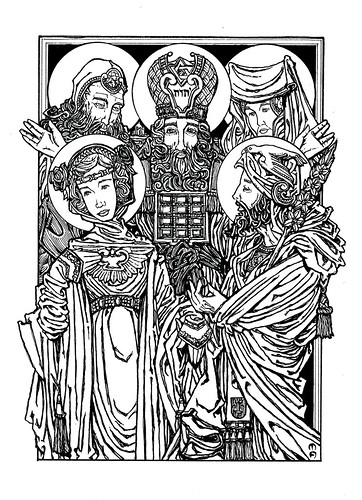
I was recently interviewed by Deacon Lawrence Klimecki of Gryphon Rampant Studio about my my work in art and liturgical design. Lawrence is a seasoned and very talented graphic artist in his own right, incidentally, with considerable skills in the digital realm as well. Perhaps it is a bit vainglorious to quote from your own interview, but I think both Deacon Klimecki's questions and my answers will be of interest to our readers, if only to generate further thought and discussion on the subject of sacred art. The article is accompanied by examples of my illustrations and designs. Some extracts:
LK: Tell us some more about your work.
MGA: [...] I have a lot of admiration for the medieval model of sacred art, which saw the highest form of art as indelibly religious, and more importantly, tied to both the liturgy and to a received culture. It's one reason I love taking commissions, as it forces me to submit my own interests and preferences to bigger needs and wants. At the same time I'm not trying to turn the clock back. I see myself as engaging in a search-and-rescue operation for much of the remainder of Western Culture that emerged after the Renaissance, which is why I often incorporate elements of later styles--art nouveau, art deco, and even some fairly modern influences, etc.--into my work, though always subject to larger, older traditions. [...]

I also have worked in the field of architecture, sometimes as a member of a firm, sometimes as a designer of church furnishings or as an independent design consultant working in association with an architect. The design consultant creates aesthetic concepts for an interior or exterior that an architect develops in terms of details, structure, and materials. [In addition to my illustration work,] [d]esign consulting and church furnishing design is what I am doing at present, which gives me both the opportunity to focus on the more intellectual and aesthetic aspects of the project while working with an experienced architect with an understanding of structural issues. A local classical firm which I have great relations with has been very helpful thus far along this path, and has offered to be the architect of record when I need one, or when the client hasn't obtained one already.
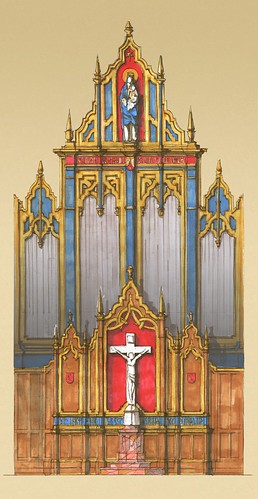
The problem is art has become something of a closed circle. [...] Essentially, [contemporary artists] say, "Here is my vision," while pounding into our heads that art is a necessity, even if we find it incomprehensible. The odd thing is even the wealthy and au-courant types still love the old masters, and will pay through the nose to support some blockbuster Rembrandt exhibit, but the idea of producing something genuinely new within that tradition simply does not seem to be an option for them in many cases. In an odd way, we've become a very "conservative" culture in terms of actually producing anything. [...]
For me, an artist's job is to follow the rules and conventions set down by received tradition [...] But that doesn't mean he can't work within those conventions to produce something wonderful and beautiful and genuinely new. [...] The central problem is our culture now has very little content--whether in terms of the Faith or even in terms of a central secular story. We have nothing to celebrate, nothing to impart, and thus as a consequence rather than, say, decorating our airports with great allegorical and historical images of flight, or of national virtue, or of the patron saints of the air, we get safely non-controversial art generated by a contest among our schoolchildren, or, at most, something abstract designed carefully not to offend. How are we supposed to get inspired by this? How are we supposed to discover what it means to be the inheritor, as a nation of immigrants, of some of the best cultural traditions of the west and the east as well?
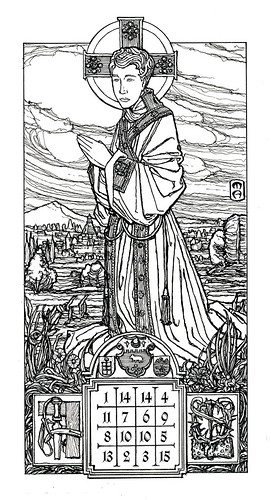
Matthew Alderman. Christ the Youth. Ink, 2010. Private Collection, Kansas.
I think a lot of people find this sort of traditional culture "elitist" or "imperialist," which drives me crazy, as I think often when you get down to it you can find more in common among the traditional cultures of the whole world than the secular universe you have nowadays. [...] Ideally, inclusion within culture would be represented by a series of statues of the great philosophers where you have both Socrates and Confucius, who the Jesuits actually first translated and introduced to the west. Nowadays you just don't have any statues at all. [...]
In architecture, it's a bit different... [...] Most of us who work for classical or traditional firms (quite a few of which exist, and in usual economic conditions, even flourish) have to fight a two-front war between people who assume we're dangerous reactionaries ([Deconstructivist par excellance] Peter Eisenmann once called an audience of classical students, to their face, a bunch of "terrorists"), and those who want something traditional but don't know where to look and thus end up asking Bob's Discount Architects for a Georgian home that appears to have been molded out of plastic. And then, nobody wins, save perhaps Bob. [...]

LK: How is your faith reflected in your work?
MGA: Considering most of my work consists of images of various saints and other religious figures, it's everywhere! There's always a slight tension between when I treat an illustration I'm doing as an exercise in composition, and as an aid to devotion, or to illustrate a particular theological point. I think ideally there should be no such clash, as they ought to be perfectly beautiful and perfectly suitable for their purpose, but working out that relationship can be tricky. I think, though, there is a tendency among purists to want to reduce religious art to a series of flat theological diagrams, which is simply not part of the Western Catholic tradition, which has had room for some limited artistic freedom (admittedly sometimes abused) for six or seven centuries or more. While I could stand to be more systematic, I do pray while I work, and try to ask God and the saint I am drawing to find that balance between composition and intelligibility--I usually ask God to let me do a worthy drawing, but also to have a bit of fun with the subject while I'm at it. And that "fun" also has a component of Faith to it, as it usually manifests itself in the details where I work in another subtler level of symbolism. An ornamental edging of a dress worn by the Virgin might have seashells worked into it, for her title of Stella Maris, for instance. I am reminded of the work of the architect Edwin Lutyens, who once designed light fixtures resembling cardinal's hats for a Jesuit chapel, with the humbling and subtle joke behind then that the red hat was always just a bit above reach for most Jesuits.
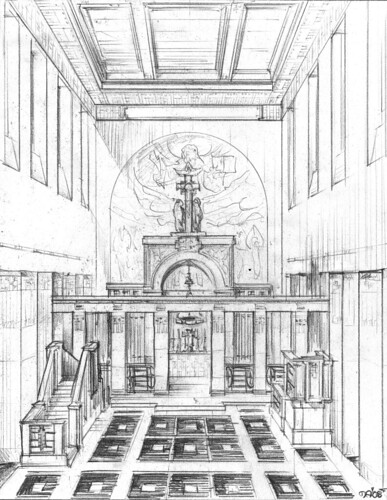
In architecture, it's much the same. It's easy to assume a "Catholic" church building will have some saints here, some pointy windows there, maybe a dome--and it often should have these things--but if you don't get the essence right, if you don't adhere to those fundamental underlying codes, it'll look superficial. The way we lay out the sanctuary, the way we plan the location of the altar, or install a baldachin or pulpit, the spatial arrangement of all these is critical in elucidating what we believe. Is the altar and the tabernacle the center or focus of the church, or is it the people? What do these choices tell us about what we believe? It's not enough to simply smear a coating of badly-done "traditional" ornament over a modern shell-though ornament, well-done, is extremely important as well. You just have to get the soul and structure right first. In some places, of course, this may not be possible--in which case you have to use space cleverly and find subtle ways to redirect people's attention to the points that matter.
The full interview can be found here. Images are derived from here and here.










![[SMMMHDH]](http://www.mgilleland.com/music/smmmhdh.png)