Thursday, December 30

So... beautiful...
I have always been fascinated by Spanish wood-paste statuary. It's a technique perfected in the Counter-Reformation period, and boy does that show: intricate molds are created, a special wood-paste is poured in, glass eyes added, and the whole thing detailed by hand.
I found a treasure-trove of images of such statues for sale, not merely the standard (for this style) Sacred Heart, St. Teresa, and Our Ladies of Grace and Carmel, but dozens. It's so fun just to look at!
Wednesday, December 29
More on the Silent Canon
Just to make sure that I'm not preaching liturgical rebellion here, I ought to let you all know that a reliable source has pointed me towards some sentences in the IGRM which indicate (or, at the very least presume) that the silent Canon, while quite lovely, isn't licit in the Novus Ordo. I have heard several conflicting opinions in this regard, but this is the first time I've seen some actual citations, which indicate the answer is in the negative. Here's what my friend found:
Just to make sure that I'm not preaching liturgical rebellion here, I ought to let you all know that a reliable source has pointed me towards some sentences in the IGRM which indicate (or, at the very least presume) that the silent Canon, while quite lovely, isn't licit in the Novus Ordo. I have heard several conflicting opinions in this regard, but this is the first time I've seen some actual citations, which indicate the answer is in the negative. Here's what my friend found:
30. Among the parts assigned to the priest, the Eucharistic Prayer is preeminent; it is the high point of the entire celebration. Next are the prayers: the opening prayer or collect, the prayer over the gifts, and the prayer after communion. The priest, presiding over the assembly in the person of Christ, addresses these prayers to God in the name of the entire holy people and all present. Thus there is good reason to call them "the presidential prayers."Thoughts, anyone?
32. The nature of the presidential texts demands that they be spoken in a loud and clear voice and that everyone present listen with attention. While the priest is speaking these texts, there should be no other prayer or liturgical song, and the organ or other instruments should not be played.
216. The preface is sung or said by the presiding priest celebrant alone; the Sanctus is sung or recited by all concelebrants with the congregation and the choir.
217. After the Sanctus, the priest concelebrants continue the Eucharistic Prayer in the way described. Unless otherwise indicated, only the presiding celebrant makes the gestures.
218. The parts said by all the concelebrants together and above all the words of consecration which all are bound to pronounce are to be spoken in such a way that the concelebrants say them in a very low voice and the presiding celebrant's voice is heard clearly. In this way the people should be able to understand the text without difficulty.
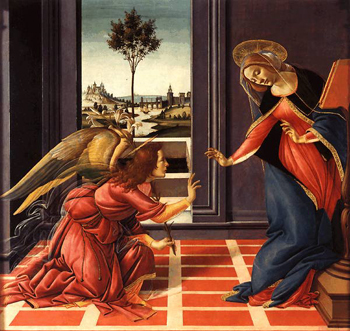
Annunciation, Sandro Botticelli
Coming soon: an essay by yours truly which rambles through the Theology of the Body, brushes past Savonarola, Florentine neo-Platonism, pre-Christian Ireland and the Greek custom of painting pagan sages in the narthex of churches, and which answers the question, "What do Botticelli's painting of the naked Venus and the stable in Bethlehem have in common?" A lot more than you'd think. Watch this space.
"Who will rid me of this meddlesome priest?"

An eyewitness account of the martyrdom of Saint Thomas Becket, by Edward Grim:
(from http://www.eyewitnesstohistory.com/becket.htm)
An eyewitness account of the martyrdom of Saint Thomas Becket, by Edward Grim:
(from http://www.eyewitnesstohistory.com/becket.htm)
"The murderers followed him; 'Absolve', they cried, 'and restore to communion those whom you have excommunicated, and restore their powers to those whom you have suspended.'
"He answered, 'There has been no satisfaction, and I will not absolve them.'
'Then you shall die,' they cried, 'and receive what you deserve.'
'I am ready,' he replied, 'to die for my Lord, that in my blood the Church may obtain liberty and peace. But in the name of Almighty God, I forbid you to hurt my people whether clerk or lay.'
"Then they lay sacrilegious hands on him, pulling and dragging him that they may kill him outside the church, or carry him away a prisoner, as they afterwards confessed. But when he could not be forced away from the pillar, one of them pressed on him and clung to him more closely. Him he pushed off calling him 'pander', and saying, 'Touch me not, Reginald; you owe me fealty and subjection; you and your accomplices act like madmen.'
"The knight, fired with a terrible rage at this severe repulse, waved his sword over the sacred head. 'No faith', he cried, 'nor subjection do I owe you against my fealty to my lord the King.'
"Then the unconquered martyr seeing the hour at hand which should put an end to this miserable life and give him straightway the crown of immortality promised by the Lord, inclined his neck as one who prays and joining his hands he lifted them up, and commended his cause and that of the Church to God, to St. Mary, and to the blessed martry Denys. Scarce had he said the words than the wicked knight, fearing lest he should be rescued by the people and escape alive, leapt upon him suddenly and wounded this lamb who was sacrificed to God on the head, cutting off the top of the crown which the sacred unction of the chrism had dedicated to God; and by the same blow he wounded the arm of him who tells this. For he, when the others, both monks and clerks, fled, stuck close to the sainted Archbishop and held him in his arms till the one he interposed was almost severed.
"Then he received a second blow on the head but still stood firm. At the third blow he fell on his knees and elbows, offering himself a living victim, and saying in a low voice, 'For the Name of Jesus and the protection of the Church I am ready to embrace death.'
"Then the third knight inflicted a terrible wound as he lay, by which the sword was broken against the pavement, and the crown which was large was separated from the head. The fourth knight prevented any from interfering so that the others might freely perpetrate the murder.
"As to the fifth, no knight but that clerk who had entered with the knights, that a fifth blow might not be wanting to the martyr who was in other things like to Christ, he put his foot on the neck of the holy priest and precious martyr, and, horrible to say, scattered his brain and blood over the pavement, calling out to the others, 'Let us away, knights; he will rise no more.'"

I've been very impressed by the commentary I've received on the last post, and our as-always erudite and well-behaved Dear Readers have stirred up a few more thoughts in my mind.
I think that in general getting a sense of exactly what the Missa Normativa is and cand be before jettisoning it is important, especially to show people ritual is not against Vatican II or is some scary, alien thing. Furthermore, the Church will need to come to some conclusions about quite a few unsolved problems and questions involved in the reform, such as chant, the vernacular, and other concerns. Detailed study of the Liturgical Movement of the last two centuries, especially from 1930 to 1960 is also crucial to give a sense of how reform is undertaken and also to get a sense of the mix of "traditional" and "liberal" ideas--some quite good, others less prudent in hindsight--the reformers advocated.
The Tridentine indult, if liberally applied, will also generate a general atmosphere of reverence, though we need to ensure it exposes itself to the public at large rather than remaining a curious sidelight in most dioceses. This may require a change of ethos among the Bishops and also to some degree the faithful attending the Tridentine Mass.
Liturgical catechesis about the Tridentine Rite, the Eastern Rites and also the mass of the Pastoral Provision is necessary to "explain ourselves" to the people in the pew, who are unaware of most of the issues at stake. I wouldn't even mind if they allowed some priests to use, in some places, a translation of the Tridentine Mass into English to make its beauties more accessible to Joe Catholic, though this would probably mostly serve to confuse some and infuriate others. That being said, we need to remember after 30 years, the vernacular Mass is simply not going to disappear and actively work towards a reverent and accurate translation.
The other thing is, like the Vernacular, the Missa Normativa is not going to go away. While something similar to Trent (with some minor simplifications) is the final goal, the Missa Normativa (which has some virtues to it, mind you) should be our starting point for the reform, and slowly "built up" towards the goal. Drastic change, however good, risks confusing the faithful even further. The way Trent pruned and polished the old rite is a good example (though the current rite requires more emendation than pruning), as are Pius XII's comparatively cautious reforms of the late 1950s.
Two Specific Notes
1. I believe the silent Canon is licit. Some of the rubrics in the original text of the 1970 Missal seem to presume it; it seems to have been forgotten, however, like the maniple. That being said, I think it shouldn't necessarily be silent all of the time.
2. I am familiar with the whole debate between whether the present Rite is a new creation versus viewing it as a continuation of the old rite, and there are quite a few notable sources, Nichols, Monsignor Gamber, and Cardinal Ratzinger to back up the argument against continuity. They do have some important points, but I there is still a great measure of continuity between the rites which is important to recognize.
There is, perhaps, not as much continuity as we might like, but the continuity is still there; it seems to me more evident when the Mass is properly said according to all the rubrics, facing east and also when you study what parts of the old Mass would have to been heard by the laity andwhat prayers were originally priestly and private. To some extent I think this question is a bit of a red herring, as whatever its origin, the Mass we use today could stand some measure of reform.
Tuesday, December 28

I am presently writing an introduction for the revised form of the Ordo Karolingianus, the hypothetical reform of the Mass I presented on the Shrine last September. I've tidied the Mass text up somewhat since you last read it, ommitting unnecessarily archaic language (but not stooping to the level of ICEL), adding footnotes giving my sources and explaining my reasons, and also correcting some mistakes in the text. If anyone is interested, I can email you a PDF file of the new revision; eventually, I hope to compile it into a larger pamphlet with the preface, several essays, and a number of appendices detailing previous proposals to reform the Liturgy. One section will consist of Twelve Articles for Realistic Liturgical Reform, an attempt to codify the principles I tried to go by in my own proposed revision and also suggest how to go about improving the celebration of the current Pauline Ordo. Here are the first three. More will come in time. Please let me know what you think:
1. Ubi Petrus, Ecclesia est. Any lasting reform of the liturgy must be accomplished within the mind of the two-thousand-year-old Church and with obedience to Christ’s vicar on earth, the Pope. All debates and controversies must be waged in the spirit of charity and fealty to the Magisterium, under the principles proclaimed in the constitution Sacrosanctum Concilium of the Second Vatican Council and the encyclical Mediator Dei of Pope Pius XII.
2a. While the mass is eternal and timeless, the congregation that participates in it nonetheless bound by time. All immediate actions to reform the mass should and must be realistic in recalling the pastoral well-being of the faithful. Through catechesis, they should be prepared for change, lest the celebration of the Eucharist lead to even greater division within the Church.
2b. While the wholesale restoration of the liturgical patrimony of the Roman Rite would bring great joy to many, at this late date this may simply not be immediately possible in the Church at large. Tradition-minded liturgical scholars, in advocating proposals, must be guided by prudence, a sense of proportion, and an ability to discern which battles can be won, which require compromise, and which require a tactical retreat. Better that a portion of the reform be enacted than the whole be thoroughly lost. Also, certain positive reforms enacted in the last 30 years (the public Penitential Rite, or the simplification of the order of the Priest's Communion at Mass) should not summarily dismissed.
3a. A clear sense of both the original intention of the Council Fathers and of the true content of and possibilities offered by the rubrics of the Missal of 1970 needs to be achieved, and furthermore, inculcated at the parish level. A thorough study of the rites with a liberal orientation towards tradition and a good sense of Christian imagination is necessary.
3b. A careful examination of the liturgical life of particularly outstanding parishes and cathedrals should be undertaken. Customs now largely forgotten but nonetheless licit, such as (i) the eastward position, (ii) the silent Canon, under appropriate circumstances, (iii) the celebration of fully solemn masses with greater frequency in a parochial setting, preferably every Sunday (iv) the maniple, the amice, the biretta, and the cassock worn with mass vestments and the wearing of cassock and surplice when distributing the other Sacraments, (iv) full use of the rubrics for the solemn Mass presently in force, including the use of incense, taperers, bells and torch-bearers, when possible, (v) the celebration of Vespers and Benediction and other devotions outside of mass, and (vi) the fostering of seasonal customs and specific local traditions such as processions and public blessings must be disseminated beyond traditionalist enclaves. If priests will not take the initiative, laymen should encourage them in the manner prudence demands.
3c. However, rites, texts and customs explicitly forbidden by local authority (if it be within their competence) should not be further encouraged, lest scandal be given.
Monday, December 27

"Gather This In, Punk!"
Via the inimitible Fr. Sibley comes this hilarious gem of an article, "Dirty Harry Goes to Church" (if, like me, you haven't seen any Dirty Harry movies, insert John Wayne instead):
Moving past the “greeter,” Callahan is then hit with more contrived hugs than he would face at a Stuart Smalley-run support group. Attempting to avoid this barrage of groping, flabby, clutching arms belonging to people he doesn't know, but now is expected immediately to embrace, he tries to fade from view and take refuge against the wall. Unfortunately for him, he cannot hide because the floral arrangements in the narthex are so profuse that they make an FTD warehouse look like the Mojave Desert.While the author goes on to discuss the need for a liturgy where men can be men, I have to say, it's not just the guys who feel this way. I, too, have often found myself squirming in church for one reason or another. It may be that girl whom I've never seen before in my life but who still insists on wrapping both arms around me and squeezing firmly, despite my futilely outstretched hand at the Sign of Peace. Unless we've been aquainted for at least multiple weeks and have shared at least one meaningful conversation, I probably don't want to hug you. Nothing personal, but there is, quoth Qoheleth, "a time to be far from embraces."
Then there's that person who taps my arm insistently from the "Let us pray as our Savior taught us," straight up until the kingdom, the power and the glory--unless at some point I give up and hold hands with him. In any situation outside of the Lord's Prayer, this would be considered downright rude behavior for anyone over 3 years old, but apparenly something about the Pater Noster makes repetitive obnoxiousness rivaling that of Dr. Weston acceptable. (Extra points for catching the literary reference.) The only ones whom I might forgive for this offense are particularly attractive young men in their early 20's or so; others need not apply. So, until then, don't be surprised if I seem to have a chronic and particulary contagious-sounding cough, but only at Mass.
It's not just the touching that makes me squirm, either. Take, for instance, a recent weekend, when the deacon at the parish I was visiting decided to make some volunteers come up and hold up large pieces of tagboard listing his points while he strolled up the aisle a bit. Now, his homily might have made a decent talk in a different setting, but honestly, anything long enough that you're calling up volunteers--even aside from the problem of the volunteers ipso facto--is just plain too long to be going on during Mass. Give me 7-12 minutes on the readings, and then move on. I have heard some valuable things in long homilies (from the Pope, for example), but honestly, you have to be really good if you're going to hold my attention that long in the morning, and even better if I'm avoiding eye contact from fear of being volunteered for easel duty, or worse. It's not that I don't try to focus, but it just ain't going to happen for the entirety of your 25-minute discourse on some aspect of interpersonal relationships, most of which I could have gotten from an MSN article or two.
Also, banners with handprints or other types of felt/cotton/paper cut out shapes--these are for the hallway of the parochial school, not across the street in the sanctuary of the church. (I know they're both called St. Mary's; try not to get the two confused, though.) My basic criteria here, and really in all the above mentioned areas is, if it would look utterly ridiculous at the Vatican, I probably don't want to see it at Mass. Not that San Pietro hasn't suffered its share of that. (If anyone from the Vatican is reading this, I have 3 words: prendi nuovi paramenti. The polyester I saw at Sunday High Mass looked utterly ridiculous.)
Closing thought #1: I'm currently working on a theory that places cuteness as the root of all liturgical evil, but it still needs some tweaking. "Cuteness" covers hand-holding, felt banners, and homemade bread rather nicely, for example, but this isn't cute at all. Also, children's choirs singing polyphony might qualify as cute (I'm pretty sure I'll absolutely melt the first time I see one) but they definitely can't get lumped in under the same umbrella. Maybe there can be an out clause if something is cute but also beautiful? I'm still working on it.
Closing thought #2: I think I should start a support group for other women interested in "effectively eradicating the fu-fu funk of effeminized Christianity,"as the above article puts it. I'm pretty sure I'm in the minority on this one, at least as far as my gender is concerned, and it'd be nice to know I'm not the only one. Anyone who would enjoy discussing the meaning of the phrase "Say the black, do the red," and playing drinking games with 1968-1980 copies of Liturgical Arts Magazine is welcome to apply.
</rant; soapbox="off">

The Latest on Institute of Christ the King in Chicago
The latest news of the Institute's recent aquisition of the above Chicago church, formerly slated for destruction, can be found here.
Highlights from the article:
St. Gelasius Church is a neo-Renaissance shell empty of pews and parishioners, so dilapidated it was once slated for destruction.
The plans include hiring American and European artists to fashion statues, paint altar designs and gild the robes of Christ and the Virgin Mary. The order expects to raise $5.9 million for the renovation with the help of a company that specializes in religious fundraising.
The St. Gelasius renovation is scheduled to take three years, after which it will be renamed the Shrine to the Divine Mercy and serve as the order's U.S. headquarters. (Currently in Wausau).
(All, in part, due to a pantsuit nun!)
The decision to reopen St. Gelasius was a relief to Sister Connie Driscoll, president of St. Martin de Porres House of Hope, a home for female substance abusers next to the church.
Driscoll, a plainspoken nun whose casual clothing contrasts with the priests' formal cassocks, fought the destruction of St. Gelasius last year. When workers sought entry to the shelter so they could shut off the church's electricity and gas lines to begin demolition, she refused.
(Pantsuit nuns meet The Institute)
"I said, 'Sister Teresa [O'Sullivan] and I are probably the only ones in the area that could respond in Latin,'" she recalled. "He said, 'Don't kid yourself. Once they start, they're going to have so many people, you're not going to be able to find parking.'"

Aww...
... we didn't do this at MY summer camp.
"We had the great joy to start a youth group this summer. For three days, parents and teenagers were able to share prayer life, games and camping."
More at Institute of Christ the King.
You know you're a Catholic Nerd when...
You bring your Adoremus Hymnal along for Christmas caroling.
You bring your Adoremus Hymnal along for Christmas caroling.
Saturday, December 25
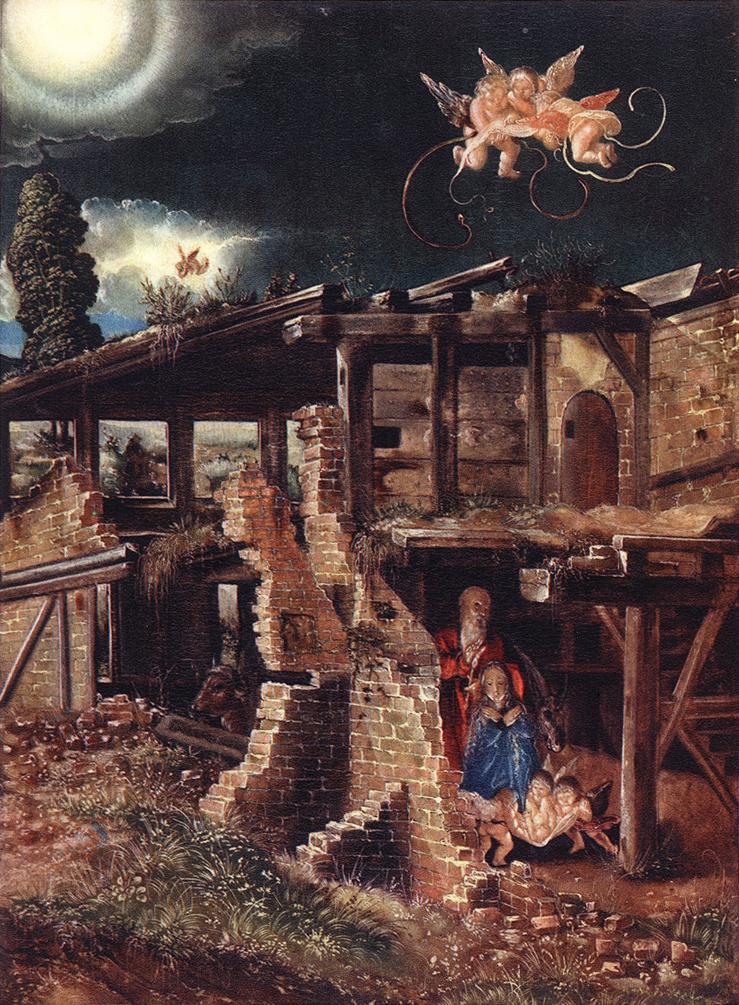
Nativity, Albrecht Altdorfer, c. 1513
The year from the creation of the world, when in the beginning God created heaven and earth, five thousand one hundred and ninety-nine: From the deluge, the year two thousand nine hundred and fifty-seven: From the birth of Abraham, the year two thousand and fifteen: From Moses and the going out of the people of Israel from Egypt, the year one thousand five hundred and ten: From David's being anointed king, the year one thousand and thirty-two: In the sixty-fifth week according to the prophecy of Daniel: In the one hundred and ninety-fourth Olympiad: From the building of the city of Rome, the year seven hundred and fifty-two: In the forty-second year of the reign of Octavian Augustus: The whole world being in peace: In the sixth age of the world: Jesus Christ, the eternal God, and Son of the eternal Father, wishing to consecrate this world by his most merciful coming, being conceived of the Holy Ghost, and nine months since his conception having passed, (here all genuflect) in Bethlehem of Juda, is born of the Virgin Mary, being made Man: The Nativity of Our Lord Jesus Christ according to the flesh.
--Roman Martyrology, December 25
Friday, December 24
Word to the wise: The movie Smokey and the Bandit is possibly one of the most painful films to watch that has ever been made in the history of cinema. I'm not sure, but it seems to involve bootlegging liquor in 1970s Texas, or car chases, or truckers, or CB radio... I'm still not sure. I took it to the bitter end last night--intermittently watercoloring and reading both Letters from a Nut and Susan Orlean's mildly clever The Bullfighter Checks her Makeup to keep from losing my mind--and I got a headache, but for some reason we couldn't find anything better to watch on TV.
For those who think I'm displaying anti-Southron Yankee prejudice, bear in mind at least part of one side of my family has lived in Florida since before the Civil War--War Between the States, War of Southern Aggression, War of Northern Aggression, The Late Unpleasantness, etc.--and let's not get into the debate over whether Florida is Southern. It was in 1845.
Never, ever, ever watch it, please, for the sake of your own sanity...the omnipresent banjo music, the endless car-chases, Burt Reynolds in that stupid hat, and the at-best mildly pretty Sally Field, who, despite being the Flying Nun, has all the humor and screen presence of a dessicated movie-lobby hotdog. There are few women who can be both beautiful and funny on screen, and unfortunately I think Sandra Bullock was probably about five when they made Smokey. And while I love a car chase as much as the next man, please, Burt, you have to break it up with, I dunno, witty banter, or at the very least some explosions and gunfire. I'm pretty sure that's what Aristotle said about car-chases in The Poetics. Oh, and lose the Deliverance soundtrack. I will say in its favor, I did rather enjoy seeing that car plow through those mailboxes...
Random thought: I wonder what it would be like if you made the Crito into an action movie.
For those who think I'm displaying anti-Southron Yankee prejudice, bear in mind at least part of one side of my family has lived in Florida since before the Civil War--War Between the States, War of Southern Aggression, War of Northern Aggression, The Late Unpleasantness, etc.--and let's not get into the debate over whether Florida is Southern. It was in 1845.
Never, ever, ever watch it, please, for the sake of your own sanity...the omnipresent banjo music, the endless car-chases, Burt Reynolds in that stupid hat, and the at-best mildly pretty Sally Field, who, despite being the Flying Nun, has all the humor and screen presence of a dessicated movie-lobby hotdog. There are few women who can be both beautiful and funny on screen, and unfortunately I think Sandra Bullock was probably about five when they made Smokey. And while I love a car chase as much as the next man, please, Burt, you have to break it up with, I dunno, witty banter, or at the very least some explosions and gunfire. I'm pretty sure that's what Aristotle said about car-chases in The Poetics. Oh, and lose the Deliverance soundtrack. I will say in its favor, I did rather enjoy seeing that car plow through those mailboxes...
Random thought: I wonder what it would be like if you made the Crito into an action movie.
Thursday, December 23
Yes, Scotus, there is a Santa Claus
Just in time for Christmas, Veritatis Splendor presents us with The Other Five Ways, in which the Angelic Doctor exposits a Respondeo that even Virginia's friends couldn't hold a Sed Contra to.
Just in time for Christmas, Veritatis Splendor presents us with The Other Five Ways, in which the Angelic Doctor exposits a Respondeo that even Virginia's friends couldn't hold a Sed Contra to.
Wednesday, December 22
Never wear a judge's wig while sitting over an air vent. *** Don Jim is nearly kidnapped by Masons (well, not really). *** Classical sculpture: it wasn't so irritatingly pure white as people think--in fact, it looked kinda garish. *** Vatican opens St. Peter's coffee bar--on the roof. *** Fr. Sibley on Christ's birth as a myth come true. *** Brad Christensen versus the Nigerian Letter scam. This should be made into a movie.
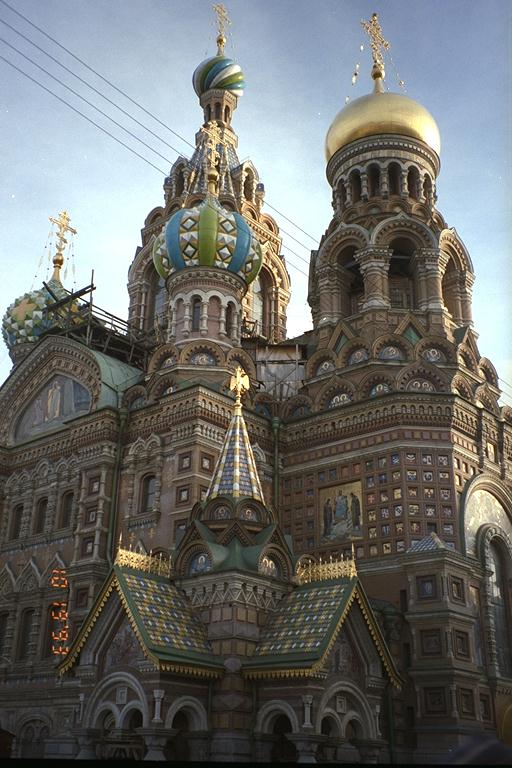
Pagans for Proper Churches?
A heathen Aussie despairs of modern cheap-jack ecclesial architecture and (jokingly) suggests she found Pagans for Proper Churches as a remedy. If even the postmoderns are criticizing the current artistic void within Christianity, we, my lords, ladies and gentlemen, are in deep existential poo. Insightful stuff from Down Under.
Oh, and lovely shots of the Churches of St. Petersburg here. Was there ugly churches looking like 1950s laundromat in 19th-century Russia? A thousand times no!
Tuesday, December 21
Blogger CatholicNerd updated Ecclesia Militans on St. Nicholas's Day. Show your support to this fledgling blog by visiting it.
Your Friendly Neighborhood Mormon
I was channel-surfing yesterday, a semiotically mindless guilty pleasure I like to enjoy from time to time over holiday breaks, and I came across an advertisement for a promotional video from the Mormons, something like The Joy of Christmas. Say what you will about the LDS, but unlike mainstream Protestants they're certainly not afraid of using images to get their point across; the commercial was chock-a-block with gauzy and glowing shots of a living nativity scene that could have easily come off a Catholic Christmas card. The LDS name wasn't mentioned explicitly until the end, when the words mormon.org materialized at the bottom of the screen, and a voice-over encouraged viewers to write to Salt Lake for details or "ask your Mormon neighbor for your free DVD."
I have to admit, I started laughing at that point. The image of someone stock-piling free DVDs in his hall closet to give out to inquiring next-door neighbors was just too much.
Last night, as my father and were sorting through the pots and pans to find the right bowl to serve as our pudding-basin for Christmas dinner (a very tricky task), I brought up the commercial. He said he probably wouldn't be surprised if the Mormons did give out videos to their parishioners that way. Those folks are intense. Theological divergences aside, maybe we Catholics could learn something from their zeal.
And I thought about it, and I think he might be on to something. It's a tricky business these days, proselytizing, and there's always something deep inside of me, perhaps a snarky, postmodern bit of me, which finds something inappropriately funny about going door-to-door with pamphlets. That's something Pentecostals do, or Jehovah's Witnesses (don't get me started on JWs), or girls in long baggy dresses with "Elder" on their nameplates. Oh, you'll just turn off people. Or freak them out. I know I probably would, but it doesn't mean other folks will. Maybe. Maybe not. I grew up with the model that you let them come to you, not the other way round, preach by example and not by words. It certainly worked well enough for my parish's RCIA program, with fifty catechumens a year, but we were a university parish and the circumstances were hardly universal.
Maybe it's not the method, but the spirit. If even a fraction of most Catholics were as willing as many Mormons to preach the Gospel with words or actions or just by treating their plain, ordinary, secular hard work as an opportunity for sanctification, we'd have something magnificent on our hands. And, I guess, there are far worse things that next-door neighbors stockpiling videotapes about the birth of Christ.
I was channel-surfing yesterday, a semiotically mindless guilty pleasure I like to enjoy from time to time over holiday breaks, and I came across an advertisement for a promotional video from the Mormons, something like The Joy of Christmas. Say what you will about the LDS, but unlike mainstream Protestants they're certainly not afraid of using images to get their point across; the commercial was chock-a-block with gauzy and glowing shots of a living nativity scene that could have easily come off a Catholic Christmas card. The LDS name wasn't mentioned explicitly until the end, when the words mormon.org materialized at the bottom of the screen, and a voice-over encouraged viewers to write to Salt Lake for details or "ask your Mormon neighbor for your free DVD."
I have to admit, I started laughing at that point. The image of someone stock-piling free DVDs in his hall closet to give out to inquiring next-door neighbors was just too much.
Last night, as my father and were sorting through the pots and pans to find the right bowl to serve as our pudding-basin for Christmas dinner (a very tricky task), I brought up the commercial. He said he probably wouldn't be surprised if the Mormons did give out videos to their parishioners that way. Those folks are intense. Theological divergences aside, maybe we Catholics could learn something from their zeal.
And I thought about it, and I think he might be on to something. It's a tricky business these days, proselytizing, and there's always something deep inside of me, perhaps a snarky, postmodern bit of me, which finds something inappropriately funny about going door-to-door with pamphlets. That's something Pentecostals do, or Jehovah's Witnesses (don't get me started on JWs), or girls in long baggy dresses with "Elder" on their nameplates. Oh, you'll just turn off people. Or freak them out. I know I probably would, but it doesn't mean other folks will. Maybe. Maybe not. I grew up with the model that you let them come to you, not the other way round, preach by example and not by words. It certainly worked well enough for my parish's RCIA program, with fifty catechumens a year, but we were a university parish and the circumstances were hardly universal.
Maybe it's not the method, but the spirit. If even a fraction of most Catholics were as willing as many Mormons to preach the Gospel with words or actions or just by treating their plain, ordinary, secular hard work as an opportunity for sanctification, we'd have something magnificent on our hands. And, I guess, there are far worse things that next-door neighbors stockpiling videotapes about the birth of Christ.
Holy Whapping Television Network (HWTN):
Primetime Schedule, December 20-24, 2004
Monday, December 20
8:00 PM -- Michelangelo and the Pope's Ceiling: The Sitcom. Mikey gets irritated that his rival Raphael is throwing noisy toga parties next door in the Stanze. Julius II calls in noted Florentine spin-doctor Nick Machiavelli, who urges him to do a painting-op showing off his kindler, gentler side (involving a mercilessly cute puppy) with hilarious results. Little Johnny Bernini tries out for the Sistine Choir, and gets in--only they want him for the soprano section. Permanently. (TV-PG: Paintings of naked people, and countertenor jokes).
8:30 PM -- I Love Beatrice. Dante has a big poetry reading coming up at the Medici Tavern, and Beatrice desperately wants to get in on it, concocting a wacky plan with her next-door neighbor, Laura, to crash it in disguise. "Beeeatriiiice, you have some 'splaining to doooo!" "Awwww, Dante, waaaaaaaah!" (TV-G).
9:00 PM -- Father Ted: A Lifetime Original Moment of Truth Movie. Movie. Repeat of last month's ratings success on the Women's Channel. On Craggy Island off the Irish coast, rector Father Ted Crilley forces Jack to join Alcoholics Anonymous ("Drink! Drink! Drink!"). Housekeeper Mrs. Doyle joins a drumming circle to empower her femininity, changes her name to Starbird, and then gets thrown out when she serves a chicken salad sandwich to a vegan. And Doughal gets a new sweater for Christmas, this one with a Big Bird on it. (TV-PG-13: Jack).
Tuesday, December 21
8:00 PM -- The Bob Bellarmine Show. Crazy next-door neighbor Galileo (Bill Daily) crashes Bob (Bob Newhart)'s dinner at the rectory for the upteenth time. Bob counsels a claustrophobic Zwinglian on his new confessional couch, an idea he got from his friend Rabbi Freud up in Vienna. (Repeat; TV-PG: Zwinglians).
8:30 PM -- The Dangerous Lives of Altar Boys. In a new segment of this popular how-to show, Ian the Traditional Liturgist explains the proper use of a thurible, but his assistant, Little Aloysius (age 5, from St. Gabriel of the Seven Sorrows Yes-You-Betcha-We-Have-An-Indult Tridentine Mission in Little Tavistock, North Dakota) burns the set down by accident. Visiting expert Father Rocca is allowed to demonstrate a profound bow. (TV-G, but don't let the kids near a lighter).
9:00 PM -- Little Women II: Jo, Interrupted. Movie. Jo rebels at the thought of being portrayed by Winona Ryder, especially after Jo is mistakenly arrested for shoplifting at the town general store. (TV-G, mostly).
Wednesday, December 22
8:00 PM -- Domers: The Soap Opera. Mary-Louise and Mary-Beth have a catfight over who's going to try to steal Mary-Kate's boyfriend, Mike, who is Mary-Mary's brother, and who also secretly has a crush on Mary-Ann's roommate, Mary-Pat, whose real name is Heather but who changed it because she was the only person on campus not named Bridget or Mary and was feeling very left out. Philosophy Student Matt tries to get advice on his Aquinas paper from Holy Matt, who asks Perfect Hair Matt if maybe Wisconsin Matt or his roommate Hat Matt might know the answer, which involves the Gospel of Matthew. A random joke about South Dining Hall tuna casserole is made, like on every show. (TV-PG: South Dining Hall).
9:00 PM -- Two Guys, a Priest, and a Pizza Place. Notre Dame's basilica rector takes a sabbatical to rediscover his Italian roots by going home to work in his family pizza place. Hijinks and wackiness ensue. (TV-PG: Hijinks and wackiness).
9:30 PM -- Rick Steves' Travels in Vatican City -- Part two of twenty. Rick visits the Vatican grocery store.
10:00 PM -- Little Women III: The Search for Spock. Movie. Jo and Meg must make a dangerous decision that could part them from all they hold dear: continue living in mid-19th-century America and wearing very large skirts or steal the decommissioned Enterprise to recover Beth's body from the restricted Genesis planet. Also starring Rich as Leonard Nimoy. (TV-G, though I doubt it).
Thursday, December 23
8:00 PM -- The Adventures of SuperBenedictineMan. SuperBenedictineMan discovers that his nemesis the Ecumenatrix is out to break into the Gesu over Christmas and steal the precious relic of St. Francis Xavier's Bionic Baptizing Bicep to kick off her plan to...well, do something really nefarious, of course, probably involving a feminist Liberating Liturgy. (TV-PG-13: Liberating Liturgies).
9:00 PM -- The Liturgist. In this new Reality TV show, Cardinal Martini auditions new majordomos for St. Peter's Basilica. Color commentary by The Most Sarcastic Priest in Ireland and Cardinal Castrillon Hoyos (unless it gives the poor guy a coronary). Special competitions for: thurible swinging, slightly random incorporation of indigenous customs, liturgical dance, designing ugly modern liturgical art, ad-libbing in Latin, interview, and special talent. "What would you say the world needs most today?" "A revision of the rubrics for Benediction. (Awkward silence). And world peace." (Applause). (TV-G, but be warned: Archbishop Milingo is trying out).
10:00 PM -- Late Night Compline with Fr. George William Rutler. Witty banter (largely in Latin) with special guests Reggie Foster and the Maytag Repairman. Musical guests: John Rutter and the Cambridge Singers.
Friday, December 24
8:00 PM -- The Holy Whapping Christmas Special. A snowstorm forces the gang, driving to Stillwater to buy Christmas presents at Loome's Theological Bookstore, to stay overnight at the ICRSP parish in Wausau. Andy discovers with horror that tonight's dinner at the rectory will contain only mushrooms, and that the closest Piggly Wiggly is in the next state. Matt attempts to convince the pastor to let him use a cope while serving mass, or an amice anyway, while he discovers his attempts to found a sodality dedicated to St. Murgen have gotten him irate phone messages both from Student Activities and the Congregation for the Doctrine of the Faith. Trying to find an appropriately Christmassy movie, Dan looks for a copy of The Seventh Seal at the local Blockbuster and ends up having to drive halfway to Madison in the process. Emily discovers she has a long-lost identical twin sister, and gets into a long argument as to which one of them is the evil twin but the breach is healed by a long conversation about baked goods, firearms, sewing and football. Rich (guest star Pete Best) tries to convince the visiting regional superior to build a replica of the Gesu in South Bend. S. introduces the good priests of the parish to Tex-Mex/Indian fusion cuisine and in the end shows the bickering friends the True Meaning of Christmas, which presumably doesn't involve putting up Christmas lights around Halloween. Special appearance by the Schauss Family Singers. (TV-G).
10:00 PM -- Friday Night Live! All the way from La Fortune Student Center, the Whapsters consume vast quantities of Frappucinos and discuss tonight's question: "If Thomas Aquinas had been a professional wrestler, what would his nickname have been?" Musical guests John Tavener and Mick Jagger do a duet version of the Akathist of Thanksgiving. (TV-G).
11:00 PM -- Little Women V: The Final Insult. Movie. Jo and Elizabeth Cady Stanton discover a book in the attic called Liberating Liturgies and try to empower their Irish Catholic maid Bridget through the use of interpretive dance. Also starring Archbishop Milingo. (TV-PG-13: Liberating Liturgies).
Primetime Schedule, December 20-24, 2004
Monday, December 20
8:00 PM -- Michelangelo and the Pope's Ceiling: The Sitcom. Mikey gets irritated that his rival Raphael is throwing noisy toga parties next door in the Stanze. Julius II calls in noted Florentine spin-doctor Nick Machiavelli, who urges him to do a painting-op showing off his kindler, gentler side (involving a mercilessly cute puppy) with hilarious results. Little Johnny Bernini tries out for the Sistine Choir, and gets in--only they want him for the soprano section. Permanently. (TV-PG: Paintings of naked people, and countertenor jokes).
8:30 PM -- I Love Beatrice. Dante has a big poetry reading coming up at the Medici Tavern, and Beatrice desperately wants to get in on it, concocting a wacky plan with her next-door neighbor, Laura, to crash it in disguise. "Beeeatriiiice, you have some 'splaining to doooo!" "Awwww, Dante, waaaaaaaah!" (TV-G).
9:00 PM -- Father Ted: A Lifetime Original Moment of Truth Movie. Movie. Repeat of last month's ratings success on the Women's Channel. On Craggy Island off the Irish coast, rector Father Ted Crilley forces Jack to join Alcoholics Anonymous ("Drink! Drink! Drink!"). Housekeeper Mrs. Doyle joins a drumming circle to empower her femininity, changes her name to Starbird, and then gets thrown out when she serves a chicken salad sandwich to a vegan. And Doughal gets a new sweater for Christmas, this one with a Big Bird on it. (TV-PG-13: Jack).
Tuesday, December 21
8:00 PM -- The Bob Bellarmine Show. Crazy next-door neighbor Galileo (Bill Daily) crashes Bob (Bob Newhart)'s dinner at the rectory for the upteenth time. Bob counsels a claustrophobic Zwinglian on his new confessional couch, an idea he got from his friend Rabbi Freud up in Vienna. (Repeat; TV-PG: Zwinglians).
8:30 PM -- The Dangerous Lives of Altar Boys. In a new segment of this popular how-to show, Ian the Traditional Liturgist explains the proper use of a thurible, but his assistant, Little Aloysius (age 5, from St. Gabriel of the Seven Sorrows Yes-You-Betcha-We-Have-An-Indult Tridentine Mission in Little Tavistock, North Dakota) burns the set down by accident. Visiting expert Father Rocca is allowed to demonstrate a profound bow. (TV-G, but don't let the kids near a lighter).
9:00 PM -- Little Women II: Jo, Interrupted. Movie. Jo rebels at the thought of being portrayed by Winona Ryder, especially after Jo is mistakenly arrested for shoplifting at the town general store. (TV-G, mostly).
Wednesday, December 22
8:00 PM -- Domers: The Soap Opera. Mary-Louise and Mary-Beth have a catfight over who's going to try to steal Mary-Kate's boyfriend, Mike, who is Mary-Mary's brother, and who also secretly has a crush on Mary-Ann's roommate, Mary-Pat, whose real name is Heather but who changed it because she was the only person on campus not named Bridget or Mary and was feeling very left out. Philosophy Student Matt tries to get advice on his Aquinas paper from Holy Matt, who asks Perfect Hair Matt if maybe Wisconsin Matt or his roommate Hat Matt might know the answer, which involves the Gospel of Matthew. A random joke about South Dining Hall tuna casserole is made, like on every show. (TV-PG: South Dining Hall).
9:00 PM -- Two Guys, a Priest, and a Pizza Place. Notre Dame's basilica rector takes a sabbatical to rediscover his Italian roots by going home to work in his family pizza place. Hijinks and wackiness ensue. (TV-PG: Hijinks and wackiness).
9:30 PM -- Rick Steves' Travels in Vatican City -- Part two of twenty. Rick visits the Vatican grocery store.
10:00 PM -- Little Women III: The Search for Spock. Movie. Jo and Meg must make a dangerous decision that could part them from all they hold dear: continue living in mid-19th-century America and wearing very large skirts or steal the decommissioned Enterprise to recover Beth's body from the restricted Genesis planet. Also starring Rich as Leonard Nimoy. (TV-G, though I doubt it).
Thursday, December 23
8:00 PM -- The Adventures of SuperBenedictineMan. SuperBenedictineMan discovers that his nemesis the Ecumenatrix is out to break into the Gesu over Christmas and steal the precious relic of St. Francis Xavier's Bionic Baptizing Bicep to kick off her plan to...well, do something really nefarious, of course, probably involving a feminist Liberating Liturgy. (TV-PG-13: Liberating Liturgies).
9:00 PM -- The Liturgist. In this new Reality TV show, Cardinal Martini auditions new majordomos for St. Peter's Basilica. Color commentary by The Most Sarcastic Priest in Ireland and Cardinal Castrillon Hoyos (unless it gives the poor guy a coronary). Special competitions for: thurible swinging, slightly random incorporation of indigenous customs, liturgical dance, designing ugly modern liturgical art, ad-libbing in Latin, interview, and special talent. "What would you say the world needs most today?" "A revision of the rubrics for Benediction. (Awkward silence). And world peace." (Applause). (TV-G, but be warned: Archbishop Milingo is trying out).
10:00 PM -- Late Night Compline with Fr. George William Rutler. Witty banter (largely in Latin) with special guests Reggie Foster and the Maytag Repairman. Musical guests: John Rutter and the Cambridge Singers.
Friday, December 24
8:00 PM -- The Holy Whapping Christmas Special. A snowstorm forces the gang, driving to Stillwater to buy Christmas presents at Loome's Theological Bookstore, to stay overnight at the ICRSP parish in Wausau. Andy discovers with horror that tonight's dinner at the rectory will contain only mushrooms, and that the closest Piggly Wiggly is in the next state. Matt attempts to convince the pastor to let him use a cope while serving mass, or an amice anyway, while he discovers his attempts to found a sodality dedicated to St. Murgen have gotten him irate phone messages both from Student Activities and the Congregation for the Doctrine of the Faith. Trying to find an appropriately Christmassy movie, Dan looks for a copy of The Seventh Seal at the local Blockbuster and ends up having to drive halfway to Madison in the process. Emily discovers she has a long-lost identical twin sister, and gets into a long argument as to which one of them is the evil twin but the breach is healed by a long conversation about baked goods, firearms, sewing and football. Rich (guest star Pete Best) tries to convince the visiting regional superior to build a replica of the Gesu in South Bend. S. introduces the good priests of the parish to Tex-Mex/Indian fusion cuisine and in the end shows the bickering friends the True Meaning of Christmas, which presumably doesn't involve putting up Christmas lights around Halloween. Special appearance by the Schauss Family Singers. (TV-G).
10:00 PM -- Friday Night Live! All the way from La Fortune Student Center, the Whapsters consume vast quantities of Frappucinos and discuss tonight's question: "If Thomas Aquinas had been a professional wrestler, what would his nickname have been?" Musical guests John Tavener and Mick Jagger do a duet version of the Akathist of Thanksgiving. (TV-G).
11:00 PM -- Little Women V: The Final Insult. Movie. Jo and Elizabeth Cady Stanton discover a book in the attic called Liberating Liturgies and try to empower their Irish Catholic maid Bridget through the use of interpretive dance. Also starring Archbishop Milingo. (TV-PG-13: Liberating Liturgies).
Wednesday, December 15
A Finals-Week Thought of the Day
Pride is thinking I'm important for absolutely any other reason than the agapic love of Christ.
I admit I made it up, but I think it's true. At least, it's comforting in final after final :) Thoughts?
Pride is thinking I'm important for absolutely any other reason than the agapic love of Christ.
I admit I made it up, but I think it's true. At least, it's comforting in final after final :) Thoughts?
Tuesday, December 14

Neon halos, dusty churches and St. Rita. What could be more Italian? This is by far my favorite photo from my Sicily field from my year abroad.
Random Photos and Paintings from the Archive
My eclectically messy desk during sophomore year. For hours of fun, play "name the saint" with all the icons. And that's a stain on the photo, not Spanish moss.
A favorite watercolor I did of Audrey Hepburn in profile.
Our intrepid blogger on a Sicilian mountaintop, squinting horribly. That's my sketchbook in the right jacket pocket. And yes, that indeed is a wildflower I've stuffed in my buttonhole.
My eclectically messy desk during sophomore year. For hours of fun, play "name the saint" with all the icons. And that's a stain on the photo, not Spanish moss.
A favorite watercolor I did of Audrey Hepburn in profile.
Our intrepid blogger on a Sicilian mountaintop, squinting horribly. That's my sketchbook in the right jacket pocket. And yes, that indeed is a wildflower I've stuffed in my buttonhole.

Even happier: An image of Our Lady of Guadalupe slaying the Dragon of the Apocalypse, from the (apparently new) seminarian blog Quodlibeta.
Maniple Alert!
Speaking of happy, here's a very happy picture of the Catholic blogosphere's very own Fr. Bryce Sibley in full Gaudete rig. Real men wear pink...er...I mean, rose.
Speaking of happy, here's a very happy picture of the Catholic blogosphere's very own Fr. Bryce Sibley in full Gaudete rig. Real men wear pink...er...I mean, rose.
Once again, conclusive proof that Modern Man has too much time on his hands, or very odd priorities.

"Mr. Potatohead will not make you happy."
--Professor R. explains Thomas Aquinas's contention that created goods are not enough.
Sunday, December 12
The parade (or should that be procession?) of baked goods continues...
November 17th marked the feast of St. Elizabeth of Hungary. Following in her example, we wore roses and distributed homemade bread to poor, starving ... college students.
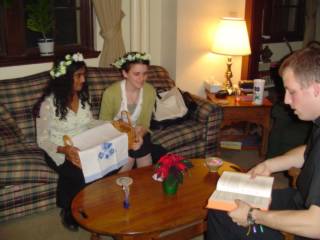
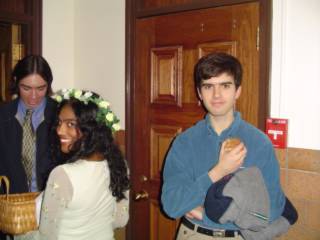
Father blesses the bread after Mass.
A couple of weeks later, we celebrated the feast of St. Andrew (and, of course, Andy's name day) with a cake commemorating the great Saint's former profession.
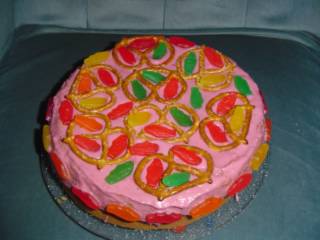
Stay tuned for more mouth-watering POD-ness!
November 17th marked the feast of St. Elizabeth of Hungary. Following in her example, we wore roses and distributed homemade bread to poor, starving ... college students.


Father blesses the bread after Mass.
A couple of weeks later, we celebrated the feast of St. Andrew (and, of course, Andy's name day) with a cake commemorating the great Saint's former profession.

Stay tuned for more mouth-watering POD-ness!
Just when you think you've seen it all...

Voluntary Human Extinction Movement
I don't even know what to say about this.
My favorite part is the "Why Breed?" chart (scroll down to the middle of the page), which refutes all the false reasons why one would want to have children, for example:
Voluntary Human Extinction Movement
I don't even know what to say about this.
My favorite part is the "Why Breed?" chart (scroll down to the middle of the page), which refutes all the false reasons why one would want to have children, for example:
"Reason given: 'I just love children.'Further comments would fail to do this justice to these "four legs = good, two legs = bad" crazies, so I really just recommend having a look for yourself, if you can stomach it.
Real Reason: 'Out of touch with inner child, and with existing children.'"

A panel from Federigo di Montefeltro's study; for more see this fascinating article on Wunderkammern.
Out of the depths of finals week, I offer a selection of my best posts from the last year-and-a-half, hoping to remember the joys of sunny Rome amid rumors of a coming snow storm here...
Adventures with Cardinal Pell - A two-parter: Sacra Purpura, in which Matt attends a Vatican consistory, with interruptions from a Polish brass band. And the sequel, An Evening with the Cardinal, in which he engages in an adventuresome round of ecclesiastical celebrity-watching with the Archbishop of Sydney and an Antipodean Catholic Nerd.
A Seacoast in Bohemia - Partying on St. Cyril's day at San Clemente with the Collegio Nepomuceno.
The Skull on Jumping Jack Flash’s Prie-Dieu - On winning an award: Vanitatis vanitatum, &c.
The Four Italian Poems - The Borromini Girl, A Psalm for the Sibyl, The Transfiguration of Apulia and The Chapel of Relics, Palermo Cathedral.
Waiting on the Via Crucis for a Green Light - The Scala Santa reconsidered.
Indiana Matt and the Catacomb of Doom - Subterranean adventures with a intoxicated nun (well, not really) in the moonscape of the Catacombs of Santa Priscilla.
A Bedtime Story for the Eve of St. George's Day - Damsels in distress, garnish, Action Man, and a rather practical princess.
Holy Week in Rome - in three parts: Long Shadows on Good Friday where Matt attends a Tenebrae service after an exhausting train trip from Taormina to Rome, Judas and Peter: A Morality Play and Lumen Christi, in which we visit St. Peter's for Easter Vigil and eat pancakes at eleven at night.
Raphael, Federigo and Vasari: Homes for Princes and Painters - A two-parter from our adventures in the old Papal Marches: With Batman and Borges in Urbino. From a megalomaniacal palace of courtly life and love to the humble beauty of Raphael's birthplace, and several tangential diversions on pop culture and Jorge Luis Borges's infinite library. At Home with Raphael and Vasari - How an artist should grow up, and how he should live, and how he should die. With a few frescoes in between.
A King at Home - The Piccola Farnesina, a most unusual palace; and the delights and shortcomings of urban living.
High Mass at San Gregorio - A sliver of heaven eaven beneath vaults of mannerist plasterwork.
The Descent of Mount Tabor - Matt's experiences going to confession at St. Peter's; and leaving the Eternal City.
Friday, December 10
It's always gratifying...
... when a Thomistic teaching rears its head.
Thomas believed that, after a lifetime of studying philosophy, it would be possible to prove the existence of God. That is why his 5 proofs are often brushed a side -- they are merely an outline or a sketch of this life-long philosophical pursuit. To conclusively prove God's existence, one must actually spend a lifetime considering all the points involved in his quick sketches of a proof for God.
However, rationally, philosophy cannot prove too much more than that some Godly figure must exist. Not the trinity, certainly not the Incarnation, infact, not much at all. Deism, perhaps.
Now one of Britain's most famous atheist philosophers, after a lifetime of study, Announces He Believes in God. More or less.
... when a Thomistic teaching rears its head.
Thomas believed that, after a lifetime of studying philosophy, it would be possible to prove the existence of God. That is why his 5 proofs are often brushed a side -- they are merely an outline or a sketch of this life-long philosophical pursuit. To conclusively prove God's existence, one must actually spend a lifetime considering all the points involved in his quick sketches of a proof for God.
However, rationally, philosophy cannot prove too much more than that some Godly figure must exist. Not the trinity, certainly not the Incarnation, infact, not much at all. Deism, perhaps.
Now one of Britain's most famous atheist philosophers, after a lifetime of study, Announces He Believes in God. More or less.
Thursday, December 9

Give me some credit...
The owner of a site specializing in stained glass, from which we linked to an image a few days ago, asked for a little credit. Rather than just adding a little note by the image we used, though, I liked the site and am referencing it here instead.
It's a commercial site, but they have a nice collection of good pictures of 19th century glass here.
Also, they sell some reproductions, the best one of which I already own (see picture above).
Sorry, but I'm a sucker for stained glass.
Also of interest for those near Chicago is the stained glass display at, of all places, Navy Pier shopping center. There is no admission charge, and they have a lot of good Tiffany and ecclesiastical windows -- from the heights of inspiration to the depths of modern minimalism.
Wednesday, December 8

The foremost dental hygienist of the Middle Ages?
Florence King theorizes, jokingly, that Eleanor of Aquitaine invented flossing. Also, La King gives us a a charming aside on the exploding viscera of the Duchess of Montpensier.

All of our readers at Notre Dame are invited to a Solemn Mass for the Immaculate Conception tonight at the Chapel of St. Charles Borromeo at Alumni Hall starting at 7:15 PM. The celebrations will begin with Benediction of the Blessed Sacrament at 6:50 in the Chapel of Notre Dame Our Mother at the Coleman-Morse Center. Afterwards, at 7:00, there will be a Litany Procession with the celebrant from the Coleman-Morse Center to Alumni Hall, when mass will begin. Come join us!
This is evil, wicked, malevolent, blasphemous, treacherous, sinful, and wrong.
Monday, December 6
Selections from the Italian notebooks of Matthew Alderman
(image quality improves when enlarged)
An original drawing of St. Rose of Viterbo
A page of architectural details from Rome
Fortitude, after Botticelli
Studies of the Madonna, St. Barbara, and angels, after Botticelli
An original design for alb and and cope for Advent
Siena's Palazzo del Pubblico
(image quality improves when enlarged)
An original drawing of St. Rose of Viterbo
A page of architectural details from Rome
Fortitude, after Botticelli
Studies of the Madonna, St. Barbara, and angels, after Botticelli
An original design for alb and and cope for Advent
Siena's Palazzo del Pubblico
The Further Further Adventures of Murgen the Mermaid
From the comments box at Ecclesia Anglicana:
From the comments box at Ecclesia Anglicana:
Other saints have been referred to as 'Mermen' in historical literature of the British Isles. Some scholars hold that it meant one who dwelt on the smaller isles off the coast (the same that were the choice of 'desert' for British, Irish, and French monastics.) So, a 'Mer-man' or 'Mer-maid' was someone who lived on the sea. Those small islands like Iona, Caldey, or Skellig Michael were not all that accessible - it was really 'living out upon the sea/in the sea'. The local churches saw these islands as 'halfway to heaven' - they were dangerous, ideal for ascetic labour, and pre-Christian belief was that such were the abodes of the Dead (see the 'Blessed Isles' tradition.) We know archaeologically that many islands off of Britain were used as graveyards for that same reason. No doubt embellishment of the stories mixed with borrowed 'Classical Roman' ideas such as 'half man, half fish' mermaids produced the later form of the stories. St. Murgen, however, I would bet to have been really a castaway on one of those islands: living a natural hermit-like existence.My friend Steve has a theorem that runs something like this: Life is interesting, and therefore any explanation of it which is not as interesting or even dull is therefore false. Sort of like the anti-Occam's razor (Chesterton's spatula?) While I rather like this maxim, this less romantic explanation of St. Murgen's peculiar legend is nonetheless a little easier to handle for those among us who dislike zoomorphic saints. And it of course has the advantage of not having to rewrite established biology...
"They put the 'damn' in Amsterdam."
- My roommate
Today has been spent primarily reflecting on the moral and spiritual mess that is the Netherlands.
It began today in CCD class when my co-teacher was reviewing what we had established in our study of morality to date in the semester (we teach 7th and 8th graders). We had already established the principle of non-contradiction, the non-relative nature of morality, the application laws stemming from human nature not only physically but spiritually. Today we wated to make these foundations, based on inane examples, hit home.
It began with a student who asked why abortion wasn't to be considered simply an opinion. So we applied all of the above to this example, and it worked quite well. Then we discussed what happens when one begins to view morality as an "opinion" rather than as something proceeding from the way humans are designed. Our case in point was the Netherlands: when morality becomes an opinion, you are obliged, are you not, to let everyone hold their own opinion.
How has this played out in the Netherlands? A friend of ours (met over this blog!) told us of his encounter with some Dutch students. He asked, for whatever reason, how their grandparents were. "Grandparents?" the students asked. Yeah, you know: your parents' parents, everyone has them... "There are no grandparents in the Netherlands," was the dead-serious reply. They all move to France for fear they'll be euthanized.
And we went on to talk about the other ways in which the Netherlands is a morally stunning land. (At lunch, another friend commented that the State Department should issue a travel advisory for all Americans visiting the Netherlands under 12 months or over 65.) But I remembered, after class, that a priest I know who had been in Paris in the 1940s had said that the Dutch Church was among the strongest in Europe.
What happened?
This link was written in 1988 and explores the self-destruction of the Dutch Church and the underlying factors which paved the way. It's a worthy, but very depressing, read.
Growth of a 'new church': the Dutch experiment
- My roommate
Today has been spent primarily reflecting on the moral and spiritual mess that is the Netherlands.
It began today in CCD class when my co-teacher was reviewing what we had established in our study of morality to date in the semester (we teach 7th and 8th graders). We had already established the principle of non-contradiction, the non-relative nature of morality, the application laws stemming from human nature not only physically but spiritually. Today we wated to make these foundations, based on inane examples, hit home.
It began with a student who asked why abortion wasn't to be considered simply an opinion. So we applied all of the above to this example, and it worked quite well. Then we discussed what happens when one begins to view morality as an "opinion" rather than as something proceeding from the way humans are designed. Our case in point was the Netherlands: when morality becomes an opinion, you are obliged, are you not, to let everyone hold their own opinion.
How has this played out in the Netherlands? A friend of ours (met over this blog!) told us of his encounter with some Dutch students. He asked, for whatever reason, how their grandparents were. "Grandparents?" the students asked. Yeah, you know: your parents' parents, everyone has them... "There are no grandparents in the Netherlands," was the dead-serious reply. They all move to France for fear they'll be euthanized.
And we went on to talk about the other ways in which the Netherlands is a morally stunning land. (At lunch, another friend commented that the State Department should issue a travel advisory for all Americans visiting the Netherlands under 12 months or over 65.) But I remembered, after class, that a priest I know who had been in Paris in the 1940s had said that the Dutch Church was among the strongest in Europe.
What happened?
This link was written in 1988 and explores the self-destruction of the Dutch Church and the underlying factors which paved the way. It's a worthy, but very depressing, read.
Growth of a 'new church': the Dutch experiment
Sunday, December 5

Thursday, December 2

The Blessed Virgin Mary, Spouse of the Holy Spirit
Drawing by Matthew Alderman published in the October 2004 edition of the Advocata Nostra, an orthodox Catholic publication on the campus of the University of Notre Dame. For a larger version, see here.
Wednesday, December 1

Brompton Oratory, London
I received an email from Michael Rose today alerting me to his new webzine dedicated to Church architecture. Dellachiesa.com looks excellent and includes such useful features as a link to the new Fatima basilica project entitled "Eyesore Alert," portfolios of the best traditional-minded church architects around, essays on history and tradition, and, of course, lots and lots of fellow Domer Matt Enquist's supremely spiffy watercolors. Definitely droolworthy for any and all in the Catholic blogosphere. The only problem is, you have to pay to get the best of the internet goodies...perhaps he might consider a reduced rate for us starving artistic nerdlings?
Incidentally, while on the subject of Michael Rose, he has a new book out entitled In Tiers of Glory, which includes two watercolors by yours truly. At his request I contributed a review to Amazon.com recently which I think gives a neat precis of the book's thesis. (I see, much to my amusement the other customer review is by Demetri Porphyrios, who's a visiting professor at ND). If you look carefully on p. 37, you'll see the whole Holy Whapping gang painted in the crowd scene in front of San Marco Cathedral. I'm the one in the Venetian general's uniform.
(Blogger accidentally ate the first version of this post, deleting the comments: my apologies for those who posted in reply.)
(Cue tinkly Dudley Do-Right-style piano continuo)
Ladies and Gentlemen, for your cinematiscopic viewing-pleasure, Holy Whapping Superba-Llewellyn Vintage Filmographical and Wireless Entertainment Ltd. proudly present in glorious silent black-and-white the 1922 photo-play TRAPPED BY THE MORMONS!
Let the imdb.com review speak for itself:
While horribly un-oecumenical, there was a fad in Britain during the second decade of the twentieth century for Mormon exploitation flicks a la A Study in Scarlet. I suppose it's the Latter Day Saints version of the eeeeeevil conniving (and Jesuitical) Jesuit of so much over-the-top nineteenth-century nativist propaganda...
For any Mormons reading this, I apologize; I know this bears about as much resemblance to your church as Guido Sarducci and The Da Vinci Code does to Catholicism. But it is, you have to admit, pretty darn weird...
Ladies and Gentlemen, for your cinematiscopic viewing-pleasure, Holy Whapping Superba-Llewellyn Vintage Filmographical and Wireless Entertainment Ltd. proudly present in glorious silent black-and-white the 1922 photo-play TRAPPED BY THE MORMONS!
Let the imdb.com review speak for itself:
This is, without question, my Favorite Bad Movie. I first saw it about 20 years ago as a college midnight movie, and it stayed with me. I finally found it on tape at and actually bought it, which is something I rarely do. However, this film is so memorably and ineptly hilarious, I had to get it.Good grief. Someone call Tom Servo.
It's a silent British film which is to Mormonism as Reefer Madness is to [drug] usage. The plot--what there is of it--is of a Mormon polygamist luring small-town English girls to forced marriages, upon which they are sent off to Salt Lake City. Needless to say, the heroine, played by Evelyn Brent, is saved by her poor, wheelchair-bound father and her dashing sailor boyfriend.
While horribly un-oecumenical, there was a fad in Britain during the second decade of the twentieth century for Mormon exploitation flicks a la A Study in Scarlet. I suppose it's the Latter Day Saints version of the eeeeeevil conniving (and Jesuitical) Jesuit of so much over-the-top nineteenth-century nativist propaganda...
For any Mormons reading this, I apologize; I know this bears about as much resemblance to your church as Guido Sarducci and The Da Vinci Code does to Catholicism. But it is, you have to admit, pretty darn weird...

Personally, I'm booking for Urban Meyer to be the new coach, but I admit it's mostly because I keep picturing him calling for the First Crusade.

I mean, come on... Urban...football...crusades, how much more perfect could it get? The parody possiblities are endless.










![[SMMMHDH]](http://www.mgilleland.com/music/smmmhdh.png)