Sunday, November 30
Fun with the Nestorians
From the immensely witty and engaging From the Holy Mountain by William Dalrymple:
"...Alarmed Anglican missionaries who tried to make contact with Nestorians in the nineteenth and early twentieth centuries reported they [the Nestorians, not the Anglicans] would go into battle against tribal enemies led by their bishop, wearing his purple episcopal trousers, and their priests would return bearing the severed ears of their victims. On one occasion a dog-collared Anglican vicar was invited to lunch by a Nestorian chieftain and had the temerity to refuse, offering some lame excuses. 'It is my hope that you will come and stay,' repeated the chieftain. 'If you do I shall be proud to recieve you; if you do not, my honor will make it needful for me to shoot you.' "
Yikes. So much for ecumenism.
From the immensely witty and engaging From the Holy Mountain by William Dalrymple:
"...Alarmed Anglican missionaries who tried to make contact with Nestorians in the nineteenth and early twentieth centuries reported they [the Nestorians, not the Anglicans] would go into battle against tribal enemies led by their bishop, wearing his purple episcopal trousers, and their priests would return bearing the severed ears of their victims. On one occasion a dog-collared Anglican vicar was invited to lunch by a Nestorian chieftain and had the temerity to refuse, offering some lame excuses. 'It is my hope that you will come and stay,' repeated the chieftain. 'If you do I shall be proud to recieve you; if you do not, my honor will make it needful for me to shoot you.' "
Yikes. So much for ecumenism.
Saturday, November 29

St. Athanasius of Alexandria
Greek to Me
"Yes, some really quite strange religions out there in the East. Coptic monks out in the Egyptian desert saying 'old Father Abbot who died last year appears to me when I look over my right shoulder.' " A polite titter. It was the genial bespectacled Englishman at the Almost Corner bookstore in Trastevere speaking. He meant well; he's a good fellow. Still...
I smiled and forced a chuckle.
He'd pointed to a weighty paperback called From the Holy Mountain, presumably a semi-humorous travelogue involving Greek Orthodoxy. It sat on the crowded center island of the even-more-cluttered shop along with Caring for the Neurotic Dog, and something about Nostradamus. Then there was was something like Great Hoaxes in Exploration and Route 66 A.D. with a centurion wearing CHiPs sunglasses on the cover. Neither did anything for me. On the floor was a manual on horoscope symbols.
Nothing was looking appealing, much to my surprise. Even great Homer nods, I suppose.
I'd asked him to recommend something "amusing." The scanty collection of cheesy Clancy-oid paperbacks that line the rickety metal shelves of the Notre Dame Rome Program Lending Library was simply not cutting it for bedtime reading. Neither was re-re-reading the collection of P.J. O'Rourke essays I'd brought over on the plane eons ago. While I'm always one to enjoy his making humorous hay out of the latest round of troubles in Trashcanistan or Upper Revolta, one can only get so many laughs out of a piece on violent South Korean student protests or Cory Aquino, especially over a period of three months.
I flipped through the book; it didn't look half bad, had some nice historical tidbits. Not too irreverent, and the price was about right for the cash I had on me. Though I thought it best, if only for the sake of dramatic irony, to pass over the fact I was planning to be at the Greek Rite Catholic Church on Via del Babuino in ten minutes time. Saturday Vespers, probably right up there on the quite strange meter for him. Maybe I could hide it in my jacket if the priest got inquisitive. "What is this? Is mocking holy desert fathers? Is outrage!"
But seriously now.
I suppose it's technically possible to get from the Lungaretta in Trastevere to Sant' Atanasio near the Spanish steps in ten minutes, but not without some of those pesky Coptic teleportation skills. I'd lingered perhaps too long at San Salvatore in Onda on the way over, paying a call on St. Vincent Pallotti in his silver mask entombed in the glass altar.
Anyway, I threaded my way through the Saturday night hordes of central Rome, passing a jaunty jazz band with portable drumset in Campo dei Fiori, ducking around a brace of young matrons with baby carriages and dodging a flock of nuns in white Birkinstocks. By the time I reached Sant' Andrea the bells of the nine hundred churches, oratories and chapels of Rome were clanging the hour away, and when I reached the Pantheon, it was starting to rain with sparse, indifferent drops.
The Corso was packed, almost verging on Dick Clark territory beyond the construction work near the column of Antonius Pius. Still, the fortune-tellers that sit next to the plastic webbing around the incomprehensible excavations seemed to have disappeared for the evening. I reached the Spanish Steps by 7:20, according to one of the colorfully inaccurate clocks on the street. I finally saw an elegantly nondescript baroque church loom up on one side. A large plaque to one side looked Greek to me, so I bolted in, crossed myself Eastern-fashion and entered another world.
It's mysterious, strange and wonderful, that alone was enough to draw me. Though a tip from my friend at the Irish College and the fact that my Confirmation name was almost Athanasius, well, it didn't hurt either.
Overhead, three vast crystal chandeliers blazing with lights hung from the whitewashed vaults, casting a mysterious twilight over the twin transepts. It was a curious mix of classical, feminine Roman and mystical, virile Greek, evoking some Romanov court chapel in long-ago Petrograd. Candles burned before icons the twin in classical side-chapels, one enshrined in a high gilded tower-shrine near the narthex. Everyone was standing, black silhouettes in the semidarkness. Before me blazed a grand iconostasis embellished with Bramantesque pilasters, painted marble patterning and elegant faux mosaics. A crucifix hovered overhead in the mellow light, while stiff doctors and bishops gesticulated with surprising grace and fluidity from icons decorating the lobed transepts.
Beyond the curtained Royal Doors, I glimpsed the back of the priest standing before the altar, his high black klobuk veil falling over the back of his dazzling gold cope. Two silver trikaria candlesticks flanked the ornate crucifix before him, amber-glassed lamps burning overhead beneath the eucharistic Dove suspended from the half-invisible baldacchino.
It was glorious in a strangely pacific way. The black-robed clerks were singing a complex, droning antiphon that could send shivers down your spine with harmonic, deeply masculine resonances. They stood in the south transept, grouped behind a strangely Latin pulpit with a carved eagle as the bookstand, reading their music from double-sided lecterns. Some were clean-shaven, others as bearded, olive and Byzantine as winged John the Forerunner on a transept icon.
The priest made his obeisances and then appeared at the side door, the curtain pulled across by an invisible supernumerary. He incensed us with a clattering, belled thurible. Vigorous jingling one-armed swings, a flurry of delicate tapping crossings among clergy, choir and some of the faithful.
I tried to fit in and follow suit, accidentally doing it "backwards" or possibly sideways and sometimes absentmindedly kissing my thumb in an effort to create some new hybrid Hispanic-Hellene rite. Not everyone seemed to be following quite as well as I was, a few strolling in and out, some sitting, most standing. A tall, elegant blonde woman left with her husband or boyfriend halfway through the liturgy, while others entered later than I, surprisingly enough. One black-robed clerk left early, too.
But it was still marvelous, with the long Kyrie litany with its chanted, exotic Greek tropes and quick, vigorous responsories. Or even the semi-incomprehensible Italian readings from St. Paul, curiously enough, given from before the pulpit rather than in it. The priest bowed and blessed and bowed again, and cried out in a stentorian voice, "Sophia! Orthi!" as the lectors began and ended, Greek versicles flowing into Italian and Italian back into Greek. Wisdom. Let us be attentive. Not a bad idea for us Latins to remember in our own liturgies.
The candles burning before the icons flickered, sometimes steadily, sometimes almost guttering, the colored lamps of the sanctuary almost glittering with the quickness of their flames. My gaze wandered around the church, over the baptismal font, over the westernized pictures of the Apostles or the foot of the vast image of the church's patron half-visible through the sanctuary doors. He appeared to be trampling on some Arian writings.
But soon the rite ended. The priest, clad only in cassock, golden stole and klobuk blessed us with an ornate Eastern gesture that recalls in the ritualized bent of the fingers the sacred initials of Christ in Greek. And we bowed and crossed ourselves, and I almost looked convincing. The great purple curtain of the sanctuary slowly closed, and the cantors lined up one-by-one to venerate the icons placed on two lecterns before the iconostasis with graceful kisses and bows. The priest joined them, draping his veil and cap curiously over his shoulder as he made his reverence, and then pulling it back over his venerable head.
And the congregation soon vanished, and I was alone in the half-darkened nave of the church, watching the clerks move silently in the darkness, strange black-cloaked figures extinguishing the candles and folding up the lecterns with ritual solemnity. I could smell warm candle-wax, and I could see the rose-pink glass of the icon lamps burning brighter in front of the Virgin and Christ. And so I chose to depart, my head full of resonant memory and warm flame. A clerk locked the door behind me as I exited.
And so I returned to the everyday world of Rome, stumbling into the Corso across from the Florence Moon leather coat shop, the grimy Augustinian church down the street. I strolled down towards San Carlo, had a curious "what-will-they-wear-next?" gander at the extravagant hounds'-tooth-sheathed vapid-eyed fiberglass covergirls in the big window of one of the boutiques and threaded my way back home.
Still, adventure stalked my steps, if only a little bit. I stopped long enough at Santa Maria Maddalena, my favorite Roccoco church, to see the candles burning on its steps and hear a choir do a last-minute rehearsal of a heavenly Mozartean Sanctus for their concert in half-an-hour's time according to the posters. And then out into the little Piazza Maddalena again to hear an accordionist playing the Radetsky March at a sidewalk cafe. I thought I heard applause in the portico of the Pantheon as I passed, but I never figured out why.
And so here I sit before my computer, ponder my evening, and wonder where it all leads. Very strange religions. A joke, I know. Still, strange is not always silly, best not to forget the strange and serious side of life. To see it with all its colors and gilding and weird holy visions, like the miracle of a service I attended, like the heaven on earth the emissaries of St. Vladimir saw at Hagia Sophia more than ten centuries ago.
For beauty, especially nowadays in this cluttered and crowded and hostile world, is often strange by comparison. All the more reason to treasure every last deep chanted note and every clinking swing of the censer.
Friday, November 28
A Highpoint of Medieval Typology

Credit: Elfie Raymond, image and some text
The Verdun Altar
Few things theological are as interesting to me as typological exegesis. "Reading the Word of the New Testament by the Light of the Old" is what makes the Bible come alive for me, and what got this particular Catholic interesting in reading Scripture. It's how I teach Scripture to my 6th grade students and how I explain complex theological questions to Protestants.
Medieval typology is especially interesting, and I suspect this is for two reasons. First, it has an innocence and ingenuity to it that is often lacking in the modern mind. But primarily, those monks simply knew their stuff and had years to spend executing it.
"In the year of the Lord, one thousand one hundred and eighty one, the seventeen tripartite panels known as the Altar of Verdun were completed and dedicated to Mary, Our Lady, Most Holy Virgin, Mother of the Savior, the Lord's humble handmaid, footstool of the trinity, intercessor for sinners, consolatrix of the dying, Mater Dolorosa and Queen of Heaven. The time of the panels' dedication in 1181 fell in the short interval between the second and third crusade. The place of the new shrine was an Augustinian monastery near Vienna, the ancient Vindobona, watching over the majestic course of the eastward-flowing Danube from where the mountains glide into the fertile Pannonian plane."
For example, the above graphic depicts Moses going to Egypt (Exodus 4:18-23). The Latin caption reads,
"It redimat gentem dux sub Pharaone gementem"
or,
"(Moses) the leader goes to save the people suffering under Pharao"
The monks linked this type with another Old Testament image, the Passover Lamb going to Slaughter (Exodus 12:1-14).
"Christi mactandus in formam clauditur agnus"
"The sacrificial lamb is prefiguring Christ"
And then they depict the typological fulfilment, Palm Sunday: Christ goes to Jerusalem (Matthew 21:1-11; Luke 19:28-40; John 12:12-19, Mark 11:1-11).
"Turba Deo plaudit qui quos vult salvat et audit"
"The multitude rejoiced in the Lord who listens and saves whom he pleases."
Credit: Elfie Raymond, image and some text
The Verdun Altar
Few things theological are as interesting to me as typological exegesis. "Reading the Word of the New Testament by the Light of the Old" is what makes the Bible come alive for me, and what got this particular Catholic interesting in reading Scripture. It's how I teach Scripture to my 6th grade students and how I explain complex theological questions to Protestants.
Medieval typology is especially interesting, and I suspect this is for two reasons. First, it has an innocence and ingenuity to it that is often lacking in the modern mind. But primarily, those monks simply knew their stuff and had years to spend executing it.
"In the year of the Lord, one thousand one hundred and eighty one, the seventeen tripartite panels known as the Altar of Verdun were completed and dedicated to Mary, Our Lady, Most Holy Virgin, Mother of the Savior, the Lord's humble handmaid, footstool of the trinity, intercessor for sinners, consolatrix of the dying, Mater Dolorosa and Queen of Heaven. The time of the panels' dedication in 1181 fell in the short interval between the second and third crusade. The place of the new shrine was an Augustinian monastery near Vienna, the ancient Vindobona, watching over the majestic course of the eastward-flowing Danube from where the mountains glide into the fertile Pannonian plane."
For example, the above graphic depicts Moses going to Egypt (Exodus 4:18-23). The Latin caption reads,
"It redimat gentem dux sub Pharaone gementem"
or,
"(Moses) the leader goes to save the people suffering under Pharao"
The monks linked this type with another Old Testament image, the Passover Lamb going to Slaughter (Exodus 12:1-14).
"Christi mactandus in formam clauditur agnus"
"The sacrificial lamb is prefiguring Christ"
And then they depict the typological fulfilment, Palm Sunday: Christ goes to Jerusalem (Matthew 21:1-11; Luke 19:28-40; John 12:12-19, Mark 11:1-11).
"Turba Deo plaudit qui quos vult salvat et audit"
"The multitude rejoiced in the Lord who listens and saves whom he pleases."

Coolness! My Diocese Has a Spiffy Website!
And nobody told me.
The Diocese of Pensacola-Tallahassee. And to think I had no idea we were living on the Emerald Coast all this time...
The Shrine of the Holy Whapping Holiday Special:
Rain, Sophia House, Drunk Frescoes, and an Italian Thanksgiving with the Arkies
It's raining in Rome now, has been all afternoon. I came out of the hotel and crossed Piazza Sant' Andrea, looking up to calmly study some stony counterreformation priests and an ecstatic pincushion St. Sebastian on the church facade. Then I saw a wonderfully hopeful slice of blue sky. But then it hit. Like God turning on the cosmic shower. The hard-falling drops actually hurt by the time I jogged to the big studio door on Via Monterone and jammed my key into the lock.
S. was sitting in the kitchen. She was calmly eating a slice of Spanish omlette, left over from Thanksgiving dinner, and informed me I had hail in my hair. Sure enough, as I toweled myself off I found a whole colony of buck-shot-sized bits of melting ice like salt off a Michigan road. Explains that unpleasant pain bit.
So, stranded without my umbrella, I postponed my afternoon museum-going and got to work on drafting a perspective of my latest project. Besides work and food and yesterday's Gaudi entertainment, it's shaping up to be a quiet weekend in studio. About half the class is out traipsing around Europe and the rest of us are dutifully working on our assignments, or wasting time on Instant Messenger. I'll probably have a crack at door number two later in the day and see who I can find digesting their turkey online.
I have to admit, for six or seven college girls, a gifted Italian janitor and one professor working in a kitchen smaller than some people's closets, the ladies (and two gentlemen) of the Notre Dame Rome Studies Architecture Program put out quite a spread. By the time night had fallen and the table had been set, there was a little bit of everything out there to eat and be thankful for. A better holiday couldn't be asked for, away from home at least.
A word on the setting. We dined, quite literally, under frescoes. A fresco, anyway. A few years ago, some of the undergrads drank too much and decided to decorate the whitewashed vault with their watercolor paints one weekend. Somehow the then-program director didn't find out until the following Monday, and then he couldn't do anything since the dedicatory inscription included his name, in bad Latin, and the pontifical-sounding meme PONT. MAX. Pontifex Maximus, the high priest.
I mean, how can you turn down that sort of memorial?
Plus, the illusionistic cherubs with their dangling feet and little flying wings aren't half bad considering the sozzled genesis of the whole extravaganza. This is another of the many reasons I don't drink.
Anyway, this frescoed storage room is always handy for when we feel like a bit of domesticity. We pull up three or four (or twelve or thirteen) drafting tables, grab as many stools as possible and put out our best disposable plastic silverwear.
It's a delight, a real slice of home in a strange sort of way. There weren't the lingering kitchen discussions over newly-cooked gibblets or surreptitious toast-snatching, but we had other traditions like opening up our online e-cards, full of MIDI hymns, dancing variety-show turkeys, cornstalks and, most surprisingly, Strong Bad's imaginary metal band Limozeen.
All this simulated domesticity reminded me of my first year of school when I looked forward to visiting some older female theo student friends off campus. They called their rented bungalo "Sophia House," after wisdom, and flew the Papal flag from their porch. We, lonely little freshmen, always enjoyed their surrogate maternal presence, and just as importantly, that cozy fireplace.
I still remember going out back with Meghan to gather firewood, one of those little memories that I will cherish forever for reasons I perhaps don't fully understand yet. It's vivid. I can still feel the too-hot heat on my back, a wonderful memory, and one of the girls with her guitar, and my newfound college friends sitting back and enjoying the moment before we would trundle off into the unseasonable and cool November night and return to the hectic world of last-minute deadlines and narrow lofted beds. Now they're gone, graduated, and nobody lives there anymore.
So many connected memories, firelight and collegiate friendship inextricably tied to cold North Florida Christmases as a child. And that heartbreakingly sweet moment when you have to finally say goodbye to your mother on the weekend of freshman orientation. And she looks up at the big golden dome with the statue of the Virgin and tells you our mother will be watching us.
In some curious way it's like John and Christ and Mary at Calvary. It's a moment of transition and separation which makes you feel, paradoxically, closer to her than you'd ever felt before.
Someone's playing a recording of Schubert's Ave Maria in the depths of the studio here. All I need, theme music. But thank God, it is so sweet to remember these things, and be thankful for them.
It all leads back to the same search for home. As urbanists, we architects are used to having it drummed into our heads that you can and must live in the city, in an apartment. The very town becomes your real home, the civic hearth your fireplace, the piazza your solarium and your parlor. It's a lovely ideal, but--but--
Humanity wants something slightly different, I think. I'm not sure how to reconcile it with the civic hive. We want to be inhabitants of a city, but also free citizens with free families. A city of men can't all marry the same impassive metropolitan goddess with her turreted mural crown and Juno profile. You want your own fireplace, your own civic hearth, just as you want your own sweet Vestal to tend it, and you to tend to her. The same goes for women, but I'm stumped on nifty analogies there.
It seems the attempt to recall the domestic tranquility of childhood, however imperfectly reconstructed, has almost the sweet poignancy of the real thing.
And, comparisons with home or no, it was quite an impressive turnout in terms of both guests and food. There was a whole turkey, sliced Italian turkey in lemon sauce, potatoes, a vast omlette, improvised pseudo-cranberry sauce, sausage stuffing, carrots, apple and pumpkin pies, peach cobbler and plenty of ice-cream.
I sat near the director, the ever-genial Professor Y. (the successor to the Pont. Max.), with my seminarian pal John on one side. He'd come in full rig, cassock and fascia, and almost a cappello romano, but he had decided not to overdo it. He wasn't sure how formal it was to be, and when he saw everyone else in shirtsleeves and jeans, he undid a few top-buttons and removed the sash, and then set to work on what to do with all that falling cloth while balanced on a rather high stool.
They don't wear the red and blue piping like they did pre-Vatican II, except for MCs during services sometimes, and Gamarelli doesn't stock his size anyway. Sad, but on the other hand, given the inconvenient costumes some of the other seminaries had as their dress (e.g., the Germans, who seemed to have dressed like an unholy three-way cross between Dagwood, Darth Vader and Cardinal Mazarin) perhaps it's easier on their dry-cleaning budgets. Still, where else would you get to wear a frickin' red cape to class? But I digress.
John said grace, and we all gratefully tucked in. Conversation ping-ponged around the table. One of the professors' wives explaining to Pino, our delightful though monoglot porter-cum-special occasion chef, that the seminarian's Boston accent was like JFK's.
I can't remember what I said to everyone else, but the seminarian and I chatted up a storm. John and I covered everything from Latin to the infinitely fascinating subject of clerical TV tastes. The cartoon Family Guy and scandalous, surreal Father Ted seem to be faves at the North American College. I also bummed some free theological advice off him, which he didn't mind.
The newly-discovered Pope Innocent III action figure and my Catholic Nerd friends with their hagiographic practical jokes also were sources of amusement. Though they were largely lost on the rest of the company, as it probably should be.
Soon the plates were cleared away and the great u-shaped table of drafting boards vanished in short order. The storage room returned to its humdrum, familiar half-empty self. Some of us lingered to watch a movie in the hall upstairs. Outside, the rain started up again. I decided to call it an evening.
And so I called home from my little hotel room in the shadow of Sant' Andrea della Valle. For it was now time for me to feel the warmth of my own family hearth.
Join we all with one accord,
Praise we all our common Lord.
For we all have heard His voice,
All have made His will our choice.
Fellows with the Saints of old,
No more strangers in the fold.
One the Shepherd rule us ought,
One the flock His blood hath bought.
Branches on Christ our vine,
Leading on His life divine:
As with the Father With the Son,
So in Christ we all are one.
--American Moravian hymn, 18th century (Gaudiemus Pariter).
Rain, Sophia House, Drunk Frescoes, and an Italian Thanksgiving with the Arkies
It's raining in Rome now, has been all afternoon. I came out of the hotel and crossed Piazza Sant' Andrea, looking up to calmly study some stony counterreformation priests and an ecstatic pincushion St. Sebastian on the church facade. Then I saw a wonderfully hopeful slice of blue sky. But then it hit. Like God turning on the cosmic shower. The hard-falling drops actually hurt by the time I jogged to the big studio door on Via Monterone and jammed my key into the lock.
S. was sitting in the kitchen. She was calmly eating a slice of Spanish omlette, left over from Thanksgiving dinner, and informed me I had hail in my hair. Sure enough, as I toweled myself off I found a whole colony of buck-shot-sized bits of melting ice like salt off a Michigan road. Explains that unpleasant pain bit.
So, stranded without my umbrella, I postponed my afternoon museum-going and got to work on drafting a perspective of my latest project. Besides work and food and yesterday's Gaudi entertainment, it's shaping up to be a quiet weekend in studio. About half the class is out traipsing around Europe and the rest of us are dutifully working on our assignments, or wasting time on Instant Messenger. I'll probably have a crack at door number two later in the day and see who I can find digesting their turkey online.
I have to admit, for six or seven college girls, a gifted Italian janitor and one professor working in a kitchen smaller than some people's closets, the ladies (and two gentlemen) of the Notre Dame Rome Studies Architecture Program put out quite a spread. By the time night had fallen and the table had been set, there was a little bit of everything out there to eat and be thankful for. A better holiday couldn't be asked for, away from home at least.
A word on the setting. We dined, quite literally, under frescoes. A fresco, anyway. A few years ago, some of the undergrads drank too much and decided to decorate the whitewashed vault with their watercolor paints one weekend. Somehow the then-program director didn't find out until the following Monday, and then he couldn't do anything since the dedicatory inscription included his name, in bad Latin, and the pontifical-sounding meme PONT. MAX. Pontifex Maximus, the high priest.
I mean, how can you turn down that sort of memorial?
Plus, the illusionistic cherubs with their dangling feet and little flying wings aren't half bad considering the sozzled genesis of the whole extravaganza. This is another of the many reasons I don't drink.
Anyway, this frescoed storage room is always handy for when we feel like a bit of domesticity. We pull up three or four (or twelve or thirteen) drafting tables, grab as many stools as possible and put out our best disposable plastic silverwear.
It's a delight, a real slice of home in a strange sort of way. There weren't the lingering kitchen discussions over newly-cooked gibblets or surreptitious toast-snatching, but we had other traditions like opening up our online e-cards, full of MIDI hymns, dancing variety-show turkeys, cornstalks and, most surprisingly, Strong Bad's imaginary metal band Limozeen.
All this simulated domesticity reminded me of my first year of school when I looked forward to visiting some older female theo student friends off campus. They called their rented bungalo "Sophia House," after wisdom, and flew the Papal flag from their porch. We, lonely little freshmen, always enjoyed their surrogate maternal presence, and just as importantly, that cozy fireplace.
I still remember going out back with Meghan to gather firewood, one of those little memories that I will cherish forever for reasons I perhaps don't fully understand yet. It's vivid. I can still feel the too-hot heat on my back, a wonderful memory, and one of the girls with her guitar, and my newfound college friends sitting back and enjoying the moment before we would trundle off into the unseasonable and cool November night and return to the hectic world of last-minute deadlines and narrow lofted beds. Now they're gone, graduated, and nobody lives there anymore.
So many connected memories, firelight and collegiate friendship inextricably tied to cold North Florida Christmases as a child. And that heartbreakingly sweet moment when you have to finally say goodbye to your mother on the weekend of freshman orientation. And she looks up at the big golden dome with the statue of the Virgin and tells you our mother will be watching us.
In some curious way it's like John and Christ and Mary at Calvary. It's a moment of transition and separation which makes you feel, paradoxically, closer to her than you'd ever felt before.
Someone's playing a recording of Schubert's Ave Maria in the depths of the studio here. All I need, theme music. But thank God, it is so sweet to remember these things, and be thankful for them.
It all leads back to the same search for home. As urbanists, we architects are used to having it drummed into our heads that you can and must live in the city, in an apartment. The very town becomes your real home, the civic hearth your fireplace, the piazza your solarium and your parlor. It's a lovely ideal, but--but--
Humanity wants something slightly different, I think. I'm not sure how to reconcile it with the civic hive. We want to be inhabitants of a city, but also free citizens with free families. A city of men can't all marry the same impassive metropolitan goddess with her turreted mural crown and Juno profile. You want your own fireplace, your own civic hearth, just as you want your own sweet Vestal to tend it, and you to tend to her. The same goes for women, but I'm stumped on nifty analogies there.
It seems the attempt to recall the domestic tranquility of childhood, however imperfectly reconstructed, has almost the sweet poignancy of the real thing.
And, comparisons with home or no, it was quite an impressive turnout in terms of both guests and food. There was a whole turkey, sliced Italian turkey in lemon sauce, potatoes, a vast omlette, improvised pseudo-cranberry sauce, sausage stuffing, carrots, apple and pumpkin pies, peach cobbler and plenty of ice-cream.
I sat near the director, the ever-genial Professor Y. (the successor to the Pont. Max.), with my seminarian pal John on one side. He'd come in full rig, cassock and fascia, and almost a cappello romano, but he had decided not to overdo it. He wasn't sure how formal it was to be, and when he saw everyone else in shirtsleeves and jeans, he undid a few top-buttons and removed the sash, and then set to work on what to do with all that falling cloth while balanced on a rather high stool.
They don't wear the red and blue piping like they did pre-Vatican II, except for MCs during services sometimes, and Gamarelli doesn't stock his size anyway. Sad, but on the other hand, given the inconvenient costumes some of the other seminaries had as their dress (e.g., the Germans, who seemed to have dressed like an unholy three-way cross between Dagwood, Darth Vader and Cardinal Mazarin) perhaps it's easier on their dry-cleaning budgets. Still, where else would you get to wear a frickin' red cape to class? But I digress.
John said grace, and we all gratefully tucked in. Conversation ping-ponged around the table. One of the professors' wives explaining to Pino, our delightful though monoglot porter-cum-special occasion chef, that the seminarian's Boston accent was like JFK's.
I can't remember what I said to everyone else, but the seminarian and I chatted up a storm. John and I covered everything from Latin to the infinitely fascinating subject of clerical TV tastes. The cartoon Family Guy and scandalous, surreal Father Ted seem to be faves at the North American College. I also bummed some free theological advice off him, which he didn't mind.
The newly-discovered Pope Innocent III action figure and my Catholic Nerd friends with their hagiographic practical jokes also were sources of amusement. Though they were largely lost on the rest of the company, as it probably should be.
Soon the plates were cleared away and the great u-shaped table of drafting boards vanished in short order. The storage room returned to its humdrum, familiar half-empty self. Some of us lingered to watch a movie in the hall upstairs. Outside, the rain started up again. I decided to call it an evening.
And so I called home from my little hotel room in the shadow of Sant' Andrea della Valle. For it was now time for me to feel the warmth of my own family hearth.
Join we all with one accord,
Praise we all our common Lord.
For we all have heard His voice,
All have made His will our choice.
Fellows with the Saints of old,
No more strangers in the fold.
One the Shepherd rule us ought,
One the flock His blood hath bought.
Branches on Christ our vine,
Leading on His life divine:
As with the Father With the Son,
So in Christ we all are one.
--American Moravian hymn, 18th century (Gaudiemus Pariter).
Thursday, November 27
Now I've seen everything
A Google Search directory in Latin. Now, you can go back to your turkey and gravy or pre-turkey nibbling on just-cooked gibblets or bits of dry toast that's supposed to go into the stuffing. Speaking of which, the studio kitchen smells wonderful right now.
A Google Search directory in Latin. Now, you can go back to your turkey and gravy or pre-turkey nibbling on just-cooked gibblets or bits of dry toast that's supposed to go into the stuffing. Speaking of which, the studio kitchen smells wonderful right now.
For All Your Catholic Nerd Christmas Gift Needs
The Pope Innocent III action figure. Dan, if you're reading this, I think he'd look good next to you-know-who's Thomas Jefferson and Sigmund Freud dolls... And Emily, wouldn't this just be perfect for Fr. Sibley, at least until they come up with a companion Julius II model?
Thanks to the inimitable Eve Tushnet for the link.
The Pope Innocent III action figure. Dan, if you're reading this, I think he'd look good next to you-know-who's Thomas Jefferson and Sigmund Freud dolls... And Emily, wouldn't this just be perfect for Fr. Sibley, at least until they come up with a companion Julius II model?
Thanks to the inimitable Eve Tushnet for the link.

Gaudi on Thanksgiving
We're doing a Thanksgiving dinner tonight, with not one but two types of turkey, the good ol' American kind and some newfangled stuffed roll that is allegedly more Italian. So they told me, anyway. The whole studio is filled with mingling aromas, some familiar, some exotic, and I carried the memory in my head after I finished my cereal and left.
We've got today off, and so following the prompting of a sign on the side of a bus and the bilingual directions of the slightly-confused cashier at the Spanish bookshop in Piazza Navona, I turned up at the Chiostro de Bramante next to Santa Maria della Pace to have a look at the new art and architecture exhibition Gaudi e il modernismo catalano.
Gaudi is one of my favorite architects, a sort of free-form art nouveau genius or roccoco medievalist. He simply defies description; trying to link him to Catalan modernismo is somewhat of a tenuous leap, for he himself seems to have felt a closer allegiance not to up-to-the-minute urbanity but medieval guildsman and the ancient classical traditions of the Mediterranean. I can't help but agree, even though sometimes it's hard to figure out where to plug the saintly old architect into the classical canon. That doesn't make it any less true.
It's hard to say what in his architecture makes this believable, but it's there, somewhere, in the drip-castle Gothic impressionism of the Sagrada Familia, the cubist morisco flourishes of his early works or the hallucinogenic Sesamee Street dragonscale dreamscape of his apartment blocks. Nonetheless, he had his followers, and it is a delight to see his work in context.
Professor D., who is picky with his exhibits, would have probably considered it a bit "lame" (his own words) given he would have probably expected a few more models of Sagrada Familia and maybe a dancing bear or two. I found it delightful, walking through the spare Renaissance rooms of the cloister as if in a trance. Semester's end and urban life and a thousand other things had worn me a little thin over the last week and here I seemed finally to find soporific comfort.
It was, like a dream, a wondrous mix of familiar and unfamiliar; simple things well-designed and well-designed simple things. There were some of the old standards I'd seen before in glossy photographs, like the stupendous wrought-iron gateway of Casa Vicens with its palm leaves and undulating spikes, or dozens of new surprises in the form of works on paper, drawings, posters, bookcovers all so full of fresh art nouveau life and industrial Catalan spunk. So many virginal cousins of pre-Rapheaelite women, and so many well-dressed, smiling bourgeois daughters of Barcelona. Both were part of Gaudi's world, the timeless and the secular. Sometimes the two came together, though.
For then there was The First Communion. It is, by far, the most ambitious piece of terra-cotta ever produced. I went back three times to gaze upon it in my semi-stupor, to try and sketch at least one visual sliver of it. The sculptor's name was Josep Llimona, and nobody has heard of him, it seems.
It shows two young girls, two unearthly and pure young girls, though they were probbaly the daughters of some merchant or industrialist or whatever. One has just bent in to receive the Host on her tongue, showing a rim of pearly front teeth between parted lips. The other demurely looks down. It's almost life-size, showing them from the shoulders up, their hands and backs seeming to dissolve into the trailing draperies that cover their hands and heads and even the rail and one girl's prayerbook. Neither my drawings or the catalogue photo even hope to do it justice.
Eventually, I took a final turn out into the upper story of the cortile proper, pausing for a minute on one of the cold marble seats set into the base of the delicate Bramante columns. It's a wonderful, serene, cool little space, so rigorous in line and yet so natural in feel, a counterpoint to the theatrical effect that art nouveau produced with its undulating, vegetal curves. But both are wonderful to behold.
The sky was cloudy and grey above one side, but over the great octagonal dome of Santa Maria della Pace (of Peace!), it began to be veined with blue and silver-gilt. A little out-of-place Gothic spire, perhaps that of Santa Maria dell' Anima (of Souls!), the old German church, rose up next to it. It seemed almost the work of Gaudi with its delicate tilework roof and elaborate wrought-iron eagle finial. And yet it all harmonized. Peace and souls, perfect.
The sun was coming out, and there were many things to be thankful for. And, as strange as that may sound, I can't think of a better way to celebrate today.
Wednesday, November 26
The Borromini Girl: An Annunciation
to an unknown maiden seen sketching in the cortile of Sant’ Ivo della Sapienza
When we entered, a merry maelstrom of studious noise
Full of commonplace bodies,
She was there,
Standing isolated in the center of the colonnade
Of this palace of lacy rain and mildew,
La Sapienza—wisdom,the wisdom of a university
And a universe. Once a college, now an archive:
Wisdom robed in musty cracked sienna stucco.
Wisdom has set up his seven pillars,
In this urban wilderness.
Grass grew parasitically
Between the coal-black pavement stones.
(And I heard a distant voice cry: O Sapientia!)
She continued to draw, oblivious to us and all others.
I knew not her language or name.
She was cool and quiet as a classical column,
Standing there in the pale damp gothic light
Of a Roman drizzle, a perfect sentient counterpoint
To the weird suicidal snail shell of the Borromini
Church’s baroque lantern,
A glorious monument to self-destructive genius,
A flaming crown for a momentary phoenix of invention.
And whanne Sche hadde herd, Sche was troublid in his word,
And thouyte what maner salutacioun this was.
(They say it means charity, wisdom,
The perfect Platonic
Perfection of the sphere, the ball, suspended over the
Rayonnant crown of burning charity:
And the cross above that with the dove of the
Holy Ghost—but we were told not to draw
The brass summit-cruciform,
Lest this baroque-gothic monstrum seem
Less than weightless
By its Sacrifice).
Did she know, this serene virgin,
In rumpled brown corduroy trousers and a sky-blue parka
That matched her pale sapient eyes, far more vivid
Than the empty sky overhead,
Did she know that the tortured architect of this place
Had killed himself, leaving this one of
A dozen unhallowed tombstones?
Borromini hath fallen on his sword.
Borromini hath fallen by his own sword.
And cut himself body from soul.
(And a voice cried: O Adonai!)
No—or perhaps she had looked beyond the blood stained
Across the snow-white stucco, looking
With an intent crook of a dark eyebrow,
With a bowed head framed by a tumbledown lock
Of her bobbed gold-brown hair
With an intent purse of her pink, untinted, elemental lips—
Lips like those that said, in Nazareth,
Two millennia ago: Fiat voluntas tua—
With her neck craning forward with vague eyes
With those eyes growing wide
As if she had just seen the whole
Of the Universe, and
As if to hear the music of the building
And the very music of the Spheres—
And the voice cried: O Radix Iesse!
—With all these, with this careful drawing
And attention
And placid serene attention
She birthed the building anew
In my mind, a monument
Not to uncontrollable genius,
Not to self-slaughter and dismal overgrown despair,
A whitened sepulchre
Full of stony funereal torches crowning its highest pinnacles:
But instead it became incarnate blinding whiteness,
A lobed dome like the mind of God, with colorless color
Like the wing of a seagull
Perched atop one Michelangelesque finial in the dismal sky.
Like the wing of the Dove.
And the voice from heaven cried: O Clavis David!
She hesitates—
And Marie seide to the aungel,
On what maner schal this thing be doon,
For Y knowe not man?
—she hesitates, and there is, as she shifts her weight,
A sharp balletic movement as she thrusts out one leg,
A stamping of feet like a foal pawing the earth.
Perfectly commonplace as she is a commonplace girl,
With a pretty, anonymous profile.
She sketches, intently, bending close to her page,
Impossibly close, like a monk in a scriptorium.
A shy scratch,
A deep breath,
A symmetrical parting of her
Drooping gilt locks.
The shy downward turn of her head like a Bernini angel,
A glimpse over one shoulder.
The wind flickers through her hair—O Oriens!
O Rex Gentium!
And the rain spirals out through drainpipes like Solomonic columns.
I am mad with damp cold, and have lost my coat.
And she bows profoundly, stiff-backed,
Stretching and placing her work at her feet
As if to study it
But it seems more as if she is honoring, with a sacred gesture
Those creedal words, et incarnatus est.
And Elizabeth was fulfillid with the Hooli Goost, and criede with a greet vois,
And seide, Blessid be Thou among wymmen,
And blessid be the Fruyt of Thi wombe.
And the monument is clean and new,
Freed from debt and ghost of suicide,
And the cross is bright in the newly-fired morning sun.
O Emmanuel.
And the voice cried again, from the the womb:
Tomorrow I shall be.
For God’s providence and God’s charity, and God’s wisdom, is wondrous.
I looked for her again later, and she had gone.
to an unknown maiden seen sketching in the cortile of Sant’ Ivo della Sapienza
When we entered, a merry maelstrom of studious noise
Full of commonplace bodies,
She was there,
Standing isolated in the center of the colonnade
Of this palace of lacy rain and mildew,
La Sapienza—wisdom,the wisdom of a university
And a universe. Once a college, now an archive:
Wisdom robed in musty cracked sienna stucco.
Wisdom has set up his seven pillars,
In this urban wilderness.
Grass grew parasitically
Between the coal-black pavement stones.
(And I heard a distant voice cry: O Sapientia!)
She continued to draw, oblivious to us and all others.
I knew not her language or name.
She was cool and quiet as a classical column,
Standing there in the pale damp gothic light
Of a Roman drizzle, a perfect sentient counterpoint
To the weird suicidal snail shell of the Borromini
Church’s baroque lantern,
A glorious monument to self-destructive genius,
A flaming crown for a momentary phoenix of invention.
And whanne Sche hadde herd, Sche was troublid in his word,
And thouyte what maner salutacioun this was.
(They say it means charity, wisdom,
The perfect Platonic
Perfection of the sphere, the ball, suspended over the
Rayonnant crown of burning charity:
And the cross above that with the dove of the
Holy Ghost—but we were told not to draw
The brass summit-cruciform,
Lest this baroque-gothic monstrum seem
Less than weightless
By its Sacrifice).
Did she know, this serene virgin,
In rumpled brown corduroy trousers and a sky-blue parka
That matched her pale sapient eyes, far more vivid
Than the empty sky overhead,
Did she know that the tortured architect of this place
Had killed himself, leaving this one of
A dozen unhallowed tombstones?
Borromini hath fallen on his sword.
Borromini hath fallen by his own sword.
And cut himself body from soul.
(And a voice cried: O Adonai!)
No—or perhaps she had looked beyond the blood stained
Across the snow-white stucco, looking
With an intent crook of a dark eyebrow,
With a bowed head framed by a tumbledown lock
Of her bobbed gold-brown hair
With an intent purse of her pink, untinted, elemental lips—
Lips like those that said, in Nazareth,
Two millennia ago: Fiat voluntas tua—
With her neck craning forward with vague eyes
With those eyes growing wide
As if she had just seen the whole
Of the Universe, and
As if to hear the music of the building
And the very music of the Spheres—
And the voice cried: O Radix Iesse!
—With all these, with this careful drawing
And attention
And placid serene attention
She birthed the building anew
In my mind, a monument
Not to uncontrollable genius,
Not to self-slaughter and dismal overgrown despair,
A whitened sepulchre
Full of stony funereal torches crowning its highest pinnacles:
But instead it became incarnate blinding whiteness,
A lobed dome like the mind of God, with colorless color
Like the wing of a seagull
Perched atop one Michelangelesque finial in the dismal sky.
Like the wing of the Dove.
And the voice from heaven cried: O Clavis David!
She hesitates—
And Marie seide to the aungel,
On what maner schal this thing be doon,
For Y knowe not man?
—she hesitates, and there is, as she shifts her weight,
A sharp balletic movement as she thrusts out one leg,
A stamping of feet like a foal pawing the earth.
Perfectly commonplace as she is a commonplace girl,
With a pretty, anonymous profile.
She sketches, intently, bending close to her page,
Impossibly close, like a monk in a scriptorium.
A shy scratch,
A deep breath,
A symmetrical parting of her
Drooping gilt locks.
The shy downward turn of her head like a Bernini angel,
A glimpse over one shoulder.
The wind flickers through her hair—O Oriens!
O Rex Gentium!
And the rain spirals out through drainpipes like Solomonic columns.
I am mad with damp cold, and have lost my coat.
And she bows profoundly, stiff-backed,
Stretching and placing her work at her feet
As if to study it
But it seems more as if she is honoring, with a sacred gesture
Those creedal words, et incarnatus est.
And Elizabeth was fulfillid with the Hooli Goost, and criede with a greet vois,
And seide, Blessid be Thou among wymmen,
And blessid be the Fruyt of Thi wombe.
And the monument is clean and new,
Freed from debt and ghost of suicide,
And the cross is bright in the newly-fired morning sun.
O Emmanuel.
And the voice cried again, from the the womb:
Tomorrow I shall be.
For God’s providence and God’s charity, and God’s wisdom, is wondrous.
I looked for her again later, and she had gone.
Tuesday, November 25
If for no other reason, it would be worth being a Philo major for our advisor's emails alone. Here are some highlights from this semester:
"I have a lot of pesky non-majors trying to crash our courses. I know, you're thinking that I shouldn't give them the time of day. But, dear ones, we must have mercy on the unenlightened."
"Since, unlike St. Martin de Porres, I cannot (I don't think) bi-locate, this presents a certain problem."
"Remember that there are a lot of freshmen and sophomores out there who would be much happier as philosophy majors than they are now -- even though they might not yet realize this fact about themselves. Take the time to talk with them and befriend them and invite them into the fold. Your reward will be great in Malloy Hall and in my mind (though not in your pocketbook).
(On the other hand, there are some of you out there spreading nasty, vicious rumors, e.g., that the Logic course is intolerably difficult. How do you expect us to get more philosophy majors if you tell them the ...... er, I mean, if you spread nasty, vicious, rumors?)"
"For even though a mother would not forget the child of her womb, directors of undergraduate studies have been known to forget their advisees."
"Now, all together, "Thank you, Professor F, for taking the initiative to compensate for our negligence! You're welcome. Have a nice day. :--)"
"I have a lot of pesky non-majors trying to crash our courses. I know, you're thinking that I shouldn't give them the time of day. But, dear ones, we must have mercy on the unenlightened."
"Since, unlike St. Martin de Porres, I cannot (I don't think) bi-locate, this presents a certain problem."
"Remember that there are a lot of freshmen and sophomores out there who would be much happier as philosophy majors than they are now -- even though they might not yet realize this fact about themselves. Take the time to talk with them and befriend them and invite them into the fold. Your reward will be great in Malloy Hall and in my mind (though not in your pocketbook).
(On the other hand, there are some of you out there spreading nasty, vicious rumors, e.g., that the Logic course is intolerably difficult. How do you expect us to get more philosophy majors if you tell them the ...... er, I mean, if you spread nasty, vicious, rumors?)"
"For even though a mother would not forget the child of her womb, directors of undergraduate studies have been known to forget their advisees."
"Now, all together, "Thank you, Professor F, for taking the initiative to compensate for our negligence! You're welcome. Have a nice day. :--)"
And now, since every other person I know has linked this...
Just when you thought you'd seen it all, it's Papal Anime! The Adventures of Superpope, Episode I
Courtesy of phatmass.com
Just when you thought you'd seen it all, it's Papal Anime! The Adventures of Superpope, Episode I
Courtesy of phatmass.com
Monday, November 24
Life on a Balcony
It is a crime to get used to a city, especially if that city is Rome. Any great city almost overwhelms the first-time visitor with her mind-bogglingly infinite variety, the cafe around the next bend, the grubby forgotten baroque facade, or even the newly-discovered flavor of gelato in the ice-cream parlor, but the trick is to not neglect finding new friends to complement these old memories. And it's not too difficult. Even looking out over one's figurative backyard can be a surprisingly gripping adventure.
The studio where I spend much of my day is about a minute's walk from the traffic-choked intersection and asphalt piazza in front of the pocked travertine facade of Sant' Andrea della Valle. It's bare and unfriendly in appearance, but still there is much to hold the eye beyond the church, like the out-of-place John Bull Pub with its trippy advertising showing a three-faced Van Gough peddling some sort of wanna-be Absinthe. Or the Argentine steak place with its miraculous empanadas or the glass-fronted salon and wig shop next to the (gasp) McDonalds, with its display case looking like the collected trophies of the Barbie Headhunter Tribe.
Despite looking intimidating, there's plenty of friendly faces on the square, such as Stefano, the gentle Mussolini-look-alike who is landlord of the big Fascist-style apartment building on the square. He's always willing to chat with you in garbled Anglo-Italian, and then some. I once ran into him with some friends, one of whom was Spanish--and she discovered one of his chatting buddies not only knew English but castellano, in one of those weird synchronistic urban events that could only happen in Rome.
You need your hip waders to get through the amount of history here. Even though the Corso Vittorio Emmanuelle, that much-maligned pseudo-Parisian gash on the Roman urban fabric, is only about a hundred years old, a walk from our quarters at the pleasantly spare hotel on Piazza Paradiso takes us sights more venerable than the oldest memories of the United States. We walk past two famous palazzi by Peruzzi and Raphael, and our path down these urban canyons even gives us a Morse-code glimpse or two of that wondrous meershaum-colored proto-Salvador Dali lighthouse that Borromini stuck atop the stepped dome of Sant' Ivo della Sapienza.
Sant' Ivo is possibly one of the most extraordinary buildings ever built, and perhaps the most successful cupola in history. If you define successful as being easily noticed, and I would, at least some of the time. When you look at it walking past studio to the Pantheon, the drum seems to strain against its encircling pilasters, on the verge of some weird holy explosion. Far from expressing timeless knowledge, it seems to pulsate with the unruly life of the students that would have populated the old Sapienza, now entombed as the Roman State Archives.
Beyond that, it remains inscrutable, one part beehive, one part papal tiara, one part flaming theological crown, one part ziggurat-cum-Solomonic temple. It's a sin to get used to looking at that.
But even the mundane is exciting, in a certain way. I've said it a dozen times, but it's true. You can get lost in Rome, utterly, completely lost to the point of hopeless disorientation only a few yards from home. I took a wrong turn once on the way back from San Luigi and found myself in a parallel dimension. The inexplicable street sign for Largo Teatro della Valle made sense--there was actually a whole theater crammed back on a side-street, a grand facade that would have made a normal American town the ornament of ten counties. And then there was an Italian Baptist church with a restrained Counterreformation facade. Huh.
Even from the windows of our studio there's a whole little world to enjoy. I think I've seen everything from that balcony facing down on Via dei Redentoristi. There's the perpetual grind and boombox-piped hits of the restorers reworking the Capranica escucheons and anonymous plasterwork of the apartment lobby downstairs. There's the little old man who always passes by at seven and turns right instead of left, or the young man in the window straight across the way chattering on a cell-phone. Cynthia, one of my arkie friends, informs me the next window over, a little shuttered square set into the pink stucco is a high traffic bathroom, and sometimes there's a disadantage to having a studio desk that overlooks that view.
There's also a lingerie shop on the corner, which I imagine comes in handy.
And there's more noble memories. Like the marble plaque recalling the flood of December 28, 1870 with a Plimsol line at around eye-level. And if you raise your eyes, you have a wall-shrine of the Sorrowful Madonna serenely watching over the whole scene in luminous blue.
The Virgin sees everything here, especially what we get up to. We give back plenty to the little street. Yesterday the balcony was an outdoor barber-shop for half the day as one of the boys buzzed away at willing guinea-pigs with too much hair and not enough money for the two pierced bald guys who clip and mousse away at your scalp over on Via Monterone. And then there's the more mundane but equally gripping calls back home as students strain to get the rinky-dink signals of their telefonini up and out over the rooftops to the nearest transmitter. Sometimes it works, sometimes it doesn't. It's a slice of life.
Best of all, there's the fact that we have our own private perspective on the ongoing soap opera at No. 20, the big closed-up arch on the lowest floor of that enormous salmon-colored wall. It's next to an inexplicable bent piece of iron gridwork. The sharp-tongued, sharply-dressed blonde young lady who parks her tiny car inside every evening will descend into operatic screaming-fits whenever the inevitable happens and someone blocks her access to the garage. Last time she threatened to call the police, and then came back for a screeching encore of retribution. At least it helps me practice my Italian.
The funniest thing was as we enjoyed this domestic spat as the sun went down, I'd noticed all the other windows were starting to open, golden light within. Two women across the way were eagerly drinking in the drama, while the young man with the phone, now phoneless, had joined the party. We simply sat there and watched from above, from our urban skybox, and nobody seemed to mind. We had box seats at the opera, and free ones at that. Call me a gossip, but it's very difficult to complain about that sort of arrangement.
It is a crime to get used to a city, especially if that city is Rome. Any great city almost overwhelms the first-time visitor with her mind-bogglingly infinite variety, the cafe around the next bend, the grubby forgotten baroque facade, or even the newly-discovered flavor of gelato in the ice-cream parlor, but the trick is to not neglect finding new friends to complement these old memories. And it's not too difficult. Even looking out over one's figurative backyard can be a surprisingly gripping adventure.
The studio where I spend much of my day is about a minute's walk from the traffic-choked intersection and asphalt piazza in front of the pocked travertine facade of Sant' Andrea della Valle. It's bare and unfriendly in appearance, but still there is much to hold the eye beyond the church, like the out-of-place John Bull Pub with its trippy advertising showing a three-faced Van Gough peddling some sort of wanna-be Absinthe. Or the Argentine steak place with its miraculous empanadas or the glass-fronted salon and wig shop next to the (gasp) McDonalds, with its display case looking like the collected trophies of the Barbie Headhunter Tribe.
Despite looking intimidating, there's plenty of friendly faces on the square, such as Stefano, the gentle Mussolini-look-alike who is landlord of the big Fascist-style apartment building on the square. He's always willing to chat with you in garbled Anglo-Italian, and then some. I once ran into him with some friends, one of whom was Spanish--and she discovered one of his chatting buddies not only knew English but castellano, in one of those weird synchronistic urban events that could only happen in Rome.
You need your hip waders to get through the amount of history here. Even though the Corso Vittorio Emmanuelle, that much-maligned pseudo-Parisian gash on the Roman urban fabric, is only about a hundred years old, a walk from our quarters at the pleasantly spare hotel on Piazza Paradiso takes us sights more venerable than the oldest memories of the United States. We walk past two famous palazzi by Peruzzi and Raphael, and our path down these urban canyons even gives us a Morse-code glimpse or two of that wondrous meershaum-colored proto-Salvador Dali lighthouse that Borromini stuck atop the stepped dome of Sant' Ivo della Sapienza.
Sant' Ivo is possibly one of the most extraordinary buildings ever built, and perhaps the most successful cupola in history. If you define successful as being easily noticed, and I would, at least some of the time. When you look at it walking past studio to the Pantheon, the drum seems to strain against its encircling pilasters, on the verge of some weird holy explosion. Far from expressing timeless knowledge, it seems to pulsate with the unruly life of the students that would have populated the old Sapienza, now entombed as the Roman State Archives.
Beyond that, it remains inscrutable, one part beehive, one part papal tiara, one part flaming theological crown, one part ziggurat-cum-Solomonic temple. It's a sin to get used to looking at that.
But even the mundane is exciting, in a certain way. I've said it a dozen times, but it's true. You can get lost in Rome, utterly, completely lost to the point of hopeless disorientation only a few yards from home. I took a wrong turn once on the way back from San Luigi and found myself in a parallel dimension. The inexplicable street sign for Largo Teatro della Valle made sense--there was actually a whole theater crammed back on a side-street, a grand facade that would have made a normal American town the ornament of ten counties. And then there was an Italian Baptist church with a restrained Counterreformation facade. Huh.
Even from the windows of our studio there's a whole little world to enjoy. I think I've seen everything from that balcony facing down on Via dei Redentoristi. There's the perpetual grind and boombox-piped hits of the restorers reworking the Capranica escucheons and anonymous plasterwork of the apartment lobby downstairs. There's the little old man who always passes by at seven and turns right instead of left, or the young man in the window straight across the way chattering on a cell-phone. Cynthia, one of my arkie friends, informs me the next window over, a little shuttered square set into the pink stucco is a high traffic bathroom, and sometimes there's a disadantage to having a studio desk that overlooks that view.
There's also a lingerie shop on the corner, which I imagine comes in handy.
And there's more noble memories. Like the marble plaque recalling the flood of December 28, 1870 with a Plimsol line at around eye-level. And if you raise your eyes, you have a wall-shrine of the Sorrowful Madonna serenely watching over the whole scene in luminous blue.
The Virgin sees everything here, especially what we get up to. We give back plenty to the little street. Yesterday the balcony was an outdoor barber-shop for half the day as one of the boys buzzed away at willing guinea-pigs with too much hair and not enough money for the two pierced bald guys who clip and mousse away at your scalp over on Via Monterone. And then there's the more mundane but equally gripping calls back home as students strain to get the rinky-dink signals of their telefonini up and out over the rooftops to the nearest transmitter. Sometimes it works, sometimes it doesn't. It's a slice of life.
Best of all, there's the fact that we have our own private perspective on the ongoing soap opera at No. 20, the big closed-up arch on the lowest floor of that enormous salmon-colored wall. It's next to an inexplicable bent piece of iron gridwork. The sharp-tongued, sharply-dressed blonde young lady who parks her tiny car inside every evening will descend into operatic screaming-fits whenever the inevitable happens and someone blocks her access to the garage. Last time she threatened to call the police, and then came back for a screeching encore of retribution. At least it helps me practice my Italian.
The funniest thing was as we enjoyed this domestic spat as the sun went down, I'd noticed all the other windows were starting to open, golden light within. Two women across the way were eagerly drinking in the drama, while the young man with the phone, now phoneless, had joined the party. We simply sat there and watched from above, from our urban skybox, and nobody seemed to mind. We had box seats at the opera, and free ones at that. Call me a gossip, but it's very difficult to complain about that sort of arrangement.
Saturday, November 22
Proof that my hometown is actually relevant...
Beloved old Tallahassee, Florida, land of my birth, got a mention on none other than the weekly Strong Bad Email over at Homestar Runner. So take that, Miami!
Beloved old Tallahassee, Florida, land of my birth, got a mention on none other than the weekly Strong Bad Email over at Homestar Runner. So take that, Miami!
On the Eve of St. Clement's Day in Rome
After two days of searching and a week of anticipation, I never did find Cardinal Medina or his mass at Santa Cecilia. When I dropped by this morning to pay my respects in the humming, crowded church, nobody was quite sure when the Tridentine rite was to be celebrated. When I went down to the crypt, I found it full of weird nuns in those odd white pseudo-cassocks strumming guitars and singing in English, which didn't strike me as terribly encouraging.
When I finally tracked him down with the assistance of a diminutive, fully-wimpled sister, the pastor ended up giving me the time for the main mass. Which was to be presided over by another prince of the Church entirely. Anyway, I soon discovered that the principal mass and procession was on for the same time as the festivities at San Clemente for the vigil of their feast, and they were going to have firecrackers. Tough choice, but the firecrackers won out.
The St. Clement's day festival in Rome is so Italian it could happen in New York. It has that concentrated, wonderfully cinematic Italianness one simply can't find beyond the watery bounds of Manhattan. After a long and harrowing detour around the Palatine and back towards the Campidoglio to avoid another tiresome pacifist demonstration that was cluttering up central Rome from Il Gesu to the Vittoriano, I arrived to find the procession had already begun. So I followed the lights and the music.
A scraggly-looking brass band played vigorously at the head of the cortege, followed up a banner-bearer, torchers in the black and scarlet habit of the clerks of the Propaganda Fide, as well as assisting Dominican clergy in surplice and tunic. Then came the great gilded head-reliquary of the saint on a litter borne on the shoulders of four men in identical martyr-maroon sweatshirts with the Latin inscription Nihil dificile volenti, the meaning of which is entirely lost on me. After them followed Dominicans in cappa and tunic and surpliced acolytes. And then us, the laity, some bearing burned-down wax tapers.
A truly Italian touch came in the fact that at each corner of the sedia were plastic flame-shaped red lights that blinked on and off the whole time. Only in Italy.
On either side, people ran ahead and lit spark fountains affixed to the walls or taped to stop signs, blazing away with magnesium whiteness until the flammules died in a halo of gold on the sidewalk. Overhead were strung extravagant exotic displays of lights that had a faint hint of some small-town orientalist movie palace. It was great. It was tacky. It was pious. It was holy. It was Italy.
We processed into the church through the side door, the banner dipping as we entered. Incense, and the first notes of the organ prelude. Six candles shone on the altar, and four more burned before the grating of St. Clement's tomb, decorated with the palm branches of martyrdom. The prayers alternated between the American-accented Italian of Cardinal Stafford's prayers and the Irish-accented Latin of the Dominican schola. Everywhere was the scarlet of blood and the white of papal purity, in the vestments of the clerics, in the festoons of flowers bedecking the choir enclosure, in the banner on the high marble ambo.
As the mass concluded, the brass band started up again outside. I strolled through the booths that had been set up, a wonderful and just plain weird melange of local products. The earthy smell of dozens of cheeses and great hocks of ham filled the air, while others steamed and sizzled away at their cooking chestnuts. Middle-aged marathon runners in spandex pranced around in expectation of some race later on in the evening's festivities. There were people with big bowls full of names for raffles, half-a-dozen antique dealers with the same identical porcelain dressed dolls and ormolou tchotkches, a table selling something resembling oversized tarot cards, two or three American Indian memorabilia peddlars, some horrible velvet paintings of wolves and a truly penitential Ecce Homo, not to mention the contingent from the pet adoption agency. And the Mussolini booth.
Yes, the Mussolini booth. You heard right. He's here, too. Some dealer had set up his wares, and almost all of the antiques he'd set out seemed to be Fascist in inspiration: newspaper clippings, calendars, replica flags, and three or four busts of Il Duce, either chrome-domed or wearing an even more unfortunate hat. He had posted some earnest notice pointing out the only ideology he was supporting was collectionismo, thank you so very much. I started laughing and moved away.
And so, with the night chill starting to fall, I left the fair behind as the band struck up another jaunty number. The Colosseum stood before me, framed nicely in a sliver of street and lit with the extravagance of a Las Vegas ruin. It was amazing, an evening straight out of a Hollywood Rome. And I had a saint to thank for it, chestnuts, procession, blinky lights, Mussolini and all.
After two days of searching and a week of anticipation, I never did find Cardinal Medina or his mass at Santa Cecilia. When I dropped by this morning to pay my respects in the humming, crowded church, nobody was quite sure when the Tridentine rite was to be celebrated. When I went down to the crypt, I found it full of weird nuns in those odd white pseudo-cassocks strumming guitars and singing in English, which didn't strike me as terribly encouraging.
When I finally tracked him down with the assistance of a diminutive, fully-wimpled sister, the pastor ended up giving me the time for the main mass. Which was to be presided over by another prince of the Church entirely. Anyway, I soon discovered that the principal mass and procession was on for the same time as the festivities at San Clemente for the vigil of their feast, and they were going to have firecrackers. Tough choice, but the firecrackers won out.
The St. Clement's day festival in Rome is so Italian it could happen in New York. It has that concentrated, wonderfully cinematic Italianness one simply can't find beyond the watery bounds of Manhattan. After a long and harrowing detour around the Palatine and back towards the Campidoglio to avoid another tiresome pacifist demonstration that was cluttering up central Rome from Il Gesu to the Vittoriano, I arrived to find the procession had already begun. So I followed the lights and the music.
A scraggly-looking brass band played vigorously at the head of the cortege, followed up a banner-bearer, torchers in the black and scarlet habit of the clerks of the Propaganda Fide, as well as assisting Dominican clergy in surplice and tunic. Then came the great gilded head-reliquary of the saint on a litter borne on the shoulders of four men in identical martyr-maroon sweatshirts with the Latin inscription Nihil dificile volenti, the meaning of which is entirely lost on me. After them followed Dominicans in cappa and tunic and surpliced acolytes. And then us, the laity, some bearing burned-down wax tapers.
A truly Italian touch came in the fact that at each corner of the sedia were plastic flame-shaped red lights that blinked on and off the whole time. Only in Italy.
On either side, people ran ahead and lit spark fountains affixed to the walls or taped to stop signs, blazing away with magnesium whiteness until the flammules died in a halo of gold on the sidewalk. Overhead were strung extravagant exotic displays of lights that had a faint hint of some small-town orientalist movie palace. It was great. It was tacky. It was pious. It was holy. It was Italy.
We processed into the church through the side door, the banner dipping as we entered. Incense, and the first notes of the organ prelude. Six candles shone on the altar, and four more burned before the grating of St. Clement's tomb, decorated with the palm branches of martyrdom. The prayers alternated between the American-accented Italian of Cardinal Stafford's prayers and the Irish-accented Latin of the Dominican schola. Everywhere was the scarlet of blood and the white of papal purity, in the vestments of the clerics, in the festoons of flowers bedecking the choir enclosure, in the banner on the high marble ambo.
As the mass concluded, the brass band started up again outside. I strolled through the booths that had been set up, a wonderful and just plain weird melange of local products. The earthy smell of dozens of cheeses and great hocks of ham filled the air, while others steamed and sizzled away at their cooking chestnuts. Middle-aged marathon runners in spandex pranced around in expectation of some race later on in the evening's festivities. There were people with big bowls full of names for raffles, half-a-dozen antique dealers with the same identical porcelain dressed dolls and ormolou tchotkches, a table selling something resembling oversized tarot cards, two or three American Indian memorabilia peddlars, some horrible velvet paintings of wolves and a truly penitential Ecce Homo, not to mention the contingent from the pet adoption agency. And the Mussolini booth.
Yes, the Mussolini booth. You heard right. He's here, too. Some dealer had set up his wares, and almost all of the antiques he'd set out seemed to be Fascist in inspiration: newspaper clippings, calendars, replica flags, and three or four busts of Il Duce, either chrome-domed or wearing an even more unfortunate hat. He had posted some earnest notice pointing out the only ideology he was supporting was collectionismo, thank you so very much. I started laughing and moved away.
And so, with the night chill starting to fall, I left the fair behind as the band struck up another jaunty number. The Colosseum stood before me, framed nicely in a sliver of street and lit with the extravagance of a Las Vegas ruin. It was amazing, an evening straight out of a Hollywood Rome. And I had a saint to thank for it, chestnuts, procession, blinky lights, Mussolini and all.
Hear the Nashville OPs Chant the Salve
They ain't named after St. Cecilia for nothin'.
OK, now I'm really outta here.
They ain't named after St. Cecilia for nothin'.
OK, now I'm really outta here.
Happy Patronal Feast Day to the Nashville Dominicans!
And now, I'm off to the Christian Marriage Conference here on campus sponsored by Children of Mary. Ought to be really good. Stay tuned for more ....
And now, I'm off to the Christian Marriage Conference here on campus sponsored by Children of Mary. Ought to be really good. Stay tuned for more ....
Nunc Dimittis?
It looks like someone may have discovered the tomb of St. Simeon Senex, who you may recall from a little cameo appearance during the Presentation in the Temple. Huh. Coolness.
Senex, incidentally, means "old man," in Latin, and is the origin of the words senator and senility. I'll leave you to do the math on that. God forgive me.
It looks like someone may have discovered the tomb of St. Simeon Senex, who you may recall from a little cameo appearance during the Presentation in the Temple. Huh. Coolness.
Senex, incidentally, means "old man," in Latin, and is the origin of the words senator and senility. I'll leave you to do the math on that. God forgive me.
Looking for Medina
"She spoke not a word, but I understood all."
--Alphonse Ratisbonne, on his vision of the Virgin
It seems to be the latest fad among the Cardinals of the Sacred College to go off and celebrate a Tridentine Mass in some high-profile Roman basilica, and for once it looks like a trend I can throw my support behind. First, there's Cardinal Castrillon-Hoyos over at Santa Maria Maggiore, and then today there's Cardinal Medina. I discovered this morning it was going to be at Santa Cecilia in Trastevere. Appropriately enough since it's Party Central at the moment, celebrating its titular martyr's feast. My guess is this whole delightful spate of smells and bells is the result of clerical peer pressure. I'm not sure who's next but I imagine they're going to gang up on Mahoney in the locker room and give him an ecclesiastical wedgie before this thing is over.
I thought St. Cecilia's day was yesterday, which proves further my thesis that architects can't count. With what my friend Andy calls the Academic Eschaton winding down, we're all a bit frazzled at studio, so I have a decent excuse.
Nonetheless, when I dashed over to Sant' Andrea delle Fratte off the Corso which I had assumed was to be the site of the Cardinal's mass (it's a long story), I fully expected to be greeted with a wealth of incense and pontifical ceremony. Instead, it was just the FSSP pastor of San Gregorio and a lone server, and they had just reached the Gospel. I had garbled my schedule, and this was just an ordinary Low Mass. No cardinal, and more disconcertingly, I was late.
I fumbled around, looking for an English-Latin misalette and there weren't any to be seen. I felt peculiarly out of place, still flustered from getting lost and worried that I would be too distracted to receive Communion in the proper spirit. I stood there, in a daze, and tried to situate myself mentally in the dim nave of the church.
Sant' Andrea delle Fratte was once the site of a miracle. It is a small, perhaps forgettable Baroque church standing off a Corso sidestreet halfway up the slope of the Quirinale. The name means St. Andrew of the Thickets, hinting perhaps at the country obscurity of the little parish before it was swallowed up in the Roman civic explosion of the last two centuries. Borromini contributed the apse, cupola and campanile. Bernini's original angels from Ponte Sant' Angelo flank the apse, their milky marble skin a pale violet in the darkness. Hardly anyone remembers them.
Then, one day in January of 1842, that strange Marian year when St. Louis's lost book on the Virgin was unearthed and an obscure French priest named Sorin started a school at Notre-Dame-du-Lac in the frozen Old Northwest, a young Jewish agnostic named Alfonse Ratisbonne visited the church. He had long ago ceased to take his religion seriously, and was a scoffer at all things Catholic. He was with an aquaintence, the fervently Catholic Baron de Bussieres, who left him behind for a few moments to pray and consult with the friars concerning the funeral of a close friend. When he returned, young Alphonse was on his knees, and weeping.
He had just seen the Virgin, the Virgin of the Miraculous Medal he had openly mocked a few days earlier.
It was a dazzling story, a story out of the Golden Legend, and the full tale is even wilder, full of visions, a hovering cross and a sinister disappearing black dog, but it happened in the depths of the rationalist nineteenth century.
It makes up for the missing Cardinal to an immesurable, incompassible degree.
The old chapel of the Archangels where he saw this majestic woman, "tall, brilliant, full of sweetness and majesty," is now the chapel of the Miracle. A luminous canvas of Our Lady hangs above the altar flanked by gleaming green marble columns and sprays of fresh white flowers. Dozens of ex-votos hang on the walls. Alfonse, bearded and venerable, is commemorated in a bust on one side, while another, more familiar face, flanks him on the other. Sharp, chiseled and coweled features.
It is St. Maximilian Kolbe, who celebrated his first mass here. April 29, 1918. The saint whose name I took at Confirmation, this Knight of the Immaculate. Alphonse became a knight as well, a priest of an order like Maximilian. He soon passed into the Jesuits, the shock troops of the Holy Name, just as St. Maximilian became a Franciscan, one of those troubador-knights of Mary.
And so I sit and kneel in the silence, trying my best to follow the gestures of the priest as he silently recites the Canon. I simultaneously lose my place in the Italian translation in the misalette and give up on trying to mentally translate the Latin. I feel lost. I try not to write future blogs in my head or gawk at the rich baroque of the church. I am just silent, overwhealmed by this simple, cardinal-less low mass and the remarkable grace of God that healed the soul of Alphonse Ratisbonne.
It's strange, though. While I tried not to be distracted, I tried to apply myself and not play web journalist as I am sometimes tempted to do, I still can remember so many moments from that half-missed mass. Perhaps my mind wandered some. The altar blazing with light, the gleam of candle-flame on marble, the kiss of the priest on the paten, reflected and distorted in the tabernacle's silver sheathing, and, if I strain, the face of the image of that Woman who appeared so long ago atop this forgotten altar.
My mind was quiet as I lingered after mass. But it was a beautiful quiet, and I have only God and His Mother to thank for it.
"She spoke not a word, but I understood all."
--Alphonse Ratisbonne, on his vision of the Virgin
It seems to be the latest fad among the Cardinals of the Sacred College to go off and celebrate a Tridentine Mass in some high-profile Roman basilica, and for once it looks like a trend I can throw my support behind. First, there's Cardinal Castrillon-Hoyos over at Santa Maria Maggiore, and then today there's Cardinal Medina. I discovered this morning it was going to be at Santa Cecilia in Trastevere. Appropriately enough since it's Party Central at the moment, celebrating its titular martyr's feast. My guess is this whole delightful spate of smells and bells is the result of clerical peer pressure. I'm not sure who's next but I imagine they're going to gang up on Mahoney in the locker room and give him an ecclesiastical wedgie before this thing is over.
I thought St. Cecilia's day was yesterday, which proves further my thesis that architects can't count. With what my friend Andy calls the Academic Eschaton winding down, we're all a bit frazzled at studio, so I have a decent excuse.
Nonetheless, when I dashed over to Sant' Andrea delle Fratte off the Corso which I had assumed was to be the site of the Cardinal's mass (it's a long story), I fully expected to be greeted with a wealth of incense and pontifical ceremony. Instead, it was just the FSSP pastor of San Gregorio and a lone server, and they had just reached the Gospel. I had garbled my schedule, and this was just an ordinary Low Mass. No cardinal, and more disconcertingly, I was late.
I fumbled around, looking for an English-Latin misalette and there weren't any to be seen. I felt peculiarly out of place, still flustered from getting lost and worried that I would be too distracted to receive Communion in the proper spirit. I stood there, in a daze, and tried to situate myself mentally in the dim nave of the church.
Sant' Andrea delle Fratte was once the site of a miracle. It is a small, perhaps forgettable Baroque church standing off a Corso sidestreet halfway up the slope of the Quirinale. The name means St. Andrew of the Thickets, hinting perhaps at the country obscurity of the little parish before it was swallowed up in the Roman civic explosion of the last two centuries. Borromini contributed the apse, cupola and campanile. Bernini's original angels from Ponte Sant' Angelo flank the apse, their milky marble skin a pale violet in the darkness. Hardly anyone remembers them.
Then, one day in January of 1842, that strange Marian year when St. Louis's lost book on the Virgin was unearthed and an obscure French priest named Sorin started a school at Notre-Dame-du-Lac in the frozen Old Northwest, a young Jewish agnostic named Alfonse Ratisbonne visited the church. He had long ago ceased to take his religion seriously, and was a scoffer at all things Catholic. He was with an aquaintence, the fervently Catholic Baron de Bussieres, who left him behind for a few moments to pray and consult with the friars concerning the funeral of a close friend. When he returned, young Alphonse was on his knees, and weeping.
He had just seen the Virgin, the Virgin of the Miraculous Medal he had openly mocked a few days earlier.
It was a dazzling story, a story out of the Golden Legend, and the full tale is even wilder, full of visions, a hovering cross and a sinister disappearing black dog, but it happened in the depths of the rationalist nineteenth century.
It makes up for the missing Cardinal to an immesurable, incompassible degree.
The old chapel of the Archangels where he saw this majestic woman, "tall, brilliant, full of sweetness and majesty," is now the chapel of the Miracle. A luminous canvas of Our Lady hangs above the altar flanked by gleaming green marble columns and sprays of fresh white flowers. Dozens of ex-votos hang on the walls. Alfonse, bearded and venerable, is commemorated in a bust on one side, while another, more familiar face, flanks him on the other. Sharp, chiseled and coweled features.
It is St. Maximilian Kolbe, who celebrated his first mass here. April 29, 1918. The saint whose name I took at Confirmation, this Knight of the Immaculate. Alphonse became a knight as well, a priest of an order like Maximilian. He soon passed into the Jesuits, the shock troops of the Holy Name, just as St. Maximilian became a Franciscan, one of those troubador-knights of Mary.
And so I sit and kneel in the silence, trying my best to follow the gestures of the priest as he silently recites the Canon. I simultaneously lose my place in the Italian translation in the misalette and give up on trying to mentally translate the Latin. I feel lost. I try not to write future blogs in my head or gawk at the rich baroque of the church. I am just silent, overwhealmed by this simple, cardinal-less low mass and the remarkable grace of God that healed the soul of Alphonse Ratisbonne.
It's strange, though. While I tried not to be distracted, I tried to apply myself and not play web journalist as I am sometimes tempted to do, I still can remember so many moments from that half-missed mass. Perhaps my mind wandered some. The altar blazing with light, the gleam of candle-flame on marble, the kiss of the priest on the paten, reflected and distorted in the tabernacle's silver sheathing, and, if I strain, the face of the image of that Woman who appeared so long ago atop this forgotten altar.
My mind was quiet as I lingered after mass. But it was a beautiful quiet, and I have only God and His Mother to thank for it.
Friday, November 21
And we're back...
Been a busy and tiring week, but everything's mercifully back to normal. Anyway, expect some upcoming fun reports on the Roman St. Cecilia's day festivities at Sant' Andrea dei Fratte--with a Tridentine mass celebrated by my main man Cardinal Medina--and the procession and vespers at Party Central, i.e. the church of Santa Cecilia in Trastevere!
Oh yeah, there is the slight problem that Medina's mass will be over by 5:15 at the earliest and the procession begins at 5:30, and the two churches are on opposite sides of town. Hm. Ah, no problem.
Been a busy and tiring week, but everything's mercifully back to normal. Anyway, expect some upcoming fun reports on the Roman St. Cecilia's day festivities at Sant' Andrea dei Fratte--with a Tridentine mass celebrated by my main man Cardinal Medina--and the procession and vespers at Party Central, i.e. the church of Santa Cecilia in Trastevere!
Oh yeah, there is the slight problem that Medina's mass will be over by 5:15 at the earliest and the procession begins at 5:30, and the two churches are on opposite sides of town. Hm. Ah, no problem.
Tuesday, November 18
Reason #237 to Love Homeschooling
My mom called off class today to celebrate the release of The Two Towers Extended Edition. Wish they'd do that here; now that's a real holiday. As it is, I'll be attempting to decipher Leibniz and Hume for the forseeable future. (sigh)
My mom called off class today to celebrate the release of The Two Towers Extended Edition. Wish they'd do that here; now that's a real holiday. As it is, I'll be attempting to decipher Leibniz and Hume for the forseeable future. (sigh)
Monday, November 17
The Heralds of the Gospel
I wasn’t initially sure why I’d gotten the invitation, or exactly what was going on. My friend S. had gotten some from a nun and had passed one on to me a few weeks earlier while I was at my desk in studio. It certainly looked striking enough, an oversized parchment-colored ticket with the intricate gold and scarlet mandorla-shaped insignia of an organization that called itself in neat blue-inked italics the Araldi del Vangelo, the Heralds of the Gospel. Presumably some local little sodality, I thought. Understatement of the month.
Gli Araldi del Vangelo sono lieti di invitare la Signoria Vostra e I familiari alla Solenne Ceremonia in omaggio al Cuore Immacolato di Maria.
I could decypher that esily enough, as well as the date and place, the pontifical parish of San Gioacchino in Prati. Then this evening, just as I was thinking about dinner, I realized that lunedì 17 novembre p.v. was today, and alle ore 19:30 was less than an hour away.
So, I puzzled out the location of San Gioacchino, knotted my tie and hurried across the Tiber towards the looming silhouette of Castel Sant’ Angelo. The cupola of St. Peter’s was ringed with golden-orange floodlights, the dome glowing a subterranean silvery-green. San Gioacchino stood some ways north of the old fortress, and after skirting the moated park that ringed the Castel, I finally came across the church. Its high dome, pierced with lit windows, seemed like a heaven full of stars outlined against the purple night.
The façade was covered in a tangle of scaffolding and gauzy tarps, and I glimpsed the vague figures of a monk and a nun maneuvering a little table into place in the vestibule. I came closer, my eyes narrowing in puzzlement. I saw the gleam of polished high cavalry boots, a huge embroidered crusader cross. He wasn’t a friar—he was one of the Heralds. He had to be. I stood in awe at this formidable figure, bustling about with the table and setting up rosaries and enameled medals with the little nun’s assistance. But then I stepped across the threshold of the church and was dazzled beyond belief.
The church was packed. It was an immense space, almost blindingly bright with light, the vaulted nave rising high above me, rich with gilding and intricate frescoes full of chivalrous knights and holy kings. Dozens of tapers blazed on the distant high altar held in the outstretched arms of two immense marble angels swirling amid stony clouds presenting a terrestrial globe in gold and blue to the semi-Byzantine Christ above in the apse. And then there were the Heralds.
Some paced in the back, keeping order amid the crowd that overflowed out of the pews. Their splendid knightly habit was military and monastic at the same time, a knee-length white tunic and brown tabard marked with an immense scarlet and white Santiago cross, its sharp point stretching down to their polished boots. A chain girded their waist, with a great looped rosary clicking at one hip. Brass papal keys gleamed at their high military collars, peeping above long folded-back pointed hoods. And the whole sanctuary was filled with them in tiered ranks, a vast military orchestra of trumpeters, trombonists and choristers arrayed in perfect order.
Suddenly, as soon as I had entered, I heard a trumpet ring out loud and clear, and a procession of Herald drummers and supernumeraries slowly moved down the nave with perfect soldierly precision. Drums beat with heart-stopping vigor as they processed towards the narthex, and—and then the doors of the principal portal swung open. The drummers froze like guardsmen on parade, crossing their drumsticks with a sharp wooden click. There was a moment of perfect silence. Incense screened the church, and then came the image of the Virgin of Fatima, carried aloft on the shoulders of four robed Heralds. Loud, foundation-shaking cries of Evviva il Cuore di Maria! Viva! pierced the music as the Heralds slowly made their way to the altar step.
The ritual was to be a Solemn Crowning of the Virgin’s image, and it had all the splendor of the grandest of coronations.
It was amazing. It was utterly amazing. I strained and stretched to see what I could see, the richly-attired Herald bandsmen, representatives of other sodalities in white and blue cloaks in the first rank of pews, a priestly
officiant in a fringed golden cope. And then the girl choristers, delicate young lady heralds only a few years younger than myself. They stood just beyond the musicians, these innocent creatures, looking remarkably dignified in their golden-brown tunics and crusader tabards and powerful boots. Their sweet, strong faces were earnest and solemn, dark hair and auburn hair and fair hair pulled back and clubbed at the nape of the neck with matching brown ribbons and silver hair-clips. Flowers of Catholic womanhood.
The musicians played a blood-stirring rendition of a Handel piece and then came more shouts of acclamation from Heralds and people and more resonant trumpet calls and pounding martial drums. Incense rose plumelike from a swinging thurible, clouding the church with gilded smoke.
I notice a foppish young priest in the curious habit of the Oratory slide in the back, the lappets of his long black cloak swinging as he moved up one side-aisle.
Then came the Imposition of the Rosary on the image. An honor guard of Heralds moved slowly towards the sanctuary with the clockwork timing of an Arlington sentry. Behind them walked a young boy with a scarlet and white sash bearing the circlet on a cushion.
One of the assisting priests places it in the statue’s outstretched hand. A Herald steps to the podium to proclaim the Triumph of Mary, terrible as an army with banners. Then came more Handel, Let my right hand be exalted, and afterwards the choir intoned a Gregorian Veni Creator, the silvery, birdlike high sopranos of the heartbreakingly pure young ladies seeming as familiar and as innocent as the voices of the Women’s Liturgical Choir back at Notre Dame I remember hearing sing at vigil mass. Amid all the exotic pomp and martial blare, I could feel a touch of home, could feel at home.
Finally, the sacred moment had come, with majestic flourishes of brass and drums, and the choir brought forth an overpowering, bilingual Marian rendition of the Coronation Anthem Zadok the Priest. I was manic with excitement, my eyes swiveling wildly to record the whole glorious color-soaked scene.
And all the people rejoiced. Rejoiced. Rejoiced. Rejoiced and sang, God save the Queen, long live the Queen. May the Queen live forever. Amen. Alleluia.
The Heralds slowly lowered the sedia on which the Virgin stood, and the principal priest placed the high-arched crown atop Her effigy’s carven head. Then the Queen’s attendants lift her up on the litter as high as they could, straining with every muscle to show the new monarch to her subjects. Drums thudded and trumpets blared with bellicose fervor as the Heralds processed towards the narthex and then forward again to Her throne in the sanctuary, a flurry of crossings and genuflections sweeping the crowd. We proclaimed Her Queen of Glory, assured in victory, acclamations shouted back and forth with ritual excitement between Herald and congregation.
I think the musicians played, of all things, the Triumphal March from Aida, but my memory's a bit vague on that point. I believe the program and it says that.
Then we all recited the Consecration, pledging ourselves to Mary, and recollections of the old campus came back stronger than ever. I trip over the Italian words but remember the substance. We, my friends and I, had made the same, or similar, Consecration each fall and spring over the last two years. But it wasn’t homesickness, but a deep link, a continuity, another touch of Mary’s spreading, worldwide cloak.
The rite concluded, after a round of the Hallelujah Chorus, with the singing of the stirring Inno Pontifico, the long-ago anthem of the Papal States, full of praise for the immortal Rome of martyrs and saints. The organ thunders and the drums roll. I feel every impact of drumstick and drumhead in my marrows and eardrums, and I thank God for it. And then the long procession of Heralds and musicians, gonfaloniers, choristers and clerics files out the door right past me, and I am reminded once again of Notre Dame, the University of the Virgin, these stalwart young Catholic men and sweet, oh so sweet and devout young women.
The girls, especially, move with conscious ritual, their chests puffed out, their chins raised high, their backs ramrod straight as soldiers on parade. And their big red-leather hymnals folded beneath their arms. Their faces seem as familiar and ordinary as the faces in the dining hall, the faces in a dorm hallway, the girl who sits behind you in Geometry. Praise God for such a marvelous—such an ecstatic—such a stirring scene in praise of She Who is as terrible as an army with banners.
…Roma immortale di Martiri e di Santi,
Roma immortale accogli i nostri canti…
I wait behind as the crowd slowly begins to dissipate and watch the Heralds roll up their standards in the rear of the church, disassembling the great brass poles on which the immense banners hung. In the midst of Roma immortale a few minutes earlier, one of the Heralds had nearly lost control of his gonfalon, the sturdy metal lance wildly tipping in his hands and the serrated tails of the flag brushing off two old ladies’ chapel veils.
I watch them furl their banners, and I watch the thick crowd that envelops the central nave as votaries pay their homage to the Queen with a kiss on the image’s foot. I notice Herald friends reacquaint themselves in the side aisles, parents chat with tunicked daughters, exchanges of smiles and laughter, a bobbed head. Little fragments of other peoples’ lives slip past me in a foreign language. The Oratorian in his elegant high white collar seems to be rearranging the chairs in the sanctuary.
I watch the girl Heralds gather in little conversational knots, lovely to behold in their casual innocence. They seem more animated, human in their conversation. Their features seem more individual now despite their uniforms and identically pulled-back glossy dark hair. Some are pale and delicate, even northern and freckled, others strong-featured and olive. Straight teeth, crooked teeth, touches of charming irregularity. All seem small and lean in their magisterial garb. A pair sit in one side chapel and strike their chests in some curious penitential exercise and then go back to gossiping, eyes swiveling over the chapel’s intricately-painted vaults.
Meanwhile, the young men and the older Heralds greet one another or gawk animatedly at a lurid wax virgin-martyr displayed in the curve of a niche. One novice in a pale brown tunic, hooks a caped blue uniform cloak over his robe and looks about for parent or brothers. Two others, flanking the statue as the Queen’s guard, exchange whispered confidences behind the Virgin’s back. It is the most pleasant thing in the world to sit here and watch these young spirits.
I was distant, separated by nationality and language, but I felt close to these young people, united by an ancient faith and a common mind. I only wished I could hear it, hear those common words, those eccentric Catholic Nerd jokes or bold promises of Marian loyalty from their lips, to hear and to understand it. But there was a language between us, and so I am content to commune silently, to drink it in, and to savor this Catholic splendor before it flickers into a faded memory.
Though I get the courage to tell one of the girls “Canta bene” and she says grazie and I am willing to leave it at that.
And then I turn my attention to the Queen once again. The line of votaries is just beginning to shorten, but it’s growing even darker outside and I don’t know the neighborhood well. It looks like it will be a while. I kneel and say a brief prayer to Her and Her Son, and slip back into the evening from whence I came. I am still ecstatic with excitement at this world of knightly pledges to the real, queenly dignity of this celestial Virgin.
I am still somewhat confused as to who these modern-day knights in their boots and tabards are, whether local or worldwide, lay or professed, but nonetheless tonight I have seen enough to fill volumes. The drums still roll in my ears, and my knees are weak, my head vague with giddy excitement at the triumph of the Virgin. I take one final glance at the window-pierced dome of the lofty church as I stand out on the piazza sidewalk beyond.
It was, by far, the best evening I have spent in Rome.
I wasn’t initially sure why I’d gotten the invitation, or exactly what was going on. My friend S. had gotten some from a nun and had passed one on to me a few weeks earlier while I was at my desk in studio. It certainly looked striking enough, an oversized parchment-colored ticket with the intricate gold and scarlet mandorla-shaped insignia of an organization that called itself in neat blue-inked italics the Araldi del Vangelo, the Heralds of the Gospel. Presumably some local little sodality, I thought. Understatement of the month.
Gli Araldi del Vangelo sono lieti di invitare la Signoria Vostra e I familiari alla Solenne Ceremonia in omaggio al Cuore Immacolato di Maria.
I could decypher that esily enough, as well as the date and place, the pontifical parish of San Gioacchino in Prati. Then this evening, just as I was thinking about dinner, I realized that lunedì 17 novembre p.v. was today, and alle ore 19:30 was less than an hour away.
So, I puzzled out the location of San Gioacchino, knotted my tie and hurried across the Tiber towards the looming silhouette of Castel Sant’ Angelo. The cupola of St. Peter’s was ringed with golden-orange floodlights, the dome glowing a subterranean silvery-green. San Gioacchino stood some ways north of the old fortress, and after skirting the moated park that ringed the Castel, I finally came across the church. Its high dome, pierced with lit windows, seemed like a heaven full of stars outlined against the purple night.
The façade was covered in a tangle of scaffolding and gauzy tarps, and I glimpsed the vague figures of a monk and a nun maneuvering a little table into place in the vestibule. I came closer, my eyes narrowing in puzzlement. I saw the gleam of polished high cavalry boots, a huge embroidered crusader cross. He wasn’t a friar—he was one of the Heralds. He had to be. I stood in awe at this formidable figure, bustling about with the table and setting up rosaries and enameled medals with the little nun’s assistance. But then I stepped across the threshold of the church and was dazzled beyond belief.
The church was packed. It was an immense space, almost blindingly bright with light, the vaulted nave rising high above me, rich with gilding and intricate frescoes full of chivalrous knights and holy kings. Dozens of tapers blazed on the distant high altar held in the outstretched arms of two immense marble angels swirling amid stony clouds presenting a terrestrial globe in gold and blue to the semi-Byzantine Christ above in the apse. And then there were the Heralds.
Some paced in the back, keeping order amid the crowd that overflowed out of the pews. Their splendid knightly habit was military and monastic at the same time, a knee-length white tunic and brown tabard marked with an immense scarlet and white Santiago cross, its sharp point stretching down to their polished boots. A chain girded their waist, with a great looped rosary clicking at one hip. Brass papal keys gleamed at their high military collars, peeping above long folded-back pointed hoods. And the whole sanctuary was filled with them in tiered ranks, a vast military orchestra of trumpeters, trombonists and choristers arrayed in perfect order.
Suddenly, as soon as I had entered, I heard a trumpet ring out loud and clear, and a procession of Herald drummers and supernumeraries slowly moved down the nave with perfect soldierly precision. Drums beat with heart-stopping vigor as they processed towards the narthex, and—and then the doors of the principal portal swung open. The drummers froze like guardsmen on parade, crossing their drumsticks with a sharp wooden click. There was a moment of perfect silence. Incense screened the church, and then came the image of the Virgin of Fatima, carried aloft on the shoulders of four robed Heralds. Loud, foundation-shaking cries of Evviva il Cuore di Maria! Viva! pierced the music as the Heralds slowly made their way to the altar step.
The ritual was to be a Solemn Crowning of the Virgin’s image, and it had all the splendor of the grandest of coronations.
It was amazing. It was utterly amazing. I strained and stretched to see what I could see, the richly-attired Herald bandsmen, representatives of other sodalities in white and blue cloaks in the first rank of pews, a priestly
officiant in a fringed golden cope. And then the girl choristers, delicate young lady heralds only a few years younger than myself. They stood just beyond the musicians, these innocent creatures, looking remarkably dignified in their golden-brown tunics and crusader tabards and powerful boots. Their sweet, strong faces were earnest and solemn, dark hair and auburn hair and fair hair pulled back and clubbed at the nape of the neck with matching brown ribbons and silver hair-clips. Flowers of Catholic womanhood.
The musicians played a blood-stirring rendition of a Handel piece and then came more shouts of acclamation from Heralds and people and more resonant trumpet calls and pounding martial drums. Incense rose plumelike from a swinging thurible, clouding the church with gilded smoke.
I notice a foppish young priest in the curious habit of the Oratory slide in the back, the lappets of his long black cloak swinging as he moved up one side-aisle.
Then came the Imposition of the Rosary on the image. An honor guard of Heralds moved slowly towards the sanctuary with the clockwork timing of an Arlington sentry. Behind them walked a young boy with a scarlet and white sash bearing the circlet on a cushion.
One of the assisting priests places it in the statue’s outstretched hand. A Herald steps to the podium to proclaim the Triumph of Mary, terrible as an army with banners. Then came more Handel, Let my right hand be exalted, and afterwards the choir intoned a Gregorian Veni Creator, the silvery, birdlike high sopranos of the heartbreakingly pure young ladies seeming as familiar and as innocent as the voices of the Women’s Liturgical Choir back at Notre Dame I remember hearing sing at vigil mass. Amid all the exotic pomp and martial blare, I could feel a touch of home, could feel at home.
Finally, the sacred moment had come, with majestic flourishes of brass and drums, and the choir brought forth an overpowering, bilingual Marian rendition of the Coronation Anthem Zadok the Priest. I was manic with excitement, my eyes swiveling wildly to record the whole glorious color-soaked scene.
And all the people rejoiced. Rejoiced. Rejoiced. Rejoiced and sang, God save the Queen, long live the Queen. May the Queen live forever. Amen. Alleluia.
The Heralds slowly lowered the sedia on which the Virgin stood, and the principal priest placed the high-arched crown atop Her effigy’s carven head. Then the Queen’s attendants lift her up on the litter as high as they could, straining with every muscle to show the new monarch to her subjects. Drums thudded and trumpets blared with bellicose fervor as the Heralds processed towards the narthex and then forward again to Her throne in the sanctuary, a flurry of crossings and genuflections sweeping the crowd. We proclaimed Her Queen of Glory, assured in victory, acclamations shouted back and forth with ritual excitement between Herald and congregation.
I think the musicians played, of all things, the Triumphal March from Aida, but my memory's a bit vague on that point. I believe the program and it says that.
Then we all recited the Consecration, pledging ourselves to Mary, and recollections of the old campus came back stronger than ever. I trip over the Italian words but remember the substance. We, my friends and I, had made the same, or similar, Consecration each fall and spring over the last two years. But it wasn’t homesickness, but a deep link, a continuity, another touch of Mary’s spreading, worldwide cloak.
The rite concluded, after a round of the Hallelujah Chorus, with the singing of the stirring Inno Pontifico, the long-ago anthem of the Papal States, full of praise for the immortal Rome of martyrs and saints. The organ thunders and the drums roll. I feel every impact of drumstick and drumhead in my marrows and eardrums, and I thank God for it. And then the long procession of Heralds and musicians, gonfaloniers, choristers and clerics files out the door right past me, and I am reminded once again of Notre Dame, the University of the Virgin, these stalwart young Catholic men and sweet, oh so sweet and devout young women.
The girls, especially, move with conscious ritual, their chests puffed out, their chins raised high, their backs ramrod straight as soldiers on parade. And their big red-leather hymnals folded beneath their arms. Their faces seem as familiar and ordinary as the faces in the dining hall, the faces in a dorm hallway, the girl who sits behind you in Geometry. Praise God for such a marvelous—such an ecstatic—such a stirring scene in praise of She Who is as terrible as an army with banners.
…Roma immortale di Martiri e di Santi,
Roma immortale accogli i nostri canti…
I wait behind as the crowd slowly begins to dissipate and watch the Heralds roll up their standards in the rear of the church, disassembling the great brass poles on which the immense banners hung. In the midst of Roma immortale a few minutes earlier, one of the Heralds had nearly lost control of his gonfalon, the sturdy metal lance wildly tipping in his hands and the serrated tails of the flag brushing off two old ladies’ chapel veils.
I watch them furl their banners, and I watch the thick crowd that envelops the central nave as votaries pay their homage to the Queen with a kiss on the image’s foot. I notice Herald friends reacquaint themselves in the side aisles, parents chat with tunicked daughters, exchanges of smiles and laughter, a bobbed head. Little fragments of other peoples’ lives slip past me in a foreign language. The Oratorian in his elegant high white collar seems to be rearranging the chairs in the sanctuary.
I watch the girl Heralds gather in little conversational knots, lovely to behold in their casual innocence. They seem more animated, human in their conversation. Their features seem more individual now despite their uniforms and identically pulled-back glossy dark hair. Some are pale and delicate, even northern and freckled, others strong-featured and olive. Straight teeth, crooked teeth, touches of charming irregularity. All seem small and lean in their magisterial garb. A pair sit in one side chapel and strike their chests in some curious penitential exercise and then go back to gossiping, eyes swiveling over the chapel’s intricately-painted vaults.
Meanwhile, the young men and the older Heralds greet one another or gawk animatedly at a lurid wax virgin-martyr displayed in the curve of a niche. One novice in a pale brown tunic, hooks a caped blue uniform cloak over his robe and looks about for parent or brothers. Two others, flanking the statue as the Queen’s guard, exchange whispered confidences behind the Virgin’s back. It is the most pleasant thing in the world to sit here and watch these young spirits.
I was distant, separated by nationality and language, but I felt close to these young people, united by an ancient faith and a common mind. I only wished I could hear it, hear those common words, those eccentric Catholic Nerd jokes or bold promises of Marian loyalty from their lips, to hear and to understand it. But there was a language between us, and so I am content to commune silently, to drink it in, and to savor this Catholic splendor before it flickers into a faded memory.
Though I get the courage to tell one of the girls “Canta bene” and she says grazie and I am willing to leave it at that.
And then I turn my attention to the Queen once again. The line of votaries is just beginning to shorten, but it’s growing even darker outside and I don’t know the neighborhood well. It looks like it will be a while. I kneel and say a brief prayer to Her and Her Son, and slip back into the evening from whence I came. I am still ecstatic with excitement at this world of knightly pledges to the real, queenly dignity of this celestial Virgin.
I am still somewhat confused as to who these modern-day knights in their boots and tabards are, whether local or worldwide, lay or professed, but nonetheless tonight I have seen enough to fill volumes. The drums still roll in my ears, and my knees are weak, my head vague with giddy excitement at the triumph of the Virgin. I take one final glance at the window-pierced dome of the lofty church as I stand out on the piazza sidewalk beyond.
It was, by far, the best evening I have spent in Rome.
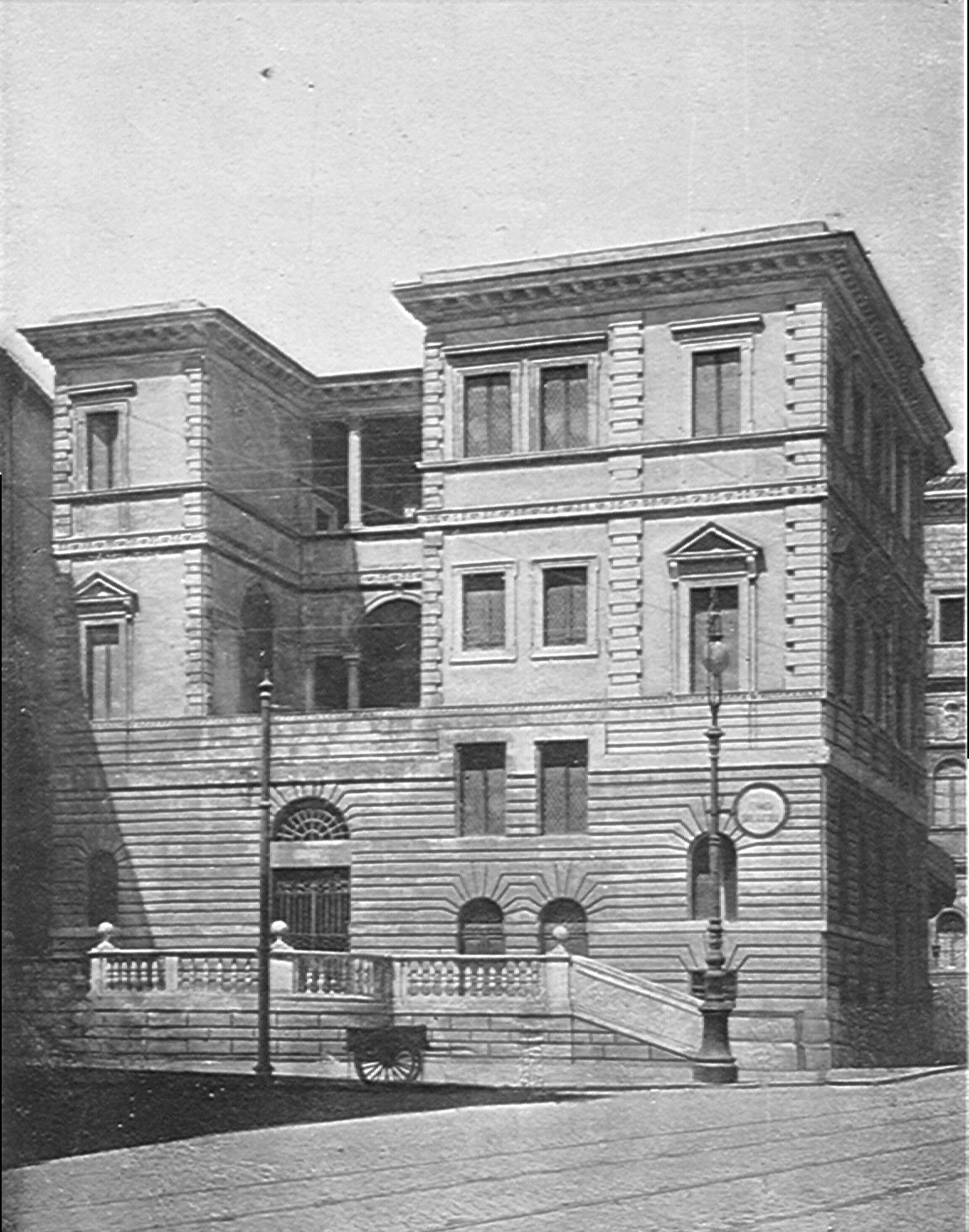
The Piccola Farnesina, Rome, around 1911
A King at Home
Everywhere else he goes he must accept the strict rules of the shop, inn, club, or museum that he happens to enter. He can eat his meals on the floor in his own house if he likes. I often do it myself; it gives a curious, childish, poetic, picnic feeling.
—G.K. Chesterton, What’s Wrong with the World
Professor D. is ecstatic. The Palazzo Piccola Farnesina, so-called with flamboyant inaccuracy, is finally free of scaffolding. It’s the first time he’d seen it in two years. We stopped by there this morning in the middle of our Monday morning walk-cum-lecture for Architectural Theory Class. I’d noticed it the day before when I crossed the Corso Vittorio Emannuelle and was astonished to discover a pleasant-looking new Renaissance building that had deposited itself in the middle distance just beyond Sant’ Andrea della Valle, squarely in the crook of the wide street’s distant curve.
I’d assumed I’d just been unobservant up until now until we found ourselves in front of the tiny palazzo and D. excitedly explained how it had suddenly materialized there, free of tarpaulins and construction workers.
It’s a bit hard to take in at one glance. A waggish soul would be tempted to call it ‘cute,’ or at the very least, strange. It is delicate, almost freestanding, and tiny, smaller in height and breadth than the neighboring bleached-white façade of the Palazzo Massimo alla Colonna or the gargantuan Cancelleria.
It’s also charmingly asymmetrical, the piano nobile stepping back around a high walled garden court facing south towards Piazza San Pantaleon. One wing of the u-shaped contrivance is a single bay, the other three or four at least, set with level but unequally-spaced windows.
Every detail is perfectly attended to, if perhaps slightly unconventionally placed, every molding in order with a certain Francophone elegance. The name’s confusing, as it brings to mind the real Farnesina, a pleasure palace (or “love shack” as my fellow arkie Cynthia irreverently calls it) built across the river and later bought up by the Farnese. Agostino Chigi was behind the construction, and anyway, the fresco cycle is a bit racier than this quaint little dollhouse of a palazzo.
It’s not really a Farnese palace at all, but instead the gigli or fleurs-de-lys that stud the banding of the façade are the insignia of a much humbler French churchman, Thomas Leroy. Sometime his home is called, appropriately enough, de Regis, a Latinization of his name taking it at face value: of the King. While French, his architect was Italian, the ubiquitous Sangallo the Younger.
The peculiar equilibrium of the cool if eccentric façade testifies to his genius, as well as those subtle details that threaten to upset the balance just enough to give it life, like a serpentine belt course neatly going up and over a set of paired windows. The stone itself seems as plastic as stucco.
When we look at our ideal image of the city, we’re used to thinking of ordinary homes as the background, the fabric, the civic bread-and-butter of the architect that serves as a demure stage-set for the great cathedrals and palazzi and monuments. Still, it is healthy to stop and look at this curiosity, if only to remind us that a man’s freedom is bound up in his home, and perhaps every now and then deserves to be manifested architecturally.
Chesterton once wrote something to the effect that only at home could we truly be free, do whatever we feel like, wear a dressing-gown and slippers or paint the rafters green: “The home,” he writes with his indefatigable charm, “is the only place of liberty. Nay, it is the only place of anarchy. It is the only spot on the earth where a man can alter arrangements suddenly, make an experiment or indulge in a whim. For a plain, hard-working man the home is not the one tame place in the world of adventure.” Instead of rotting our minds with movie theaters and bar-hopping, a young man or young woman can turn to that great adventure that is the family instead. And sometimes that is literal anarchy, for better or worse.
Leroy exercised this whimsical freedom for himself and the greater good of his household. And ultimately, for the good of the city. The character of the Piccola Farnesina, perhaps, is not as canonically Roman as one might have wished, but for all that the Corso is enriched by its presence.
Modernism made two mistakes: one was to heard workers into soulless blocks of flats to shape the world of the future, and the other was to create a tetherless suburbia that seems to continually float on the edge of a dozen cities, neither green hinterland or solemn stony townscape. Neither understands this sacred whimsy, either substituting unfettered variety or dull monotony for the happy medium that is brought about through the simple unconscious genius of the craftsman.
Le Corbusier, that great Swiss watchmaker of an architect, once designed a block of pristine white apartments, their insides marked with none of that bourgeois clutter that was holding the working class back. They were clean, simple—free. Within two months, the forward-thinking proletarians had filled their new homes with false fireplaces, dusty Victorian furniture and God-knows-what-else worse. And so they were free.
Mies van der Rohe took it a step further, pressuring the condo board of one of his pet Chicago projects to decree that the residents could only keep their window curtains open, closed or precisely half-open. It’s a fragile architecture that can’t handle a little bit of dirt, grime or chance. It’s a fragile city that can’t handle the occasional deviancy from plan, the slight kink in the boulevard, the single eccentric arch or peculiar window-frame.
If you look at the work of the anonymous craftsmen that shaped the subtle fabric of the city of Rome, they know how to harmonize their buildings with the surroundings, but not at the expense of a spark of freedom, of dignity, even humor. Perhaps the Piccola Farnesina is a grander exemplar, a wilder exaggeration of this principle, but that does not make its reality any less true.
Thus Chesterton: “The home is the one place where [you] can put the carpet on the ceiling or the slates on the floor,” if you so desire. Perhaps we don’t feel like it, but at least there is always that echo of a possibility as the rallying point for a free citizenry. Old Agostino’s love shack, full of courtiers and servants, was probably a far less free place than a humble little row-house on Via de Baullari, or perhaps even Thomas Leroy’s peculiar little palazzo with its wonderful, subdued whimsy.
He was a courtier, but a minor one, and his house, far less grand than the enormous homes of Papal nephews and black nobility is one of the first I’ve seen that has spoken of that search for gentle wildness that ends in domestic serenity.
We peered in through the grillwork of the garden entry, into a cozy entrance-court, a little barrel-vaulted hallway framed by a dainty Palladian motif, attractively scaled-down arches and pilasters and columns. The scale was as eccentric as the rest of the structure, the grand archway seeming far bigger than in reality. Walking through that archway makes you feel feel like a giant, a towering monarch. A king or a queen. De Regis. It’s not so strange. After all, isn’t a man’s house the one place where he should most feel like a king?
Sunday, November 16
Charles Borromeo at McDonald's
The old Milanese church of Santi Ambrogio e Carlo in the Corso is one of the most splendid churches in Rome. I'd only seen it before today in peaks and glimpses through the curious plexiglass sentry box that some unfeeling modern restorer had placed over the great central doors like a sort of space age instant narthex. But beyond the clear plastic, it is a marvel.
I'd set aside two hours this afternoon to view an exhibition on the history of the Knights of Malta and the other equestrian orders that was supposed to be going on at the Palazzo Venezia, about twenty minutes away from the studio. However, the lady in the gift shop quickly informed me that I was a year ahead of schedule and to come back later since there was another art show in progress. Once again, Italy refuses to make sense.
So, feeling moved by the spirit of the flaneur and having nothing better to do, I took a stroll along the Via del Corso. The street's entertainment value remains unrivaled even after more than two months in Rome; though today, I felt more even adventurous and began to stray down sidestreets to find graceful little churches, pleasant piazze, cozy shopwindows. I even stumbled upon San Silvestro, the English church in Rome. It had been hiding under a camoflauge of scaffolding all this time. A fragment of the skull of St. John the Baptist was on display in one of the side-chapels.
And then there was Santi Ambrogio e Carlo. I'd walked by it a dozen times before, but it was either late or early, post-dinner walks or pre-class wanders in the cool morning. Its dome was high and ornate, rising above an elaborate Baroque facade that, slightly set back from the road, had an even more dominating and solemn presence than most of Rome's great churches.
Inside, it's baroque, wonderfully flamboyant baroque. Yet it has a certain serenity that overrides the manic restlessness that often rises to the turbulent surface of that style. Gilding rings the elaborate cornices and remarkable Corinthian column capitals, elements that verge on the sculptural, but below, down to the simple bases and pedestals, the only decoration is the rich varegated pink and striped grey of the tromp l'oeil marble paintwork. It gives an elegant lightness to the heavy piers and bulbous mouldings, reflecting the rosy blue frescoed skies overhead.
I strolled along the ambulatory, listening to the organist practicing a pleasant, gentle Bach piece at some unseen console. A few priests wearing in velvet-collared cloaks over their cassocks moved along the side-aisles. There's a dozen reasons to love the church, the relic of St. Charles kept behind the high altar marked with his elaborate Gothic-lettered motto, humilitas, the altar of the Sacrament in the south transept with its massive allegorical figures of Faith and Adoration voluminously veiled and bearing a heavy book, a great cross, a blazing Host and chalice. And there's Bach again, playing in my head as I remember it.
Walking out, then I noticed one weirdly discordant note. Right on axis with the central door, and thus the crossing, the altar, and the relic, on the balcony level of the building directly opposite, was the hideously comic plastic effigy of none other than Ronald McDonald. There was a Golden Arches inset into the ground floor of the apartment block facing the church. It hardly seemed a fitting end to my visit, and so I turned around for one last pleasant gaze at the high altar.
That's a much better way to end a memory.
The old Milanese church of Santi Ambrogio e Carlo in the Corso is one of the most splendid churches in Rome. I'd only seen it before today in peaks and glimpses through the curious plexiglass sentry box that some unfeeling modern restorer had placed over the great central doors like a sort of space age instant narthex. But beyond the clear plastic, it is a marvel.
I'd set aside two hours this afternoon to view an exhibition on the history of the Knights of Malta and the other equestrian orders that was supposed to be going on at the Palazzo Venezia, about twenty minutes away from the studio. However, the lady in the gift shop quickly informed me that I was a year ahead of schedule and to come back later since there was another art show in progress. Once again, Italy refuses to make sense.
So, feeling moved by the spirit of the flaneur and having nothing better to do, I took a stroll along the Via del Corso. The street's entertainment value remains unrivaled even after more than two months in Rome; though today, I felt more even adventurous and began to stray down sidestreets to find graceful little churches, pleasant piazze, cozy shopwindows. I even stumbled upon San Silvestro, the English church in Rome. It had been hiding under a camoflauge of scaffolding all this time. A fragment of the skull of St. John the Baptist was on display in one of the side-chapels.
And then there was Santi Ambrogio e Carlo. I'd walked by it a dozen times before, but it was either late or early, post-dinner walks or pre-class wanders in the cool morning. Its dome was high and ornate, rising above an elaborate Baroque facade that, slightly set back from the road, had an even more dominating and solemn presence than most of Rome's great churches.
Inside, it's baroque, wonderfully flamboyant baroque. Yet it has a certain serenity that overrides the manic restlessness that often rises to the turbulent surface of that style. Gilding rings the elaborate cornices and remarkable Corinthian column capitals, elements that verge on the sculptural, but below, down to the simple bases and pedestals, the only decoration is the rich varegated pink and striped grey of the tromp l'oeil marble paintwork. It gives an elegant lightness to the heavy piers and bulbous mouldings, reflecting the rosy blue frescoed skies overhead.
I strolled along the ambulatory, listening to the organist practicing a pleasant, gentle Bach piece at some unseen console. A few priests wearing in velvet-collared cloaks over their cassocks moved along the side-aisles. There's a dozen reasons to love the church, the relic of St. Charles kept behind the high altar marked with his elaborate Gothic-lettered motto, humilitas, the altar of the Sacrament in the south transept with its massive allegorical figures of Faith and Adoration voluminously veiled and bearing a heavy book, a great cross, a blazing Host and chalice. And there's Bach again, playing in my head as I remember it.
Walking out, then I noticed one weirdly discordant note. Right on axis with the central door, and thus the crossing, the altar, and the relic, on the balcony level of the building directly opposite, was the hideously comic plastic effigy of none other than Ronald McDonald. There was a Golden Arches inset into the ground floor of the apartment block facing the church. It hardly seemed a fitting end to my visit, and so I turned around for one last pleasant gaze at the high altar.
That's a much better way to end a memory.

St. Margaret of Scotland, today's saint
Haggis and Goulash
Today on the church calendar is set aside in honor of St. Margaret of Scotland, who wasn't really Scottish. She's quite a lady. She was actually a curious mix of Saxon and Hungarian, and only Scottish by marriage. Not only that, but she was related to Bl. Gisele, the wife of St. Stephen, the Apostolic King of Hungary, and her uncle was St. Edward the Confessor. She ended up married to Malcolm III of Scotland, whose previous wife had been named Ingibjorg for some reason.
In addition to the standard pious prayer life and various other Catholic queenly thingies, she also gave great support to the Faith in her adopted country, founded monasteries and churches left and right and also managed to get her jeweled gospel book dropped into a river. It was miraculously recovered undamaged, though the English stole it and stuck it in some cupboard at the Bodeleian Library. Typical.
She helped introduce continental fashion and manners, English-style parliaments, feudalism, Benedictines and foreign merchants into Scotland. Not too shabby, and on top of that, her youngest son, David, was made a saint as well. She also foretold the day of her death, this day in 1093, four days after those of her husband and one of her sons. Her life was written by Turgot of Durham or the monk Theodoric, who is described, perhaps as an understatement, as "somewhat obscure." Rather more mystifying is that her chapel in Edinburgh Castle was at one time, technically speaking, part of Nova Scotia. You know, the one in Canada.
A relic of her head was kept by the Jesuits at Douai, where it got trashed during the French Revolution. It seems the rest of her (and her husband, Malcolm) ended up in an urn in the Escorial, though when Bishop Gillies of Edinburgh asked for them back, nobody in Spain could remember where they'd put them only four hundred years earlier.
Anyway, check out her biography here and also here, and don't forget to ask for her prayers today, even if the feast is occulted by the celebration of Sunday. And if any of you people get some nutty idea about tossing the caber around, well, on your head be it.

Hans Memling. Musician Angels. 1485. Koninkijk Museum, Antwerp.
High Mass at San Gregorio
I’m ashamed to admit it, but it’s true. I was thinking mostly about my skipped breakfast when I turned off Piazza Nicosia down towards the unassuming alleyway where the tiny church of San Gregorio ai Muratori stands. It’s Rome’s indult Latin mass parish, a church of what my friends and I jokingly call the Frat House, that growing new order known as the Priestly Fraternity of St. Peter.
It’s a grubby, lifeless little street on Sunday mornings, blinds drawn and shutters closed, a few parked cars and the open snackbar with its down-at-heels bamboo matting testifying to some sliver of neighborhood activity. Then there’s the bicycle parked in front of the church’s grimy, classical doorway, but it always seems to be there.
It was about 10:25 and the four rows of pews were full of congregants, solemn-looking young men in ties and blazers, a middle-aged tourist in a greasy ponytail, and then there was a bearded, impeccably dressed and coiffed gentleman seated one row back. A young man in a suit moved over to him, slipping an expensive tweed topcoat over his shoulders, flamboyantly mismatching his silk scarf and muted plaid blazer.
Something about the tilt of his head, moving back over the small group of kneeling churchgoers for a familiar face suggested a hint of the politician. Perhaps his assistant, small, compact, gel-haired, knotty-muscled and perfectly dressed, was a bodyguard. He stood by the door throughout the mass.
I finally found a seat next to a crop-headed German in wire glasses and a demure young lady with a Carmelite face, framed by a white head-shawl. She was carefully paging through her English-Latin St. Andrew’s Missal. I knelt. My eyes moved, perhaps carelessly, over the tiny oratory’s playful stone-grey cherubs and the tarnished gilt sunburst ringing the descending dove of the Holy Spirit. Elaborate renaissance stuccowork snaked over every surface of the sanctuary.
There was the faint Christmas smell of candle-wax, and I noticed the tiny steady flames of the six altar candlesticks glowing against the darkened and expansive image of Our Lady appearing to St. Gregory. And there was something of Advent in those delicate, isolated flames after coming in from the slight morning chill.
Two clerks in cassocks and surplices carefully set up the missal, turning the pages precisely to the proper of the day. There was a smile passed between then, perhaps a murmured joke, but they all genuflected as they moved back and forth across the footpace of the altar. I noticed the ornate silver frames of the mass cards, the printed irregular columns of the Canon’s text forming an elaborate baroque shape almost like a sarcophagus. I hadn’t noticed those before on previous visits.
Then I remembered it was the third Sunday of the month, 10:30, the parish’s monthly high mass. I heard stirrings through the half-open door of the sacristy, hints of practiced chant or murmured vesting prayers, the click of a censer just starting to smoke. I felt anticipation lick at my soul. I was still somewhat drowsy from waking up, but I soon found myself awake, alert, ready. Light winked on the bulbous brass profiles of the candlesticks.
The sacristy bell clattered, and I heard the small schola in the loft overhead begin the Gregorian melody of the introit. First came the thurifer, incense boat and censer in his upraised hands, eyes cast down solemnly, his broad medieval sleeves falling in precise folds. Then came the other clerks with glowing tapers, moving in a great circular motion from the sacristy around through the miniscule nave and then up into the sanctuary. Last came the subdeacon, deacon and priest, black birettas crowning their heads, white vestments gleaming with silk diapering and golden trim. Heavy maniples hung at their wrists, hands folded neatly at their chests. Another priest stood in the back, carefully watching, his hands hidden in the sleeves of his cassock. And so the mass began.
The mass setting was a polyphonic one, in the great tradition of Lassus and Palestrina, but uniquely suited in its simplicity for the tiny church. It was difficult to tell the composition of the schola, kneeling there beneath the loft, but by sound alone you could feel the character of the different choristers. The single deep Gregorian tone of the introit chant was exchanged for a gentle, spare Kyrie, high, ethereal sopranos and a deep, rich bass sometimes fading into the background with perfect deference, a raw tenor moving in between with graceful flourishes.
It was not museum-quality singing or chanting, lacking the cold precision of recordings for a real, unvarnished, delicate sound. Occasionally a hint of hoarseness crept into the chant of the deacon intoning the gospel or the melismatic flourishes of the tenor, but it was all the richer for its quirks.
In the sanctuary, the sotto voce prayers of the clerics, their repeated and gracefully natural bows, seemed to run in perfect time to the Gloria, to the Sanctus, to the chanted Creed and the rich interwoven melodic lines of the offertory motet. It didn’t seem synchronized or mechanical, but that both their ornate observance of the old Tridentine rubrics and the metrical perfection of the anonymous polyphony was a reflection of some greater cosmic harmony that kept perfect heavenly time without clock or metronome.
Those gestures seem almost as beautiful and sacred as the actual texts of the mass, motions with slow perfection so unfamiliar to the eyes of my post-post-Vatican II generation. There was the gracious dip of the biretta at the name of Jesus, the gentle spew of dovelike perfumed smoke back and forth from the bobbing thurible, the liturgical kiss of the assistant on priestly hand and censer-chain. There were the simultaneous bows of deacon, subdeacon and priest, or the complex motions of the murmured Confiteor as the two bowed assistants turned to the priest at the words et tibi, pater, as obvious and ritually intelligible as a spoken word. And to you, Father, I confess. Mea culpa, mea culpa, mea maxima culpa.
It was solemn but it was easy, as natural as the turn of the seasons and the rising of the sun, the clerks and deacons falling into an order and hierarchy mirroring God’s tiered creation on both earth and heaven. There were other impromptu memories, too, like the glimpse of the thurifer slipping back into the sacristy to re-light the censer, the candle flame transforming it into a wood-paneled Georges de la Tour vignette.
The politician kept looking around with a peculiar smile. The young lady hardly ever glanced up from her missal.
At long last came the Pax, the sign of peace, the Tridentine sign of peace, seldom glimpsed in this day and age. It was perhaps the most beautiful gesture I have ever seen, a slow ceremonial embrace, the interlocking movement of hands on shoulders and hands on elbows, a discrete bow of the head, a withdrawal, a nod. Pax domini sit semper tecum. Et cum spiritu tuo. The priest exchanged it with the deacon, the deacon with the subdeacon, the subdeacon with the four clerks, human order and celestial hierarchy. Seraph to cherub, cherub to throne, throne to domination. For the heavenly liturgy of the Book of Revelation was incarnate here.
And then, just as the Agnus Dei began, I realized I didn’t feel so hungry anymore.
Saturday, November 15
Fr. O. on the Great Heresies
More choice tidbits from the funniest priest alive:
On Gnosticism: "This is our baby, this is our problem child."
On the Gnostic concept of the Redeemer: "We'll call him 'Sparky.' "
On the Manichees: "They were a fun group. You should imagine some of their parties."
"To claim you're as inspired as the Sacred Scriptures, hey, get a life..."
On Gnosticism, again: "Wacko! It's going to get fun, boys and girls."
On Gnosticism, yet again: "...we've got this Demiurge dude...wouldn't that make a good name for a basketball team? 'Hello, we're the St. John's High Demiurges...we will destroy you.' "
Puzzled responses on the Patripassionist heresy: "Yeah, that's the sort of response it should be getting."
Student: So [the Arians were saying Jesus] is Superman.
Fr. O: Yes, that's about right.
"Semi-Arians, not to be confused with semiNarians..."
"Semi-Arianism was like semi-chococolate chips..."
"See what you'll get to talk about tonight when you have nothing else to do? 'Hey, let's talk about Nestorianism, great!' "
"Eutychianism, it was a name brand...You've got generic Nestorianism and then you have Eutychian Nestorianism..."
"Monophysitism...monothelitism...gahbhleh gahbhleh..."
On Pelagius: "Eeerrrt, wrong! Thanks for playing!"
"And now, the Semi-Pelagians, our last contestants for the evening!"
And one last thought:
"The old word for 'self-esteem' is 'pride.' "
More choice tidbits from the funniest priest alive:
On Gnosticism: "This is our baby, this is our problem child."
On the Gnostic concept of the Redeemer: "We'll call him 'Sparky.' "
On the Manichees: "They were a fun group. You should imagine some of their parties."
"To claim you're as inspired as the Sacred Scriptures, hey, get a life..."
On Gnosticism, again: "Wacko! It's going to get fun, boys and girls."
On Gnosticism, yet again: "...we've got this Demiurge dude...wouldn't that make a good name for a basketball team? 'Hello, we're the St. John's High Demiurges...we will destroy you.' "
Puzzled responses on the Patripassionist heresy: "Yeah, that's the sort of response it should be getting."
Student: So [the Arians were saying Jesus] is Superman.
Fr. O: Yes, that's about right.
"Semi-Arians, not to be confused with semiNarians..."
"Semi-Arianism was like semi-chococolate chips..."
"See what you'll get to talk about tonight when you have nothing else to do? 'Hey, let's talk about Nestorianism, great!' "
"Eutychianism, it was a name brand...You've got generic Nestorianism and then you have Eutychian Nestorianism..."
"Monophysitism...monothelitism...gahbhleh gahbhleh..."
On Pelagius: "Eeerrrt, wrong! Thanks for playing!"
"And now, the Semi-Pelagians, our last contestants for the evening!"
And one last thought:
"The old word for 'self-esteem' is 'pride.' "
Reasons #356 and #357 to Love Catholicism
Tonight the seminarians from the North American College (Fr. O's young charges) will be coming over for the kickoff of our Catholic Movie Night series. Tonight's showing: Ben-Hur and enormous subway sandwiches (tacos, originally, but that fell through). Fun. So, I intend to enjoy myself. (What do you mean, "how is Ben-Hur Catholic?")
Incidentally, the soccer team for North American is appropriately known as the North American Martyrs, and you gotta love that. Given the name, they used to get creamed by the now-defunct ND Arkie team, the Flying Buttresses. I'm not sure why because all the seminarians I've met thus far are about ten feet tall and huge. According to some sociologist-or-other that means they're likely to make Monsignor but not Bishop, maybe because the mitre would get knocked off every time they went through the church doors. No clue.
Meanwhile, the next stop on the Venice web-tour will be Padua, with thoughts on St. Anthony's incorrupt tongue. Then on to beautiful Venice at high tide, with some observations on its historic constitution and its citizens, famous as the rudest Italians on the peninsula. Now if you'll excuse me, I have to go stick some pinnacles to the top of a church front.
Tonight the seminarians from the North American College (Fr. O's young charges) will be coming over for the kickoff of our Catholic Movie Night series. Tonight's showing: Ben-Hur and enormous subway sandwiches (tacos, originally, but that fell through). Fun. So, I intend to enjoy myself. (What do you mean, "how is Ben-Hur Catholic?")
Incidentally, the soccer team for North American is appropriately known as the North American Martyrs, and you gotta love that. Given the name, they used to get creamed by the now-defunct ND Arkie team, the Flying Buttresses. I'm not sure why because all the seminarians I've met thus far are about ten feet tall and huge. According to some sociologist-or-other that means they're likely to make Monsignor but not Bishop, maybe because the mitre would get knocked off every time they went through the church doors. No clue.
Meanwhile, the next stop on the Venice web-tour will be Padua, with thoughts on St. Anthony's incorrupt tongue. Then on to beautiful Venice at high tide, with some observations on its historic constitution and its citizens, famous as the rudest Italians on the peninsula. Now if you'll excuse me, I have to go stick some pinnacles to the top of a church front.
Friday, November 14
(not so) New blog!
After his repeatednaggings requests, I have finally gotten around to actually logging on (the whole Google toolbar thing has made me so lazy), and adding our good friend, Brian MacMichael's blog to our sidebar links. So head on over to In Pectore and have a look at more Catholic Nerd goings on here at ND.
After his repeated
A quiz for the day:
Q. Who made the following statements:
"When marriage is redefined so as to make other relationships equivalent to it, the institution of marriage is devalued and further weakened. The weakening of this basic institution at all levels and by various forces has already exacted too high a social cost."
"...a same-sex union contradicts the nature of marriage..."
"Persons in same-sex unions cannot enter into a true conjugal union. Therefore, it is wrong to equate their relationship to a marriage."
"There is to be no separation between one's faith and life in either public or private realms."
Ratzinger? John Paul II? Nope. Give up?
Would you believe ...... the US Bishops?
Q. Who made the following statements:
"When marriage is redefined so as to make other relationships equivalent to it, the institution of marriage is devalued and further weakened. The weakening of this basic institution at all levels and by various forces has already exacted too high a social cost."
"...a same-sex union contradicts the nature of marriage..."
"Persons in same-sex unions cannot enter into a true conjugal union. Therefore, it is wrong to equate their relationship to a marriage."
"There is to be no separation between one's faith and life in either public or private realms."
Ratzinger? John Paul II? Nope. Give up?
Would you believe ...... the US Bishops?
Saints I should have remembered yesterday
In honor of his feastday (which was actually yesterday, oops), check out St. Britius's story at the ever-useful Catholic Forum site. Now wouldn't you expect St. Blog's resident wild and crazy guy and favorite man in black, Fr. Bryce Sibley, to have a rather colorful patron? Rather an understatement given that St. Martin of Tours compared Britius during his disordely early years with Judas. Furthermore, St. Britius got run out of town (twice) when he was appointed bishop. Only after forty years of exile and pennance was he able to properly claim his see. He is patron saint of stomach diseases.
You might describe him, at least in his scheming pre-bishop mode, as the Edmund Blackadder of the sanctoral cycle. Those of you who get the joke may quote me on this.
Yesterday was also the feast of St. Homobonus, a medieval tailor who, when he died, had fallen flat on his face in a cruciform posture during mass. They didn't figure out he had gone to his reward until the liturgy was over. Just be glad it wasn't a Forty Hours devotion. Then there's St. Stanislaus Kostka, who once received communion from St. Barbara, and St. Didacus, patron of San Diego in California. Lastly, there's some Welsh friend of St. Paternus (who?), St. Gredifael of Dyfed, who seems to have hit the jackpot in the bad saints' names lottery. Oh those crazy Welsh.
In honor of his feastday (which was actually yesterday, oops), check out St. Britius's story at the ever-useful Catholic Forum site. Now wouldn't you expect St. Blog's resident wild and crazy guy and favorite man in black, Fr. Bryce Sibley, to have a rather colorful patron? Rather an understatement given that St. Martin of Tours compared Britius during his disordely early years with Judas. Furthermore, St. Britius got run out of town (twice) when he was appointed bishop. Only after forty years of exile and pennance was he able to properly claim his see. He is patron saint of stomach diseases.
You might describe him, at least in his scheming pre-bishop mode, as the Edmund Blackadder of the sanctoral cycle. Those of you who get the joke may quote me on this.
Yesterday was also the feast of St. Homobonus, a medieval tailor who, when he died, had fallen flat on his face in a cruciform posture during mass. They didn't figure out he had gone to his reward until the liturgy was over. Just be glad it wasn't a Forty Hours devotion. Then there's St. Stanislaus Kostka, who once received communion from St. Barbara, and St. Didacus, patron of San Diego in California. Lastly, there's some Welsh friend of St. Paternus (who?), St. Gredifael of Dyfed, who seems to have hit the jackpot in the bad saints' names lottery. Oh those crazy Welsh.
Crooked Bologna
being another stop on a journey to Venice
Bologna is a university town, and it is often hard to separate the college from the community. The campus is the city, and its buildings weave unexpectedly in and out of the fabric. The old alma mater studiorum is also its own town, with the students electing and deposing their professors with the liberality of an Italian medieval commune.
It’s a fickle city, flickering back and forth between papal rule and local tyranny. It had once been the intractable enemy of Julius II, but when he emerged as the town’s champion against invading armies, he was greeted by raucous cheers. The result is a town (in)famous for leftist politics and rebellious behavior, dotto, grasso e rosso, learned, fat and communist-red. Italy invented the sullen left-wing college student, though sometimes he turns into Benito Mussolini instead.
One of Bologna’s more enduring landmarks is Italy’s other leaning tower, a stark, lean, flat-sided brick pinnacle listing uncomfortably at the intersection of four or five crowded streets. Next to it stands an even more slender watchtower, crowned with a tiny cupola outlined against the rainy grey sky.
It looms over the skyline in a dozen antique illustrations as starkly as an anachronistic Renaissance factory chimney, its warped sister always crookedly standing to one side. The combination of straight and crooked is the perfect symbol for Bologna, and you even see the two peculiar turrets in the ubiquitous miniature city San Petronio, the city’s patron, holds in every image.
Then there’s the fact that on one of the streets running alongside the spired side-aisle of the cathedral I caught a whiff of what I assumed to be burning tires. One of the professors informed me it was marijuana. Probably explains the crooked tower. Under these circumstances, I’m not really sure how the local architects prevent the city’s numerous and picturesque loggias and porticos from caving in. Almost every major street is lined with them, shielding its citizens from the rain in this cold, wet town. They somehow stay up.
At the same time, it is also a city adorned with churches and a long history of Papal rule. The looming medieval palazzo comunale is adorned with an elaborate frontispiece ensconcing a gargantuan bronze effigy of old Julius II, which, for the longest time had been disguised as San Petronio with an immense metal mitre and crozier.
The original statue had been cast in record time by Michelangelo during his grudging stay in the city, but was shortly melted down after the Pontiff’s enemies seized the city and recast into cannon. Only the triple-crowned head remained, now housed in a local museum. The current statue is a replica and very clearly Julius, though, in muddled Bolognese fashion, the inscription overhead still salutes him as Divus Petronius, protector et pater.
One of Bologna’s many churches is San Petronio, which might be the Duomo, or might not. Our professors and our guidebooks contradicted one another on the subject. It is a massive structure, its façade a curious collision of incompleted brick underlay and elegant Gothic marble facing. On the sides, the transepts stop idiosyncratically in mid-bay, perhaps frozen by some intrusion of the plague. People have been trying to refinish the front for centuries, from Vignola’s curious half-Gothic, half-classical design to some truly hideous Fascist-Romanesque proposals from 1933, one with the principal portal inscribed with a defiant civic Libertas. Inside, it is full of northern, refrigerated light, more the world of Bach than Palestrina with its whitewashed vaults, elaborate grillwork and Germanically baroque altar-pieces. San Petronio is in there somewhere, though we never quite found him.
By far, however, the most interesting of the city’s churches is the vast labyrinth of Santo Stefano, a strange Romanesque monastery complex that grew with weird organic order over a period of centuries. Churches lead into other churches, cloisters into other courtyards until you lose and find yourself again. In the first church, the old Santo Stefano, the votive candleholders are crusted with wax, while the high sanctuary is filled with dusty, smoky light washing the funereal black marble of a distant altarpiece.
Beyond it stands the Santo Sepolcro, a strange rotunda symbolically replicating the Holy Sepulchre in Jerusalem with its circle of columns and the murky dome far overhead. It seems abandoned, the massive cauldron-like lamps hanging from the arches unlit, a handful of guttering candles and silvery subterranean electric light piercing the shadows.
At the center stands the actual Sepulchre, irregularly-shaped, with a wooden cross, draped with a shroud, rising at its highest point. A little door, gridded like those old French images of the Child Jesus as the holy prisoner in the Tabernacle, was inset into the base, allowing penitents to prostrate themselves and look into that womb of the Resurrection, or a good copy at least. A marble inlay of a skull grins up from a tomb set into the floor. Calvary. Golgotha. The place of the skull.
Even the cortiles are almost empty of visitors. Moss grows between the riverstone paving, while bloated Romanesque faces hover overhead, and the stucco’d flank of the church pales from blood red to crumbling purple and bare brick. I sat alone in a little family chapel for a few minutes, dark and dim and unlit save for the merciless blank light of the cloudy sky. A faded fresco stood over the altar, while female angelic caryatids supported the altar-shelf as they discretely covered their breasts, a curiously earthy detail.
Alone. Does no one go to church in Bologna?
It may have been empty then, but as I walked out, Santo Stefano seemed filled with devotees, votive candles blazing. The Cathedral had been full for mass when we stopped in early that morning, while I had inadvertently walked in on an elaborate Vesperal service at another church that evening, pews filled. Not bad for a famously rosso town.
In addition to San Petronio (wherever he is), there are two other saints buried here. St. Catherine of Bologna’s incorrupt body, darkened by candle-smoke, sits enthroned in her old convent, while the more famous St. Dominic lies in a more conventional tomb to the south of San Petronio. I unfortunately missed St. Catherine due to bad research, but there was no way I was going to not check out San Domenico.
When we visited the church that morning and I loaded up on Dominican souvenirs in the gift-shop, I discovered they had Vespers that evening. Having gone to a Saturday vigil mass the night before in Modena—after which we had gone out to a Malaysian restaurant and eaten coconut chicken—I decided I would stop by that evening. Vespers with St. Dominic. Splendid.
With class and touring over, I lingered in the nave of the Cathedral. Mass was going on in the distant sanctuary, the baroque baldacchino a luminous sentry-box in the darkness. Banks of hundreds of votive candles blazed on either hand, throwing burnished light on the gilding and dark wood of the side-chapel reredos. As doors closed and opened, they flickered in the cold night air.
The white baroque plasterwork of San Domenico, however, was blindingly well-lit. I heard the invitatorium being sung in Italian at the other end of the church and hurried to one of the front pews. I listened as a young cantor in the black and white robes of the Dominican order sang, in strangely lackluster vernacular, the various psalms of the day. He stood to one side of the altar, while the celebrant was seated behind it on a raised sedilia. The rest of the brothers sat rather haphazardly, some in full preaching dress, others in plain white tunics, along the benches in the transepts. One of them looked about four feet tall.
It seemed strangely impoverished. Not fifty feet away I had glimpsed one of the finest oratories in Europe, lofty-vaulted and adorned with miraculous inlaid choirstalls, the immense missal-stand decorated with an image of St. Francis and St. Dominic embracing like the seeming opposites faith and reason, peace and justice. And now it was empty, the ancient chants abandoned for some paltry substitute. That, and it looked like the cantor’s white capuce was out of control. I later discovered he was wearing a faintly preposterous scarf underneath his hood.
But then something happened. They sang the Magnificat, and it seemed like a portal opened into another world. Solemn bows studded the chanting, and then, suddenly, two friars picked up the elaborate candelabra placed before the altar and led us in a grand procession to the middle of the church, moving towards the Lady Chapel that stood opposite the tomb of the Saint.
Suddenly, the black and white figures clustered around the altar, facing ad orientem towards the image of the Virgin above enshrined amid a whirl of gilded cherubim. The Tonus Monasticus setting of the Salve was sung, and then came more Latinate chanting from a lectionary. Another ancient responsory was begun and then we processed to the tomb, the Arca de San Domenico.
It had been grilled off by a high metalwork screen when we had visited that morning. But now it was open. We moved towards it, the friars circling the tomb, and more prayers were sung to implore the help of their holy patron. And then the ritual ended and we were left there to venerate the ark, a spired marble monument standing ensconced in an ambulatory-like apse. Some of us moved towards the back to make our reverences, and I realized there was a prie-dieu there I hadn’t noticed before. It was set before the niche enshrining the relic of his skull.
And so I bent down and knelt and saw a little glimpse of blackened bone beneath the glittering gold and glass. A stiff silver half-figure of the saint crowned the urn, bearing a tiny book—a real book with velvet cover and turnable parchment pages—in its hand. It was St. Dominic, the hound of God. It was his very cranium, this domed valve of sanctity that had caged the thoughts and prayers of his holy mind. I later discovered the young Michelangelo had done one of the sculptures that crown the tomb, one I had completely missed.
But nothing could compete with that fragment of holiness I had glimpsed, both the monks and their founder.
being another stop on a journey to Venice
Bologna is a university town, and it is often hard to separate the college from the community. The campus is the city, and its buildings weave unexpectedly in and out of the fabric. The old alma mater studiorum is also its own town, with the students electing and deposing their professors with the liberality of an Italian medieval commune.
It’s a fickle city, flickering back and forth between papal rule and local tyranny. It had once been the intractable enemy of Julius II, but when he emerged as the town’s champion against invading armies, he was greeted by raucous cheers. The result is a town (in)famous for leftist politics and rebellious behavior, dotto, grasso e rosso, learned, fat and communist-red. Italy invented the sullen left-wing college student, though sometimes he turns into Benito Mussolini instead.
One of Bologna’s more enduring landmarks is Italy’s other leaning tower, a stark, lean, flat-sided brick pinnacle listing uncomfortably at the intersection of four or five crowded streets. Next to it stands an even more slender watchtower, crowned with a tiny cupola outlined against the rainy grey sky.
It looms over the skyline in a dozen antique illustrations as starkly as an anachronistic Renaissance factory chimney, its warped sister always crookedly standing to one side. The combination of straight and crooked is the perfect symbol for Bologna, and you even see the two peculiar turrets in the ubiquitous miniature city San Petronio, the city’s patron, holds in every image.
Then there’s the fact that on one of the streets running alongside the spired side-aisle of the cathedral I caught a whiff of what I assumed to be burning tires. One of the professors informed me it was marijuana. Probably explains the crooked tower. Under these circumstances, I’m not really sure how the local architects prevent the city’s numerous and picturesque loggias and porticos from caving in. Almost every major street is lined with them, shielding its citizens from the rain in this cold, wet town. They somehow stay up.
At the same time, it is also a city adorned with churches and a long history of Papal rule. The looming medieval palazzo comunale is adorned with an elaborate frontispiece ensconcing a gargantuan bronze effigy of old Julius II, which, for the longest time had been disguised as San Petronio with an immense metal mitre and crozier.
The original statue had been cast in record time by Michelangelo during his grudging stay in the city, but was shortly melted down after the Pontiff’s enemies seized the city and recast into cannon. Only the triple-crowned head remained, now housed in a local museum. The current statue is a replica and very clearly Julius, though, in muddled Bolognese fashion, the inscription overhead still salutes him as Divus Petronius, protector et pater.
One of Bologna’s many churches is San Petronio, which might be the Duomo, or might not. Our professors and our guidebooks contradicted one another on the subject. It is a massive structure, its façade a curious collision of incompleted brick underlay and elegant Gothic marble facing. On the sides, the transepts stop idiosyncratically in mid-bay, perhaps frozen by some intrusion of the plague. People have been trying to refinish the front for centuries, from Vignola’s curious half-Gothic, half-classical design to some truly hideous Fascist-Romanesque proposals from 1933, one with the principal portal inscribed with a defiant civic Libertas. Inside, it is full of northern, refrigerated light, more the world of Bach than Palestrina with its whitewashed vaults, elaborate grillwork and Germanically baroque altar-pieces. San Petronio is in there somewhere, though we never quite found him.
By far, however, the most interesting of the city’s churches is the vast labyrinth of Santo Stefano, a strange Romanesque monastery complex that grew with weird organic order over a period of centuries. Churches lead into other churches, cloisters into other courtyards until you lose and find yourself again. In the first church, the old Santo Stefano, the votive candleholders are crusted with wax, while the high sanctuary is filled with dusty, smoky light washing the funereal black marble of a distant altarpiece.
Beyond it stands the Santo Sepolcro, a strange rotunda symbolically replicating the Holy Sepulchre in Jerusalem with its circle of columns and the murky dome far overhead. It seems abandoned, the massive cauldron-like lamps hanging from the arches unlit, a handful of guttering candles and silvery subterranean electric light piercing the shadows.
At the center stands the actual Sepulchre, irregularly-shaped, with a wooden cross, draped with a shroud, rising at its highest point. A little door, gridded like those old French images of the Child Jesus as the holy prisoner in the Tabernacle, was inset into the base, allowing penitents to prostrate themselves and look into that womb of the Resurrection, or a good copy at least. A marble inlay of a skull grins up from a tomb set into the floor. Calvary. Golgotha. The place of the skull.
Even the cortiles are almost empty of visitors. Moss grows between the riverstone paving, while bloated Romanesque faces hover overhead, and the stucco’d flank of the church pales from blood red to crumbling purple and bare brick. I sat alone in a little family chapel for a few minutes, dark and dim and unlit save for the merciless blank light of the cloudy sky. A faded fresco stood over the altar, while female angelic caryatids supported the altar-shelf as they discretely covered their breasts, a curiously earthy detail.
Alone. Does no one go to church in Bologna?
It may have been empty then, but as I walked out, Santo Stefano seemed filled with devotees, votive candles blazing. The Cathedral had been full for mass when we stopped in early that morning, while I had inadvertently walked in on an elaborate Vesperal service at another church that evening, pews filled. Not bad for a famously rosso town.
In addition to San Petronio (wherever he is), there are two other saints buried here. St. Catherine of Bologna’s incorrupt body, darkened by candle-smoke, sits enthroned in her old convent, while the more famous St. Dominic lies in a more conventional tomb to the south of San Petronio. I unfortunately missed St. Catherine due to bad research, but there was no way I was going to not check out San Domenico.
When we visited the church that morning and I loaded up on Dominican souvenirs in the gift-shop, I discovered they had Vespers that evening. Having gone to a Saturday vigil mass the night before in Modena—after which we had gone out to a Malaysian restaurant and eaten coconut chicken—I decided I would stop by that evening. Vespers with St. Dominic. Splendid.
With class and touring over, I lingered in the nave of the Cathedral. Mass was going on in the distant sanctuary, the baroque baldacchino a luminous sentry-box in the darkness. Banks of hundreds of votive candles blazed on either hand, throwing burnished light on the gilding and dark wood of the side-chapel reredos. As doors closed and opened, they flickered in the cold night air.
The white baroque plasterwork of San Domenico, however, was blindingly well-lit. I heard the invitatorium being sung in Italian at the other end of the church and hurried to one of the front pews. I listened as a young cantor in the black and white robes of the Dominican order sang, in strangely lackluster vernacular, the various psalms of the day. He stood to one side of the altar, while the celebrant was seated behind it on a raised sedilia. The rest of the brothers sat rather haphazardly, some in full preaching dress, others in plain white tunics, along the benches in the transepts. One of them looked about four feet tall.
It seemed strangely impoverished. Not fifty feet away I had glimpsed one of the finest oratories in Europe, lofty-vaulted and adorned with miraculous inlaid choirstalls, the immense missal-stand decorated with an image of St. Francis and St. Dominic embracing like the seeming opposites faith and reason, peace and justice. And now it was empty, the ancient chants abandoned for some paltry substitute. That, and it looked like the cantor’s white capuce was out of control. I later discovered he was wearing a faintly preposterous scarf underneath his hood.
But then something happened. They sang the Magnificat, and it seemed like a portal opened into another world. Solemn bows studded the chanting, and then, suddenly, two friars picked up the elaborate candelabra placed before the altar and led us in a grand procession to the middle of the church, moving towards the Lady Chapel that stood opposite the tomb of the Saint.
Suddenly, the black and white figures clustered around the altar, facing ad orientem towards the image of the Virgin above enshrined amid a whirl of gilded cherubim. The Tonus Monasticus setting of the Salve was sung, and then came more Latinate chanting from a lectionary. Another ancient responsory was begun and then we processed to the tomb, the Arca de San Domenico.
It had been grilled off by a high metalwork screen when we had visited that morning. But now it was open. We moved towards it, the friars circling the tomb, and more prayers were sung to implore the help of their holy patron. And then the ritual ended and we were left there to venerate the ark, a spired marble monument standing ensconced in an ambulatory-like apse. Some of us moved towards the back to make our reverences, and I realized there was a prie-dieu there I hadn’t noticed before. It was set before the niche enshrining the relic of his skull.
And so I bent down and knelt and saw a little glimpse of blackened bone beneath the glittering gold and glass. A stiff silver half-figure of the saint crowned the urn, bearing a tiny book—a real book with velvet cover and turnable parchment pages—in its hand. It was St. Dominic, the hound of God. It was his very cranium, this domed valve of sanctity that had caged the thoughts and prayers of his holy mind. I later discovered the young Michelangelo had done one of the sculptures that crown the tomb, one I had completely missed.
But nothing could compete with that fragment of holiness I had glimpsed, both the monks and their founder.










![[SMMMHDH]](http://www.mgilleland.com/music/smmmhdh.png)